
#FactCheck- Old 2019 Video Falsely Shared as Iran Seizing US Ship in Hormuz
Executive Summary:
Amid the ongoing tensions in West Asia, a video is being widely circulated on social media with the claim that Iran has seized a US ship in the Strait of Hormuz. However, a research by the CyberPeace found that the claim is false. The video is from 2019 and is unrelated to the current situation. It actually shows Iran’s Islamic Revolutionary Guard Corps (IRGC) seizing a British-flagged tanker, Stena Impero. The ongoing conflict involving the United States, Israel and Iran since late February has raised concerns over global energy supply. The Strait of Hormuz, located between Iran and Oman, is a key route for global oil and maritime trade. Rising tensions in the region have impacted this route, although Iran has stated that it has not been completely closed.
Claim:
Users on X (formerly Twitter) are sharing the video as breaking news, claiming that Iran has captured a US ship in the Strait of Hormuz. The posts suggest that the move is a direct warning to the United States.

Fact Check:
To verify the claim, we extracted keyframes from the viral video and conducted a reverse image search. This led us to the same video posted on the X handle of Iran’s Press TV on July 20, 2019.
Link:
- https://x.com/PressTV/status/1152597789362262016?s=20
- https://x.com/PressTV/status/1152597789362262016?s=20

The caption of the post stated that the footage showed the moment when IRGC forces seized the British oil tanker Stena Impero in the Strait of Hormuz. Further, we found a July 2019 report by Al Jazeera that included visuals matching the viral video. According to the report, Iran’s IRGC had intercepted the British-flagged tanker on July 19, 2019, after which the footage was released.
https://www.aljazeera.com/news/2019/7/20/iran-releases-video-showing-capture-of-british-oil-tanker

Conclusion:
The viral claim is misleading. The video is not recent and does not show Iran capturing a US ship. It is from 2019 and depicts the seizure of the British tanker Stena Impero by Iran’s IRGC.

Related Blogs
Executive Summary
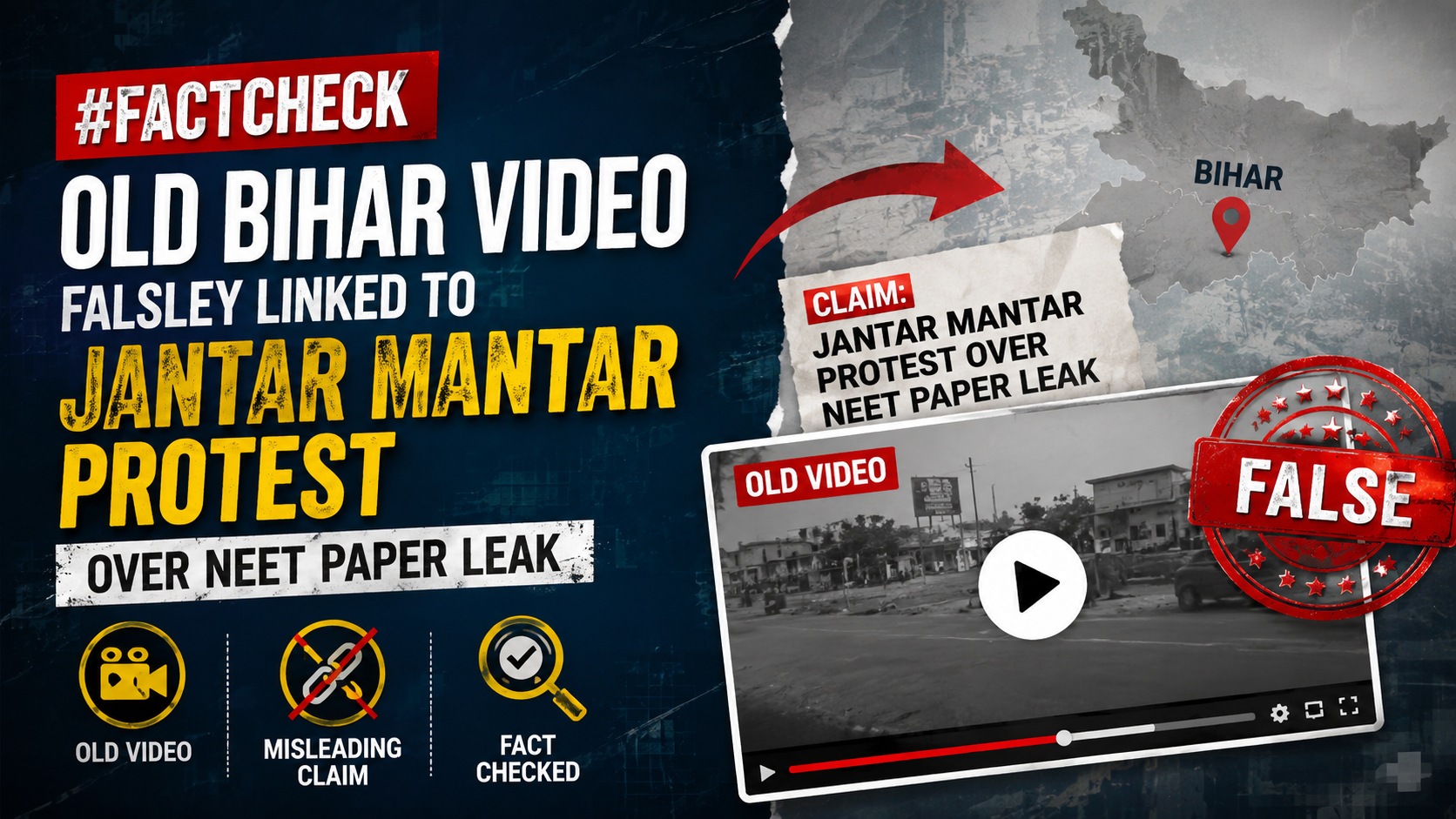
A video is being widely shared on social media with the claim that a person attempted to set a Thar vehicle on fire during the ongoing protest at Jantar Mantar. CyberPeace Research Wing’s research found that the viral video is not from Jantar Mantar, Delhi. The footage is from Gaya, Bihar, where some people allegedly attempted to set a vehicle on fire after a collision involving a Thar and other vehicles on July 16.
Claim:
A 23-second video is being shared on Facebook claiming to show a person attempting to set a Thar vehicle on fire during the ongoing NEET paper leak protest at Jantar Mantar in Delhi. In the video, a man can be seen trying to ignite the vehicle, while police personnel intervene and stop him. However, the crowd continues to attempt to set the vehicle on fire.
https://www.facebook.com/reel/1575765261002644

Fact Check:
To verify the claim, we extracted keyframes from the viral video and conducted a reverse image search. During the research, we found the same video uploaded on the News18 YouTube channel on July 18, 2026. The caption accompanying the video identified the incident as being from Bihar.
https://www.youtube.com/shorts/fzAPajxyi3A
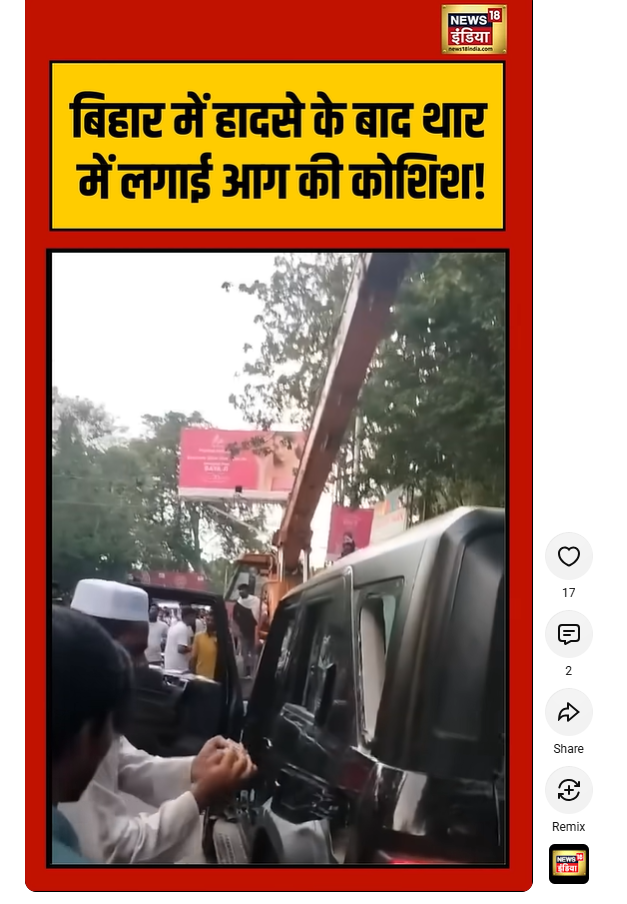
Further, a keyword search led us to a report published by Dainik Bhaskar on July 16, 2026. The report contained visuals matching the viral video, along with the statement of the person seen in the viral footage.

According to the report, the incident took place in Gaya, Bihar, after a collision between a Thar vehicle and other vehicles. Following the accident, some people gathered at the spot and allegedly attempted to set the vehicle on fire.
Conclusion:
CyberPeace Research Wing’s fact check found the viral claim to be misleading. The video does not show an incident from the ongoing Jantar Mantar protest in Delhi. The footage is from Gaya, Bihar, where a Thar vehicle was involved in a collision with other vehicles on July 16, following which some people attempted to set the vehicle on fire.
Executive Summary
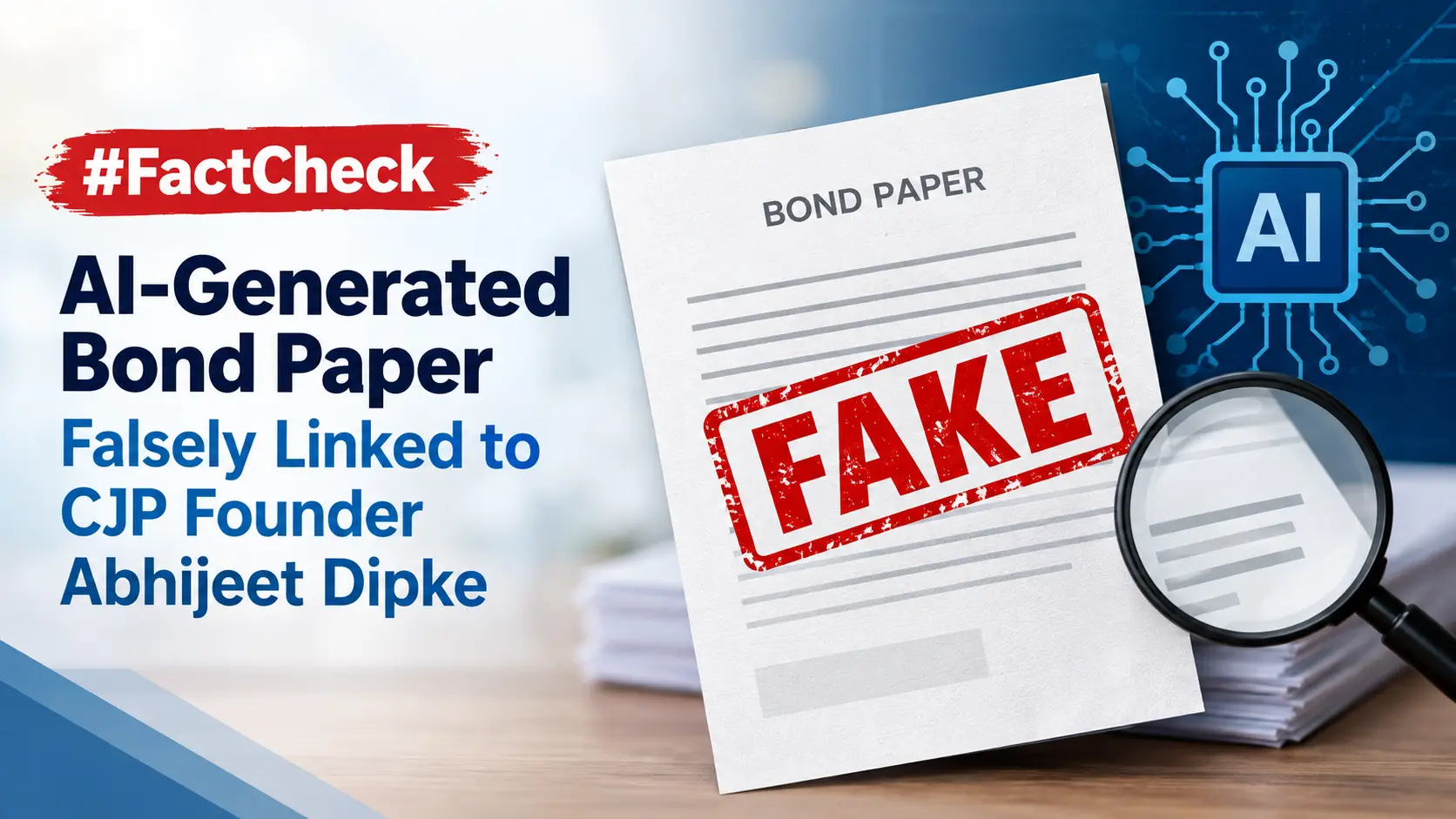
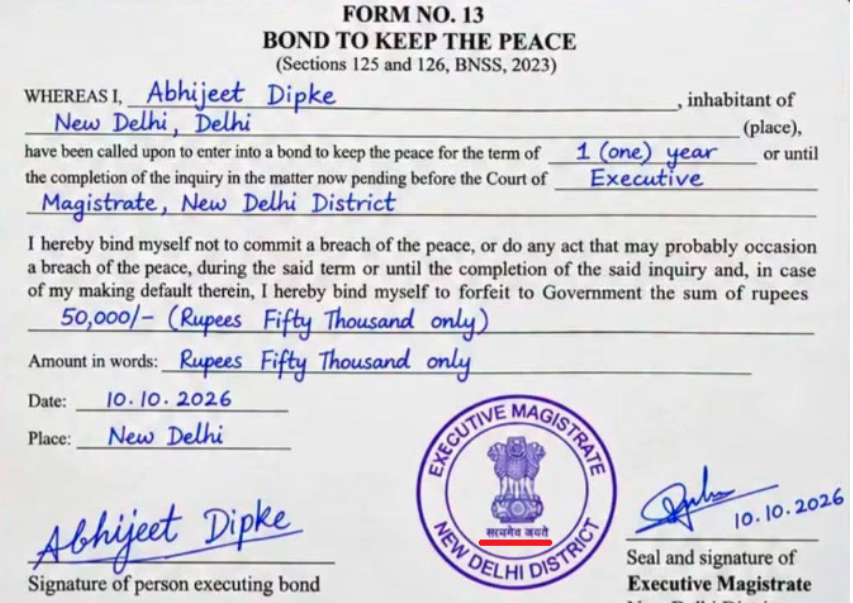
Amid the ongoing protests in Delhi, an image of a bond paper is being widely shared on social media. The image is being shared with the claim that it shows the bond allegedly submitted in court by Cockroach Janata Party (CJP) founder Abhijeet Dipke for his release. The purported bond mentions that Abhijeet Dipke would not participate in any protest in the future and that he had furnished a bail bond of Rs 50,000. CyberPeace Research found that the image of the bond paper being shared in connection with Abhijeet Dipke is not genuine, but was created using AI.
Claim
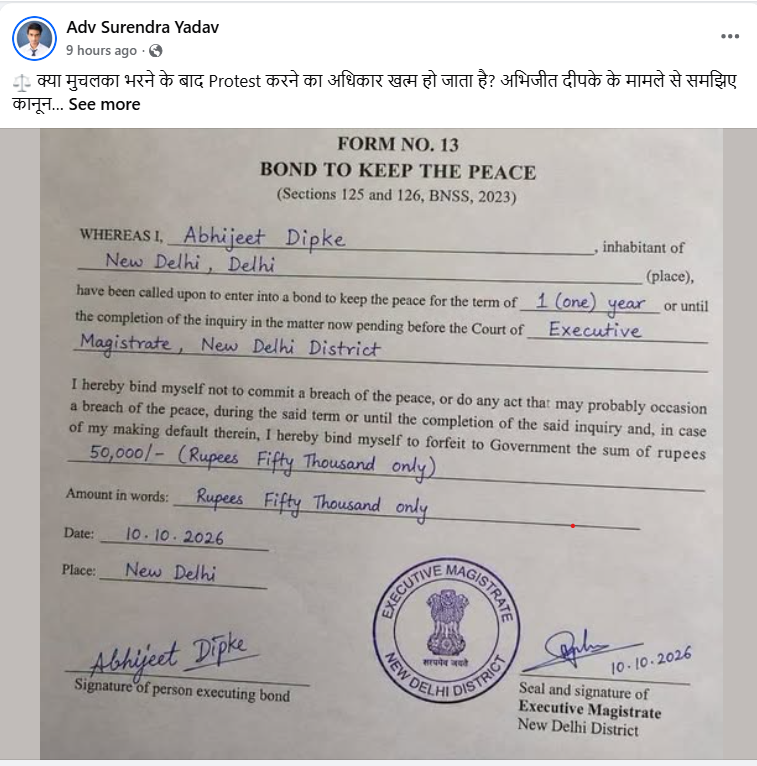
Amid the ongoing protests in Delhi, an image of a bond paper is being widely shared on social media. It is being claimed that the image shows the bond allegedly submitted in court by Cockroach Janata Party (CJP) founder Abhijeet Dipke for his release. The purported bond mentions that Abhijeet Dipke would not participate in any protest in the future and that he had furnished a bail bond of Rs 50,000.
https://www.facebook.com/photo/?fbid=122133387387390171&set=a.122113963941390171
https://ghostarchive.org/archive/C8SDb
Fact Check
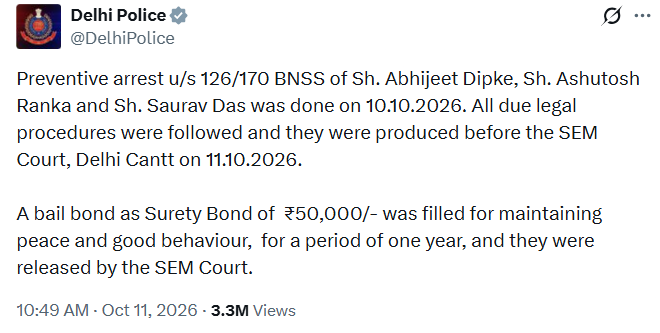
In a post shared on X, the Delhi Police stated that Abhijeet Dipke, Ashutosh Ranka and Saurav Das were taken into preventive custody on October 10, 2026, under Sections 126/170 of the Bharatiya Nagarik Suraksha Sanhita (BNSS). According to the police, all legal procedures were followed, and the three were produced before the SEM court at Delhi Cantt on October 11, 2026. In its post, the Delhi Police also stated that a bail bond (surety bond) of ₹50,000 was furnished for a period of one year to maintain peace and good behaviour.
https://x.com/DelhiPolice/status/2109151954438136069
To verify the viral image of the bond paper, we examined the Delhi Police’s social media handles and searched other media reports. However, we did not find the viral image of the bond paper in any article or X post published by a credible source. We then closely examined the viral bond paper. During our analysis, we noticed a clear error. The spelling of “Satyamev Jayate” on the seal affixed to the document is incorrect. Based on this error, we suspected that the purported image of the bond paper being circulated on social media may have been created using AI.
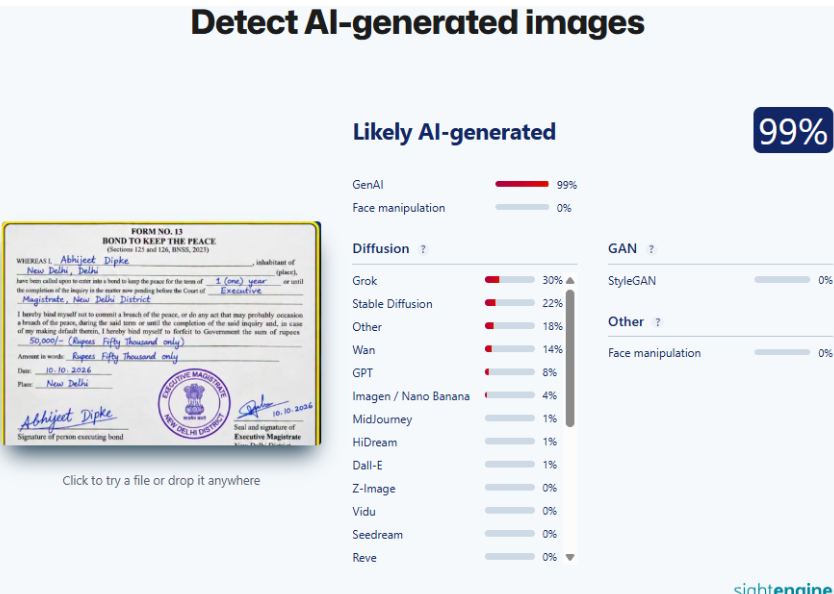
As the next step in our research, we used AI detection tools to analyse the viral image. We scanned the image using Sightengine, which indicated that the viral image is 99% likely to be AI-generated.
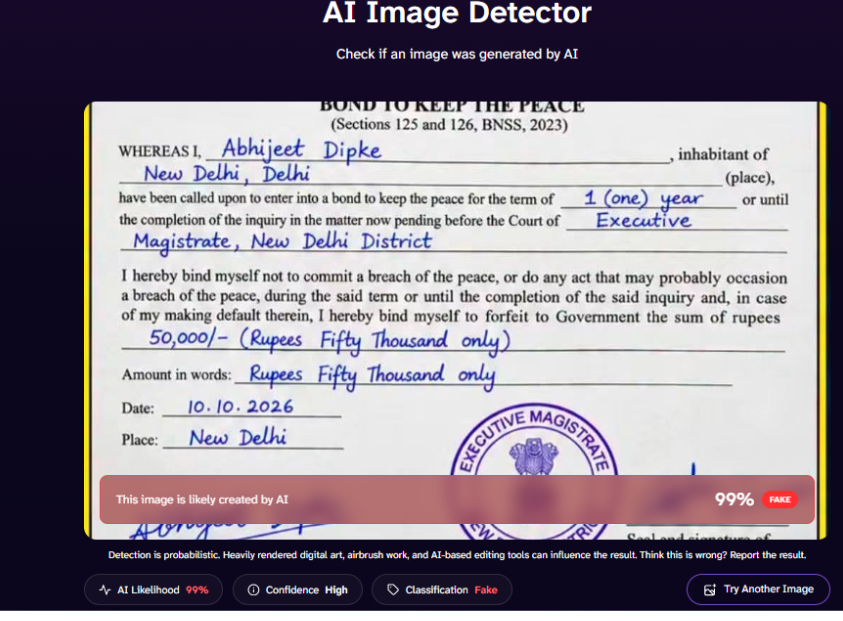
DeepAI, in its analysis, estimated a 99% likelihood that the viral bond paper was created using AI.
Conclusion
Our research found that the image of the bond paper being shared in connection with Abhijeet Dipke is not genuine but was created using AI.

Introduction
Rapid growth in India’s Digital Economy has opened up various options for companies to utilise digital technology as part of their operations. Examples of these technologies include cloud computing; online payment systems; digitally enabled supply chains; and platforms that facilitate remote working. As small and medium enterprises(SMEs) represent a major part of India’s economy, they have quickly been able to capitalise on the benefits these technologies provide in improving their operational efficiency and developing an increased presence within the market. However, this rapid pace of digitalisation creates an exposure to a much greater breadth of cyber-security threats than ever for SMEs. Today, perhaps the greatest cyber-threat facing SMEs in India is ransomware, an increasing frequent type of cyber-attack that has been increasing on a global scale over the past few years and in response, there have been numerous initiatives by various government agencies, industry organisations, and cyber-security firms designed to educate the general public on the risks of ransomware.
What is Ransomware?
Ransomware is a type of malware, which prevents all users being able to access their file system or access their data until they pay a ransom. In a standard ransomware event an attacker will breach the company's network, and encrypt all critical files so that they are unable to be used. The attacker usually demands payment in bitcoin because it is a difficult trace and promises to provide a key to unlock the data in exchange for the payment. Attackers gain access to company networks by using social engineering techniques such as phishing email, stolen password, or exploiting an unpatched vulnerability in the software that is running on the company's network.
The Rising Threat of Ransomware
Cybercriminals have created one of the most destructive varieties of cybercrimes around the world through ransomware; while experts in the cybersecurity field project losses to global ransomware damage may reach $30 billion by 2025. There has also been a marked increase in SMEs being attacked by ransomware-based cybercriminals throughout India. NASSCOM has done research and found that many SMEs in India have experienced attempted ransomware attacks in the past few years alone. According to incident reports provided through CERT-In, there has been a noticeable increase in the number of cybercrime occurrences throughout different sectors of India’s economy since those reports began. These developments have shown an increase in the size and level of sophistication of ransomware related threats.
Why Indian SMEs Remain Vulnerable Despite Awareness
Despite increased awareness about cyber threats, there is a large number of Indian SMEs that continue to be vulnerable to ransomware. The main reason is financial limitations. Many small businesses typically have limited financial resources and those limited resources more often than not, go towards operations, including production, logistics, and marketing - cybersecurity costs are usually viewed as additional costs.
Another significant problem facing SMEs is a shortage of skilled cybersecurity professionals. Large enterprises typically have dedicated security teams responsible for protecting the enterprise, whereas SMEs will employ IT staff generally without any specific expertise in detecting/countering cyber threats. Human error are also significant contributors to these cyber incursion events. An employee can inadvertently click on an email link or download an infected attachment, or use a weak password - all of which could provide opportunities for cybercriminals to access the company's network. Phishing emails continue to be the most common approach for initiating ransomware.
Furthermore - many SMEs have implemented digital platforms, such as cloud-based applications and payment processing, without appropriately executing cybersecurity planning prior to implementation. Many of the issues that have arisen from such rapid digitisation are due to a lack of sufficient planned cybersecurity measures as part of the implementation process. This has also resulted in a situation where technological advancements such as Ransomware as a Service (RaaS) have created an even larger pool of potential perpetrators (cybercriminals) with little-to-no expertise being able to launch a widespread ransomware campaign using readily available/pre-manufactured tools.
Real-World Cyber Incidents Affecting Indian SMEs
As several examples recently demonstrate, Indian SMEs continue to experience significant cyber attack risks. Recently, a logistics firm located in Gurugram found itself locked out of nearly 4,000 shipments due to a ransomware attack, which cost them ₹12 lakhs to fix because they had poor backups and another incident in Gurugram which highlights how vulnerable many SMEs in the country continue to be to ransomware attacks. In the case of a garments company, a hacker compromised the company's server by placing ransomware on its system. The company was forced to shut down its computerised warehouse system as a result of the attack. Only after the company had lost access to its system, did it receive a ransom demand from the hacker, in the form of an email requesting payment of 15 bitcoins (approximately ₹25 lakh), in order for the hacker to restore the company's access to the system. The hacker also threatened to delete the company's financial and banking records if the ransom were not paid. Gurgaon Police's Cyber Cell received the report of the incident, and registered a first information report (FIR) against unknown hackers. The case represents an opportunity for SMEs to evaluate the risks associated with ransomware.
Bridging the Gap Between Awareness and Implementation
Although awareness campaigns can show organisations what types of cybersecurity risks they’re exposed to, these campaigns will not keep businesses from being victims of a ransomware attack by themselves.. The most critical step forward is the implementation of the principles of cybersecurity from an understanding viewpoint to that of an active action. Organisations need to go beyond being aware of the risks related to cyber and then put measures in place to mitigate those risks.
To improve cybersecurity, organisations may need to spend money on developing and maintaining systems; set up regular training for employees on handling cyber threats and implementing an incident response plan to address security incidents; back up data regularly; maintain the hardware and software used in the organisation's computer systems at least once a month (or more often if necessary); and monitor all aspects of its computer systems continuously for weaknesses or problems.
The Way Forward: Strengthening SME Cybersecurity
In order to truly address the ransomware threat, collaboration by businesses, government agencies and cyber security professionals is mandatory. One of the biggest roles in this collaboration is through governmental initiatives to enhance the overall level of awareness of digital security among SMEs (small to medium-sized enterprises). Improved SME understanding of cyber risks will be based on the availability of affordable security solutions that are specifically tailored for small businesses.
Industry partnerships as well as public-private partnerships also aid the sharing of threat intelligence to strengthen collaborative defense against all cybercriminal activity.
Conclusion
Despite Indian SMEs being aware of cyber threats, they have been unable to implement safeguards or Cyber Security plans due to limited financial resources, insufficient qualified personnel, human errors, and the rapid pace at which digital technology is being adopted without adequate Cyber Security measures. In order to respond effectively to the growing threat of Ransomware, Indian SMEs must evolve from being aware of cyber threats to proactively developing Cyber Security strategies that will allow them to prevent, prepare for, and recover from the increased cyber threat posed by the rapidly growing digitalisation of business within an increasingly globalised economy.
References
- https://www.ibm.com/think/topics/ransomware
- https://primeinfoserv.com/indias-sme-cybersecurity-crisis-real-incidents-real-lessons-2024-2025/
- https://timesofindia.indiatimes.com/city/gurgaon/ransomware-attack-on-apparel-firm-all-data-lost/articleshow/59496777.cms#
- https://ciso.economictimes.indiatimes.com/news/cybercrime-fraud/indian-businesses-face-nearly-700-ransomware-attacks-per-day-kaspersky/120471668
- https://smestreet.in/msmenews/indian-smes-remain-alarmingly-exposed-to-ransomware-threats-sophos-report-2025-9456628
- https://m.economictimes.com/news/how-to/how-can-indian-smes-combat-ransomware-attacks/articleshow/108047111.cms
