
#FactCheck- Manhattan Fire Video Falsely Shared as Hezbollah Attack on Israel
Executive Summary
A video showing a building engulfed in flames is going viral on social media, with users claiming it depicts an attack by Hezbollah on Israel’s military headquarters. The clip is being shared with assertions that several Israeli soldiers were killed and many remain trapped inside the burning structure. However, a research by the CyberPeace Research Wing found that the claim is false. The viral video is not from Israel but from New York City in the Manhattan area, where a residential building caught fire.
Claim
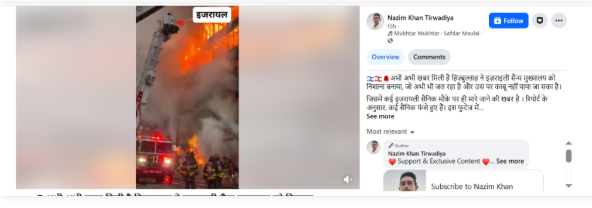
A Facebook user, ‘Nazim Khan Tirwadiya’, shared the video on April 15, 2026, claiming that Hezbollah had targeted an Israeli military headquarters, resulting in heavy casualties and ongoing fire.
Fact Check
To verify the claim, we extracted keyframes from the viral video and conducted a reverse image search. This led us to a longer version of the same clip uploaded on the YouTube channel “FDNY Response Videos” on April 12, 2026. The video description identified the location as Manhattan, New York City.

Further keyword searches led us to a report published by ABC7NY on April 12, 2026. According to the report, a massive fire broke out in a six-storey apartment building in Manhattan’s Midtown area around 6 a.m. Firefighters worked extensively to control the blaze, and two firefighters sustained minor injuries. No fatalities were reported.

Conclusion
The viral claim is false. The video does not show an attack on Israel by Hezbollah. Instead, it captures a fire incident in a residential building in Manhattan, New York City. The clip has been shared with a misleading narrative unrelated to the actual event.

Related Blogs
.webp)
Introduction
Social media platforms have begun to shape the public understanding of history in today’s digital landscape. You may have encountered videos, images, and posts that claim to reveal an untold story about our past. For example, you might have seen a post on your feed that has a painted or black and white image of a princess and labelled as "the most beautiful princess of Rajasthan who fought countless wars but has been erased from history.” Such emotionally charged narratives spread quickly, without any academic scrutiny or citation. Unfortunately, the originator believes it to be true.
Such unverified content may look harmless. But it profoundly contributes to the systematic distortion of historical information. Such misinformation reoccurs on feeds and becomes embedded in popular memory. It misguides the public discourse and undermines the scholarly research on the relevant topic. Sometimes, it also contributes to communal outrage and social tensions. It is time to recognise that protecting the integrity of our cultural and historical narratives is not only an academic concern but a legal and institutional responsibility. This is where the role of the Ministry of Culture becomes critical.
Pseudohistorical News Information in India
Fake news and misinformation are frequently disseminated via images, pictures, and videos on various messaging applications, which is referred to as “WhatsApp University” in a derogatory way. WhatsApp has become India’s favourite method of communication, while users have to stay very conscious about what they are consuming from forwarded messages. Academic historians strive to understand the past in its context to differentiate it from the present, whereas pseudo-historians try to manipulate history to satisfy their political agendas. Unfortunately, this wave of pseudo-history is expanding rapidly, with platforms like 'WhatsApp University' playing a significant role in amplifying its spread. This has led to an increase in fake historical news and paid journalism. Unlike pseudo-history, academic history is created by professional historians in academic contexts, adhering to strict disciplinary guidelines, including peer review and expert examination of justifications, assertions, and publications.
How to Identify Pseudo-Historic Misinformation
1. Lack of Credible Sources: There is a lack of reliable primary and secondary sources. Instead, pseudohistorical works depend on hearsay and unreliable eyewitness accounts.
2. Selective Use of Evidence: Misinformative posts portray only those facts that support their argument and minimise the facts which is contradictory to their assertions.
3. Incorporation of Conspiracy Theories: They often include conspiracy theories, which postulate secret groups, repressed knowledge. They might mention that evil powers influenced the historical events. Such hypotheses frequently lack any supporting data.
4. Extravagant Claims: Pseudo-historic tales sometimes present unbelievable assertions about historic persons or events.
5. Lack of Peer Review: Such work is generally never published on authentic academic platforms. You would not find them on platforms like LinkedIn, but on platforms like Instagram and Facebook, as they do not pitch for academic publications. Authentic historical research is examined by subject-matter authorities.
6. Neglect of Established Historiographical Methods: Such posts lack knowledge of a recognised methodology and procedures, like the critical study of sources.
7. Ideologically Driven Narratives: Political, communal, ideological, and personal opinions are prioritised in such posts. The author has a prior goal, instead of finding the truth.
8. Exploitation of Gaps in the Historical Record: Pseudo-historians often use missing or unclear parts of history to suggest that regular historians are hiding important secrets. They make the story sound more mysterious than it is.
9. Rejection of Scholarly Consensus: Pseudo-historians often reject the views of experts and historians, choosing instead to believe and promote their strange ideas.
10. Emphasis on Sensationalism: Pseudo-historical works may put more emphasis on sensationalism than academic rigour to pique public interest rather than offer a fair and thorough account of the history.
Legal and Institutional Responsibility
Public opinion is the heart of democracy. It should not be affected by any misinformation or disinformation. Vested interests cannot be allowed to sabotage this public opinion. Specifically, when it concerns academia, it cannot be shared unverified without any fact-checking. Such unverified claims can be called out, and action can be taken only if the authorities take over the charge. In India, the Indian Council of Historical Research (ICHR) regulates the historical academia. As per the official website, their stated aim is to “take all such measures as may be found necessary from time to time to promote historical research and its utilisation in the country,”. However, it is now essential to modernise the functioning of the ICHR to meet the demands of the digital era. Concerned authorities can run campaigns and awareness programmes to question the validity and research of such misinformative posts. Just as there are fact-checking mechanisms for news, there must also be an institutional push to fact-check and regulate historical content online. The following measures can be taken by authorities to strike down such misinformation online:
- Launch a nationwide awareness campaign about historical misinformation.
- Work with scholars, historians, and digital platforms to promote verified content.
- Encourage social media platforms to introduce fact-check labels for historical posts.
- Consider legal frameworks that penalise the deliberate spread of false historical narratives.
History is part of our national heritage, and preserving its accuracy is a matter of public interest. Misinformation and pseudo-history are a combination that misleads the public and weakens the foundation of shared cultural identity. In this digital era, false narratives spread rapidly, and it is important to promote critical thinking, encourage responsible academic work, and ensure that the public has access to accurate and well-researched historical information. Protecting the integrity of history is not just the work of historians — it is a collective responsibility that serves the future of our democracy.
References:
- https://kuey.net/index.php/kuey/article/view/4091
- https://www.drishtiias.com/daily-news-editorials/social-media-and-the-menace-of-false-information
Executive Summary
A video is being shared on social media with the claim that a Dalit woman was raped inside the Ram Temple in Ayodhya. In the video, two women can be seen crying, while some people around them appear to be consoling them. CyberPeace Research Wing’s research found the viral claim to be false. Our research found that the viral video has been created by combining two separate clips. In the first part of the video, a woman can be seen staging a protest at Buddha Park in Haldwani and raising issues related to her in-laws. The second part shows a girl expressing her anger. Our research found that this clip has been available on the internet since December 27, 2025. Neither of the two videos is related to the alleged rape of a Dalit woman inside the Ram Temple in Ayodhya.
Claim:
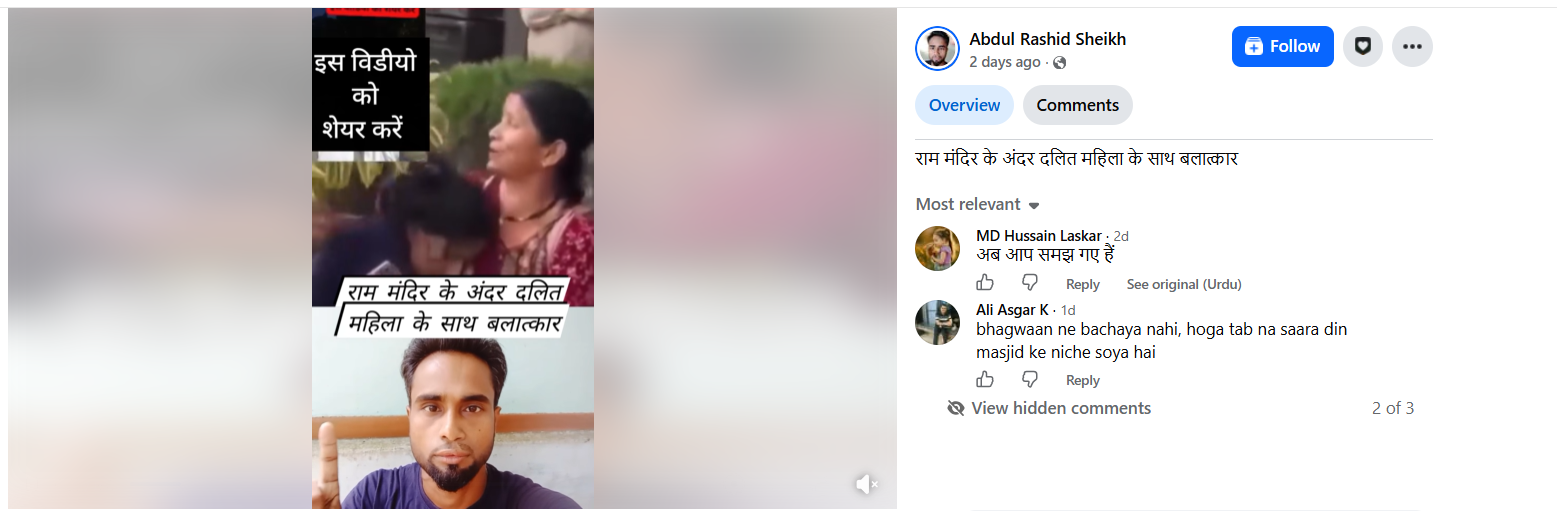
A Facebook user shared the viral video on September 21, 2026, with the caption, “Dalit woman raped inside the Ram Temple.”The post link, archive link and screenshot are provided below.
https://www.facebook.com/watch/?v=1420442086956519
Fact Check
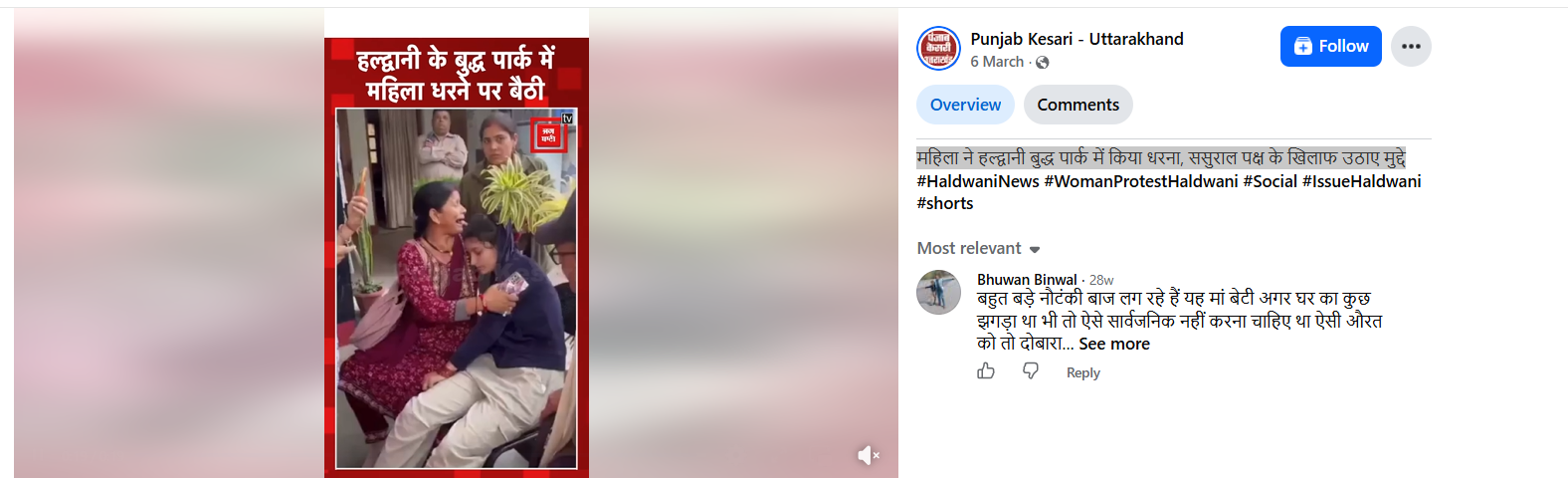
To verify the authenticity of the viral image, we conducted a Google search using relevant keywords. However, we did not find any credible media report related to the viral image during the search. To verify the claim, we conducted a reverse image search of the keyframes from the video. During the search, we found the same video on the Facebook page of Punjab Kesari - Uttarakhand, where it was published on March 6, 2026. According to the post, the woman staged a protest at Buddha Park in Haldwani and raised issues related to her in-laws. The link and screenshot of the relevant post are provided below.
https://www.facebook.com/watch/?v=897776589732940
Meanwhile, we found the second part of the viral video on LinkedIn, where the video was published on December 27, 2025.
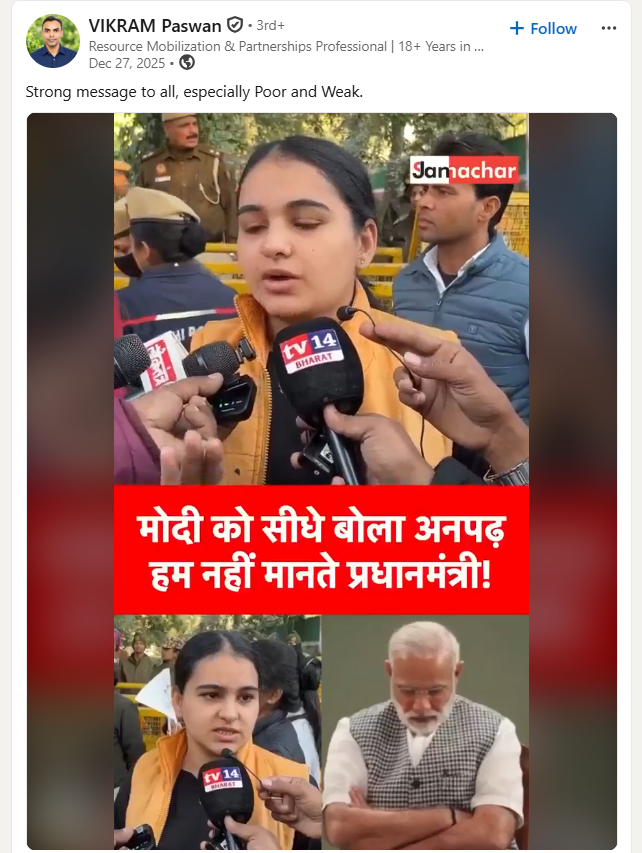
Our research makes it clear that two old and unrelated videos are being shared with a misleading claim linking them to the Ram Temple in Ayodhya. The videos have no connection with the alleged incident on the temple premises, and based on the available evidence, there is no confirmation of any such incident taking place at the Ram Temple. Our research found that the viral video was created by combining two separate clips. In the first part of the video, a woman can be seen staging a protest at Buddha Park in Haldwani and raising issues related to her in-laws. In the second part, a girl can be seen expressing her anger. Our research found that this clip has been available on the internet since December 27, 2025. Neither of the two videos is related to the alleged rape of a Dalit woman inside the Ram Temple in Ayodhya.
Procedural History:
The case started with a 2011 Madras High Court ruling that included the appellant’s personal information. In the case discussed, the court decided in 2024, the appellant went to the Madurai Bench of the Madras High Court to request that his name and other identifying information from that previous ruling be redacted. He argued that his right to privacy under Article 21 of the Indian Constitution was violated by the ongoing release of such private information into the public arena. He claimed that the revelation had hurt him in real ways, such as having his application for an Australian visa denied. Therefore, without compromising the ideals of open justice, the current procedures aimed to have the court recognize a person’s “Right to be Forgotten” within a broader framework of privacy and data protection.
Background and Factual Matrix
The appellant was charged under Sections 417 and 376 of the IPC. The trial court convicted him in 201, but later, the High Court in 2014 fully, completely and unconditionally acquitted him, which was not based on the benefit of doubt. Following the acquittal, he remarried and has three children. The judgment of both the High Court and the Trial Court has personal and intimate details about him. Being available in the public domain has caused him significant repercussions, as he was denied a visa to travel to Australia by authorities, citing the criminal cases. The appellant has filed a plea seeking a mandamus directing the Registrar General, Additional Registrar General, and Registrar (IT-Statistics) as R1, R2, R3 to redact his name and other identities from the acquittal judgment. He has sought a direction from Ikanoon Software Development Private Limited (R4) to reflect the redaction in its publication.
Issue
- Whether a writ of mandamus can lie against a High Court for redaction of personal details from its own judgment, or does such a prayer tantamount to a High Court issuing a writ against itself?
- Whether the High Court, being a Court of Record under Article 215 of the Indian Constitution, is entitled to preserve its record for perpetuity in its original form without any modification or redaction?
- Whether the ‘Right to be Forgotten' can be recognised and enforced in the absence of a specific statutory provision or Supreme Court direction, given that it constitutes an exception to the fundamental principle of open courts and open justice?
Adjudication and Reasoning
The division bench has allowed the Writ appeal and granted the following relief:
- R4 directed to take down the judgment in Crl.A. (MD) No.321 of 2011 dated 30.04.2014 forthwith.
- R1 to R3 directed to redact the name and other details of the Writ Petitioner relating to his identity from the judgment dated 30.04.2014 in Crl.A.(MD) No. 321 of 2011 and ensure that only the redacted judgment is available for publication or for uploading.
Rule
- Courts have a wide discretion in deciding whether to allow redaction or not. Such discretion can either be granted at the request of the party seeking redaction or, in appropriate cases, even suo moto by the court.
- The accused who have earned full, complete and unconditional acquittal without any benefit of doubt have a legitimate claim to move forward for redaction of personal information.
- The open Court doesn’t require absolute disclosure of all personal information, and the courts, while deciding the concern of privacy and the right to ensure that in litigations to leave behind parts of their past which are no longer relevant, have to balance the concept of open Court on the one hand and privacy concerns of a citizen on the other.
- As the High Court is the repository of a wide range of information and is entitled to preserve the original record in perpetuity. However, without diluting the sanctity of the original record, the public reflection of that record can be moderated to preserve the privacy of the person to whom that record pertains.
Reasoning
- Drawing on the judgment K.S. Puttaswamy v. Union of India, the court found Article 21 to protect not only informational privacy but also the "right to be forgotten," which gives individuals the right to request the deletion of any personal data when there is no longer any legitimate public interest in retaining such information. Such irreparable reputational damage is thus an infringement on constitutional privacy that demands judicial redaction.
- The court rejected the argument that a writ against its own order is impermissible, drawing a distinction between challenging the legal correctness of a judgment and seeking redaction of personal information. Allowing redaction will not question the validity of the judgment; rather, it will simply change its public appearance to ensure privacy.
- Since a High Court is a Court of Record with an obligation to preserve its judgments in their unaltered form forever, the court held here that such internal maintenance of complete records was not incompatible with the issuance of a redacted public version. Institutional integrity is maintained when the original kept in the archives is supplemented with a public version that masks the privacy areas.
- Open justice principles work to establish transparency, accountability, and public confidence, but these are not absolute. The court took a proportionality stance: personal identifiers, where they neither educate nor have precedential value and continue to inflict harm, may be expunged without affecting the established legal principles of judgment.
- Although the DPDP Act exempts courts from several statutory obligations, the court held that it can, by virtue of its inherent discretion, protect personal data, and in so doing, exercise that power without the need for any legislative command. Traditionally the Madras High Court rules provide for the possibility of restriction of certified copies, thus establishing redaction as feasible both legally and administratively.
