
#FactCheck: 2023 Manipur Violence Video Falsely Shared as Indian Army Bombing Minority House
Executive Summary
A video showing a house collapsing after a massive explosion is being widely shared on social media with the claim that it shows the Indian Armed Forces bombing the house of a minority community in Manipur. CyberPeace Research Wing ’s research found that the claim is false. The viral video dates back to 2023 and shows a house being demolished in Churachandpur during the ethnic violence between the Kuki and Meitei communities in Manipur.
Claim:
An X (formerly Twitter) user shared the video with the caption: “This is Manipur, not Palestine. The Indian Army is destroying minority houses in Manipur.”
The post claimed that the visuals showed the Indian Army carrying out an attack on minority community houses in Manipur.
https://www.facebook.com/reel/1042491035382024

Fact Check:
To verify the claim, CyberPeace Research Wing conducted a reverse image search using keyframes extracted from the viral video. During the search, we found the same video shared by NDTV’s official Instagram account on July 21, 2024.
According to the caption of the post, the video was from 2023, when ethnic clashes broke out between the Kuki and Meitei communities in Manipur. The post stated that the incident took place in Churachandpur, where the house of Naorem Ibomcha Meitei was destroyed by the Kuki community during the violence.
https://www.instagram.com/reels/C9sQWeTSCFx/

Further research revealed that India Today had also shared the same video with similar details
https://www.instagram.com/reels/C9sRq1nSy51/

Conclusion:
The research found that the viral video is being circulated with a misleading claim. The footage does not show the Indian Armed Forces bombing a minority community’s house in Manipur. It is from 2023 and shows the demolition of a house in Churachandpur during the ethnic violence between the Kuki and Meitei communities.

Related Blogs
.webp)
Executive Summary:
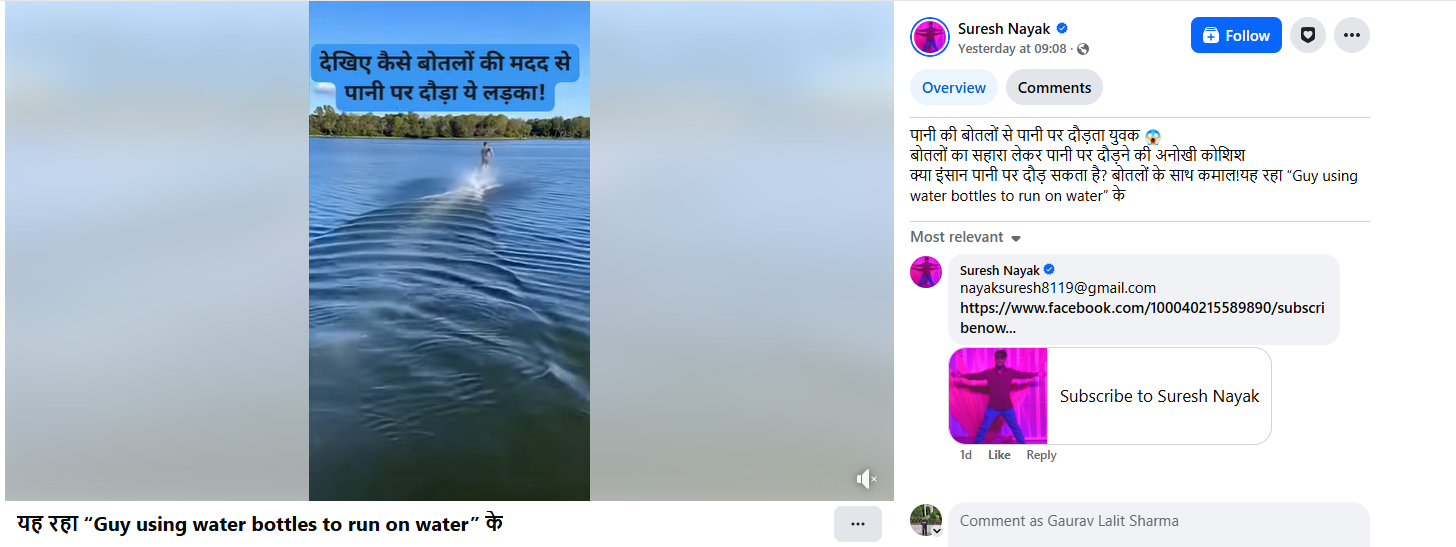
A video is being shared on social media showing a man running rapidly in a river with water bottles tied to both his feet. Users are circulating the video claiming that the man is attempting to run on water using the support of the bottles. CyberPeace’s research found the viral claim to be false. Our research revealed that the video being shared on social media is not real but has been generated using artificial intelligence (AI).
Claim :
The claim was shared by a Facebook user on February 5, 2026, who wrote that a man was running on water using water bottles tied to his feet, calling it a unique attempt and questioning whether humans can run on water. Links to the post, its archived version, and screenshots are provided below.
Fact Check:
To verify the claim, we searched relevant keywords on Google but did not find any credible media reports supporting the incident. A closer examination of the viral video revealed several visual irregularities, raising suspicion that it may have been AI-generated. The video was then scanned using the AI detection tool Hive Moderation. According to the tool’s results, the video is 99 percent likely to be AI-generated.

Conclusion:
Our research confirms that the viral video does not depict a real incident and has been falsely shared as a genuine attempt to run on water.
Executive Summary
A Pakistani propaganda account on social media has claimed that Russian President Vladimir Putin ignored Indian Prime Minister Narendra Modi and stood alongside the Pakistani Prime Minister. Research by CyberPeace’s research wing found that PM Modi and President Putin held a bilateral meeting on the sidelines of the SCO Summit in Bishkek, Kyrgyzstan. During the meeting, the two leaders exchanged warm greetings and discussed several issues, including the India-Russia strategic partnership.
Claim:
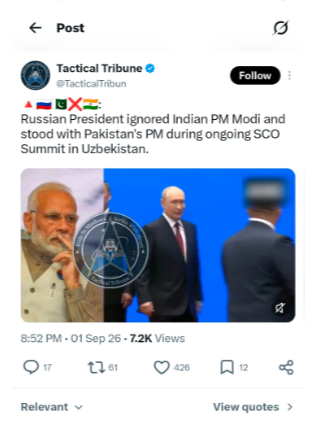
A social media post claims that Russian President Vladimir Putin ignored Prime Minister Narendra Modi and stood alongside the Pakistani Prime Minister.
https://x.com/TacticalTribun/status/2094808040973172786
Fact Check:
To verify the truth behind the viral claim, we searched Google using relevant keywords related to Prime Minister Narendra Modi’s official visit to Kyrgyzstan. During the search, we found a video posted on ANI’s X handle on September 1, 2026. According to the video, Prime Minister Narendra Modi met Chinese President Xi Jinping and Russian President Vladimir Putin in Bishkek during the 26th Shanghai Cooperation Organisation (SCO) Summit.
https://x.com/ANI/status/2094675518897692896

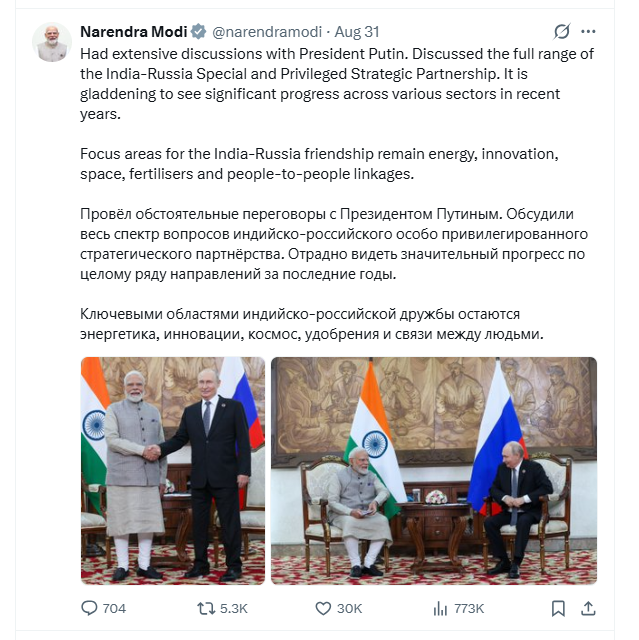
In the next step of our research, we scanned Prime Minister Narendra Modi’s X account, where we found a post dated August 31, 2026. In the post, PM Modi wrote, “Had extensive discussions with President Putin. Discussed the full range of the India-Russia Special and Privileged Strategic Partnership. It is gladdening to see significant progress across various sectors in recent years. Focus areas for the India-Russia friendship remain energy, innovation, space, fertilisers and people-to-people linkages.”
https://x.com/narendramodi/status/2094433881714032725?s=20
At the end of our research, we found a report published on the Aaj Tak website on September 1, 2026. According to the report, Prime Minister Narendra Modi was in Bishkek, the capital of Kyrgyzstan, where he attended the Shanghai Cooperation Organisation (SCO) Summit. Several leaders of the organisation, including Chinese President Xi Jinping, Russian President Vladimir Putin and Pakistani Prime Minister Shehbaz Sharif, also attended the summit. During the summit, a moment was captured in which PM Modi warmly greeted Chinese President Xi Jinping and Russian President Vladimir Putin together, while Shehbaz Sharif was seen quietly walking past them.

Conclusion:
Our research established that the claim that Russian President Vladimir Putin ignored Prime Minister Narendra Modi and gave preference to the Pakistani Prime Minister is misleading. The viral post presents video footage from different occasions out of context. In reality, Prime Minister Narendra Modi and President Putin held a bilateral meeting, during which the two leaders discussed several key issues, including the India-Russia strategic partnership.

Executive Summary:
A viral video circulating on social media inaccurately suggests that it shows Israel moving nuclear weapons in preparation for an assault on Iran, but a detailed research has established that it instead shows a SpaceX Starship rocket (Starship 36) being towed for a pre-planned test in Texas, USA, and the footage does not provide any evidence to back-up the claim of an Israeli action or a nuclear missile.

Claim:
Multiple posts on social media sharing a video clip of what appeared to be a large, missile-like object being towed to an unknown location by a very large vehicle and stated it is Israel preparing for a nuclear attack on Iran.
The caption of the video said: "Israel is going to launch a nuclear attack on Iran! #Israel”. The viral post received lots of engagement, helpingClaim: to spread misinformation and unfounded fear about the rising conflicts in the Middle East.

Fact check:
By doing reverse image search using the key frames of the viral footage, this landed us at a Facebook post dated June 16, 2025.

A YouTube livestream from NASASpaceflight is dated 15th June 2025. Both sources make it clear that the object was clearly identified as SpaceX Starship 36. This rocket was being towed at SpaceX's Texas facility in advance of a static fire test and as part of the overall preparation for the 10th test flight. In the video, there is clearly no military ordinance or personnel, or Israel’s nuclear attack on Iran markings.
More support for our conclusions came from several articles from SPACE.com, which briefly reported on the Starship's explosion shortly thereafter during various testing iterations.


Also, there was no mention of any Israeli nuclear mobilization by any reputable media or defence agencies. The resemblance between a large rocket and a missile likely added some confusion. Below is a video describing the difference, but the context and upload location have no relation to the State of Israel or Iran.

Conclusion:
The viral video alleging that the actual video showed Israel getting ready to launch a nuclear attack on Iran is false and misleading. In fact, the video was from Texas, showing the civilian transport of SpaceX’s Starship 36. This highlighted how easily unrelated videos can be used to create panic and spread misinformation. If you plan on sharing claims like this, verify them instead using trusted websites and tools.
- Claim: Misleading video on Israel is ready to go nuclear on Iran
- Claimed On: Social Media
- Fact Check: False and Misleading
