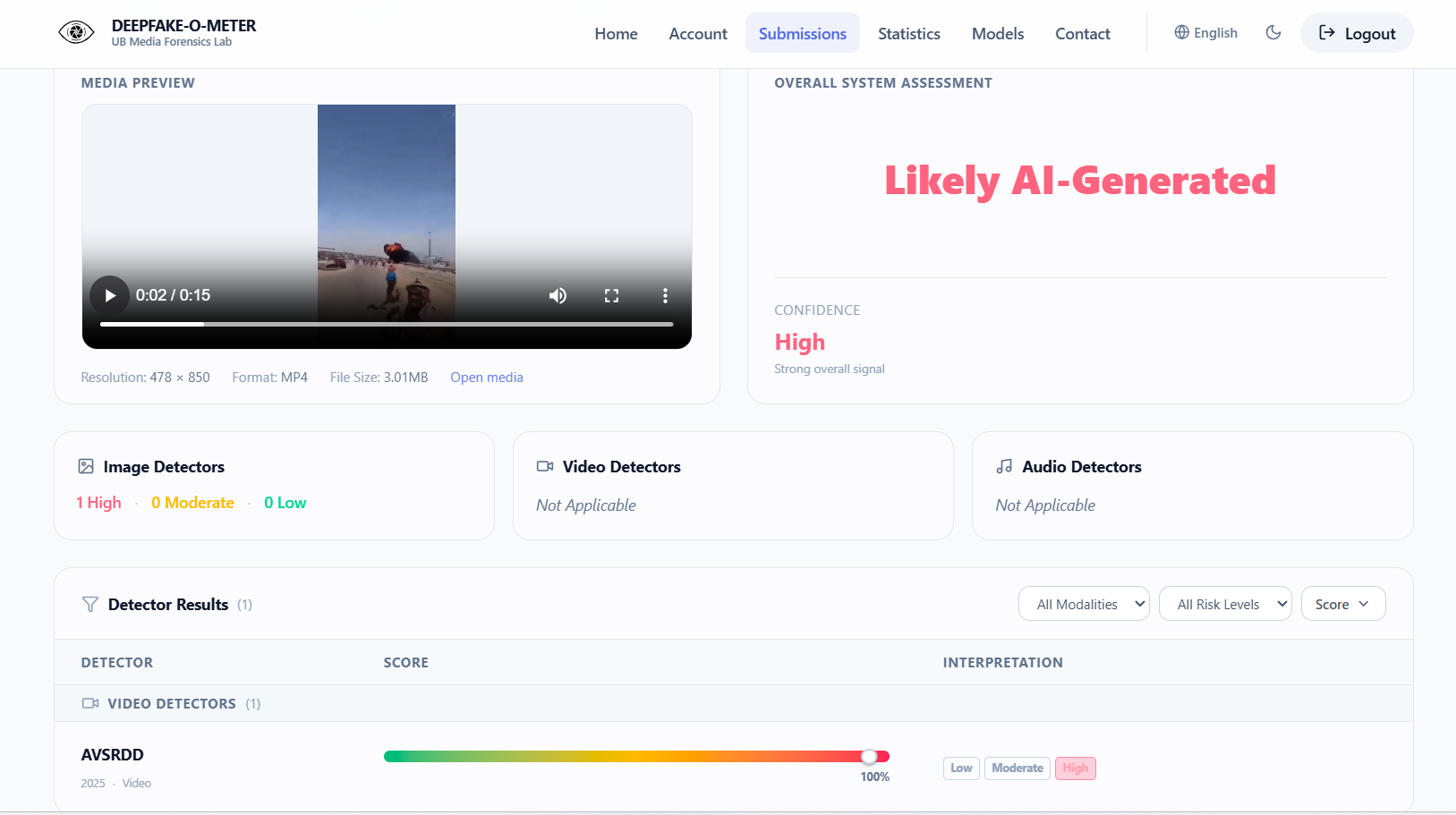
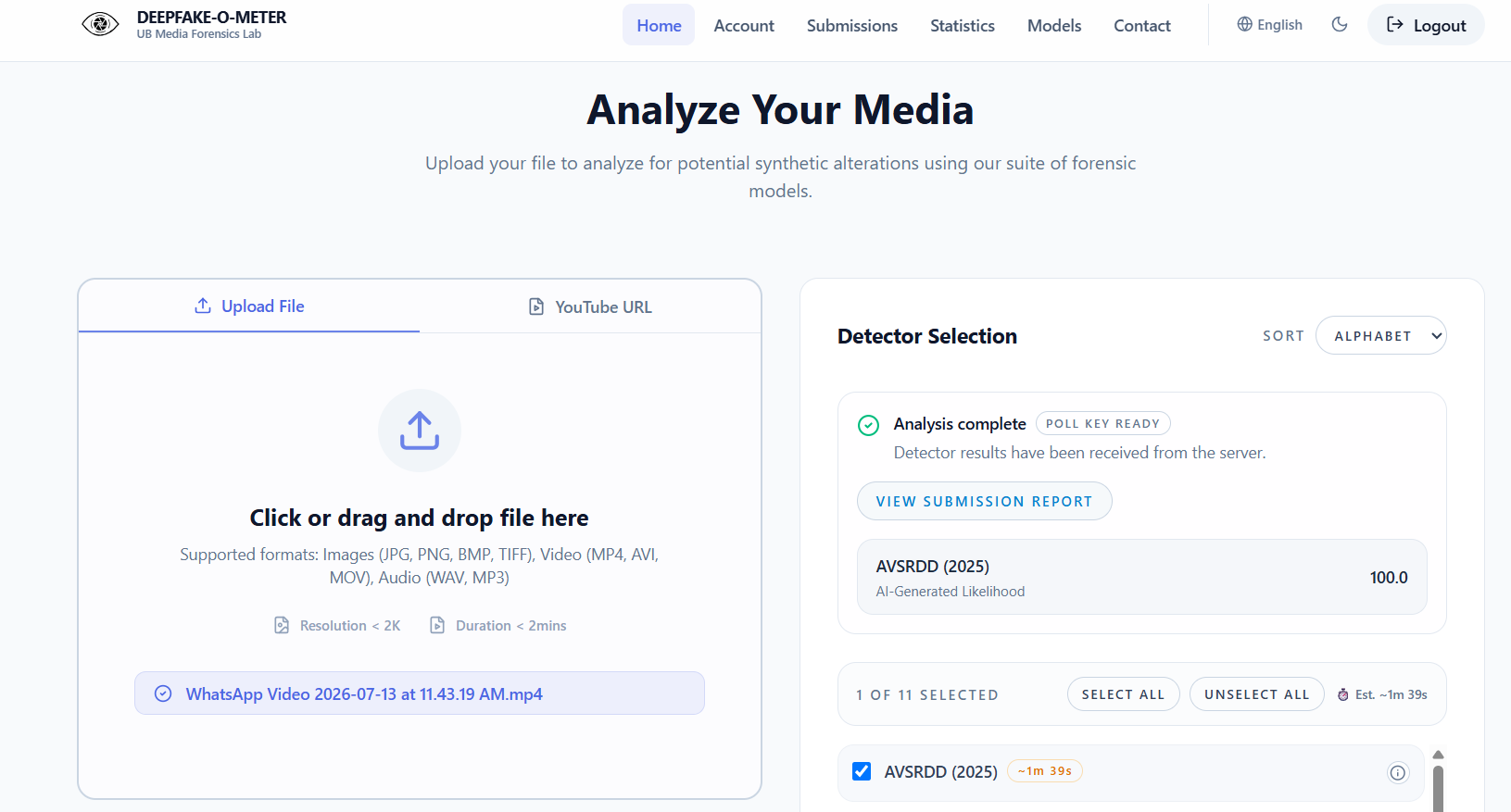
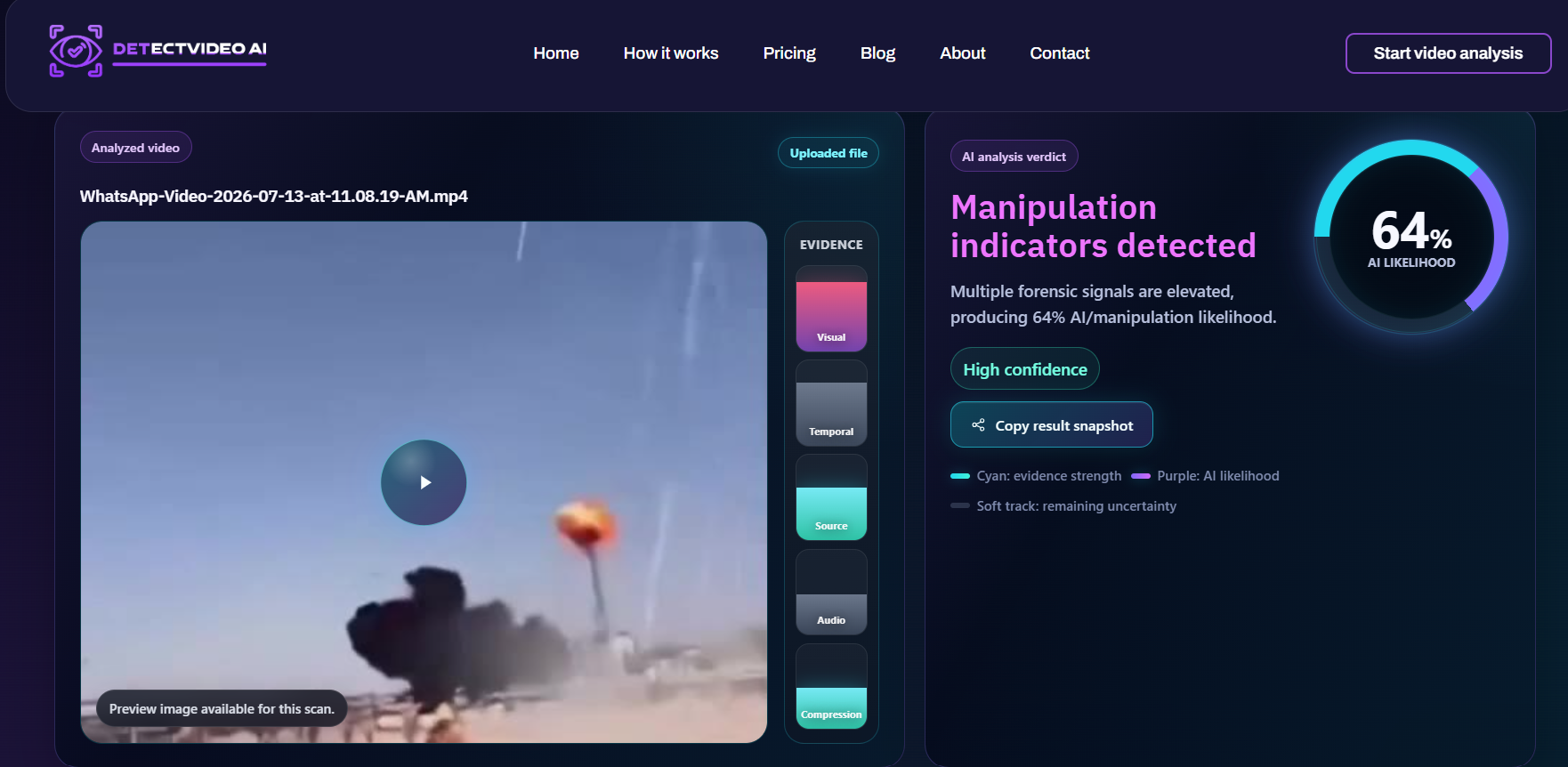
#FactCheck- Indian Navy Video from Seychelles Exercise Passed Off as Anti-Piracy Action
Executive Summary
A video showing armed personnel detaining individuals on board a ship is being widely shared on social media with the claim that Indian Navy’s MARCOS captured 35 Somali pirates during a recent anti-piracy operation. However, research by the CyberPeace Research Wing found the claim to be misleading. The viral video is actually from the joint military exercise ‘LAMITIYE 2026’, held in Seychelles in March, involving the Indian Armed Forces and the Seychelles Defence Forces.
Claim
Users on X (formerly Twitter) shared the clip with captions such as: “Indian Navy MARCOS captured 35 Somali pirates,” presenting it as footage of a recent anti-piracy mission.

Fact Check
To verify the claim, we extracted keyframes from the viral video and conducted a reverse image search. This led us to the same video posted on March 20 by a Facebook page named “Defence Squad.” The caption identified the visuals as showing Indian Navy MARCOS and the Seychelles Defence Forces’ Special Operations Unit during the joint military exercise LAMITIYE 2026.
Link:
- https://www.facebook.com/reel/1263962865936234

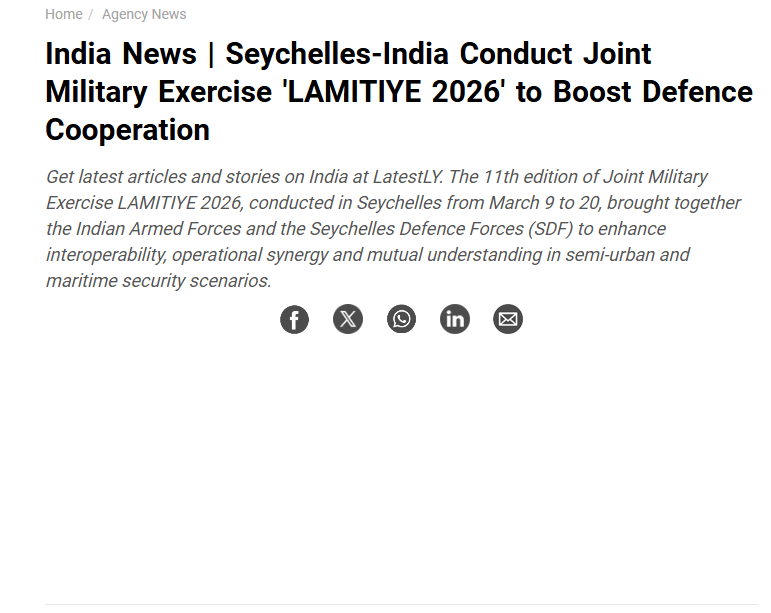
Further keyword searches led to multiple news reports carrying screenshots from the same video. These reports confirmed that the 11th India-Seychelles joint military exercise, LAMITIYE 2026, was conducted in Seychelles from March 9 to March 20.
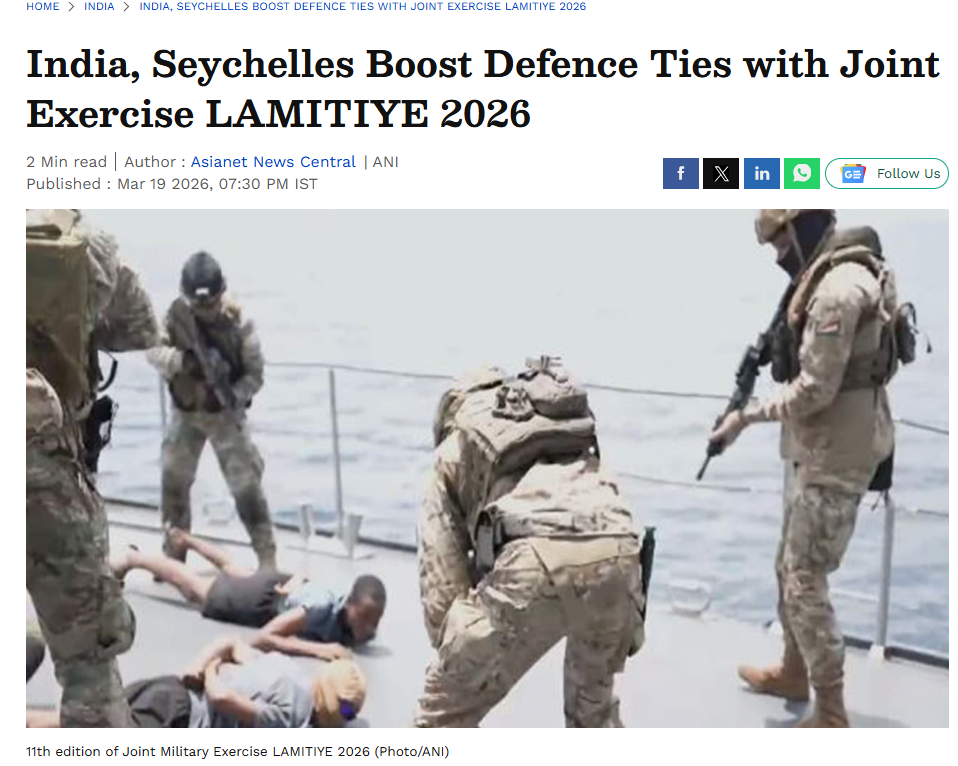
We did not find any recent reports about the Indian Navy capturing Somali pirates. However, in March 2024, the Indian Navy had captured 35 Somali pirates who had hijacked a bulk carrier and taken hostages. The suspects were later handed over to Mumbai Police for legal proceedings.
Conclusion
The viral claim is misleading. The video being circulated as footage of an anti-piracy operation by the Indian Navy does not show the capture of Somali pirates. Instead, it is from the India-Seychelles joint military exercise ‘LAMITIYE 2026’, conducted in March with the participation of the Indian Armed Forces and the Seychelles Defence Forces. While the Indian Navy had indeed captured 35 Somali pirates in a separate incident in March 2024, there are no credible or recent reports linking such an operation to the viral video. The clip has been taken out of context and is being shared with a false narrative, leading to misinformation about a routine military exercise.
Related Blogs

Cyber attacks in India besides becoming common are also getting deadlier. Each strike has taken proportions to drive home the fact that no one is safe.
Hacker ‘John Wick’, hasn’t spared India’s PM or Paytm. Cyber intelligence firm Cyble which dredges the Dark Web has red-flagged hacking episodes at Truecaller, Dunzo, Unacademy, Naukri.com, Bharat Earth Movers Limited (BEML), LimeRoad and IndiaBulls.Picture this, Mumbai-based cybersecurity firm Sequretek, says in Covid-hit 2020, India has seen a 4000% spike in phishing emails and a 400% uptake in the number of policy violations that have grown over 400% as per the latest statistics.Besides the threat to crucial data, the cost suffered by companies is phenomenal. According to a report by IBM’s ‘Cost of a Data Breach Report 2020’ report, Indian companies witnessed an average $2 Mn total cost of data breach in 2020, this is an increase of 9.4% from 2019.
Another survey by Barracuda Networks revealed that 66% of Indian organisations have had at least one data breach or cybersecurity incident since shifting to a remote working model during the pandemic.
Indian Startups At Mercy Of Cyber Attacks
More recently personal data of 2.8 Lakh WhiteHat Jr students and teachers were exposed, where crucial details of minors have been made available on the dark web. Another major breach that took place this week and exclusively reported by Inc42 was when data of 1.4 Mn job seekers was leaked when jobs portal IIMjobs was hacked.
Vineet Kumar, the founder of Cyber Peace Foundation (CPF), a think tank of cybersecurity and policy experts, said that with the increased digitisation of companies and their processes, data has become the new oil.
“You get good money when you sell users data on the dark web. Hackers discovering vulnerabilities and using SQL injections to pull entire databases remains a common practice for hacking,” Kumar told Inc42.
The CyberPeace Foundation says from mid-April to the end of June it noticed 8,98,7841 attacks, July and August saw 64,52,898 attacks. Whereas September and October saw 1,37,37,516 attacks and 18,149,233 attacks respectively.
Speaking to Inc42, Pankit Desai, cofounder and CEO, Sequretek says, “Originally only a limited set of systems were being exposed, now with WFH all systems have to be exposed to the internet as all your processes are enabled remotely. WFH also creates an additional challenge where ‘personal assets are being used for professional purposes’ and ‘professional assets are being used for personal purposes.”
Malwares like SpyMax, Blackwater are being used as a combination of phishing mails and poorly secured home computers to harvest credentials. These credentials are then used for carrying out attacks. The number of attacks with harvested credentials is already up 30%, the company revealed.
Government data shows that in 2019 alone, India witnessed 3.94 lakh instances of cybersecurity breaches. In terms of hacking of state and central government websites, Indian Computer Emergency Response Team (CERT-In) data shows that a total of 336 websites belonging to central ministries, departments, and state governments were hacked between 2017 and 2019.
According to Nasscom’s Data Security Council of India (DSCI) report 2019, India witnessed the second-highest number of cyber attacks in the world between 2016 and 2018. This comes at a time when digitisation of the Indian economy is predicted to result in a $435 Bn opportunity by 2025.On September 22, the Ministry of Electronics and Information Technology (MeITY) told the Parliament that Indian citizens, commercial and legal entities faced almost 7 lakh cyberattacks till August this year.
The Indian Computer Emergency Response Team (CERT-In) has “reported 49,455, 50,362, 53,117, 208,456, 394,499 and 696,938 cybersecurity incidents during the year 2015, 2016, 2017, 2018, 2019 and 2020 (till August) respectively,” the MeITY said while responding to an unstarred question in the Lok Sabha regarding cyberattacks on Indian citizens and India-based commercial and legal entities.“
India also lacks a cohesive nation-wide cyber-strategy, policies, and procedures. Regulations around data privacy, protection, and penalty should be enacted and enforced as these measures will help businesses evaluate their cybersecurity posture and seek ways to improve. Currently, incident reporting is not mandatory. By making it compulsory, there will be a body of research data that can provide insights on threats to India and inform the government on strategies it can undertake to strengthen the nation’s cyber posture,” said Kumar Ritesh, founder and CEO, Cyfirma.The Internet Crime Report for 2019, released by the USA’s Internet Crime Complaint Centre of the Federal Bureau of Investigation (FBI), has revealed that India stands third in the world among top 20 countries that are victims of internet crimes.
Kumar attributes these numbers to Indian’s lack of basic cyber awareness. However, a poignant point is also the lack of a robust cybersecurity policy in India. Though the issue was touched upon by Prime Minister Narendra Modi during his Independence Day speech on Aug 15, 2020, not much movement has happened on that front.
“Cybersecurity is a very important aspect, which cannot be ignored. The government is alert on this and is working on a new, robust policy,” Modi said.The PM’s announcement was made in the backdrop of the government’s initiative to connect 1.5 lakh gram panchayats through an optical fiber network, thereby increasing the country’s internet connectivity.
With India pipped to take on the world with its IT prowess and increased digital integration the need for a robust policy is now more than ever.
Source: https://inc42.com/buzz/3-94-lakhs-and-counting-how-cyberattacks-are-a-worry-for-digital-india/

The Illusion of Digital Serenity
In the age of technology, our email accounts have turned into overcrowded spaces, full of newsletters, special offers, and unwanted updates. To most, the presence of an "unsubscribe" link brings a minor feeling of empowerment, a chance to declutter and restore digital serenity. Yet behind this harmless-seeming tool lurks a developing cybersecurity threat. Recent research and expert discussions indicate that the "unsubscribe" button is being used by cybercriminals to carry out phishing campaigns, confirm active email accounts, and distribute malware. This new threat not only undermines individual users but also has wider implications for trust, behaviour, and governance in cyberspace.
Exploiting User Behaviour
The main challenge is the manipulation of user behaviour. Cyber thieves have learned to analyse typical user habits, most notably the instinctive process of unsubscribing from spam mail. Taking advantage of this, they now place criminal codes in emails that pose as real subscription programs. These codes may redirect traffic to fake websites that attempt to steal credentials, force the installation of malicious code, or merely count the click as verification that the recipient's email address is valid. Once confirmed, these addresses tend to be resold on the dark web or included in additional spam lists, further elevating the threat of subsequent attacks.
A Social Engineering Trap
This type of cyber deception is a prime example of social engineering, where the weakest link in the security chain ends up being the human factor. In the same way, misinformation campaigns take advantage of cognitive biases such as confirmation or familiarity, and these unsubscribe traps exploit user convenience and habits. The bait is so simple, and that is exactly what makes it work. Someone attempting to combat spam may unknowingly walk into a sophisticated cyber threat. Unlike phishing messages impersonating banks or government agencies, which tend to elicit suspicion, spoofed unsubscribe links are integrated into regular digital habits, making them more difficult to recognise and resist.
Professional Disguise, Malicious Intent
Technical analysis determines that most of these messages come from suspicious domains or spoofed versions of valid ones, like "@offers-zomato.ru" in place of the authentic "@zomato.com." The appearance of the email looks professional, complete with logos and styling copied from reputable businesses. But behind the HTML styling lies redirection code and obfuscated scripts with a very different agenda. At times, users are redirected to sites that mimic login pages or questionnaire forms, capturing sensitive information under the guise of email preference management.
Beyond the Inbox: Broader Consequences
The consequences of this attack go beyond the individual user. The compromise of a personal email account can be used to carry out more extensive spamming campaigns, engage in botnets, or even execute identity theft. Furthermore, the compromised devices may become entry points for ransomware attacks or espionage campaigns, particularly if the individual works within sensitive sectors such as finance, defence, or healthcare. In this context, what appears to be a personal lapse becomes a national security risk. This is why the issue posed by the weaponised unsubscribe button must be considered not just as a cybersecurity risk but also as a policy and public awareness issue.
Platform Responsibility
Platform responsibility is yet another important aspect. Email service providers such as Gmail, Outlook, and ProtonMail do have native unsubscribe capabilities, under the List-Unsubscribe header mechanism. These tools enable users to remove themselves from valid mailing lists safely without engaging with the original email content. Yet many users do not know about these safer options and instead resort to in-body unsubscribe links that are easier to find but risky. To that extent, email platforms need to do more not only to enhance backend security but also to steer user actions through simple interfaces, safety messages, and digital hygiene alerts.
Education as a Defence
Education plays a central role in mitigation. Just as cyber hygiene campaigns have been launched to teach users not to click on suspicious links or download unknown attachments, similar efforts are needed to highlight the risks associated with casual unsubscribing. Cybersecurity literacy must evolve to match changing threat patterns. Rather than only targeting clearly malicious activity, awareness campaigns should start tackling deceptive tactics that disguise themselves as beneficial, including unsubscribe traps or simulated customer support conversations. Partnerships between public and private institutions might be vital in helping with this by leveraging their resources for mass digital education.
Practical Safeguards for Users
Users are advised to always check the sender's domain before clicking any link, avoid unknown promotional emails, and hover over any link to preview its true destination. Rather than clicking "unsubscribe," users can simply mark such emails as spam or junk so that their email providers can automatically filter similar messages in the future. For enhanced security, embracing mechanisms such as mail client sandboxing, two-factor authentication (2FA) support, and alias email addresses for sign-ups can also help create layered defences.
Policy and Regulatory Implications
Policy implications are also significant. Governments and data protection regulators must study the increasing misuse of misleading unsubscribe hyperlinks under electronic communication and consent laws. In India, the new Digital Personal Data Protection Act, 2023 (DPDPA), provides a legislative framework to counter such deceptive practices, especially under the principles of legitimate processing and purpose limitation. The law requires that the processing of data should be transparent and fair, a requirement that malicious emails obviously breach. Regulatory agencies like CERT-In can also release periodic notifications warning users against such trends as part of their charter to encourage secure digital practices.
The Trust Deficit
The vulnerability also relates to broader issues of trust in digital infrastructure. When widely used tools such as an unsubscribe feature become points of exploitation, user trust in digital platforms erodes. Such a trust deficit can lead to generalised distrust of email systems, digital communication, and even legitimate marketing. Restoring and maintaining such trust demands a unified response that includes technical measures, user education, and regulatory action.
Conclusion: Inbox Hygiene with Caution
The "unsubscribe button trap" is a parable of the modern age. It illustrates how mundane digital interactions, when manipulated, can do great damage not only to individual users but also to the larger ecosystem of online security and trust. As cyber-attacks grow increasingly psychologically advanced and behaviorally focused, our response must similarly become more sophisticated, interdisciplinary, and user-driven. Getting your inbox in order should never involve putting yourself in cyber danger. But as things stand, even that basic task requires caution, context, and clear thinking.

Introduction
Artificial intelligence is often hailed as a democratiser of knowledge, opportunity and skill. It is set to improve diagnostics, personalised learning, and productivity to boost the economy, which can assist millions of people to leave poverty. However, this may be an incomplete picture. A report of the United Nations Development Programme in 2025 tells a more complex tale. The Next Great Divergence: Why AI May Widen Inequality Between Countries cautions that, unless acts are taken to intervene, AI will not alleviate inequality between countries but will instead concentrate benefits in already advantaged economies and increase risks in more vulnerable ones.
Two Gaps, One Crisis
AI is not going to create a level playing field: it has been injected into a world where there is unprecedented inequality. The report outlines two structural asymmetries that will influence the ways in which its effects manifest: a capability gap and a vulnerability gap.
Those countries that have high connectivity, skills, compute and regulation will be in a position to reap a greater portion of the AI dividend. Others will be exposed to greater risks of job losses, information exclusion, misinformation, and the indirect consequences of increased energy and water demands.
The centre of this transition is the Asia-Pacific region, that harbors a population of more than 55 per cent of the world. More than half of the global AI users are now located in the region, but the initial positions are quite different. Nations such as Singapore and South Korea are already spending a lot of money on AI infrastructure, with others still striving to offer basic broadband services. Two out of three individuals already use AI tools in certain high-income economies. In most countries with low incomes, the utilisation is lower. Such figures are important as they depict not only a gap in technology but also a structural difference in terms of who controls AI and who is controlled by the latter.
When Inequality Becomes a Trust Problem
Any trusted technological system is based on three tenets: transparency, fairness and accountability. AI inequality negatively impacts all three.
If governments implement imported AI systems in areas with limited technical capability, with limited transparency on their operation, their construction, and their biases. Citizens do not really trust when decision-making systems are black boxes and domestic institutions lack the know-how to question them.
Data exclusion also interferes with fairness. The AI systems trained with the datasets not sufficiently representative of the rural population, linguistic minorities, and women will generate poorer results in those groups systematically. Since South Asian women are much less likely to own a smartphone, this impacts their representation in digital data, and consequently in any AI system trained on such data.
Safety Risks Are Not Evenly Distributed
The lack of trust has a direct safety aspect. For example, those countries that have less robust information ecosystems have a greater exposure to AI-generated misinformation that can bias the discourse of the populace, alter elections, and cause violence. They also have the weakest capability of screening, tagging, or combating such content.
The same can be said about labour markets. The very same technologies that can speed up marginalisation and destabilise governance increase human insecurity, especially among employees in the informal economy with weak social security. The UNDP report points out that the exposure of female employment to disruption by AI is disproportionate to that of male employment, which further presents a gendered dimension in an already unequal situation.
Risks of infrastructure are skewed as well. Large AI systems may create disproportionately high energy and water demands on countries that host the data infrastructure without there being an equivalent economic payback. The environmental cost is local while profits are outsourced. Dangers of AI spread downwards, and the advantages go upwards.
The Governance Gap and Regulatory Arbitrage
Governance is perhaps the most important aspect. There are only a few states that presently have extensive AI regulation systems. This gives rise to a patchy landscape, in which safety standards differ dramatically and where companies have an incentive to install systems in jurisdictions that have weaker regulation.
The main reason is the lack of capability, as expressed by Philip Schellekens, chief economist of the UNDP in Asia and the Pacific, who says that those countries that invest in skills, computing power and well-run governance structures will gain. The rest will be left far behind.
This departure has its ramifications outside the nations. When users in other areas are subjected to widely different rates of safety and equity by the same international platforms, the concept of uniform digital norms would no longer be sustainable. Confidence in AI systems is lost not only locally but also on a global scale.
Way Forward
The UNDP report makes it clear that there is no inevitability of divergence. To avert it, however, it is necessary to consider AI governance as a development, rather than a technology problem.
The capacity to govern should be constructed and not presumed. This implies assisting countries in establishing regulatory systems, institutional capacity, and facilitating cross-border collaboration on standards. It can also imply considering some AI features as a public good, with common models and open standards that do not allow a few firms or states to become too powerful.
The UNDP articulates the problem in a simple manner: in the end, the world's people and not machines must decide on what technologies should be given priority and how to utilise them optimally.
Conclusion
AI inequality is often framed as an economic divergence story. But its implications run deeper. It reshapes who is protected, who is visible in data, and who has the power to challenge harmful outcomes. The risk is not just that some countries fall behind economically. It is that the global digital ecosystem fragments into zones of high trust and low trust, high protection and low protection. The choices made now will determine which path prevails. AI can reinforce existing divides or help bridge them.
But that outcome will not be decided by the technology itself. It will be decided by how societies choose to distribute access, power, and responsibility in the systems they build.
References
- https://www.undp.org/sites/g/files/zskgke326/files/2025-12/undp-rbap-the-next-great-divergence_1.pdf
- https://www.undp.org/asia-pacific/press-releases/ai-risks-sparking-new-era-divergence-development-gaps-between-countries-widen-undp-report-finds
- https://www.undp.org/asia-pacific/blog/next-great-divergence-how-ai-could-split-world-again-if-we-dont-intervene
- https://www.aljazeera.com/news/2025/12/2/ai-threatens-to-widen-inequality-among-states-un
- https://www.undp.org/asia-pacific/next-great-divergence
- https://www.eco-business.com/press-releases/ai-risks-spark-new-era-of-divergence-as-development-gaps-widen-undp-report/