#FactCheck - Viral Video of Car Arson Falsely Linked to Iran Protests
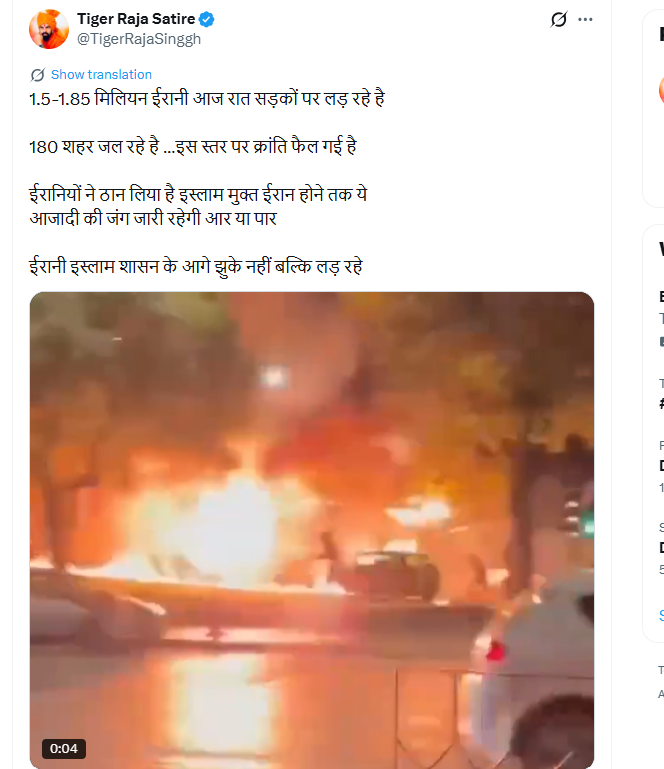
Amid reports of widespread protests in Iran over the past two weeks, a video showing protesters setting cars on fire is being widely shared on social media with claims that it depicts recent unrest in the country.
However, research by Cyber Peace Foundation has found the viral claim to be false. Our resarch shows that the video is not from Iran, but from violent protests that took place near the Turkish Consulate in Thessaloniki, Greece, on November 1, 2025.
Claim:
On January 11, 2026, users on social media platform X (formerly Twitter) shared the viral video claiming it showed massive anti-regime protests in Iran. One such post alleged:
“1.5–1.85 million Iranians are fighting on the streets tonight. 180 cities are burning… The revolution has spread. Iranians have decided to continue this fight for freedom until Iran becomes free from Islamic rule.”
The post’s link and archived version can be seen below: (Link and archive link)
Fact Check:
To verify the claim, we extracted keyframes from the viral video and conducted a Google Reverse Image Search. During this process, we found the same video uploaded on Instagram on November 2, 2025, well before the recent protests in Iran. (Link): https://www.instagram.com/reel/DQjRtCOjOPM/
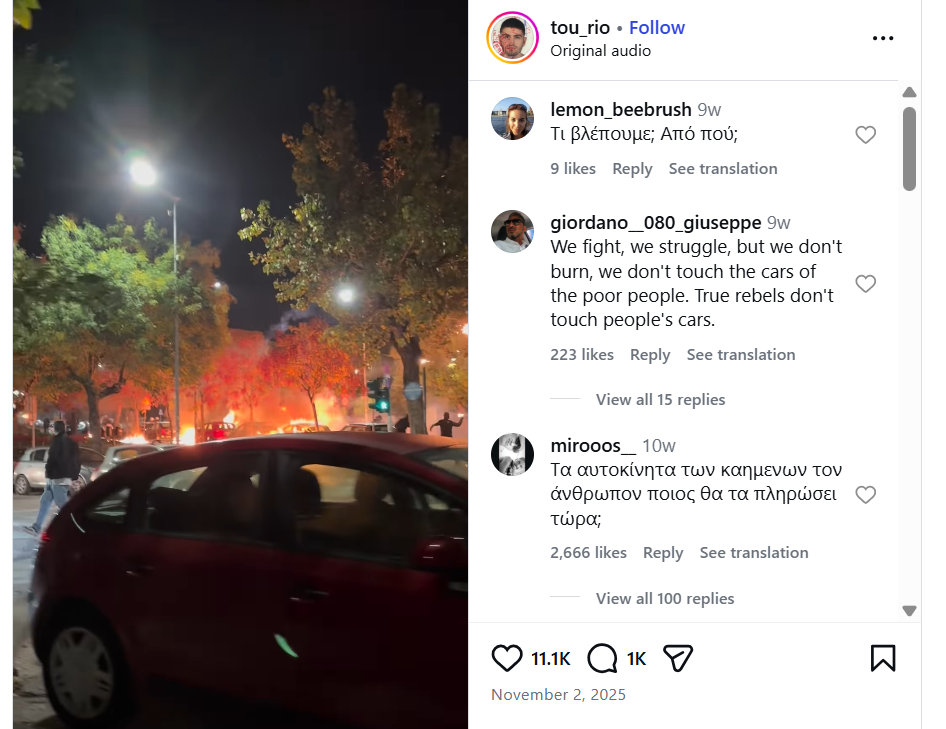
Further analysis revealed that the video was uploaded from a Greek Instagram account, indicating that the visuals are unrelated to Iran.
It is important to note that while protests in Iran have been ongoing for the past two weeks, the viral video has been circulating on the internet since early November 2025, establishing a clear timeline mismatch.
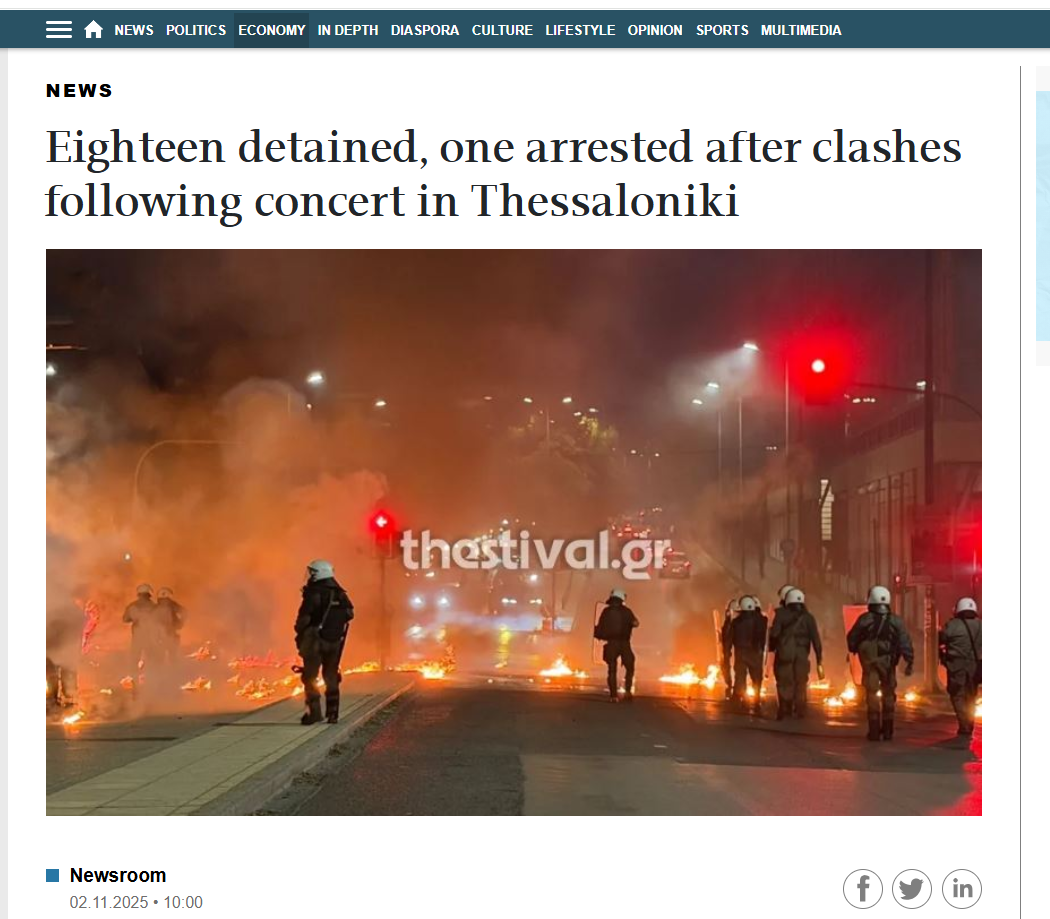
A keyword search led us to a report published on November 2, 2025, by Ekathimerini, a leading Greek media outlet. The report detailed violent clashes that erupted in Thessaloniki following a concert by Greek rapper Lex.
According to the report:
Police in Thessaloniki detained 18 people and arrested one individual on drug-related charges. The unrest began when a group attacked police forces stationed outside the Turkish Consulate. During the clashes, six cars were damaged, two of them completely burned, along with a garbage bin. ( report link and screenshot)
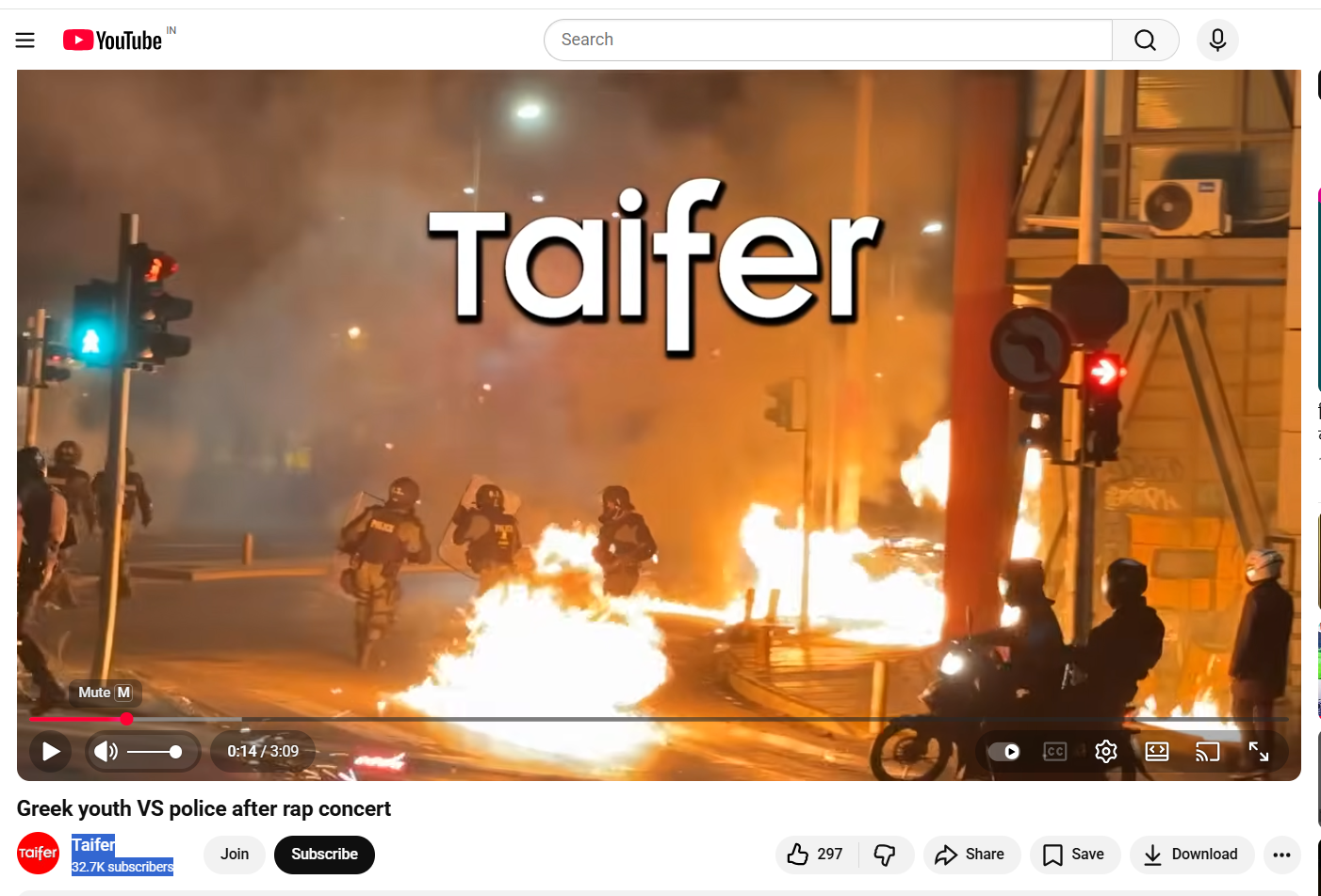
In the next stage of the investigation, we found similar visuals to the viral video on a YouTube channel named “Taifer”, where the footage was published on November 2, 2025. The link to the post and its screenshot can be seen below.
(YouTube link): https://www.youtube.com/watch?v=TejETjQRmTQ
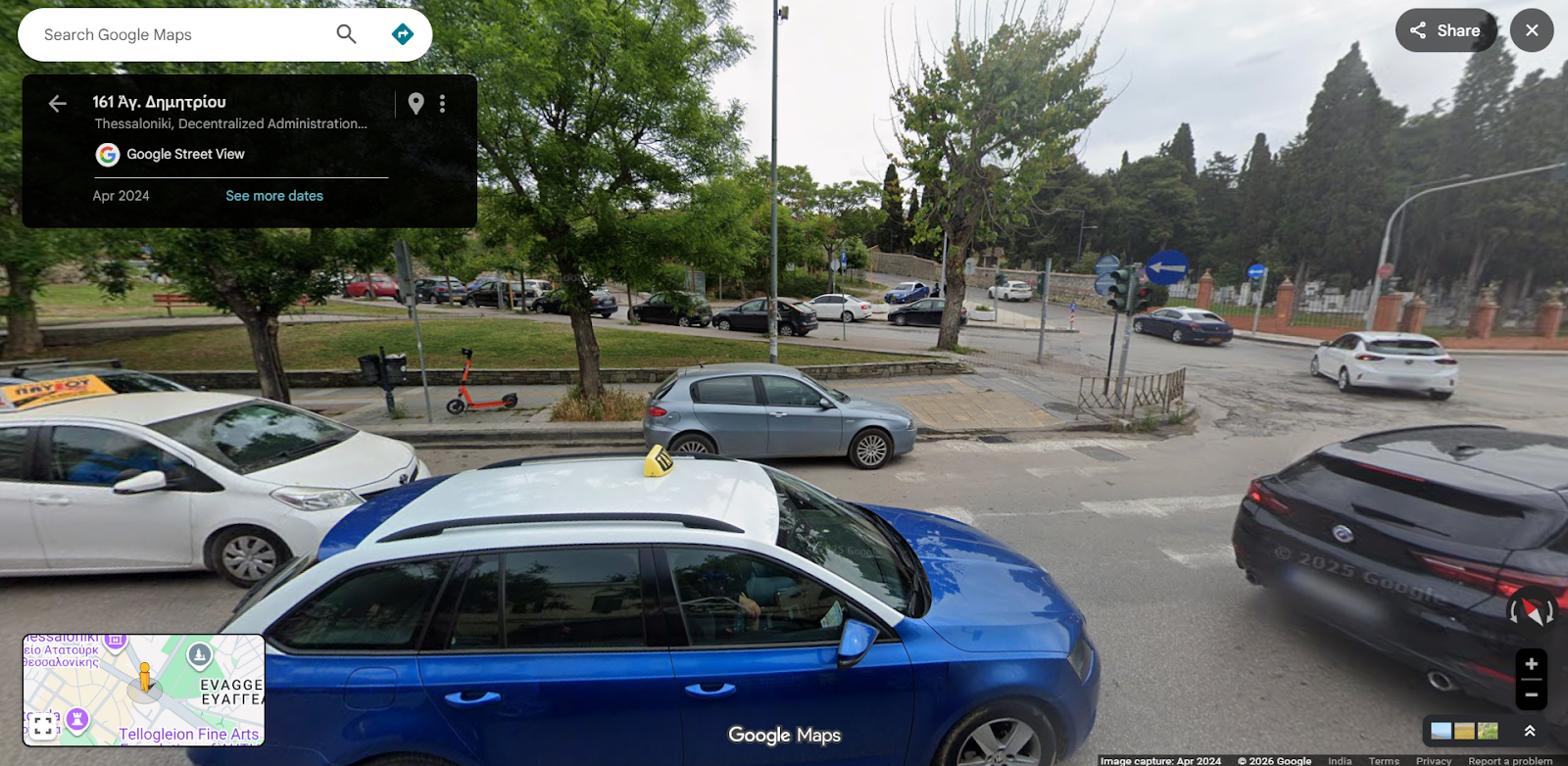
To strengthen our findings, we conducted a geolocation analysis of the video. By comparing road layouts, surrounding buildings, light poles, and other visual markers with online maps and images, we confirmed that the location shown in the video matches Agios Dimitriou Street in Thessaloniki, Greece.
(Location link)
Our research clearly establishes that the viral video being shared as footage of recent protests in Iran is misleading. The video actually shows violent demonstrations near the Turkish Consulate in Thessaloniki, Greece, on November 1, 2025, and has no connection to the current situation in Iran.
Related Blogs

Introduction
In real-time warfare scenarios of this modern age, where actions occur without delay, the relevance of edge computing emerges as paramount. By processing data close to the source in the battlefield with the help of a drone or through video imaging from any military vehicle or aircraft, the concept of edge computing allows the military to point targets faster and strike with accuracy. It also enables local processing to relay central data, helping ground troops get intelligence inputs to act rapidly in critical mission scenarios.
As the global security landscape experiences a significant transformation in different corners of the world, it presents unprecedented challenges in the present scenario. In this article, we will try to understand how countries can maintain their military capabilities with the help of advanced technologies like edge computing.
Edge Computing in Modern Warfare
Edge computing involves the processing and storage of data at the point of collection on the battlefield, for example, through vehicles and drones, instead of relying on centralized data centers. This enables faster decision-making in real-time. This approach creates a resilient and secure network by reducing reliance on potentially compromised external connections, supporting autonomous systems, precision-based targeting, and data sharing among military personnel, drones, and command centers amidst a challenging environment.
A report released by the US Department of Defence in March 2025 found a crucial reality surrounding the operation of hardware relying on outdated industrial-age processes in the digital era. In the case of applications with video, edge computing helps to deliver significant advantages to a wide range of crucial military operations, which include:
- Situational awareness with real-time data processing that provides improved battlefield visibility and proper threat detection.
- Autonomous warfare systems such as drones, which use a tactical edge cloud computing to get the capability to navigate faster.
- Developing a strong communication and networking capability to secure low-latency communication for troops to stay connected in challenging environments.
- Ensuring predictive maintenance with the help of effective sensors to carry out edge detection and attrition at an early point, thereby reducing equipment failures.
- Developing effective targeting and weapons systems to ensure faster processing to enable precision-based targeting and response, besides a strong logistics and supply chain that can provide real-time tracking to improve delivery accuracy and resource management.
This report also highlighted that the DoD is rapidly updating its software and investing in AI enablers like data sets or MLOps tools. This also stresses the breaking down of integration barriers by enforcing MOSA (Modular Open Systems Approaches), APIs (Application Programming Interface), and modular interfaces to ensure interoperability across platforms, sensors, and networks to make software-defined warfare an effective strategy.
Developing Edge with Artificial Intelligence for Future Warfare
A significant insight from the work of the US Department of Defense is its emphasis on the importance of edge computing in shaping the future of warfare. In that context, the Annual Threat Assessment Report highlights a key limitation of traditional AI strategies that rely on centralised cloud computing, since these might not be suitable for modern battlefields with congested networks and limited bandwidth. The need for real-time data processing requires a distributed and edge-based AI solution to address contemporary threats. This report also directly supports the deployment of effective edge with AI in a defined, disrupted, intermittent, and limited-bandwidth (DDIL) environment. In that case, when the communication networks fail, the edge servers at the edge of the network offer crucial advantages that cloud-dependent systems cannot. This ability to analyse data and make decisions without consistent connectivity and operate with limited computational resources is a strategic necessity.
The scenario of warfare is a phenomenon that requires maintaining a strong strategic and tactical approach, which, in the present times, is being examined through the domain of digital platforms. Modern warfare patterns demand faster decision-making and edge computing deliveries by shifting the power of distant servers to the frontlines. The US military is already moving in the direction of deploying edge-enabled systems to prove the nature of sensors and networks to compute at the tactical edge to transform warfighting.
However, it can be understood with the help of an example, as creating fusion in the skies with F-35s. As they have showcased the capability of edge computing by fusing sensor data with MADL (Multi-Functional Advanced Data Link) to create a unified picture, making the squadrons a force multiplier. An example of this was visible when an F-35 relayed real-time tracking data, enabling a navy ship to neutralise a missile beyond its range.
Conclusion: The Way Ahead
As the changing nature of warfare moves towards adopting software-defined systems, where edge computing thrives as a futuristic military technology, it calls for the need for integration across all domains of warfighting. But at the same time, several imperatives do emerge, such as:
- Developing an open architecture that enables both flexibility and innovation.
- Ensuring an effective connectivity that actually combines a confluence of legacy systems.
- Developing interoperability among the systems that can function in synergy with all platforms and can function across all domains.
- Prioritising edge-native AI development systems, where it is also necessary to ensure the shift to adopting cloud-based AI models to create solutions optimised from the ground up for edge deployment.
- Investing in edge infrastructure to establish a robust edge computing infrastructure that enables rapid deployment by testing and updating AI capabilities across diverse hardware platforms. Like the way the military training academies in India are developing training infrastructures for training officer cadets or personnel to handle drones and all forms of advanced warfare tactics emerging in this age.
- Fostering talent and expertise by embracing commercial solutions where software talent could be enabled across the enterprises with expertise in edge computing capabilities and AI. In this case, the role of the commercial sector can help to drive innovations in edge AI, and the only way to move in this direction is by leveraging these advances through partnerships and collaborative efforts.
Taking the example of the ARPANET, which once seeded the modern internet, edge computing can also help to create a transformative network effect within the digital battlespace. In conclusion, future conflicts will be defined by the speed and accuracy provided by the edge, as nations integrating AI and robust edge infrastructures can hold a strong advantage in the multi-domain battlefields in the future.
References
- https://www.idsa.in/mpidsanews/rk-narangs-article-what-the-regions-first-drone-warfare-taught-us-published-in-the-new-indian-express
- https://latentai.com/blog/software-defined-warfare-why-edge-ai-is-critical-to-americas-defense-future/
- https://www.boozallen.com/s/insight/blog/how-the-us-military-is-using-edge-computing.html
- https://capsindia.org/wp-content/uploads/2022/08/RK-Narang-3.pdf
- https://www.newindianexpress.com/opinions/2025/May/12/what-the-regions-first-drone-warfare-taught-us
- https://www.maris-tech.com/blog/edge-computing-in-the-military-challenges-and-solutions/#:~:text=In%20modern%20warfare%2C%20decisions%20need,enables%20precision%20targeting%20and%20response
- https://cassindia.com/digital-soldiers/

Introduction
The term ‘super spreader’ is used to refer to social media and digital platform accounts that are able to quickly transmit information to a significantly large audience base in a short duration. The analogy references the medical term, where a small group of individuals is able to rapidly amplify the spread of an infection across a huge population. The fact that a few handful accounts are able to impact and influence many is attributed to a number of factors like large follower bases, high engagement rates, content attractiveness or virality and perceived credibility.
Super spreader accounts have become a considerable threat on social media because they are responsible for generating a large amount of low-credibility material online. These individuals or groups may create or disseminate low-credibility content for a number of reasons, running from social media fame to garnering political influence, from intentionally spreading propaganda to seeking financial gains. Given the exponential reach of these accounts, identifying, tracing and categorising such accounts as the sources of misinformation can be tricky. It can be equally difficult to actually recognise the content they spread for the misinformation that it actually is.
How Do A Few Accounts Spark Widespread Misinformation?
Recent research suggests that misinformation superspreaders, who consistently distribute low-credibility content, may be the primary cause of the issue of widespread misinformation about different topics. A study[1] by a team of social media analysts at Indiana University has found that a significant portion of tweets spreading misinformation are sent by a small percentage of a given user base. The researchers conducted a review of 2,397,388 tweets posted on Twitter (now X) that were flagged as having low credibility and details on who was sending them. The study found that it does not take a lot of influencers to sway the beliefs and opinions of large numbers. This is attributed to the impact of what they describe as superspreaders. The researchers collected 10 months of data, which added up to 2,397,388 tweets sent by 448,103 users, and then reviewed it, looking for tweets that were flagged as containing low-credibility information. They found that approximately a third of the low-credibility tweets had been posted by people using just 10 accounts, and that just 1,000 accounts were responsible for posting approximately 70% of such tweets.[2]
Case Study
- How Misinformation ‘Superspreaders’ Seed False Election Theories
During the 2020 U.S. presidential election, a small group of "repeat spreaders" aggressively pushed false election claims across various social media platforms for political gain, and this even led to rallies and radicalisation in the U.S.[3] Superspreaders accounts were responsible for disseminating a disproportionately large amount of misinformation related to the election, influencing public opinion and potentially undermining the electoral process.
In the domestic context, India was ranked highest for the risk of misinformation and disinformation according to experts surveyed for the World Economic Forum’s 2024 Global Risk Report. In today's digital age, misinformation, deep fakes, and AI-generated fakes pose a significant threat to the integrity of elections and democratic processes worldwide. With 64 countries conducting elections in 2024, the dissemination of false information carries grave implications that could influence outcomes and shape long-term socio-political landscapes. During the 2024 Indian elections, we witnessed a notable surge in deepfake videos of political personalities, raising concerns about the influence of misinformation on election outcomes.
- Role of Superspreaders During Covid-19
Clarity in public health communication is important when any grey areas or gaps in information can be manipulated so quickly. During the COVID-19 pandemic, misinformation related to the virus, vaccines, and public health measures spread rapidly on social media platforms, including Twitter (Now X). Some prominent accounts or popular pages on platforms like Facebook and Twitter(now X) were identified as superspreaders of COVID-19 misinformation, contributing to public confusion and potentially hindering efforts to combat the pandemic.
As per the Center for Countering Digital Hate Inc (US), The "disinformation dozen," a group of 12 prominent anti-vaccine accounts[4], were found to be responsible for a large amount of anti-vaccine content circulating on social media platforms, highlighting the significant role of superspreaders in influencing public perceptions and behaviours during a health crisis.
There are also incidents where users are unknowingly engaged in spreading misinformation by forwarding information or content which are not always shared by the original source but often just propagated by amplifiers, using other sources, websites, or YouTube videos that help in dissemination. The intermediary sharers amplify these messages on their pages, which is where it takes off. Hence such users do not always have to be the ones creating or deliberately popularising the misinformation, but they are the ones who expose more people to it because of their broad reach. This was observed during the pandemic when a handful of people were able to create a heavy digital impact sharing vaccine/virus-related misinformation.
- Role of Superspreaders in Influencing Investments and Finance
Misinformation and rumours in finance may have a considerable influence on stock markets, investor behaviour, and national financial stability. Individuals or accounts with huge followings or influence in the financial niche can operate as superspreaders of erroneous information, potentially leading to market manipulation, panic selling, or incorrect impressions about individual firms or investments.
Superspreaders in the finance domain can cause volatility in markets, affect investor confidence, and even trigger regulatory responses to address the spread of false information that may harm market integrity. In fact, there has been a rise in deepfake videos, and fake endorsements, with multiple social media profiles providing unsanctioned investing advice and directing followers to particular channels. This leads investors into dangerous financial decisions. The issue intensifies when scammers employ deepfake videos of notable personalities to boost their reputation and can actually shape people’s financial decisions.
Bots and Misinformation Spread on Social Media
Bots are automated accounts that are designed to execute certain activities, such as liking, sharing, or retweeting material, and they can broaden the reach of misinformation by swiftly spreading false narratives and adding to the virality of a certain piece of content. They can also artificially boost the popularity of disinformation by posting phony likes, shares, and comments, making it look more genuine and trustworthy to unsuspecting users. Bots can exploit social network algorithms by establishing false identities that interact with one another and with real users, increasing the spread of disinformation and pushing it to the top of users' feeds and search results.
Bots can use current topics or hashtags to introduce misinformation into popular conversations, allowing misleading information to acquire traction and reach a broader audience. They can lead to the construction of echo chambers, in which users are exposed to a narrow variety of perspectives and information, exacerbating the spread of disinformation inside restricted online groups. There are incidents reported where bot's were found as the sharers of content from low-credibility sources.
Bots are frequently employed as part of planned misinformation campaigns designed to propagate false information for political, ideological, or commercial gain. Bots, by automating the distribution of misleading information, can make it impossible to trace the misinformation back to its source. Understanding how bots work and their influence on information ecosystems is critical for combatting disinformation and increasing digital literacy among social media users.
CyberPeace Policy Recommendations
- Recommendations/Advisory for Netizens:
- Educating oneself: Netizens need to stay informed about current events, reliable fact-checking sources, misinformation counter-strategies, and common misinformation tactics, so that they can verify potentially problematic content before sharing.
- Recognising the threats and vulnerabilities: It is important for netizens to understand the consequences of spreading or consuming inaccurate information, fake news, or misinformation. Netizens must be cautious of sensationalised content spreading on social media as it might attempt to provoke strong reactions or to mold public opinions. Netizens must consider questioning the credibility of information, verifying its sources, and developing cognitive skills to identify low-credibility content and counter misinformation.
- Practice caution and skepticism: Netizens are advised to develop a healthy skepticism towards online information, and critically analyse the veracity of all information sources. Before spreading any strong opinions or claims, one must seek supporting evidence, factual data, and expert opinions, and verify and validate claims with reliable sources or fact-checking entities.
- Good netiquette on the Internet, thinking before forwarding any information: It is important for netizens to practice good netiquette in the online information landscape. One must exercise caution while sharing any information, especially if the information seems incorrect, unverified or controversial. It's important to critically examine facts and recognise and understand the implications of sharing false, manipulative, misleading or fake information/content. Netizens must also promote critical thinking and encourage their loved ones to think critically, verify information, seek reliable sources and counter misinformation.
- Adopting and promoting Prebunking and Debunking strategies: Prebunking and debunking are two effective strategies to counter misinformation. Netizens are advised to engage in sharing only accurate information and do fact-checking to debunk any misinformation. They can rely on reputable fact-checking experts/entities who are regularly engaged in producing prebunking and debunking reports and material. Netizens are further advised to familiarise themselves with fact-checking websites, and resources and verify the information.
- Recommendations for tech/social media platforms
- Detect, report and block malicious accounts: Tech/social media platforms must implement strict user authentication mechanisms to verify account holders' identities to minimise the formation of fraudulent or malicious accounts. This is imperative to weed out suspicious social media accounts, misinformation superspreader accounts and bots accounts. Platforms must be capable of analysing public content, especially viral or suspicious content to ascertain whether it is misleading, AI-generated, fake or deliberately misleading. Upon detection, platform operators must block malicious/ superspreader accounts. The same approach must apply to other community guidelines’ violations as well.
- Algorithm Improvements: Tech/social media platform operators must develop and deploy advanced algorithm mechanisms to detect suspicious accounts and recognise repetitive posting of misinformation. They can utilise advanced algorithms to identify such patterns and flag any misleading, inaccurate, or fake information.
- Dedicated Reporting Tools: It is important for the tech/social media platforms to adopt robust policies to take action against social media accounts engaged in malicious activities such as spreading misinformation, disinformation, and propaganda. They must empower users on the platforms to flag/report suspicious accounts, and misleading content or misinformation through user-friendly reporting tools.
- Holistic Approach: The battle against online mis/disinformation necessitates a thorough examination of the processes through which it spreads. This involves investing in information literacy education, modifying algorithms to provide exposure to varied viewpoints, and working on detecting malevolent bots that spread misleading information. Social media sites can employ similar algorithms internally to eliminate accounts that appear to be bots. All stakeholders must encourage digital literacy efforts that enable consumers to critically analyse information, verify sources, and report suspect content. Implementing prebunking and debunking strategies. These efforts can be further supported by collaboration with relevant entities such as cybersecurity experts, fact-checking entities, researchers, policy analysts and the government to combat the misinformation warfare on the Internet.
References:
- https://journals.plos.org/plosone/article?id=10.1371/journal.pone.0302201 {1}
- https://phys.org/news/2024-05-superspreaders-responsible-large-portion-misinformation.html#google_vignette {2}
- https://phys.org/news/2024-05-superspreaders-responsible-large-portion-misinformation.html#google_vignette {3}
- https://counterhate.com/research/the-disinformation-dozen/ {4}
- https://phys.org/news/2024-05-superspreaders-responsible-large-portion-misinformation.html#google_vignette
- https://journals.plos.org/plosone/article?id=10.1371/journal.pone.0302201
- https://www.nytimes.com/2020/11/23/technology/election-misinformation-facebook-twitter.html
- https://www.wbur.org/onpoint/2021/08/06/vaccine-misinformation-and-a-look-inside-the-disinformation-dozen
- https://healthfeedback.org/misinformation-superspreaders-thriving-on-musk-owned-twitter/
- https://www.ncbi.nlm.nih.gov/pmc/articles/PMC8139392/
- https://www.jmir.org/2021/5/e26933/
- https://www.yahoo.com/news/7-ways-avoid-becoming-misinformation-121939834.html

Introduction
AI has revolutionized the way we look at growing technologies. AI is capable of performing complex tasks in fasten time. However, AI’s potential misuse led to increasing cyber crimes. As there is a rapid expansion of generative AI tools, it has also led to growing cyber scams such as Deepfake, voice cloning, cyberattacks targeting Critical Infrastructure and other organizations, and threats to data protection and privacy. AI is empowered by giving the realistic output of AI-created videos, images, and voices, which cyber attackers misuse to commit cyber crimes.
It is notable that the rapid advancement of technologies such as generative AI(Artificial Intelligence), deepfake, machine learning, etc. Such technologies offer convenience in performing several tasks and are capable of assisting individuals and business entities. On the other hand, since these technologies are easily accessible, cyber-criminals leverage AI tools and technologies for malicious activities or for committing various cyber frauds. By such misuse of advanced technologies such as AI, deepfake, and voice clones. Such new cyber threats have emerged.
What is Deepfake?
Deepfake is an AI-based technology. Deepfake is capable of creating realistic images or videos which in actuality are created by machine algorithms. Deepfake technology, since easily accessible, is misused by fraudsters to commit various cyber crimes or deceive and scam people through fake images or videos that look realistic. By using the Deepfake technology, cybercriminals manipulate audio and video content which looks very realistic but, in actuality, is fake. Voice cloning is also a part of deepfake. To create a voice clone of anyone's, audio can be deepfaked too, which closely resembles a real one but, in actuality, is a fake voice created through deepfake technology.
How Deepfake Can Harm Organizations or Enterprises?
- Reputation: Deepfakes have a negative impact on the reputation of the organization. It’s a reputation which is at stake. Fake representations or interactions between an employee and user, for example, misrepresenting CEO online, could damage an enterprise’s credibility, resulting in user and other financial losses. To be protective against such incidents of deepfake, organisations must thoroughly monitor online mentions and keep tabs on what is being said or posted about the brand. Deepfake-created content can also be misused to Impersonate leaders, financial officers and officials of the organisation.
- Misinformation: Deepfake can be used to spread misrepresentation or misinformation about the organisation by utilising the deepfake technology in the wrong way.
- Deepfake Fraud calls misrepresenting the organisation: There have been incidents where bad actors pretend to be from legitimate organisations and seek personal information. Such as helpline fraudsters, fake representatives from hotel booking departments, fake loan providers, etc., where bad actors use voice clones or deepfake-oriented fake video calls in order to propose themselves as belonging to legitimate organisations and, in actuality, they are deceiving people.
How can organizations combat AI-driven cybercrimes such as deepfake?
- Cybersecurity strategy: Organisations need to keep in place a wide range of cybersecurity strategies or use advanced tools to combat the evolving disinformation and misrepresentation caused by deepfake technology. Cybersecurity tools can be utilised to detect deepfakes.
- Social media monitoring: Social media monitoring can be done to detect any unusual activity. Organisations can select or use relevant tools and implement technologies to detect deepfakes and demonstrate media provenance. Real-time verification capabilities and procedures can be used. Reverse image searches, like TinEye, Google Image Search, and Bing Visual Search, can be extremely useful if the media is a composition of images.
- Employee Training: Employee education on cybersecurity will also play a significant role in strengthening the overall cybersecurity posture of the organisation.
Conclusion
There have been incidents where AI-driven tools or technology have been misused by cybercriminals or bad actors. Synthetic videos developed by AI are used by bad actors. Generative AI has gained significant popularity for many capabilities that produce synthetic media. There are concerns about synthetic media, such as its misuse of disinformation operations designed to influence the public and spread false information. In particular, synthetic media threats that organisations most often face include undermining the brand, financial gain, threat to the security or integrity of the organisation itself and Impersonation of the brand’s leaders for financial gain.
Synthetic media attempts to target organisations intending to defraud the organisation for financial gain. Example includes fake personal profiles on social networking sites and deceptive deepfake calls, etc. The organisation needs to have the proper cyber security strategy in place to combat such evolving threats. Monitoring and detection should be performed by the organisations and employee training on empowering on cyber security will also play a crucial role to effectively deal with evolving threats posed by the misuse of AI-driven technologies.
References:
- https://media.defense.gov/2023/Sep/12/2003298925/-1/-1/0/CSI-DEEPFAKE-THREATS.PDF
- https://www.securitymagazine.com/articles/98419-how-to-mitigate-the-threat-of-deepfakes-to-enterprise-organizations