
#FactCheck: Edited video falsely shows Akshay Kumar commenting on ‘Declassified: Operation Sindoor’ documentary
Executive Summary
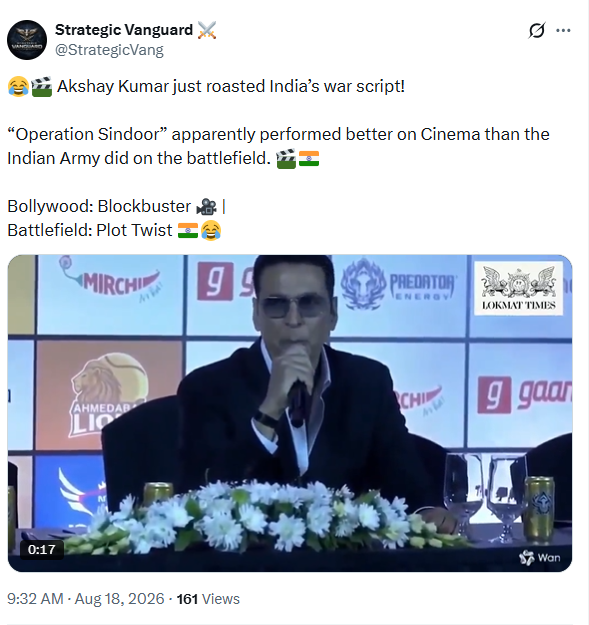
A video of Bollywood actor Akshay Kumar is being widely shared on social media with the claim that he commented on the documentary series “Declassified: Operation Sindoor,” which is based on the military operations carried out by the Indian armed forces against Pakistan following the Pahalgam terror attack in April 2025. In the viral clip, Kumar purportedly says that the documentary is performing very well, while the Indian Army's actual performance during Operation Sindoor was “nothing special.” The Research Wing of CyberPeace found that the viral video has been manipulated. Kumar did not make any such remarks about the documentary or the Indian Army.
Claim
A post on X allegedly shows Akshay Kumar saying that the recently released documentary “Declassified: Operation Sindoor” is doing well, while the Indian Army's actual performance during the operation was “nothing special.”
https://x.com/StrategicVang/status/2089563446597636212?s=20
Fact Check
To verify the claim, we conducted a Google search using keywords such as “Akshay Kumar,” “Operation Sindoor” and “documentary.” The search did not yield any credible media report confirming that Kumar had made the alleged remarks. We also checked Kumar’s official social media accounts but found no post or video in which he commented on “Declassified: Operation Sindoor” or criticised the Indian Army’s battlefield performance.
https://www.facebook.com/akshaykumarofficial/

We then conducted a reverse image search of key frames from the viral video. This led us to an X post by Lokmat Times Nagpur, which carries the same visuals seen in the viral clip. The post was published on December 10, 2025, and its watermark is also visible in the viral footage. This establishes that the original footage was available well before the documentary’s release. In the original video, Kumar can be seen speaking about the Indian Street Premier League, and not the “Declassified: Operation Sindoor” documentary or the Indian Army.
https://x.com/LokmatTimes_ngp/status/1998460903415595252

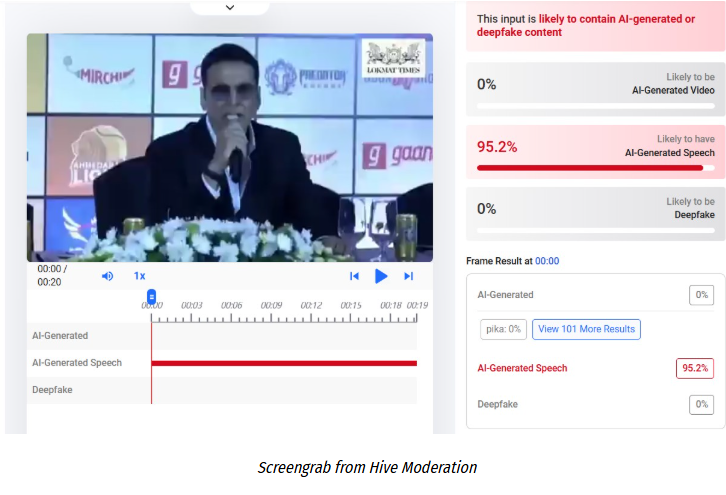
We further analysed the viral video using multiple AI-detection tools. Hive Moderation indicated a high probability of AI-generated/deepfake content
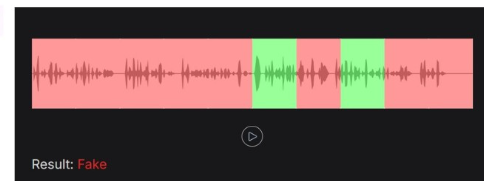
Another detector classified Kumar’s voice as likely deepfake, while Resemble AI also flagged the audio as fake.
Conclusion
The viral video has been digitally manipulated to make it appear as though Akshay Kumar commented on the “Declassified: Operation Sindoor” documentary and criticised the Indian Army’s performance during Operation Sindoor. The original footage predates the documentary and shows Kumar speaking about the Indian Street Premier League. The viral claim is false.

Related Blogs

Executive Summary
As West Bengal heads for vote counting on May 4, 2026, following the second phase of Assembly polling held on April 29, a video is being widely shared on social media. The clip shows security personnel baton-charging civilians, with users claiming it depicts force being used during the West Bengal Assembly Elections 2026. Research by CyberPeace Research Wing found that the viral claim is misleading. The video is actually from Bangladesh and is being falsely linked to the West Bengal elections to spread confusion.
Claim
A Facebook user named “Adv Mohd Salman” shared the clip on April 29, 2026, using Bengal-related hashtags and claiming that voters standing in line were beaten to influence the election outcome. The post alleged that free and fair voting rights were being suppressed.

Fact Check
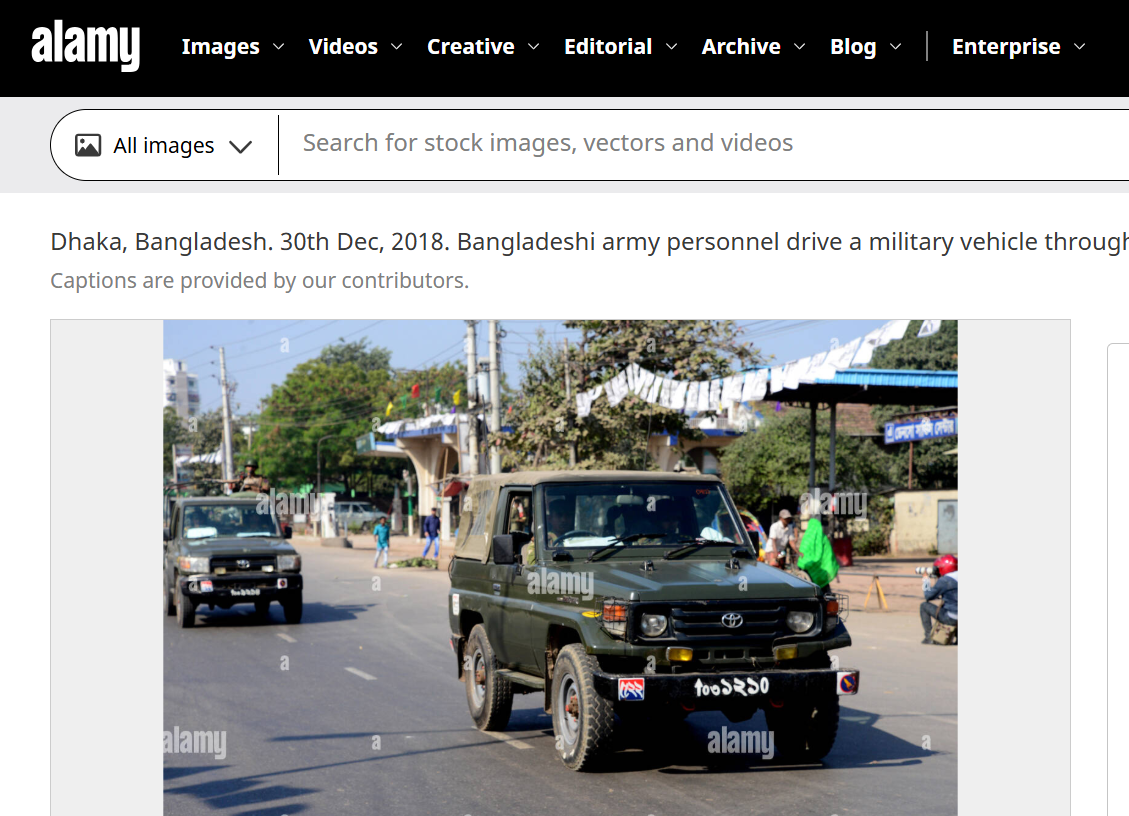
To verify the claim, we closely examined the viral video. A vehicle visible in the footage had a registration number written in a non-Hindi script. Using Google Lens reverse image search, we found a matching image uploaded on Alamy on December 30, 2018. The image showed a military vehicle with the same script and registration style seen in the viral clip.
According to the description on the platform, the image was taken in Dhaka during Bangladesh’s national elections and showed Bangladeshi army personnel moving through a street near a polling station. This confirms that the viral footage is not related to the 2026 West Bengal Assembly elections.
Conclusion
Our research confirms that the video showing security personnel baton-charging civilians is from Bangladesh, not West Bengal. It is being falsely shared as footage from the 2026 West Bengal Assembly elections to mislead users.
Executive Summary:
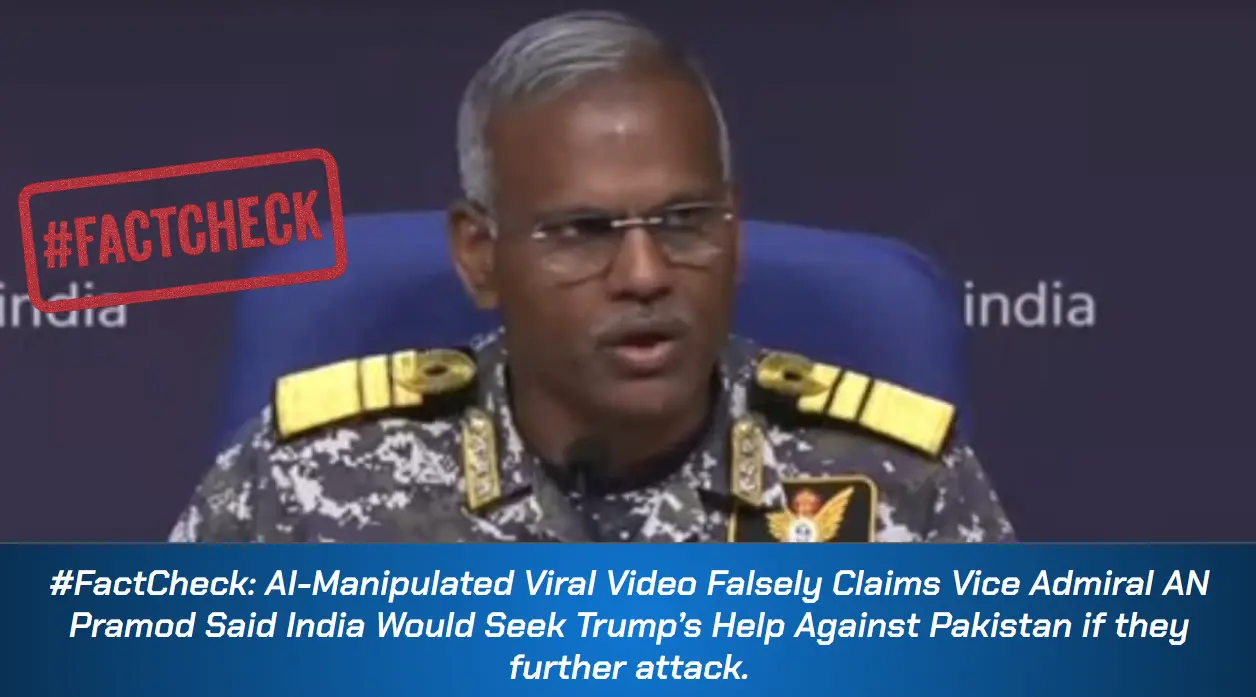
A viral video (archived link) circulating on social media claims that Vice Admiral AN Pramod stated India would seek assistance from the United States and President Trump if Pakistan launched an attack, portraying India as dependent rather than self-reliant. Research traced the extended footage to the Press Information Bureau’s official YouTube channel, published on 11 May 2025. In the authentic video, the Vice Admiral makes no such remark and instead concludes his statement with, “That’s all.” Further analysis using the AI Detection tool confirmed that the viral clip was digitally manipulated with AI-generated audio, misrepresenting his actual words.
Claim:
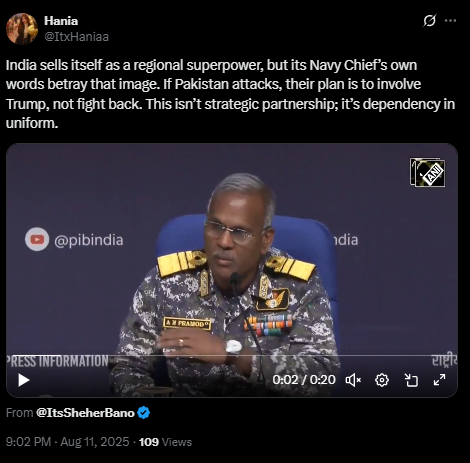
In the viral video an X user posted with the caption
”India sells itself as a regional superpower, but its Navy Chief’s own words betray that image. If Pakistan attacks, their plan is to involve Trump, not fight back. This isn’t strategic partnership; it’s dependency in uniform”.
In the video the Vice Admiral was heard saying
“We have worked out among three services, this time if Pakistan dares take any action, and Pakistan knows it, what we are going to do. We will complain against Pakistan to the United States of America and President Trump, like we did earlier in Operation Sindoor.”
Fact Check:
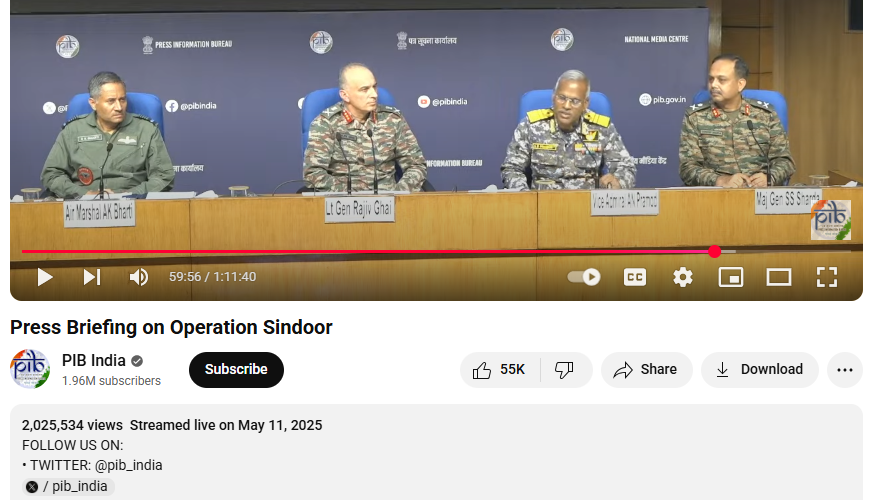
Upon conducting a reverse image search on key frames from the video, we located the full version of the video on the official YouTube channel of the Press Information Bureau (PIB), published on 11 May 2025. In this video, at the 59:57-minute mark, the Vice Admiral can be heard saying:
“This time if Pakistan dares take any action, and Pakistan knows it, what we are going to do. That’s all.”
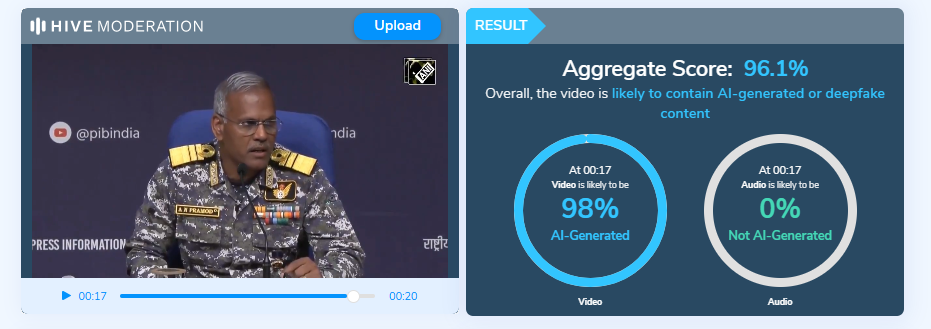
Further analysis was conducted using the Hive Moderation tool to examine the authenticity of the circulating clip. The results indicated that the video had been artificially generated, with clear signs of AI manipulation. This suggests that the content was not genuine but rather created with the intent to mislead viewers and spread misinformation.
Conclusion:
The viral video attributing remarks to Vice Admiral AN Pramod about India seeking U.S. and President Trump’s intervention against Pakistan is misleading. The extended speech, available on the Press Information Bureau’s official YouTube channel, contained no such statement. Instead of the alleged claim, the Vice Admiral concluded his comments by saying, “That’s all.” AI analysis using Hive Moderation further indicated that the viral clip had been artificially manipulated, with fabricated audio inserted to misrepresent his words. These findings confirm that the video is altered and does not reflect the Vice Admiral’s actual remarks.
Claim: Fake Viral Video Claiming Vice Admiral AN Pramod saying that next time if Pakistan Attack we will complain to US and Prez Trump.
Claimed On: Social Media
Fact Check: False and Misleading
.webp)
Introduction
In July 2025, the Digital Defence Report prepared by Microsoft raised an alarm that India is part of the top target countries in AI-powered nation-state cyberattacks with malicious agents automating phishing, creating convincing deepfakes, and influencing opinion with the help of generative AI (Microsoft Digital Defence Report, 2025). Most of the attention in the world has continued to be on the United States and Europe, but Asia-Pacific and especially India have become a major target in terms of AI-based cyber activities. This blog discusses the role of AI in espionage, redefining the threat environment of India, the reaction of the government, and what India can learn by looking at the example of cyber giants worldwide.
Understanding AI-Powered Cyber Espionage
Conventional cyber-espionage intends to hack systems, steal information or bring down networks. With the emergence of generative AI, these strategies have changed completely. It is now possible to automate reconnaissance, create fake voices and videos of authorities and create highly advanced phishing campaigns which can pass off as genuine even to a trained expert. According to the report made by Microsoft, AI is being used by state-sponsored groups to expand their activities and increase accuracy in victims (Microsoft Digital Defence Report, 2025). Based on SQ Magazine, almost 42 percent of state-based cyber campaigns in 2025 had AIs like adaptive malware or intelligent vulnerability scanners (SQ Magazine, 2025).
AI is altering the power dynamic of cyberspace. The tools previously needing significant technical expertise or substantial investments have become ubiquitous, and smaller countries can conduct sophisticated cyber operations as well as non-state actors. The outcome is the speeding up of the arms race with AI serving as the weapon and the armour.
India’s Exposure and Response
The weakness of the threat landscape lies in the growing online infrastructure and geopolitical location. The attack surface has expanded the magnitude of hundreds of millions of citizens with the integration of platforms like DigiLocker and CoWIN. Financial institutions, government portals and defence networks are increasingly becoming targets of cyber attacks that are more sophisticated. Faking videos of prominent figures, phishing letters with the official templates, and manipulation of the social media are currently all being a part of disinformation campaigns (Microsoft Digital Defence Report, 2025).
According to the Data Security Council of India (DSCI), the India Cyber Threat Report 2025 reported that attacks using AI are growing exponentially, particularly in the shape of malicious behaviour and social engineering (DSCI, 2025). The nodal cyber-response agency of India, CERT-In, has made several warnings regarding scams related to AI and AI-generated fake content that is aimed at stealing personal information or deceiving the population. Meanwhile, enforcement and red-teaming actions have been intensified, but the communication between central agencies and state police and the private platforms is not even. There is also an acute shortage of cybersecurity talents in India, as less than 20 percent of cyber defence jobs are occupied by qualified specialists (DSCI, 2025).
Government and Policy Evolution
The government response to AI-enabled threats is taking three forms, namely regulation, institutional enhancing, and capacity building. The Digital Personal Data Protection Act 2023 saw a major move in defining digital responsibility (Government of India, 2023). Nonetheless, threats that involve AI-specific issues like data poisoning, model manipulation, or automated disinformation remain grey areas. The following National Cybersecurity Strategy will attempt to remedy them by establishing AI-government guidelines and responsibility standards to major sectors.
At the institutional level, the efforts of such organisations as the National Critical Information Infrastructure Protection Centre (NCIIPC) and the Defence Cyber Agency are also being incorporated into their processes with the help of AI-based monitoring. There is also an emerging public-private initiative. As an example, the CyberPeace Foundation and national universities have signed a memorandum of understanding that currently facilitates the specialised training in AI-driven threat analysis and digital forensics (Times of India, August 2025). Even after these positive indications, India does not have any cohesive system of reporting cases of AI. The publication on arXiv in September 2025 underlines the importance of the fact that legal approaches to AI-failure reporting need to be developed by countries to approach AI-initiated failures in such fields as national security with accountability (arXiv, 2025).
Global Implications and Lessons for India
Major economies all over the world are increasing rapidly to integrate AI innovation with cybersecurity preparedness. The United States and United Kingdom are spending big on AI-enhanced military systems, performing machine learning in security operations hubs and organising AI-based “red team” exercises (Microsoft Digital Defence Report, 2025). Japan is testing cross-ministry threat-sharing platforms that utilise AI analytics and real-time decision-making (Microsoft Digital Defence Report, 2025).
Four lessons can be distinguished as far as India is concerned.
- To begin with, the cyber defence should shift to proactive intelligence in place of reactive investigation. It is not only possible to detect the adversary behaviour after the attacks, but to simulate them in advance using AI.
- Second, teamwork is essential. The issue of cybersecurity cannot be entrusted to government enforcement. The private sector that maintains the majority of the digital infrastructure in India must be actively involved in providing information and knowledge.
- Third, there is the issue of AI sovereignty. Building or hosting its own defensive AI tools in India will diminish dependence on foreign vendors, and minimise the possible vulnerabilities of the supply-chain.
- Lastly, the initial defence is digital literacy. The citizens should be trained on how to detect deepfakes, phishing, and other manipulated information. The importance of creating human awareness cannot be underestimated as much as technical defences (SQ Magazine, 2025).
Conclusion
AI has altered the reasoning behind cyber warfare. There are quicker attacks, more difficult to trace and scalable as never before. In the case of India, it is no longer about developing better firewalls but rather the ability to develop anticipatory intelligence to counter AI-powered threats. This requires a national policy that incorporates technology, policy and education.
India can transform its vulnerability to strength with the sustained investment, ethical AI governance, and healthy cooperation between the government and the business sector. The following step in cybersecurity does not concern who possesses more firewalls than the other but aims to learn and adjust more quickly and successfully in a world where machines already belong to the battlefield (Microsoft Digital Defence Report, 2025).
References:
- Microsoft Digital Defense Report 2025
- India Cyber Threat Report 2025, DSCI
- Lucknow based organisations to help strengthen cybercrime research training policy ecosystem
- AI Cyber Attacks Statistics 2025: How Attacks, Deepfakes & Ransomware Have Escalated, SQ Magazine
- Incorporating AI Incident Reporting into Telecommunications Law and Policy: Insights from India.
- The Digital Personal Data Protection Act, 2023
