
#FactCheck -AI-Generated Video Falsely Shared as IAF Pilot Complaining After Sukhoi-30 Crash
Executive Summary
A video circulating widely on social media claims to show a pilot of the Indian Air Force (IAF) crying and expressing fear about flying fighter jets, allegedly citing poor maintenance and frequent crashes. The clip is being linked to the crash of an IAF Sukhoi-30 fighter jet in Assam on March 5, in which two pilots lost their lives. In the viral video, a man dressed like a pilot is seen speaking emotionally, saying that flying fighter jets has become frightening due to lack of maintenance and repeated accidents. Several users are sharing the clip claiming that the man in the video is an IAF pilot revealing the reality behind aircraft crashes. However, research by the CyberPeace found the claim to be false. The video does not depict a real pilot or an actual incident. Instead, it appears to be an AI-generated clip created and circulated with the intent to spread misinformation.
Claim:
An Instagram user, ‘samacharsaar0’, shared the viral video on March 10, 2026, with the English caption: “2300 aircraft crashes, 1300 pilots dead: A major challenge before the IAF.”
- Source: :https://www.instagram.com/reel/DVqa4lNiYJQ
- Archived link::https://perma.cc/EUZ8-DHE3

Fact Check:
The claim was also debunked by PIB Fact Check. While verifying the viral video, PIB clarified that the clip is artificially generated and not related to any real IAF personnel.
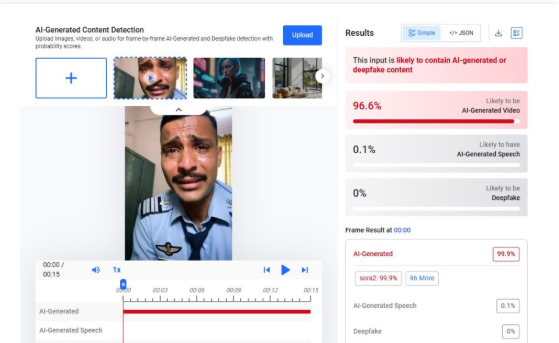
To further verify the authenticity of the video, we analyzed it using AI detection tools. The tool Hive Moderation indicated a 99.9% probability that the video was generated using artificial intelligence.
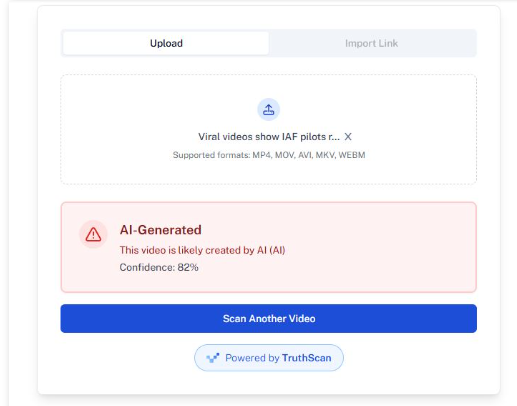
We also examined the clip using another AI detection platform, Undetectable. The analysis suggested an 82% likelihood that the video was created with AI tools. The tool also indicated the possibility that the footage may have been generated using the Sora AI video generation tool.
Conclusion
Our research concludes that the viral video of a crying “pilot” is not authentic. The clip has been created using artificial intelligence and is being misleadingly shared as a real Indian Air Force pilot speaking about aircraft crashes. The government has also denied the claim associated with the video.

Related Blogs

Introduction
As our experiments with Generative Artificial Intelligence (AI) continue, companies and individuals look for new ways to incorporate and capitalise on it. This also includes big tech companies betting on their potential through investments. This process also sheds light on how such innovations are being carried out, used, and affect other stakeholders. Google’s AI overview feature has raised concerns from various website publishers and regulators. Recently, Chegg, a US-based tech education company that provides online resources for high school and college students, has filed a lawsuit against Google alleging abuse of monopoly over the searching mechanism.
Legal Background
Google’s AI Overview/Search Generative Experience (SGE) is a feature that incorporates AI into its standard search tool and helps summarise search results. This is then presented at the top, over the other published websites, when one looks for the search result. Although the sources of the information present are linked, they are half-covered, and it is ambiguous to tell which claims made by the AI come from which link. This creates an additional step for the searcher as, to find out the latter, their user interface requires the searcher to click on a drop-down box. Individual publishers and companies like Chegg have argued that such summaries deter their potential traffic and lead to losses as they continue to bid higher for advertisement services that Google offers, only to have their target audience discouraged from visiting their websites. What is unique about the lawsuit that has been filed by Chegg, is that it is based on anti-trust law rather than copyright law, which it has dealt with previously. In August 2024, a US Federal Judge had ruled that Google had an illegal monopoly over internet search and search text advertising markets, and by November, the US Department of Justice (DOJ) filed its proposed remedy. Some of them were giving advertisers and publishers more control of their data flowing through Google’s products, opening Google’s search index to the rest of the market, and imposing public oversight over Google’s AI investments. Currently, the DOJ has emphasised its stand on dismantling the search monopoly through structural separations, i.e., divesting Google of Chrome. The company is slated to defend itself before the DC District Court Judge Amit Mehta starting April 20, 2025.
CyberPeace Insights
As per a report by Statista (Global market share of leading search engines 2015-2025), Google, as the market leader, held a search traffic share of around 89.62 per cent. It is also stated that its advertising services account for the majority of its revenue, which amounted to a total of 305.63 billion U.S. dollars in 2023. The inclusion of the AI feature is undoubtedly changing how we search for things online. Benefits for users include an immediate, convenient scan of general information pertaining to the looked-up subject, but it may also raise concerns on the part of the website publishers and their loss of ad revenue owing to fewer impressions/clicks. Even though links (sources) are mentioned, they are usually buried. Such a searching mechanism questions the incentive on both ends- the user to explore various viewpoints, as people are now satisfied with the first few results that pop up, and the incentive for a creator/publisher to create new content as well as generate an income out of it. There might be a shift to more passive consumption rather than an active one, where one looks up/or is genuinely searching for information.
Conclusion
AI might make life more convenient, but in this case, it might also take away from small businesses, their finances, and the results of their hard work. It is also necessary for regulators, publishers, and users to continue asking such critical questions to keep the accountability of big tech giants in check, whilst not compromising their creations and publications.
References
- https://www.washingtonpost.com/technology/2024/05/13/google-ai-search-io-sge/
- https://www.theverge.com/news/619051/chegg-google-ai-overviews-monopoly
- https://economictimes.indiatimes.com/tech/technology/google-leans-further-into-ai-generated-overviews-for-its-search-engine/articleshow/118742139.cms?from=mdr
- https://www.nytimes.com/2024/12/03/technology/google-search-antitrust-judge.html
- https://www.odinhalvorson.com/monopoly-and-misuse-googles-strategic-ai-narrative/
- https://cio.economictimes.indiatimes.com/news/artificial-intelligence/google-leans-further-into-ai-generated-overviews-for-its-search-engine/118748621
- https://www.techpolicy.press/the-elephant-in-the-room-in-the-google-search-case-generative-ai/
- https://www.karooya.com/blog/proposed-remedies-break-googles-monopoly-antitrust/
- https://getellipsis.com/blog/googles-monopoly-and-the-hidden-brake-on-ai-innovation/
- https://www.statista.com/statistics/266249/advertising-revenue-of-google/#:~:text=Google:%20annual%20advertising%20revenue%202001,local%20products%20are%20more%20preferred.
- https://www.statista.com/statistics/1381664/worldwide-all-devices-market-share-of-search-engines/
- https://www.techpolicy.press/doj-sets-record-straight-of-whats-needed-to-dismantle-googles-search-monopoly/

Executive Summary
A video featuring popular comedian Rajpal Yadav has recently gone viral on social media, claiming that he is currently lodged in Tihar Jail in connection with a loan default and cheque bounce case. In connection with this, another video showing Bollywood superstar Shah Rukh Khan is being widely shared online. In the viral clip, Khan is purportedly seen saying that he would help Rajpal Yadav get out of jail and also offer him a role in his upcoming film. However, research by the CyberPeace found the viral video to be fake. The clip is a deepfake, in which the audio has been manipulated using artificial intelligence. In the original video, Shah Rukh Khan is speaking about his life and personal experiences. Although several prominent Bollywood personalities have expressed support for Rajpal Yadav, the claims made in the viral video are misleading.
Claim
An Instagram user named “ayubeditz” shared the viral video on February 11, 2026, with the caption: “Rajpal Yadav bhai, stay strong, we are all with you — Shah Rukh Khan.” The link to the post and its archived version are provided below.

Fact Check
To verify the claim, we extracted key frames from the viral video and conducted a Google reverse image search. This led us to the original video uploaded on a YouTube channel titled “Locarno Film Festival” on August 11, 2024. According to the available information, Shah Rukh Khan was sharing insights about his life and career during a conversation with the festival’s Artistic Director, Giona A. Nazzaro. This raised strong suspicion that the viral video had been edited using AI.

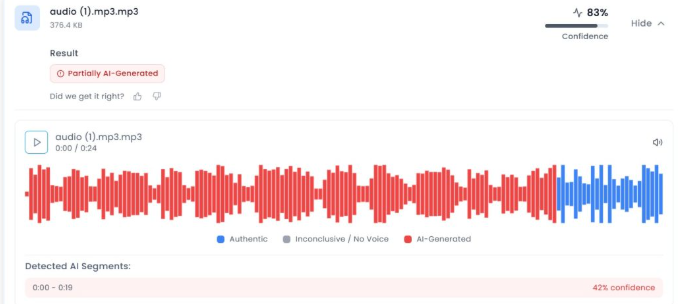
To further examine the authenticity of the audio, we analysed it using AI detection tools. The audio was first checked using Aurigin.ai, which indicated an 83 percent probability that the voice in the viral clip was AI-generated.
Conclusion
The CyberPeace’s research confirmed that the claim associated with Shah Rukh Khan’s viral video is false. The video is a deepfake in which the audio has been altered using artificial intelligence. In the original footage, Khan was discussing his life and experiences, and he did not make any statement about helping Rajpal Yadav.

Introduction
Online Gaming has gained popularity over the past few years, attracting young players worldwide and global concerns. In response to the growing fame of this industry, the Indian government has recently announced introducing a set of regulations to address various concerns and ensure a safer and more regulated online gaming environment. In this blog post, we will explore the critical aspects of these regulations and their impact on the gaming industry.
Why are Regulations needed?
Recently some games faced a ban in India – games that involve betting, games that can be harmful to the user, and games that involve a factor of addiction. Furthermore, with rising popularity, With the exponential rise of online gaming platforms in India, extensive laws to safeguard players and ensure fair gameplay needs to be implemented. Players’ protection is one of the critical factors addressing the issues which involve online addiction, underage involvement, fraud, and data privacy has become critical for the well-being of Indian gamers.
Regulatory Ambiguity: The previous legislative structure, such as the outmoded Public Gambling Act of 1867, required an update to fit the digital gambling age fully.
Outline of the New Regulations
Implementing new regulations for online gaming in India represents the government’s commitment to addressing different issues and ensuring a safer and more regulated gaming sector. Let’s have a look at these rules in detail:
National-Level Standards: The Indian government is currently working on creating national-level standards to standardise online gaming practices across all states. These rules attempt to create a uniform platform for both operators and participants. The government has also made an announcement to set SRO within 90 days to regulate online gaming.
Licencing and Compliance: To legally operate in the Indian market, online gaming firms must secure licences. The operator’s financial soundness, security measures, and adherence to responsible gaming practices will be scrutinised throughout the licencing process. Operators will need to comply with the regulations in order to maintain operations.
Measures to Promote Ethical Gaming: The new regulations emphasise player protection and ethical gaming practices. This includes steps like age verification to prevent underage involvement, self-exclusion choices for gamers who want to limit their gaming activities, and adopting tools like session limits and reality checks to promote responsible gaming.
Data Privacy: Recognising the importance of data privacy, the laws are intended to contain protections for protecting user data. To safeguard sensitive player information from unauthorised access or exploitation, online gambling operators must comply with data protection regulations and deploy strong security measures.
Restrictions on Advertising and Marketing: The legislation may limit the advertising and marketing of online gaming platforms. The emphasis will be on eliminating aggressive marketing tactics that target vulnerable people, such as kids. Stricter standards for ad content and placement may be implemented.
Anti-Fraud and Anti-Money Laundering Measures: To combat criminal activity within the gaming ecosystem, the new legislation will almost certainly force online gambling companies to employ anti-fraud and anti-money laundering measures. Operators may need to set up mechanisms to detect fraud, report suspicious activity, and work with law enforcement.
Consumer Grievance Redressal: The legislation may emphasise the construction of efficient channels for resolving consumer complaints. Players should be able to report difficulties, seek resolution, and offer feedback on their play experiences through channels. The objective is to create a transparent and accountable conflict resolution mechanism.

Impact on Online Gaming Ecosystem
Adopting new laws for online gambling in India will likely have several consequences for the gaming industry. Let us look at some of these consequences:
Increased Player Trust: Implementing restrictions will increase player confidence in online gaming platforms. Establishing clear rules and procedures and steps to safeguard participants’ interests will develop a sense of trust and transparency. This can lead to increased participation and engagement in the gaming community.
Industry Consolidation: Stricter restrictions may result in industry consolidation. Compliance with the new legislation would need resources and investments, which might favour more prominent and more established gambling firms. Smaller and more non-compliant operators may find it challenging to fulfil regulatory standards, resulting in a more consolidated gaming sector.
Technological Progress: The requirement to comply with rules could lead to technological advancements in the online gambling sector. Operators may invest in modern identity verification systems, fraud detection methods, and responsible gaming solutions to satisfy their regulatory requirements. This can result in technological breakthroughs that improve gamers’ overall gaming experience.
Foreign Investment and Collaboration: Clear laws might entice overseas investors to enter the Indian gaming business. The regulated environment may appeal to international gambling enterprises looking to enter or extend their presence in India. Collaborations between Indian and foreign gaming firms may also expand, resulting in the sharing of experience, resources, and the production of high-quality gaming products.
Legal Clarity: Implementing particular laws would give online gambling operators and users clearer legal standards. This transparency can eliminate ambiguity and possible legal issues, allowing stakeholders to navigate the gaming ecosystem with better confidence and knowledge.
Contribution to the Indian Economy: A well-regulated online gaming business has the potential to contribute to the Indian economy. It has the potential to create jobs, attract investment, and produce tax money for the government. The economic effect of the gaming ecosystem is expected to increase as it grows under the new restrictions.
Challenges and Future Approach
One of the toughest challenges will be the efficient implementation and enforcement of the new regulations. Consistency in applying the legislation across multiple jurisdictions and guaranteeing compliance by all operators would necessitate comprehensive monitoring and regulatory measures. Developing suitable enforcement organisations and transparent standards for reporting and dealing with noncompliance will be critical. Besides this, online gaming is open to more than area-specific and many gaming platforms and operates internationally. Ensuring cross-border operations is a big challenge in addressing jurisdictional challenges will be complex. Collaborative efforts between nations can regulate cross-border online gaming. There may be increased collaboration between Indian and foreign gaming firms, resulting in the exchange of information, skills, and resources. This partnership can help the Indian gaming sector flourish while attracting foreign players and investments.
Esports Development: Esports have grown in popularity worldwide, and India is no exception. The Indian esports business has the potential to thrive with proper regulation and support, drawing both players and viewers. Esports-specific factors like player contracts, tournament integrity, and licencing requirements may be addressed in the regulations.

Conclusion
Despite obstacles, India’s new online gambling legislation can potentially establish a safer and more regulated gaming sector. the future depends on successful implementation, adjusting to a shifting landscape, finding the correct balance between regulation and innovation, and promoting ethical gaming practices. The Indian online gaming business can develop sustainably with the appropriate strategy, benefiting gamers and the broader economy.
