
#FactCheck-AI-Altered Video Falsely Claims Indian Army Air Defence Officer Resigned Over ‘Operation Sindoor’
Executive Summary
A video of a soldier is being widely circulated on social media with the claim that an Indian Army Air Defence officer named Anurag Thakur resigned, alleging that soldiers martyred during “Operation Sindoor” were ignored by the government. However, research by the CyberPeace Research Wing found the claim to be false. The viral video has been manipulated with AI-generated audio and is being shared with a misleading narrative.
Claim:
Instagram users shared the clip claiming: “Indian Army Air Defence officer Anurag Thakur has resigned. He said the Government of India did not even acknowledge the deaths of soldiers.”

Fact Check:
The research began with keyword searches related to the alleged resignation of an “Indian Army Air Defence JCO Anurag Thakur.” No credible or reputed media report was found supporting such a claim. A reverse image search of a frame from the viral video led to the original footage posted by news agency ANI on its official X account on March 22, 2026. The original video runs for 1 minute and 42 seconds A comparison of both videos showed that in the viral clip, the soldier appears to be speaking in English, whereas in ANI’s authentic video, the same soldier is speaking in Hindi while addressing the media.
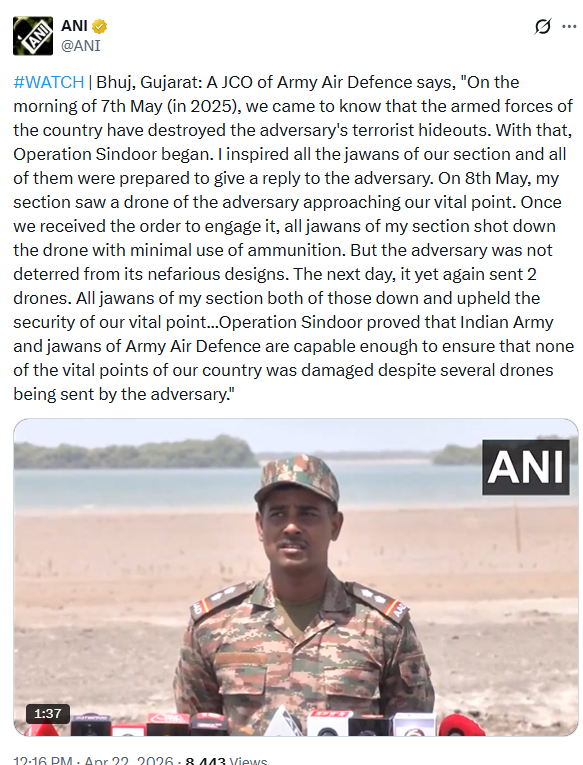
In the original video, shared by ANI from Bhuj, Gujarat, the JCO explained that on the morning of May 7, 2025, they learned that Indian armed forces had destroyed enemy terror launch pads, marking the beginning of “Operation Sindoor.” He said he motivated his unit and they were prepared to respond. He further stated that on May 8, an enemy drone heading toward a vital location was detected and shot down using minimal ammunition. Two more drones were sent the following day and were also neutralised. He added that “Operation Sindoor” demonstrated the capability of the Indian Army and Air Defence units.
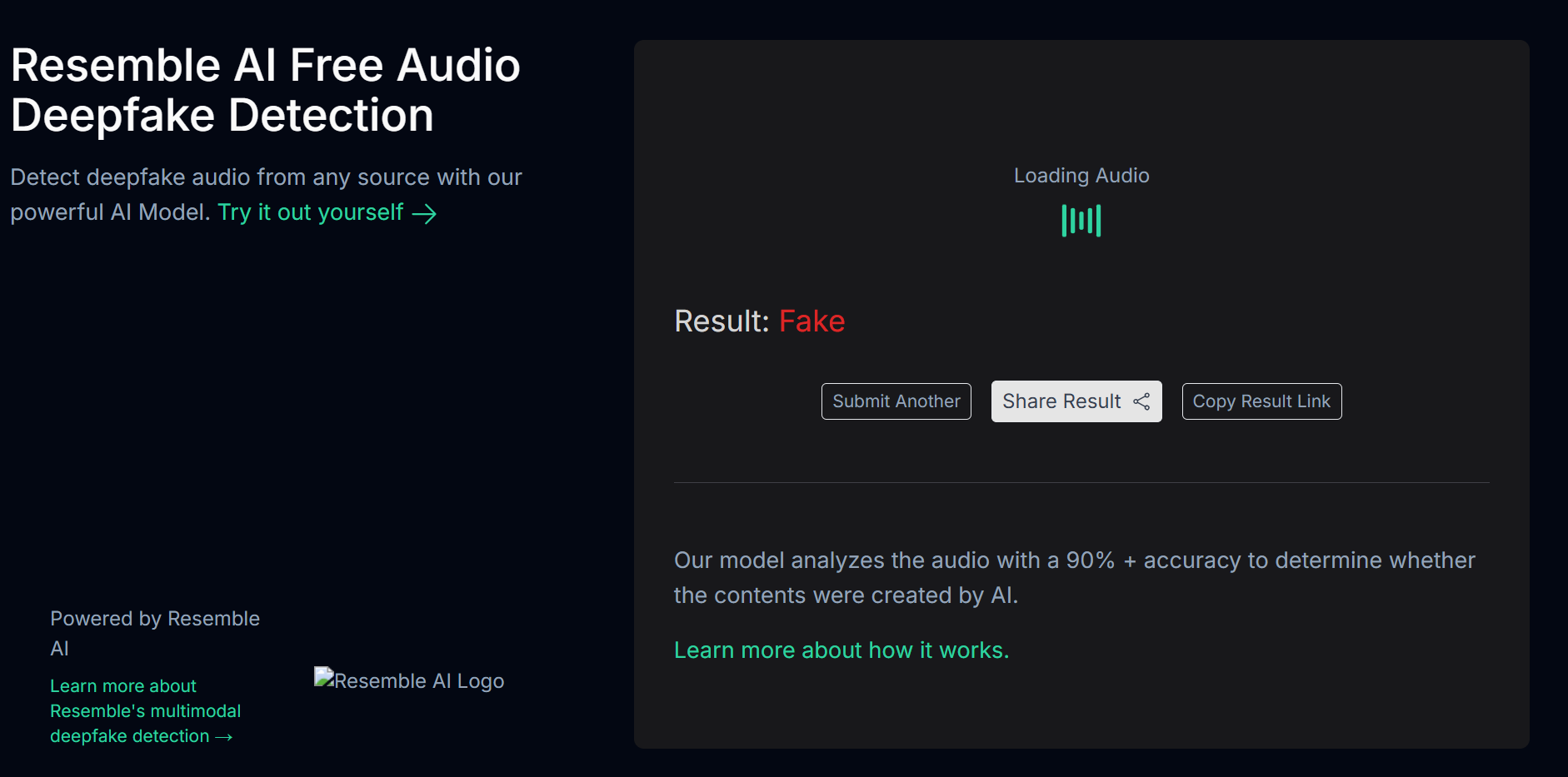
ANI had also summarised the same remarks in English in its post, which further confirmed that the viral version had been tampered with. For additional verification, the audio from the viral clip was examined using AI-based detection tools. Hiya Deepfake Voice Detector flagged it as likely fake, while Resemble AI also identified the audio as manipulated.
Conclusion:
The viral video claiming that an Indian Army Air Defence JCO resigned over ignored martyrs of “Operation Sindoor” is false. The original footage has been altered and artificial AI-generated audio was added to create a misleading narrative.

Related Blogs

Introduction
The advent of AI-driven deepfake technology has facilitated the creation of explicit counterfeit videos for sextortion purposes. There has been an alarming increase in the use of Artificial Intelligence to create fake explicit images or videos for sextortion.
What is AI Sextortion and Deepfake Technology
AI sextortion refers to the use of artificial intelligence (AI) technology, particularly deepfake algorithms, to create counterfeit explicit videos or images for the purpose of harassing, extorting, or blackmailing individuals. Deepfake technology utilises AI algorithms to manipulate or replace faces and bodies in videos, making them appear realistic and often indistinguishable from genuine footage. This enables malicious actors to create explicit content that falsely portrays individuals engaging in sexual activities, even if they never participated in such actions.
Background on the Alarming Increase in AI Sextortion Cases
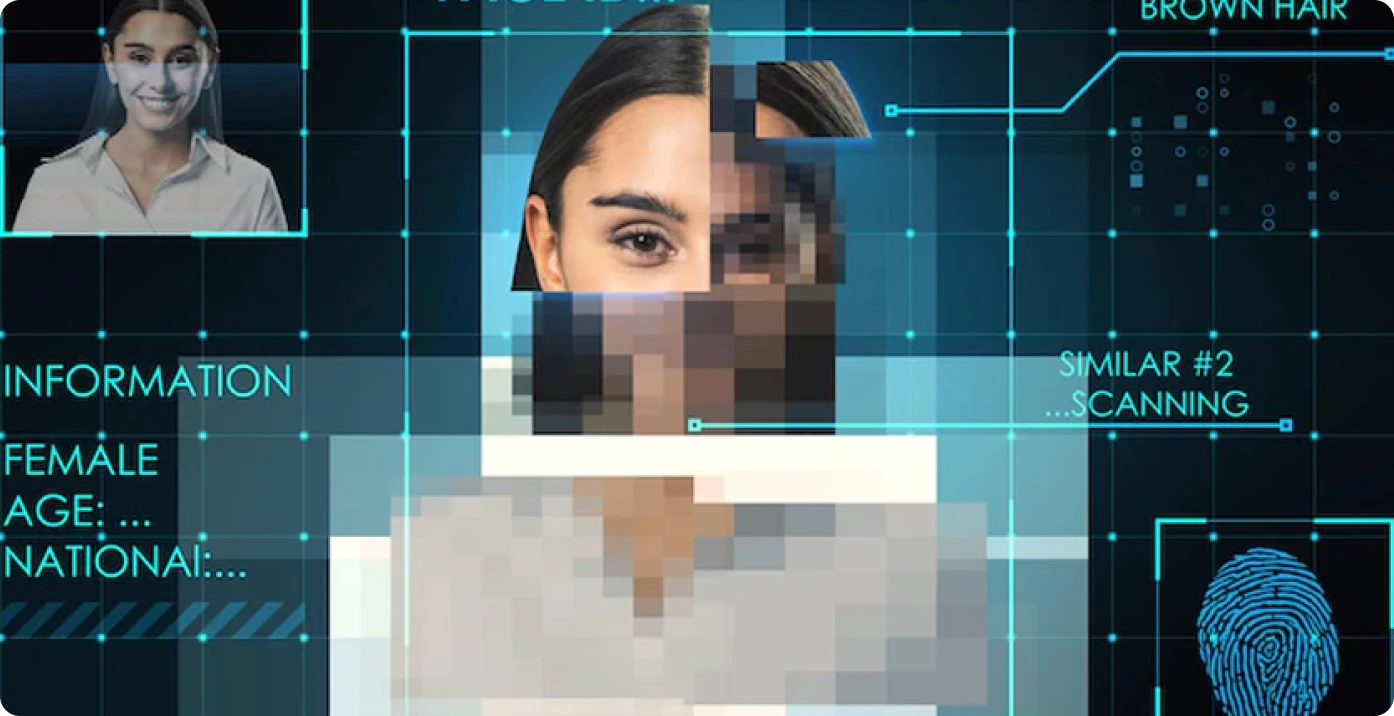
Recently there has been a significant increase in AI sextortion cases. Advancements in AI and deepfake technology have made it easier for perpetrators to create highly convincing fake explicit videos or images. The algorithms behind these technologies have become more sophisticated, allowing for more seamless and realistic manipulations. And the accessibility of AI tools and resources has increased, with open-source software and cloud-based services readily available to anyone. This accessibility has lowered the barrier to entry, enabling individuals with malicious intent to exploit these technologies for sextortion purposes.
The proliferation of sharing content on social media
The proliferation of social media platforms and the widespread sharing of personal content online have provided perpetrators with a vast pool of potential victims’ images and videos. By utilising these readily available resources, perpetrators can create deepfake explicit content that closely resembles the victims, increasing the likelihood of success in their extortion schemes.
Furthermore, the anonymity and wide reach of the internet and social media platforms allow perpetrators to distribute manipulated content quickly and easily. They can target individuals specifically or upload the content to public forums and pornographic websites, amplifying the impact and humiliation experienced by victims.
What are law agencies doing?
The alarming increase in AI sextortion cases has prompted concern among law enforcement agencies, advocacy groups, and technology companies. This is high time to make strong Efforts to raise awareness about the risks of AI sextortion, develop detection and prevention tools, and strengthen legal frameworks to address these emerging threats to individuals’ privacy, safety, and well-being.
There is a need for Technological Solutions, which develops and deploys advanced AI-based detection tools to identify and flag AI-generated deepfake content on platforms and services. And collaboration with technology companies to integrate such solutions.
Collaboration with Social Media Platforms is also needed. Social media platforms and technology companies can reframe and enforce community guidelines and policies against disseminating AI-generated explicit content. And can ensure foster cooperation in developing robust content moderation systems and reporting mechanisms.
There is a need to strengthen the legal frameworks to address AI sextortion, including laws that specifically criminalise the creation, distribution, and possession of AI-generated explicit content. Ensure adequate penalties for offenders and provisions for cross-border cooperation.
Proactive measures to combat AI-driven sextortion
Prevention and Awareness: Proactive measures raise awareness about AI sextortion, helping individuals recognise risks and take precautions.
Early Detection and Reporting: Proactive measures employ advanced detection tools to identify AI-generated deepfake content early, enabling prompt intervention and support for victims.
Legal Frameworks and Regulations: Proactive measures strengthen legal frameworks to criminalise AI sextortion, facilitate cross-border cooperation, and impose offender penalties.
Technological Solutions: Proactive measures focus on developing tools and algorithms to detect and remove AI-generated explicit content, making it harder for perpetrators to carry out their schemes.
International Cooperation: Proactive measures foster collaboration among law enforcement agencies, governments, and technology companies to combat AI sextortion globally.
Support for Victims: Proactive measures provide comprehensive support services, including counselling and legal assistance, to help victims recover from emotional and psychological trauma.
Implementing these proactive measures will help create a safer digital environment for all.

Misuse of Technology
Misusing technology, particularly AI-driven deepfake technology, in the context of sextortion raises serious concerns.
Exploitation of Personal Data: Perpetrators exploit personal data and images available online, such as social media posts or captured video chats, to create AI- manipulation violates privacy rights and exploits the vulnerability of individuals who trust that their personal information will be used responsibly.
Facilitation of Extortion: AI sextortion often involves perpetrators demanding monetary payments, sexually themed images or videos, or other favours under the threat of releasing manipulated content to the public or to the victims’ friends and family. The realistic nature of deepfake technology increases the effectiveness of these extortion attempts, placing victims under significant emotional and financial pressure.
Amplification of Harm: Perpetrators use deepfake technology to create explicit videos or images that appear realistic, thereby increasing the potential for humiliation, harassment, and psychological trauma suffered by victims. The wide distribution of such content on social media platforms and pornographic websites can perpetuate victimisation and cause lasting damage to their reputation and well-being.
Targeting teenagers– Targeting teenagers and extortion demands in AI sextortion cases is a particularly alarming aspect of this issue. Teenagers are particularly vulnerable to AI sextortion due to their increased use of social media platforms for sharing personal information and images. Perpetrators exploit to manipulate and coerce them.
Erosion of Trust: Misusing AI-driven deepfake technology erodes trust in digital media and online interactions. As deepfake content becomes more convincing, it becomes increasingly challenging to distinguish between real and manipulated videos or images.
Proliferation of Pornographic Content: The misuse of AI technology in sextortion contributes to the proliferation of non-consensual pornography (also known as “revenge porn”) and the availability of explicit content featuring unsuspecting individuals. This perpetuates a culture of objectification, exploitation, and non-consensual sharing of intimate material.
Conclusion
Addressing the concern of AI sextortion requires a multi-faceted approach, including technological advancements in detection and prevention, legal frameworks to hold offenders accountable, awareness about the risks, and collaboration between technology companies, law enforcement agencies, and advocacy groups to combat this emerging threat and protect the well-being of individuals online.

Forensic Reality Check
A screenshot shows what appeared on a screen. It does not automatically prove who created the content, whether it was altered, or what happened outside the frame.
Introduction
In today's period of time ,we observe that a screenshot seems like evidence. A screenshot can feel like proof. The screenshot comes with a name, a timestamp, a profile picture and a message all neatly placed inside an app we know well. In cases involving fraud, harassment, workplace conflicts or cybercrime individuals often send a screenshot first to the police, a company or a lawyer. This makes sense. When something troubling shows up on a phone or computer taking a screenshot feels like the thing to do. The screenshot captures the moment like a photo.
There is another side to evidence. A screenshot only shows what was on the screen at that moment. The screenshot does not tell us where the content came from. The screenshot does not show who had control of the account. The screenshot does not say if the image was edited. The screenshot does not reveal what happened before or after the screenshot was taken. The Bharatiya Sakshya Adhiniyam 2023 recognizes records. The Bharatiya Sakshya Adhiniyam also sets out rules for proving them. That means the real question is not just "Is this screenshot real?" The bigger question is, "Can we explain and verify the story behind it?”
A screenshot is evidence - but not automatically the whole story
Think of a common situation. A person receives a screenshot of a chat in which someone appears to demand money and threaten to publish private documents. The image looks genuine. Yet an investigator would still ask: Was the message actually sent? From which account or device? Does the date and time match the service records? Is the conversation complete?
Those questions do not make the screenshot useless. They make the investigation stronger.
Digital information can be copied, compressed, cropped, forwarded, or edited with little visible sign. NIST describes digital evidence as information of probative value stored or transmitted in binary form and emphasises preservation because digital files are easy to change. [3][4] The forensic mindset is simple: ask whether an image’s origin, context and integrity can be explained.
What makes a screenshot more reliable?
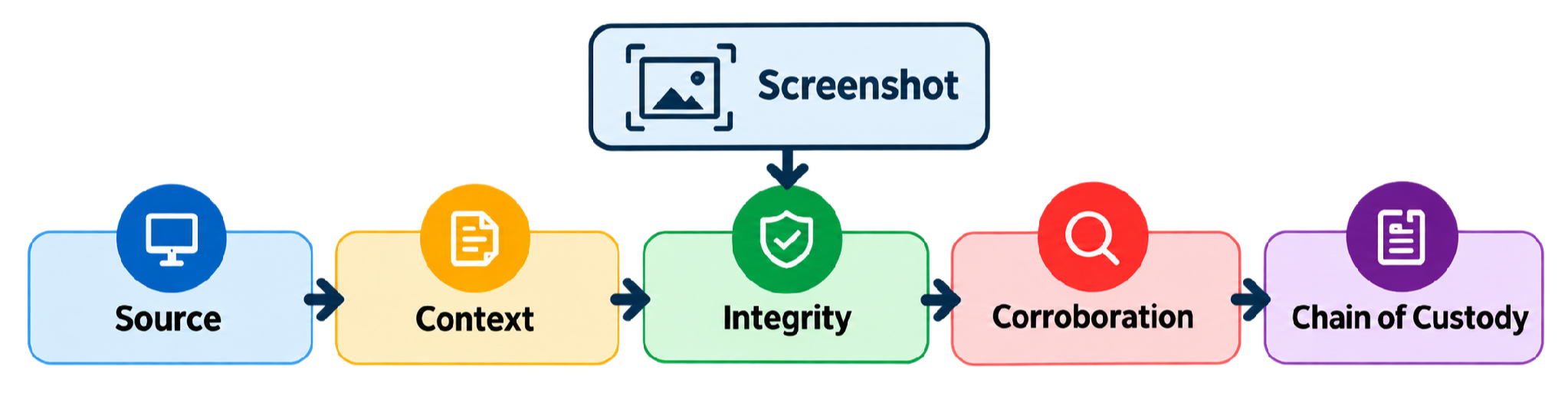
A stronger evidence package normally answers five practical questions:
• Source - Where did the image come from: a phone, laptop, messaging application, email client, cloud account, or another person?
• Context - Does it preserve the relevant username, number, URL, date, time, surrounding messages, and sequence?
• Integrity - Has the original file been retained, and can later changes be detected?
• Corroboration - Do other records support the same event, such as device artifacts, email headers, transaction data, or witness accounts?
• Chain of custody - Who collected it, when, how was it transferred, and where was it stored?
Hashing helps with integrity. A cryptographic hash acts like a digital fingerprint for a file. If the file changes, its hash value changes. NIST recommends hashing digital images and other evidence objects and securely preserving the resulting hash values. [4][5] A hash does not prove the content is truthful; it helps show that the file examined is the file that was preserved.
The Indian legal angle: admissibility is not the same as authenticity
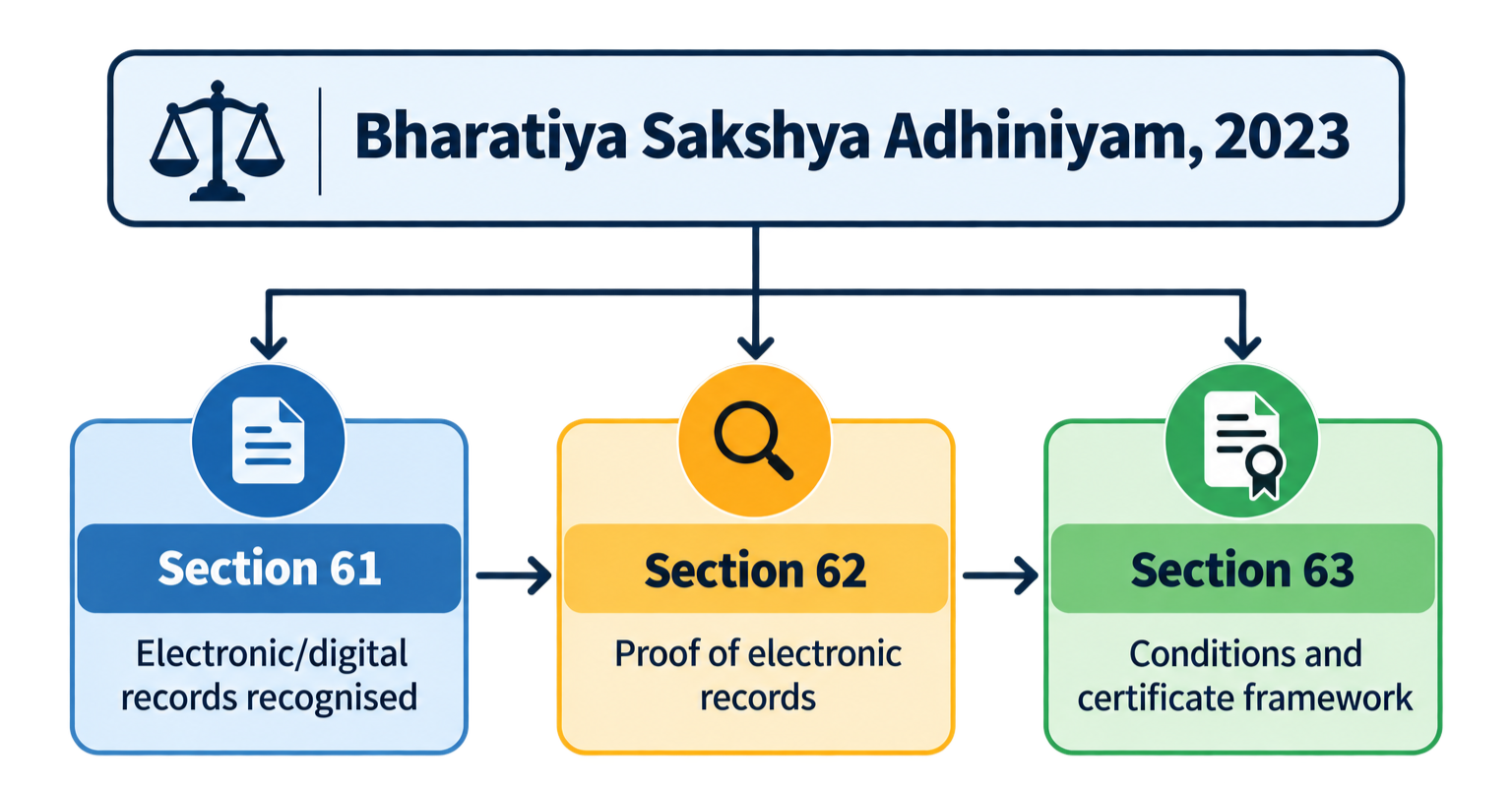
India’s current evidence framework is equally important. The Bharatiya Sakshya Adhiniyam, 2023 came into force on 1 July 2024. Section 61 says an electronic or digital record cannot be denied admissibility merely because it is electronic, subject to the Act. Section 62 directs that electronic records are proved in accordance with Section 63. [1]
Section 63 sets out conditions for admissibility and, where it applies, requires a certificate to accompany the electronic record when submitted for admission. The Schedule includes device details and fields for the relevant hash value and algorithm. [2]
There is an important practical nuance: not every screenshot automatically requires the same proof route. Treatment can depend on what is produced, how it was obtained, and how it is tendered. Investigators should preserve the underlying source wherever lawfully possible rather than treat a screenshot as a self-proving substitute for the original record.
In Pooranmal v. State of Rajasthan, decided on 10 March 2026, the Supreme Court considered call detail records rather than screenshots and held, in that case, that the certificate requirement under Section 63 was mandatory for the electronic record relied upon there. [6] The broader lesson is that digital evidence must be presented through the legal proof framework that applies to it.
REALISTIC EXAMPLE A screenshot arrives. The investigation starts.
Consider a realistic cyber-fraud complaint. A victim receives a screenshot showing what appears to be a message from a senior company executive asking an employee to transfer money urgently. The safest response is not to decide immediately whether it “looks genuine.” The investigator can preserve the original image, record its source, calculate a hash, and look for supporting material: the actual chat or email, device data, account identifiers, timestamps, transaction records, or login history.

Suppose the screenshot says 3:14 p.m., but the underlying account record shows the message was never sent. That contradiction becomes an investigative lead. If the screenshot matches the original device data and independent records, its evidentiary value becomes stronger.
The human side matters too. A victim should not be criticised for taking a screenshot. In many incidents, it is the quickest way to show another person what happened. The forensic response is simply to go one step further: preserve first, verify next, interpret last.
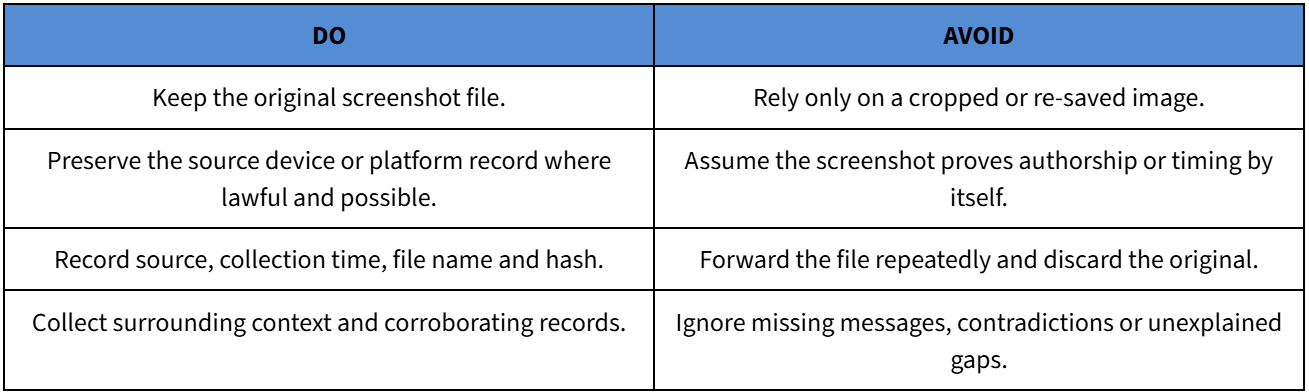
A small checklist can prevent a big evidentiary problem
The bigger lesson
Screenshots are valuable because they can preserve a moment that may later disappear: a threat, a suspicious payment instruction, a spoofed webpage, or a social-media post. But a convincing image is not the same thing as a complete digital record.
Good digital forensics connects the artifact to a source, a timeline, a method of collection, and independent facts. NIST’s work on digital evidence emphasises preservation, controlled handling, and awareness of the limits of forensic conclusions. [3][4] Confidence should follow the evidence, not replace it.
Conclusion
So, can a screenshot be evidence? The important question is whether the screenshot can be verified, put into context and backed up by evidence when the case needs it. For citizens the practical advice is clear: keep the screenshot, do not delete the screenshot, keep the screenshot and do not rely only on a forwarded copy. Preserving the source device or original platform record were lawful and possible.
For investigators and organisations, the standard is higher. Record the source and collection details preserve the screenshot, calculate and document hashes, maintain chain of custody and seek corroboration. A screenshot can open the door to an investigation. Good forensic practice is what helps establish what happened on the side of that door.
References
[1] India Code, The Bharatiya Sakshya Adhiniyam, 2023, Sections 61-62; commencement from 1 July 2024. Source
[2] India Code, The Bharatiya Sakshya Adhiniyam, 2023, Section 63 and Schedule - certificate for electronic records, including device particulars and hash value fields. Source
[3] NIST, Digital Evidence, overview of digital evidence and forensic challenges. Source
[4] NIST, Digital Evidence Preservation: Considerations for Evidence Handlers, NISTIR 8387, 2022. Source
[5] NIST / OSAC Lexicon, “Hash, Hash Value,” 2025. Source
[6] Supreme Court of India, Pooranmal v. State of Rajasthan & Anr., 2026 INSC 217, judgment dated 10 March 2026. Source
[7] NIST, ANSI/ASTM E3016-18 Standard Guide for Establishing Confidence in Digital and Multimedia Evidence Forensic Results by Error Mitigation Analysis. Source

Introduction
Iran stands as a nation poised at the threshold of a transformative era. The Islamic Republic, a land of ancient civilisations now grappling with the exigencies of the 21st century, is now making strides in the emerging field of artificial intelligence (AI). This is not merely an adoption of new tools; it is a strategic embrace, a calculated leap into the digital unknown, where the potential for economic growth and security enhancement resonates with the promise of a redefined future.
Embarking on this technological odyssey, Iranian President Ebrahim Raisi, in a conclave with the nation’s virtual business activists, delineated the ‘big steps’ being undertaken in the realm of AI. The gathering, as reported by the pro-government Tasnim News, was not a simple exchange of polite remarks but a profound discourse that offered an incisive overview of the burgeoning digital economy and the strides Iran is making in the AI landscape. The conversation deeply revolved around the current ecosystem of technology and innovation within Iran, delving into the burgeoning startup culture and the commendable drive within its youth populace to propel the nation to the forefront of technology.
Iranian AI Integration
Military Implications
The discourse ranged from the current technological infrastructure to the broader implications for the security and defense of the region. The Iranian polity, with its rich history that seamlessly blends with aspirations for the future, is acutely aware that the implications of AI reach far beyond mere economic growth. They extend into the very fibres of military might and the structure of national security. The investment in cyber capabilities in Iran is well-documented, a display of shrewdness and pragmatism. And the integration of AI technologies is the next logical step in an ever-evolving defense architecture. Brigadier General Alireza Sabahifard, Commander of the Iranian Army Air Defense Force, has underscored the pivotal role of AI in modern warfare. He identifies the ongoing adoption of AI technologies as a strategic imperative, a top priority fundamentally designed to elevate the air defense capabilities in Iran to meet 21st-century threats.
Economic Implications
Yet, the Iranian pursuit of AI is not solely confined to bolstering military prowess. It is also pervasive in nurturing economic opportunity. President Raisi’s rhetoric touches upon economic rejuvenation, job creation, and the proliferation of financial and legal support mechanisms, all blurred into a cohesive vision that would foster a suitable environment for the private sector in the AI domain. The ambition is grand and strikingly clear — a nation committed to training several thousand individuals in the digital economy sector, signaling a deep-rooted commitment to cultivating a healthy environment for AI-driven innovation.
The Iranian leader’s vision extends beyond the simple creation of infrastructure. It extends to the fostering of a healthy, competitive, and peaceful social milieu where domestic and international markets are within easy reach, promoting the prosperity of the digital economy and its activists. Such a vision of technological symbiosis, in many Western democracies, would be labelled as audaciously progressive. In Iran, however, withdrawing a major chunk of economic investments from the country's security state adds layers of complexity and nuance to this transformative narrative.
Cultural Integration
Still, Iran’s ambitious AI journey unfolds with a recognition of its cultural underpinnings and societal structure. The Nexus between the private sector, with its cyber-technocratic visionaries, and the regime, with its omnipresent ties to the Islamic Revolutionary Guard Corps, is a tightrope that requires unparalleled poise and vigilance.
Moreover, in the holy city of Qom, a hub of intellectual fervour and the domicile of half of Iran's 200,000 Shia clerics, there burgeons a captivating interest in the possible synergies between AI and theological study. The clerical establishment, hidden within a stronghold of religious scholarship, perceives AI not as a problem but as a potential solution, a harbinger of progress that could ally with tradition. It sees in AI the potential of parsing Islamic texts with newfound precision, thereby allowing religious rulings, or fatwas, to resonate with the everchanging Iranian society. This integration of technology is a testament to the dynamic interplay between tradition and modernity.
Yet the integration of AI into the venerable traditions of societies such as Iran's is threaded with challenges. Herein lays the paradox, for as AI is poised to potentially bolster religious study, the threat of cultural dissolution remains present. AI, if not judiciously designed with local values and ethics in mind, could inadvertently propagate an ideology at odds with local customs, beliefs, and the cornerstone principles of a society.
Natural Resources
Similarly, Iran's strategic foray into AI extends into its sovereign dominion—the charge of its natural resources. As Mehr News Agency reports, the National Iranian Oil Company (NIOC) is on the cusp of pioneering a joint venture with international tech juggernauts, chiefly Chinese companies, to inject the lifeblood of AI into the heart of its oil and gas production processes. This grand undertaking is nothing short of a digital renaissance aimed at achieving 'great reforms’ and driving a drastic 20% improvement in efficiency. AI’s algorithmic potency, unleashed in the hydrocarbon fields, promises to streamline expenses, enhance efficacy, and maximise production outputs, thereby bolstering Iran's economic bulwark.
The AI way Forward
As we delve further into Iran's sophisticated AI strategy, we observe an approach that is both vibrant and multi-dimensional. From military development to religious tutelage, from the diligent charge of the environment to the pursuit of sustainable economic development, Iran's AI ventures are emblematic of the broader global discourse. They mark a vivid intersection of AI governance, security, and the future of technological enterprise, highlighting the evolution of technological adoption and its societal, ethical, and geopolitical repercussions.
Conclusion
The multifaceted nature of Iran's AI pursuits encapsulates a spectrum of strategic imperatives, bringing the spearheads of defense modernisation and religious academics with the imperatives of resource allocation. It reflects a nuanced approach to the adoption and integration of technology, adjudicating between the venerable pillars of traditional values and the inexorable forces of modernisation. As Iran continues to delineate and traverse its path through the burgeoning landscape of AI, attending global stakeholders, watch with renewed interest and measured apprehension. Mindful of the intricate geopolitical implications and the transformative potential inherent in Iran's burgeoning AI endeavours, the global community watches, waits, and wonders at what may emerge from this ancient civilisation’s bold, resolute strides into the future.
References
- https://www.jpost.com/middle-east/article-792391
- https://www.ft.com/content/9c1c3fd3-4aea-40ab-977b-24fe5527300c
- https://www.foxnews.com/world/iran-looks-ai-weather-western-sanctions-help-military-fight-cheap
