
#FactCheck- AI-Generated Deepfake Falsely Shows Lt Gen Devendra Sharma Speaking About Missing Aviators in Operation Sindoor
Executive Summary
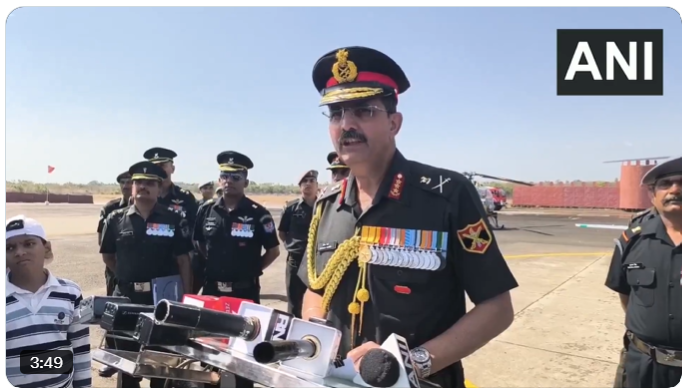
A purported video of Lieutenant General Devendra Sharma is being shared on social media, falsely portraying him as saying that “five aviators who participated in Operation Sindoor are missing from our training list. CyberPeace Research Wingresearch found that the viral video is completely fabricated and generated using artificial intelligence. The Ministry of Defence has also dismissed the clip as an AI-generated deepfake. The investigation found that Lieutenant General Devendra Sharma, Commander of the Army Training Command, never made any such statement. The viral clip has been manipulated by inserting fake audio into footage from his original speech to spread a misleading narrative.
Claim
A user on social media platform X shared the viral video with the caption:“Fifty-nine officers were listed at the Combat Army Aviation Training School, but five officers are missing. They were involved in Operation Sindoor as pilots of four Rafale jets and one Su-30 aircraft…”
Fact Check
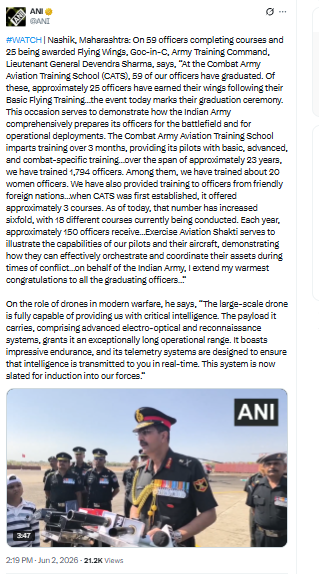
To verify the claim, we extracted several keyframes from the viral video and conducted a reverse-image search. During the investigation, we found the original video on ANI’s official X account. In the authentic footage, Lt Gen Sharma is seen speaking at a routine event at a training institution. His remarks focused on regular training-related matters, and he made no reference to missing pilots, Operation Sindoor, or any alleged losses.
https://x.com/ANI/status/2061731994971881667
In the next stage of the investigation, we found a post by the Ministry of Defence, Government of India, which also identified the viral clip as a deepfake.
https://www.facebook.com/watch/?v=1697698548109000
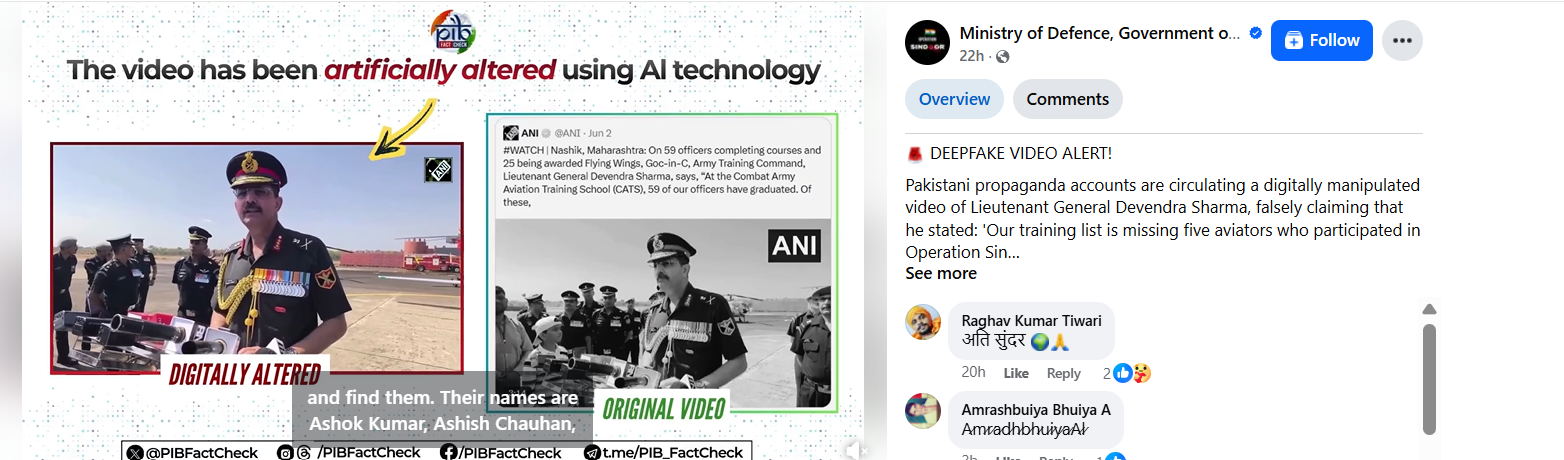
The ministry clarified that the video had been manipulated using AI-generated audio and did not reflect any genuine statement made by Lt Gen Devendra Sharma.
Conclusion
The viral video is a fabricated AI-generated deepfake. Lieutenant General Devendra Sharma never made the statement attributed to him about five missing aviators linked to Operation Sindoor. The original video was altered by inserting fake audio into authentic footage. The manipulated clip is being circulated online to spread misinformation and create confusion regarding the Indian Armed Forces.

Related Blogs
Introduction
Fundamentally, artificial intelligence (AI) is the greatest extension of human intelligence. It is the culmination of centuries of logic, reasoning, math, and creativity, machines trained to reflect cognition. However, such intelligence no longer resembles intelligence at all when it is put in the hands of the irresponsible, the one with malice, or the perverse, unleashed into the wild with minimal safeguards. Instead, distortion seems as a tool of debasement rather than enlightenment.
Recent incidents involving sexually explicit photographs created by AI on social media sites reveal an extremely unsettling reality. When intelligence is detached from accountability, morality, and governance, it corrodes society rather than elevates it. We are seeing a failure of stewardship rather than just a failure of technology.
The Cost of Unchecked Intelligence
The AI chatbot Grok, which operates under Elon Musk’s X (formerly Twitter), is the subject of a debate that goes beyond a single platform or product. The romanticisation of “unfiltered” knowledge and the perilous notion that innovation should come before accountability are signs of a bigger lapse in the digital ecosystem. We have allowed mechanisms that can be used as weapons against human dignity, especially the dignity of women and children, in the name of freedom.
We are no longer discussing artistic expression or experimental AI when a machine can digitally undress women, morph photos, or produce sexualised portrayals of kids with a few keystrokes. We stand in the face of algorithmic violence. Even if the physical touch is absent, the harm caused by it is genuine, long-lasting, and extremely personal.
The Regulatory Red Line
A major inflexion was reached when the Indian government responded by ordering a thorough technical, procedural, and governance-level audit. It acknowledges that AI systems are not isolated entities. Platforms that use them are not neutral pipes, but rather intermediaries with responsibilities. The Bhartiya Nyay Sanhita, the IT Act, the IT Rules 2021, and the possible removal of Section 79 safe-harbour safeguards all make it quite evident that innovation is not automatic immunity.
However, the fundamental dilemma cannot be resolved by legislation alone. AI is hailed as a force multiplier for innovation, productivity, and advancement, but when incentives are biased towards engagement, virality, and shock value, its misuse shows how easily intelligence can turn into ugliness. The output receives greater attention the more provocative it is. Profit increases with attention. Restraint turns into a business disadvantage in this ecology.
The Aftermath
Grok’s own acknowledgement that “safeguard lapses” enabled the creation of pictures showing children wearing skimpy attire underscores a troubling reality, safety was not absent due to impossibility, but due to insufficiency. It was always possible to implement sophisticated filtering, more robust monitoring, and stricter oversight. They were simply not prioritised. When a system asserts that “no system is 100% foolproof,” it must also acknowledge that there is no acceptable margin of error when it comes to child protection.
The casual normalisation of such lapses is what is most troubling. By characterising these instances as “isolated cases,” systemic design decisions run the risk of being trivialised. In addition to intelligence, AI systems that have been taught on enormous amounts of human data also inherit bias, misogyny, and power imbalances.
Conclusion
What is required today is recalibration. Platforms need to shift from reactive compliance to proactive accountability. Safeguards must be incorporated at the architectural level; they cannot be cosmetic or post-facto. Governance must encompass enforced ethical boundaries in addition to terms of service. The idea that “edgy” AI is a sign of advancement must also be rejected by society.
Artificial Intelligence has never promised freedom under the guise of vulgarity. It was improvement, support, and augmentation. The fundamental core of intelligence is lost when it is used as a tool for degradation.So what’s left is a decision between principled innovation and unbridled novelty. Between responsibility and spectacle, between intelligence as purpose and intellect as power.
References
https://www.rediff.com/news/report/govt-orders-x-review-of-grok-over-explicit-content/20260103.htm
Executive Summary
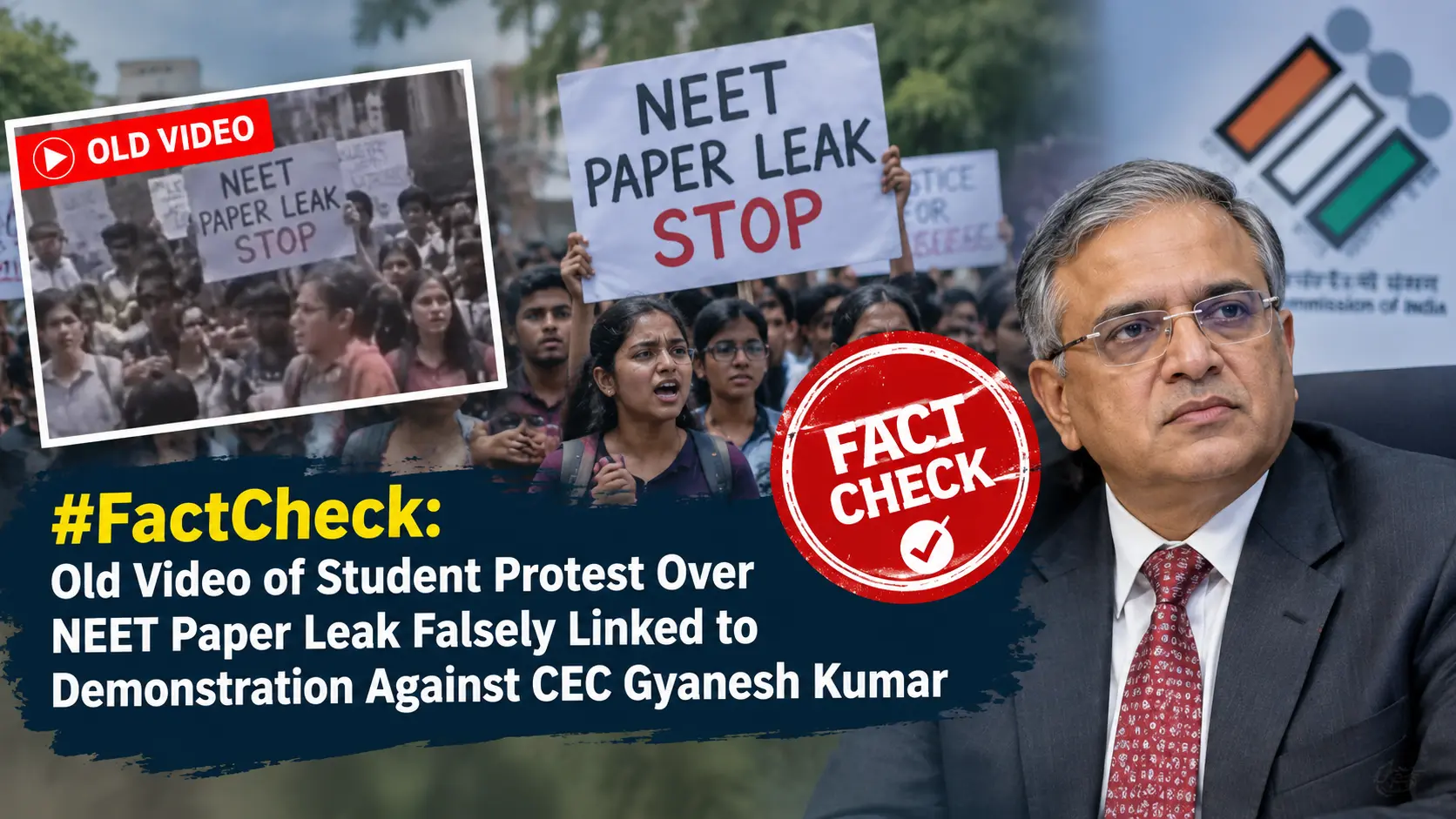
Reports of differences between the Chief Election Commissioner and the two Election Commissioners over the functioning of the Election Commission have emerged, following which protests were held across the country. Protesters demanding the resignation of Chief Election Commissioner Gyanesh Kumar took out a ‘Citizens March’ to Jantar Mantar on October 4, 2026. Against this backdrop, a video is being widely shared on social media. The video purportedly shows a CRPF personnel lathi-charging protesters. It is being shared with the claim that the footage is from the protest against Chief Election Commissioner Gyanesh Kumar at Jantar Mantar in Delhi. However, CyberPeace Research found the viral claim to be false. The viral video is not recent; it dates back to July 2026. At that time, students in Delhi were protesting over the alleged NEET paper leak and demanding the resignation of then Union Education Minister Dharmendra Pradhan.
Claim:
A Facebook user, ‘Kuldeep Pandit’, shared the viral video on October 4, 2026, with the caption: “The only thing left was the last ball, when Modi ji hit a six at the Jantar Mantar stadium and broke the backsides of traitors... Jantar Mantar is now under the control of the Indian Army, and the Army is giving freedom by the trolley load... Jai Shri Ram.”The archive link to the post can be viewed here.
https://www.facebook.com/reel/1807020453964507
https://perma.cc/RN8J-XV4K?type=standard

Fact Check
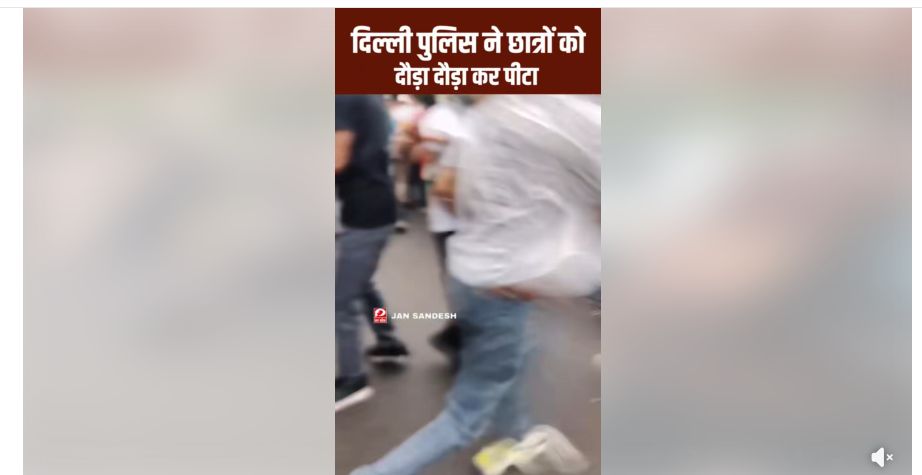
To verify the authenticity of the viral video, we extracted several keyframes using the InVID tool and conducted a reverse image search on Google. During the search, we found the viral video shared on a Facebook account named ‘Jansandesh News’ on July 21, 2026. According to the information provided with the post, the video shows a protest held at Jantar Mantar over the alleged NEET paper leak.
https://www.facebook.com/watch/?v=1786356329397999
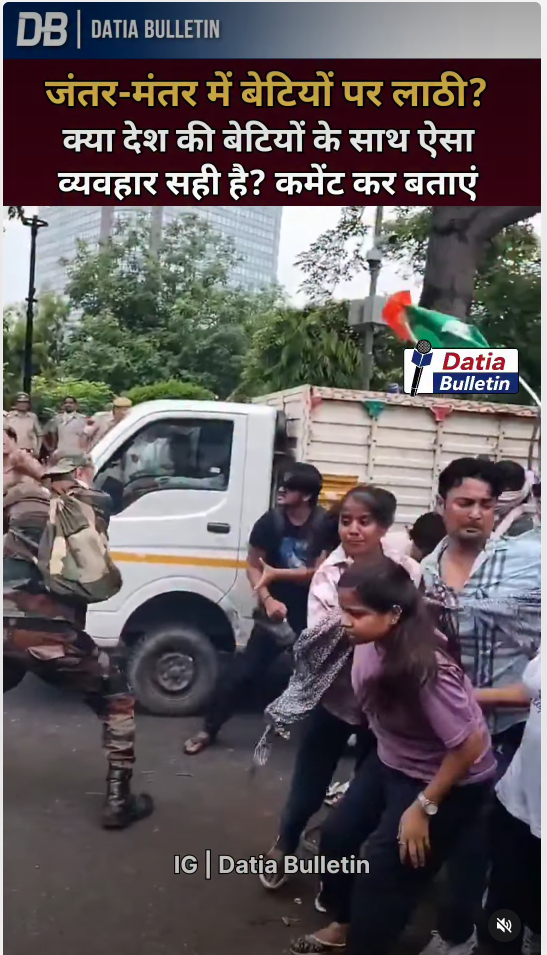
Based on the information obtained, we conducted a Google search using relevant keywords. We also found the viral video on an Instagram account named ‘datiabulletinofficial’. The video was shared on July 21, 2026, and was identified as footage from a protest held at Jantar Mantar. According to the caption, students were protesting over the alleged NEET paper leak and demanding the resignation of then Union Education Minister Dharmendra Pradhan.
https://www.instagram.com/reels/DbFXpGHzmwB/
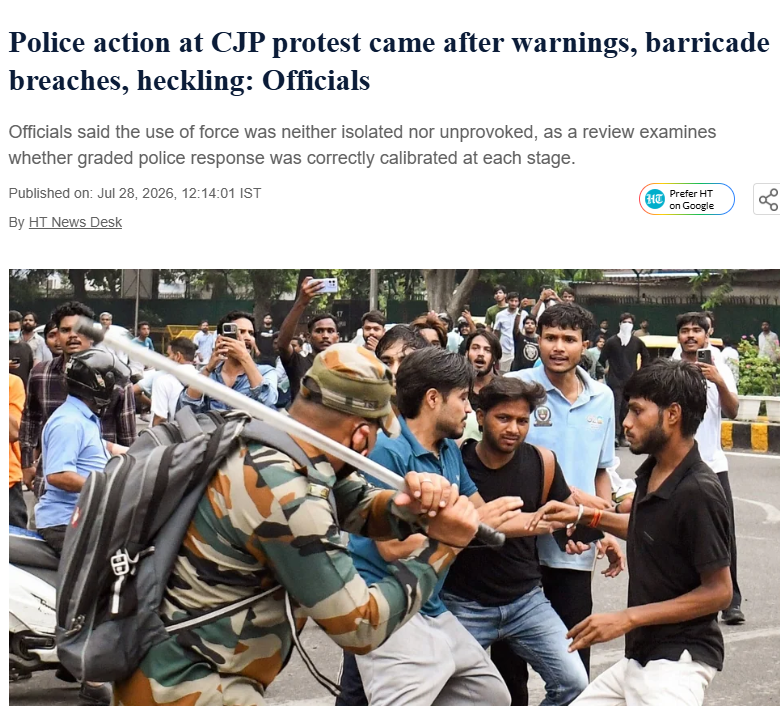
During our research, we found a news report related to the claim on the Hindustan Times website. The report was published on July 28, 2026. According to the report, “On July 20, students led by the ‘Cockroach Janta Party’ (CJP) marched towards Parliament. During the protest, police and Rapid Action Force (RAF) personnel lathi-charged the students, drawing considerable criticism. The Delhi Police later clarified that it would review the lathi-charge on the students and the action taken by the police.”The report also contains keyframes that closely resemble the visuals seen in the viral video.
Conclusion:
Our research found that the claim being made about the viral video of protesters being lathi-charged is false. The video dates back to July 2026, when students in Delhi held protests over the alleged NEET paper leak and demanded the resignation of then Union Education Minister Dharmendra Pradhan.

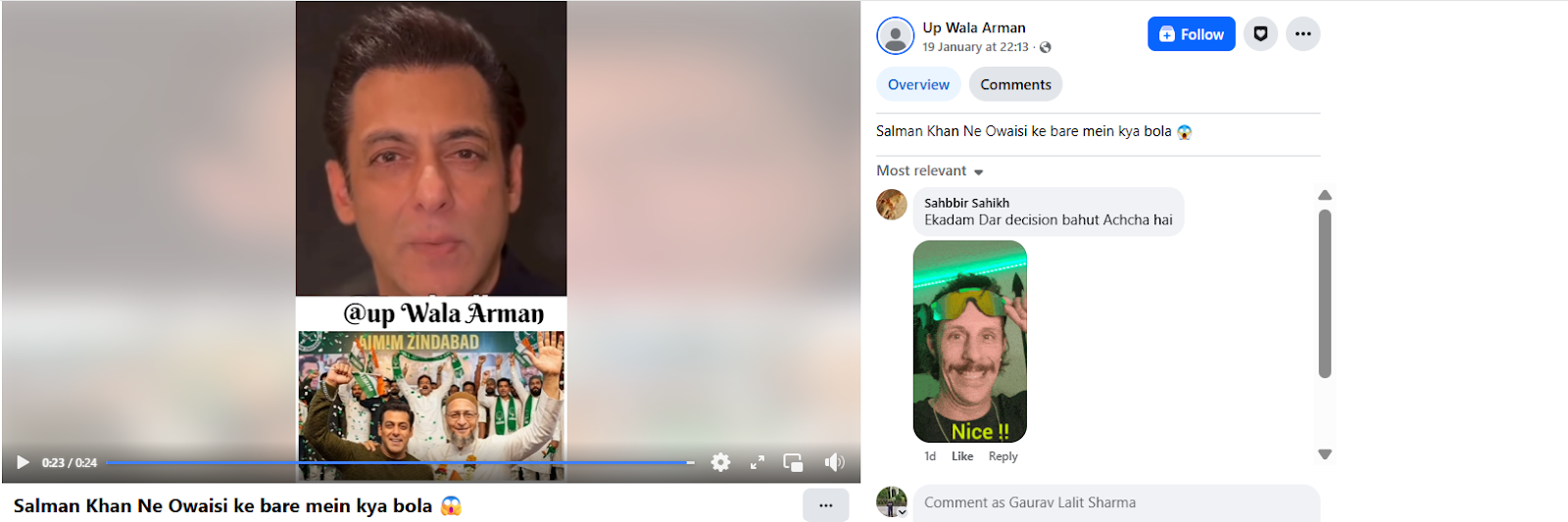
A video of Bollywood actor Salman Khan is being widely circulated on social media, in which he can allegedly be heard saying that he will soon join Asaduddin Owaisi’s party, the All India Majlis-e-Ittehadul Muslimeen (AIMIM). Along with the video, a purported image of Salman Khan with Asaduddin Owaisi is also being shared. Social media users are claiming that Salman Khan is set to join the AIMIM party.
CyberPeace research found the viral claim to be false. Our research revealed that Salman Khan has not made any such statement, and that both the viral video and the accompanying image are AI-generated.
Claim
Social media users claim that Salman Khan has announced his decision to join AIMIM.On 19 January 2026, a Facebook user shared the viral video with the caption, “What did Salman say about Owaisi?” In the video, Salman Khan can allegedly be heard saying that he is going to join Owaisi’s party. (The link to the post, its archived version, and screenshots are available.)
Fact Check:
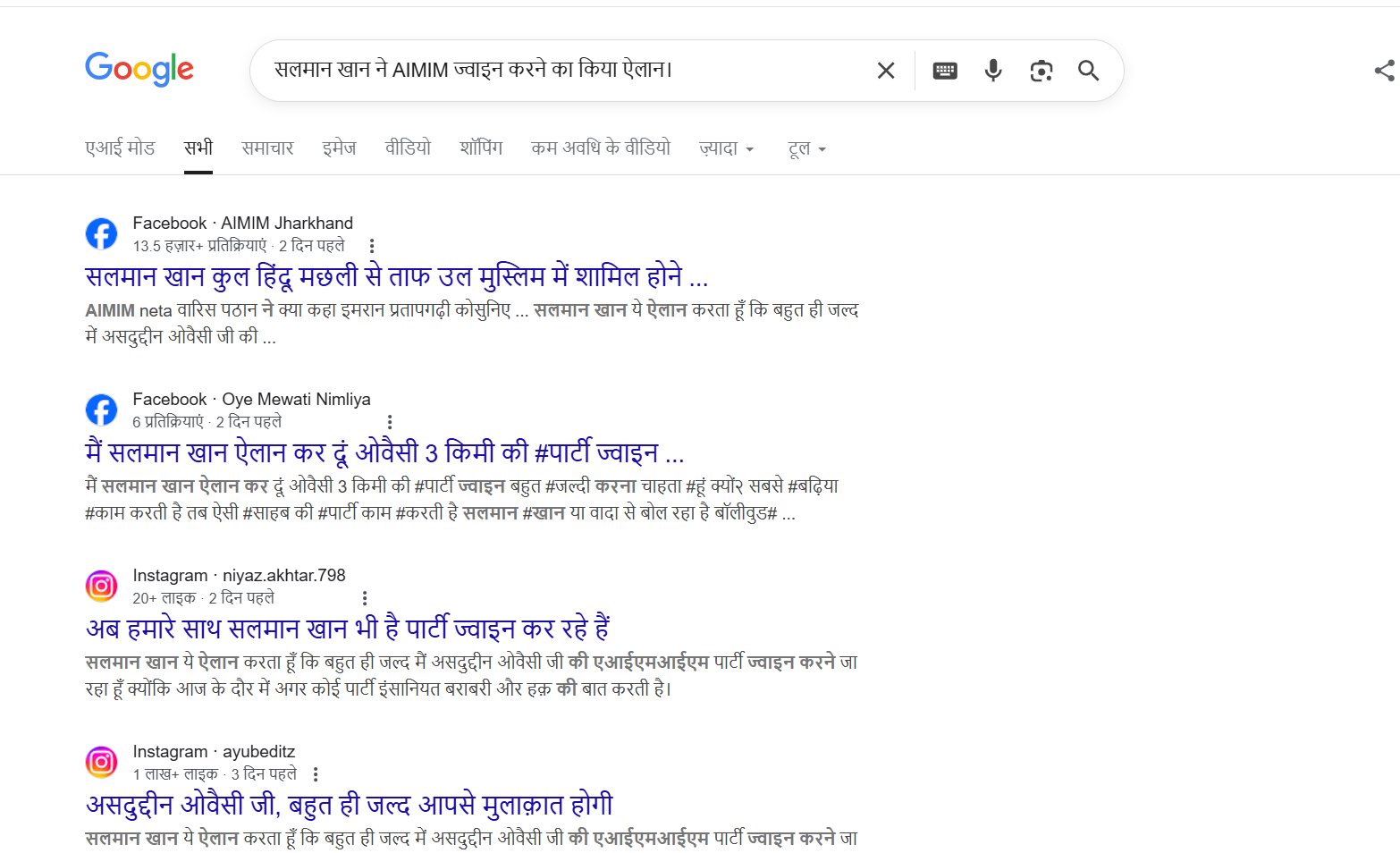
To verify the claim, we first searched Google using relevant keywords. However, no credible or reliable media reports were found supporting the claim that Salman Khan is joining AIMIM.
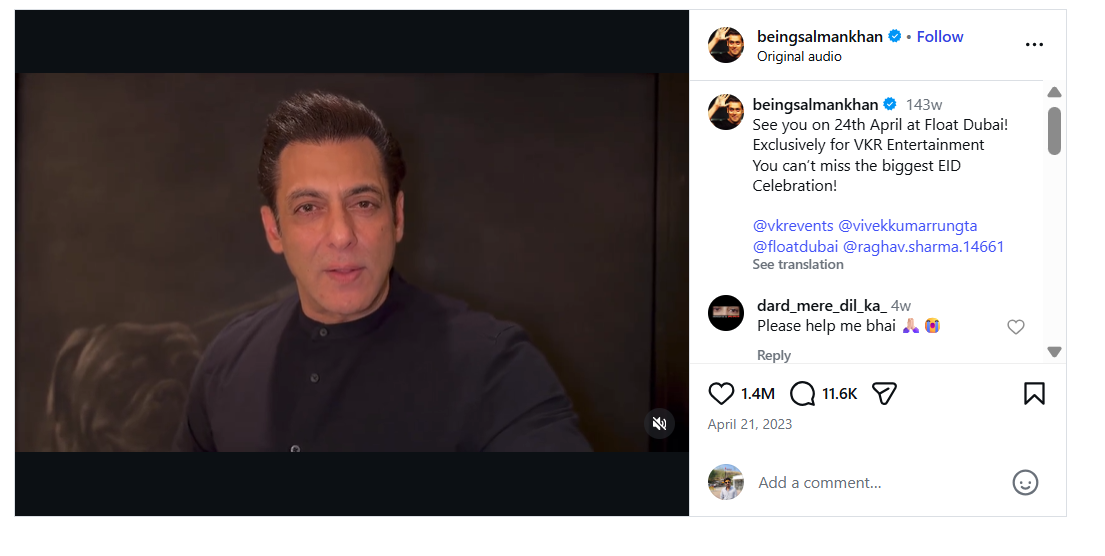
In the next step of verification, we extracted key frames from the viral video and conducted a reverse image search using Google Lens. This led us to a video posted on Salman Khan’s official Instagram account on 21 April 2023. In the original video, Salman Khan is seen talking about an event scheduled to take place in Dubai. A careful review of the full video confirmed that no statement related to AIMIM or Asaduddin Owaisi is made.
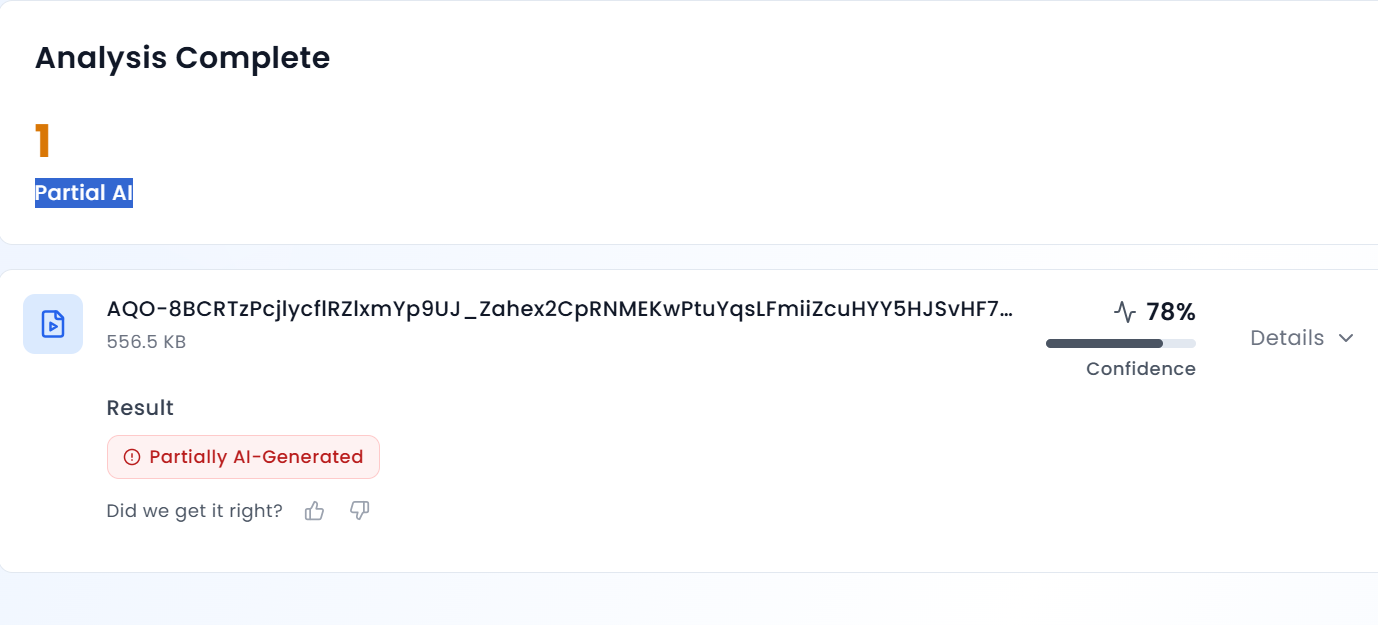
Further analysis of the viral clip revealed that Salman Khan’s voice sounds unnatural and robotic. To verify this, we scanned the video using AURGIN AI, an AI-generated content detection tool. According to the tool’s analysis, the viral video was generated using artificial intelligence.
Conclusion
Salman Khan has not announced that he is joining the AIMIM party. The viral video and the image circulating on social media are AI-generated and manipulated.
