
#FactCheck- AI-Generated Deepfake Falsely Attributes Film Remark to Army Chief Upendra Dwivedi
Executive Summary
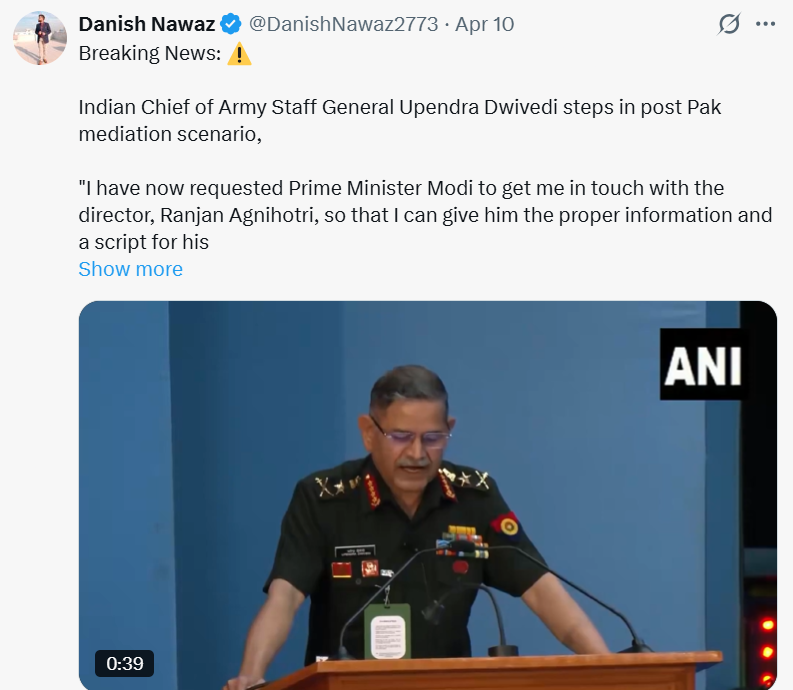
A video circulating on social media, shared by a Pakistani account, claims to show Indian Army Chief General Upendra Dwivedi making a controversial statement. In the clip, he is allegedly heard saying that he requested Prime Minister Narendra Modi to connect him with film director Ranjan Agnihotri so he could provide inputs and a script for a movie on “Operation Sindoor.”
However, research by CyberPeace has found that the viral video is an AI-generated deepfake. General Upendra Dwivedi has made no such statement.
Claim
A Pakistani user shared the viral video on X (formerly Twitter) on April 10, 2026, making the above claim.
Post links:
- https://x.com/DanishNawaz2773/status/2042312967811973225?s=20
- https://archive.ph/kAwoR
Fact Check
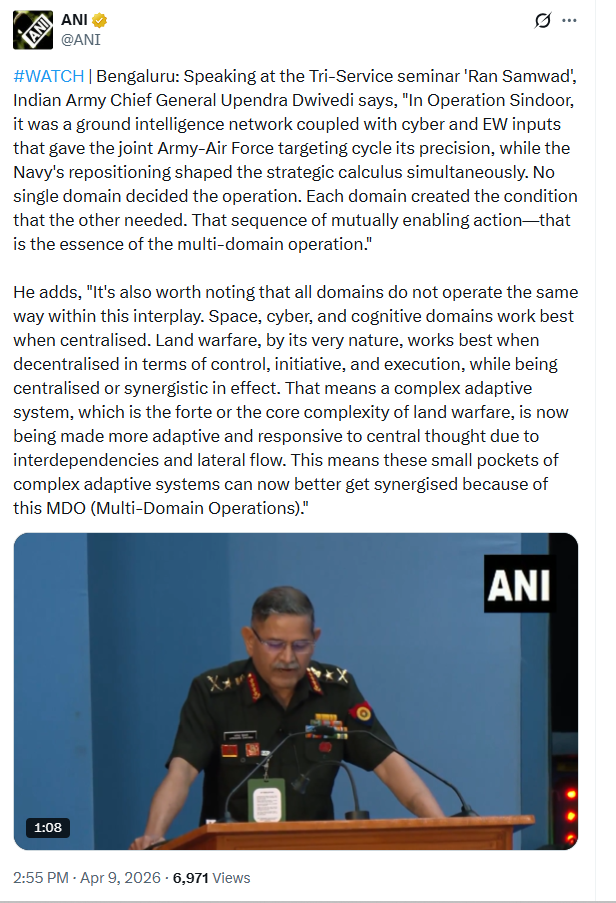
To verify the claim, we conducted keyword searches on Google but found no credible media reports supporting it. Further research led us to the original video posted on the X account of ANI. In this authentic clip, General Upendra Dwivedi is seen speaking at the ‘Ran Samwad’ seminar held in Bengaluru.
In the original video, he discusses the operational aspects of “Operation Sindoor,” including ground intelligence, cyber and electronic warfare inputs, Pakistan’s behaviour, and the challenges of a two-front scenario. There is no mention whatsoever of Pakistan mediation, Prime Minister Modi, Ranjan Agnihotri, any movie script, or a film based on Operation Sindoor.
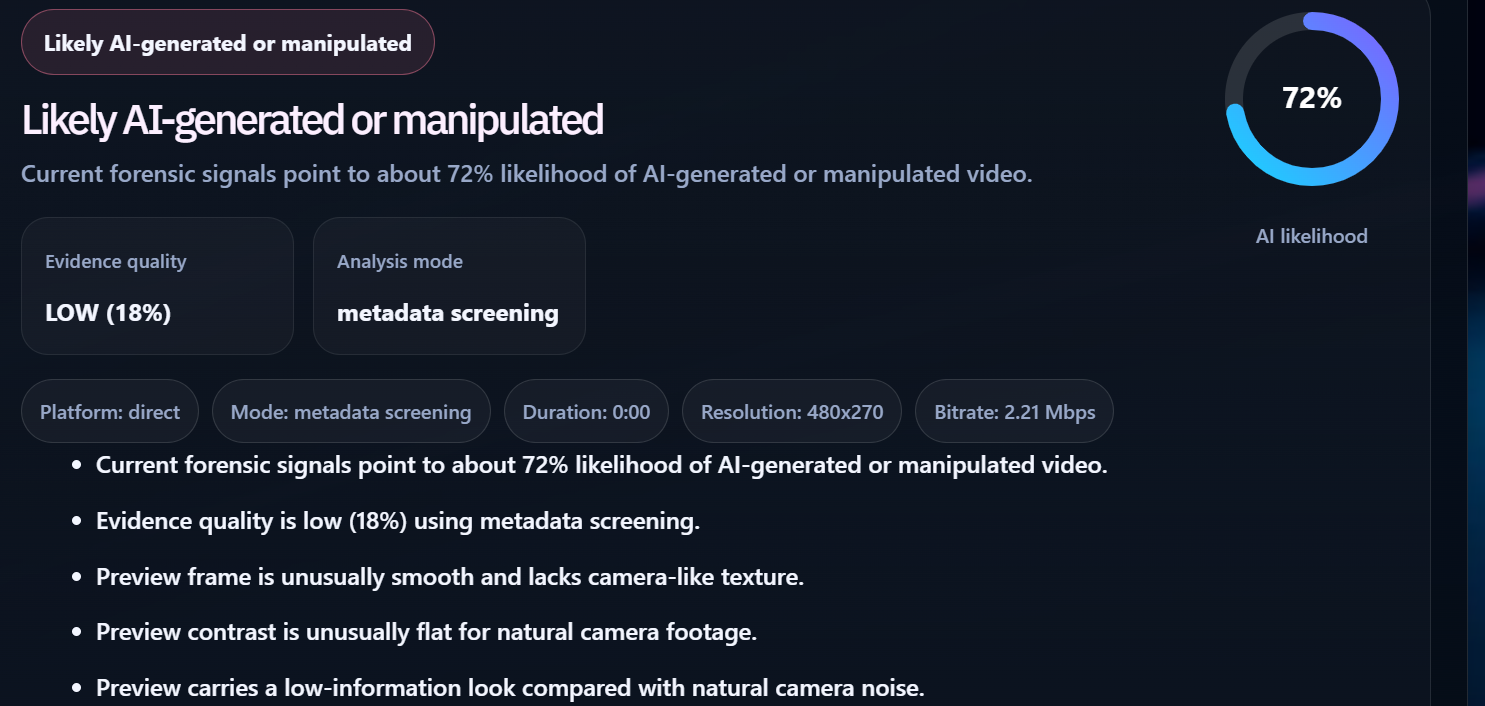
This clearly indicates that the viral clip has been manipulated and taken out of context. The video was further analyzed using the AI detection tool DetectVideo AI, which indicated a 72% probability that the content is AI-generated. This strongly supports the conclusion that the video is a deepfake.
Conclusion
The viral claim is false. The video featuring General Upendra Dwivedi has been digitally altered using AI techniques to insert fabricated statements. The original footage is from the ‘Ran Samwad’ seminar in Bengaluru, where he spoke about military strategy and multi-domain operations, not about any film or director. There is no evidence to suggest that he made any statement regarding contacting a filmmaker or contributing to a movie script. The inclusion of such references in the viral clip is entirely fabricated. This case highlights how AI-generated deepfakes are increasingly being used to spread misinformation, especially in sensitive contexts involving the military and international relations. Viewers are advised to rely on verified sources and exercise caution before sharing such content.

Related Blogs
Introduction
India is seeing a major change due to the introduction of Artificial Intelligence (AI) across all sectors of government, business, and the digital economy with regard to areas such as governance, healthcare, finance, and the infrastructure. The large scale and rapid pace of AI implementation are expected to lead to efficiency gains, innovations in products and services, and to drive economic growth; however, the growth of AI also creates many serious concerns regarding ethics, legality, and societal ramifications. Issues such as algorithmic bias in the use of algorithms by AI, a lack of transparency in decision-making algorithms, data protection risks resulting from AI employments, and unclear frameworks for determining accountability for AI-related action; bring issues of how we will govern AI in a responsible manner to the forefront of public policy discourse.
India wants to become an AI superpower and leader in technology on the world stage. As such, India has a dual responsibility to fuel innovation without discounting democratic ideals, human rights, and public trust. UNESCO's AI Readiness Assessment Methodology (RAM) is a global tool for AI governance, created to provide concrete policy guidance on how to make ethical AI a reality. The India AI RAM Report is set to be formally released by UNESCO during the India AI Impact Summit 2026, taking place in New Delhi, as a major milestone in India's developing AI governance journey.
What is UNESCO’s AI Readiness Assessment Methodology (RAM)?
UNESCO has created a simple yet effective tool, called the AI Readiness Assessment Methodology (RAM), that can assist governments in determining how well they are prepared to develop, deploy and manage Artificial Intelligence ethically, responsibly and trustworthily. RAM provides a framework for diagnosing and self-assessing the state of a country’s ability to govern AI on the basis of evidence-based decision making rather than serving as a regulatory framework or ranking system.
The most important goal of RAM is to assess a country’s overall state of readiness to govern AI based on four dimensions: institutionally, legally, socially and technologically. In doing so, RAM examines how institutions function, their maturity level and the extent to which various policies align with one another; thereby giving governments an overview of strengths, weaknesses and priorities for reform.
Unlike other frameworks, RAM does not prescribe any one-size-fits-all solutions; instead, it uses a context sensitive approach when implementing the concepts of AI governance due to differing national realities, developmental priorities and social/economic conditions. Using the ethical principles established by UNESCO, RAM converts these principles into practical actions that can guide countries in their transition from abstract commitments to concrete strategies for governing AI.
Key Dimensions Assessed Under RAM
UNESCO's AI Readiness Assessment Methodology (RAM) is a tool used to assess a country's readiness to implement ethical Artificial Intelligence through five interconnected dimensions. These include: the legal and regulatory dimension (which looks at the laws, rules, and safeguards that are currently in place related to AI), the social and cultural dimension (which looks at whether the public is aware of AI, whether it trusts AI, whether AI is an inclusive experience for all people who use AI and whether AI has affected society in various ways), and the economic dimension (which looks at innovation, participation from industry, and readiness of the market for AI).
Also included in the framework/functionality of the RAM are: scientific and educational dimension (which examines a country’s capacity to conduct serious scientific research, including research activities that prepare persons to be employable in AI jobs); and technological and infrastructure dimension (which examines the availability of data, digital infrastructure, and computing capabilities for AI projects in a country).
All five of these dimensions consider the entirety of the scope of an AI readiness evaluation to ensure that AI Governance is more than just a technical issue; rather, it is a condition of a country’s capacity to generate laws, create policy and maintain social equality in relation to all forms of Artificial Intelligence.
Methodology and Nationwide Consultative Process
RAM takes both qualitative and quantitative characteristics together to create an overall understanding of how ready any nation is for AI capabilities. It is designed with flexibility so nations can define their assessments with respect to their own institutional capabilities and development agenda.
Normally, RAM is implemented by an independent expert who is assisted by a national team consisting of various stakeholders. With respect to the RAM process used in India, it was conducted as a national consultation where representatives from across all sectors of society (government, private sector, academia, civil society, and young people) participated in the assessment's creation. This consultation process made sure there were many different viewpoints present, which increased the legitimacy of the assessment results and how relevant they are in each country. The consultation process also yields policy recommendations based on real life governing situations or challenges that are specific to different sectors.
Institutional Partnerships Behind India’s RAM
The India RAM Initiative was developed by the UNESCO South Asia Regional Office (as a partner of IndiaAI Mission and the Indian Ministry of Electronics and Information Technology) and implemented by Ikigai Law with the help of The Patrick J. McGovern Foundation. This demonstrated the need for and importance of partnership in developing governance frameworks for Artificial Intelligence (AI). The result of the RAM process is a collaborative effort that includes evidence-based international norm-setting capabilities from around the world; government policies under the guidance of national political leadership; independent legal-technical implementation; input from civil society; all with the goal of empowering (increasing) India's ability to establish and implement both a consistent (i.e., coherent) and comprehensive (i.e., inclusive) AI Governance Framework.
Significance of the India AI RAM Report and Its Launch
The India AI RAM Report provides a complete initial assessment of India’s AI ecosystem and includes key insights into AI readiness, governance strengths/weaknesses, and potential opportunities across multiple sectors. It identifies priority areas to promote a responsible and trustworthy AI ecosystem in India.
The report will be officially released during the India AI Impact Summit (February 16, 2026 at Bharat Mandapam, New Delhi) where Mr. Abhishek Venkateswaran (National Project Officer-Social and Human Sciences at UNESCO South Asia) offered additional insight into the consultative process and the overall importance of this launch on India's future AI policy path.
Policy Relevance and the Road Ahead
The RAM Framework gives the government a structure and roadmap for developing and implementing AI Governance. In doing this, RAM reinforces the alignment of IndiaAI Mission, which includes safety and trust in AI as one of the pillars. However, the results from this Assessment will not automatically translate to reforming institutions, issuing guidelines specific to sectors, or developing a mechanism for continued evaluation. Implementation will require strong and sustained commitment from political leaders, as well as the commitment of institutions involved in the reforms made possible by RAM's implementation.
Conclusion
UNESCO has developed an AI Readiness Assessment Methodology (AI-RAM) that can greatly advance the way India approaches governance with respect to artificial intelligence (AI). By focusing on "readiness" (doing what needs to be done), "responsibility" (being or having good moral principles) and "inclusivity" (including everyone), the AI-RAM will enable India to become an active participant in discussions around ethical use of AI at a global level. India is now positioned to take on a leadership role in the world by adopting this methodology, which provides a platform for establishing global standards for AI development. The real benefit of the AI-RAM will come from policy measures that will ensure future AI development in India is 'human-centered', 'trustworthy' and 'aligns with democratic values'.
References
- https://icaire.org/files/UNESCORam-en.pdf
- https://www.pib.gov.in/PressReleasePage.aspx?PRID=2134492®=3&lang=2
- https://www.facebook.com/unesconewdelhi/videos/unesco-is-set-to-launch-the-india-ai-readiness-assessment-methodology-ram-report/25955631820699516/
- https://www.unesco.org/ethics-ai/en/ram
- https://www.hindustantimes.com/india-news/unesco-meity-launch-exercise-to-assess-india-s-ai-readiness-101749188341803.html#
- https://www.manoramayearbook.in/current-affairs/india/2025/06/09/unesco-ai-readiness-assessment-methodology-ram.html
Executive Summary
Mumbai’s Mira–Bhayandar bridge has recently been in the news due to its unusual design. In this context, a photograph is going viral on social media showing a bus seemingly stuck on the bridge. Some users are also sharing the image while claiming that it is from Sonpur subdivision in Bihar. However, an research by the CyberPeace has found that the viral image is not real. The bridge shown in the image is indeed the Mira–Bhayandar bridge, which is under discussion because its design causes it to suddenly narrow from four lanes to two lanes. That said, the bridge is not yet operational, and the viral image showing a bus stuck on it has been created using Artificial Intelligence (AI).
Claim
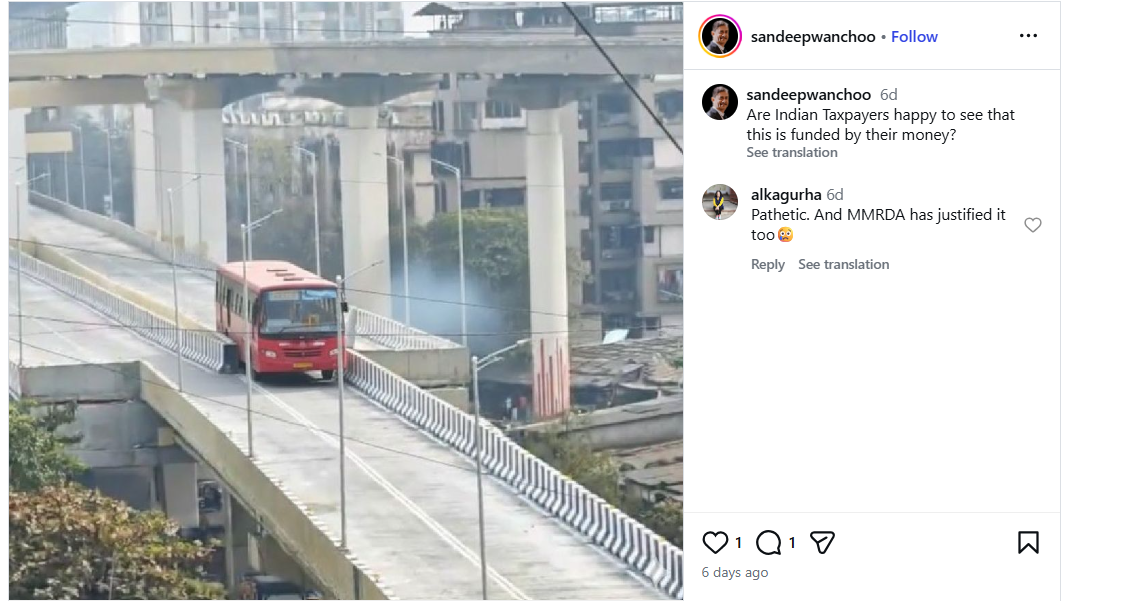
An Instagram user shared the viral image on January 29, 2026, with the caption:“Are Indian taxpayers happy to see that this is funded by their money?” The link, archive link, and screenshot of the post can be seen below.
Fact Check:
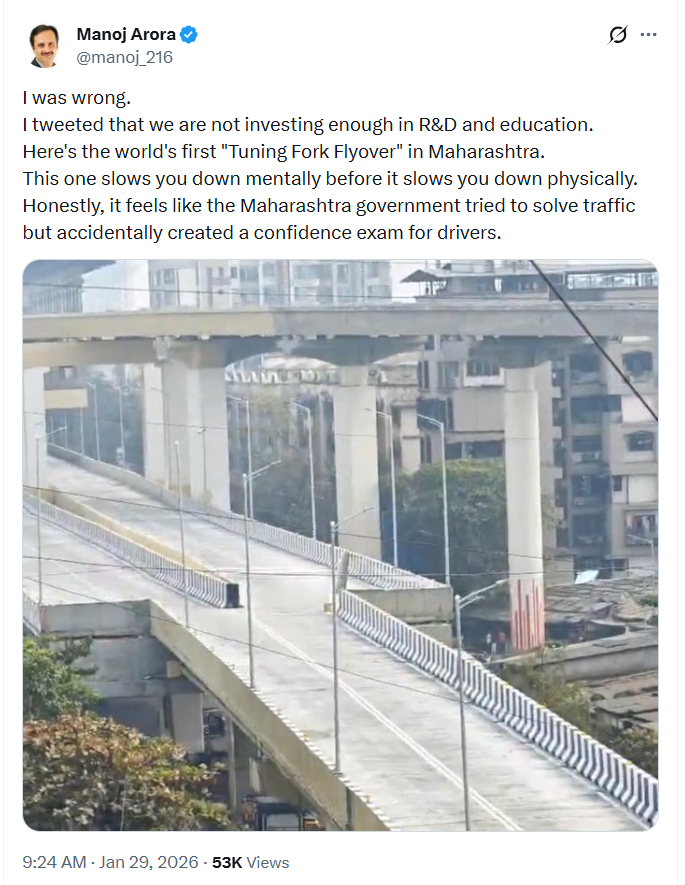
To verify the claim, we first conducted a Google Lens reverse image search. This led us to a post shared by X (formerly Twitter) user Manoj Arora on January 29. While the bridge structure in that image matches the viral photo, no bus is visible in the original post.This raised suspicion that the viral image had been digitally manipulated.
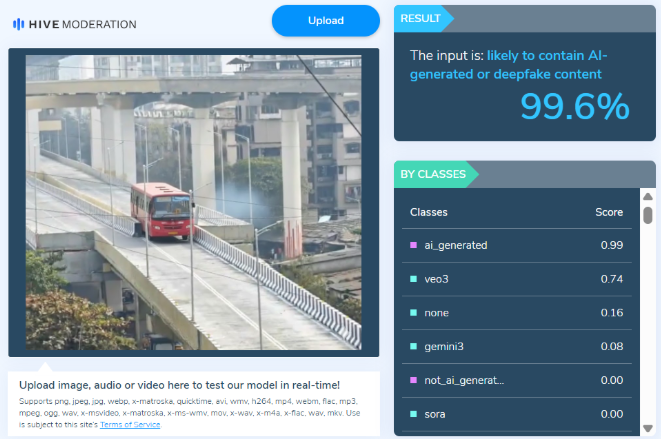
We then ran the viral image through the AI detection tool Hive Moderation, which flagged it as over 99% likely to be AI-generated
Conclusion
The CyberPeace research confirms that while the Mira–Bhayandar bridge is real and has been in the news due to its design, the viral image showing a bus stuck on the bridge has been created using AI tools. Therefore, the image circulating on social media is misleading.

Executive Summary:
A video circulating on Social media has claimed that Iran has launched a missile strike destroying Ben Gurion Airport in Tel Aviv. With rising tensions in geopolitics, the video quickly became popular. However, our research has detailed inspections through digital verification tools and visual analysis showed that the video is AI-generated. No incident or damage ever occurred.

Claim:
A viral video circulating on social media platforms claims to show Tel Aviv’s Ben Gurion Airport destroyed following an Iranian missile strike. The video is being shared with captions suggesting it is the last recorded visuals from the attack, with some users asserting it as evidence of escalating conflict between Iran and Israel.

Fact Check:
After looking into the video that purported to show the destruction of Tel Aviv's Ben Gurion Airport in an Iranian missile strike, we researched the topic whether the claim is accurate or not. The video depicts a damaged airport terminal, with debris and fires, but a visual analysis determined that there were a number of suspicious characteristics: asymmetrical layout, artificial-looking smoke patterns, and the absence of activity or humans—those are all typical indications of AI generation. Our research traced the origins of the video to an Instagram post, with a date of May 27, 2025, made by what seems to be a user who frequently shares AI-generated images.


In order to verify our conclusions, we used Hive Moderation, an AI content detection tool, which produced a result of an 80% probability that the video is altered, and this level of probability strongly supports the idea that the footage is not real. Additionally, reports from popular organizations like India Today and Reuters supported these results. All findings resulting from our research established that the video is synthetic and unrelated to any event occurring at Ben Gurion Airport, and therefore debunked a false narrative propagated on social media.

To confirm, we also compared the visuals with a real aerial image of Tel Aviv’s Ben Gurion Airport available on aviation stock sites.


Fig: Google Maps image of Tel Aviv’s Ben Gurion Airport
The visuals from the viral video are not real locations or scenes of Aviv’s Ben Gurion Airport's true location and configuration therefore it is fake and misleading.
Conclusion:
After thorough research it is concluded that the viral video is fake and it is not an actual missile strike at Ben Gurion Airport. The video is made with AI, and posted by a content creator of synthetic content well before any conflict update. There is no official confirmation or credible news coverage to substantiate the claim, with a high probability of AI-detection, and it has been proven to be digitally manipulated. Therefore, the claim is untrue and misleading.
- Claim: A video shows Iran's missile strike destroying Tel Aviv’s Ben Gurion Airport.
- Claimed On: Social Media
- Fact Check: False and Misleading
