#FactCheck - Viral video of Defence Minister Rajnath Singh supporting Israeli attacks on Iran is a deepfake
Executive Summary:
A video of India’s Defence Minister Rajnath Singh is going viral on social media. The post claims that Rajnath Singh is openly supporting Israeli-American attacks against Iran. In the video, he can allegedly be heard saying that Prime Minister Narendra Modi had visited Israel before the war began and warned Tehran that disturbing peace would have serious consequences.
Research by CyberPeace found that the viral video is a deepfake created using Artificial Intelligence (AI). Rajnath Singh has not made any such statement about Iran or the Israel-US conflict.
Claim
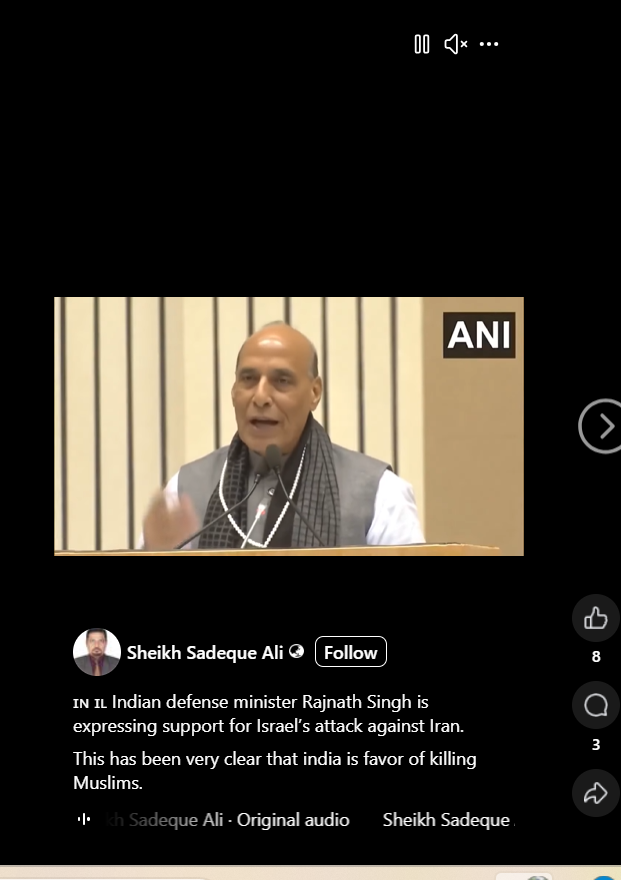
A Facebook user “Sheikh Sadeque Ali” shared the video on March 2, 2026. The caption of the post reads, “Indian Defence Minister Rajnath Singh is supporting Israel’s attack on Iran. This clearly shows that India supports the killing of Muslims.”
In the viral video, Rajnath Singh appears to say in English: “Prime Minister Modi’s visit to Israel before the attack on Iran reflects India’s solidarity with its strategic partner… He warned Tehran that hostile actions would have serious consequences for regional peace.”
Fact Check:
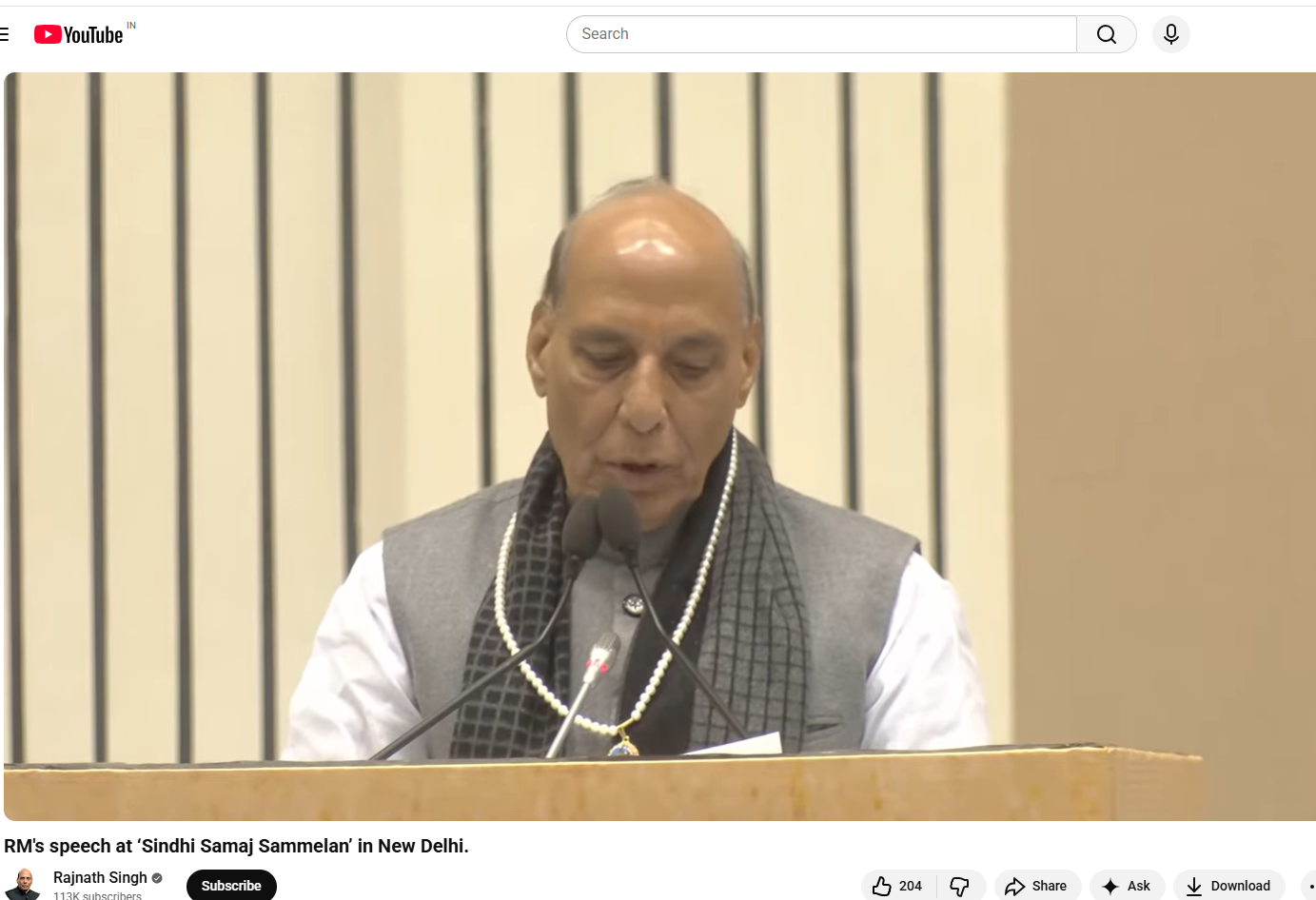
To verify the claim, we extracted keyframes from the viral video and conducted a reverse image search. During the research , we found the original video on Rajnath Singh’s official YouTube channel. The video was uploaded on November 23, 2025.In the original video, Rajnath Singh was addressing a Sindhi community conference in Delhi. During his speech, he was talking about Sindhi culture and the history of Partition. He did not mention Israel, Iran or any Middle East conflict during the entire program.
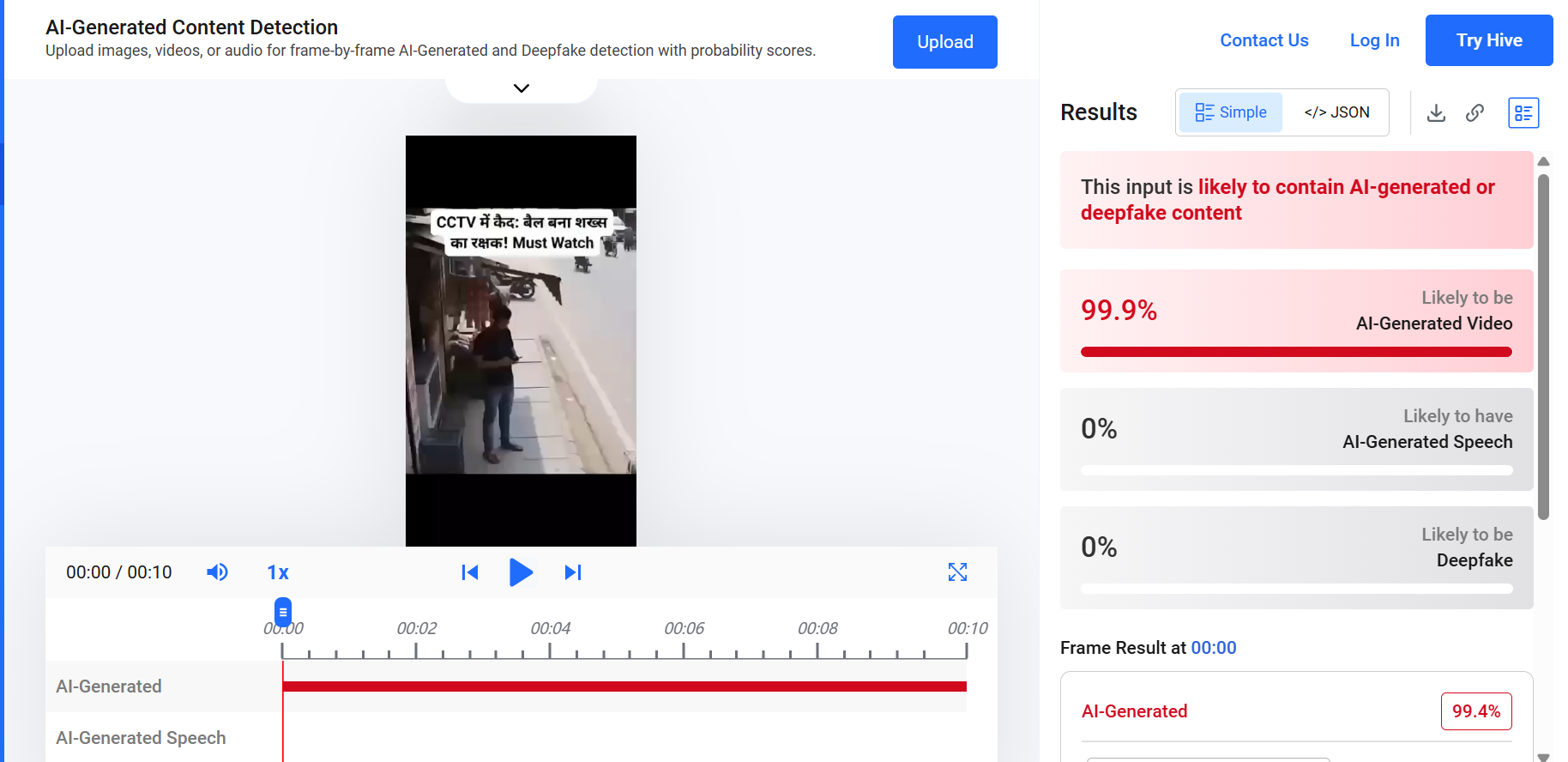
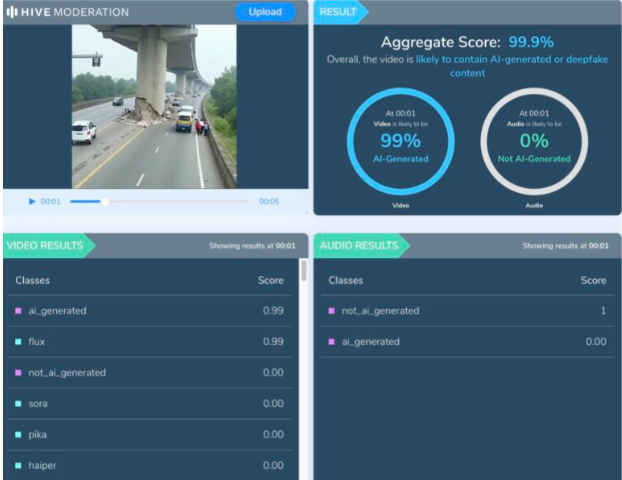
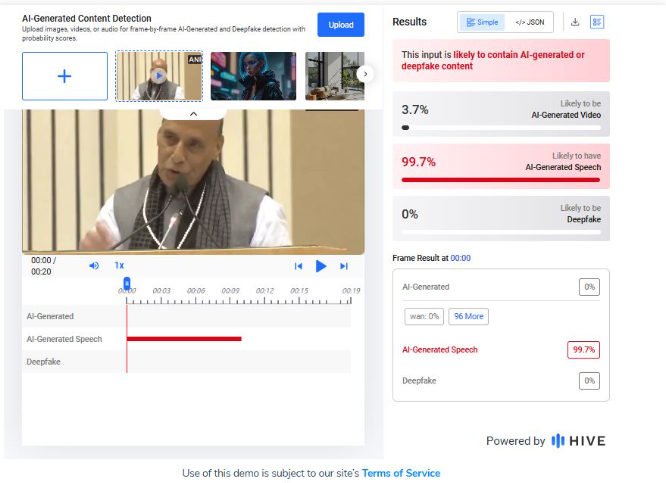
Upon closely examining the viral video, technical inconsistencies between the lip movements and the audio (lip-sync discrepancies) can be observed, which strongly indicate that the video may have been generated using AI. To verify this, we analysed the clip using several AI-detection tools. The AI detection tool Hive Moderation indicated that the video has a 99% probability of being AI-generated.
Conclusion:
Our research found that the viral video of Rajnath Singh is a deepfake. He has not made any statement supporting Israel or opposing Iran. The original video is from a Sindhi community event in Delhi, which has been digitally altered using AI to spread a misleading claim.
Related Blogs

Disclaimer:
This report is the collaborative outcome of insights derived from the CyberPeace Helpline’s operational statistics and the CyberPeace Research Team, covering the monthly helpline case trends of May 2025, the report identifies recurring trends, operational challenges, and strategic opportunities. The objective is to foster research-driven solutions that enhance the overall efficacy of the helpline.
Executive Summary:
This report summarizes the cybercrime cases reported in May, offering insights into case types, gender distribution, resolution status, and geographic trends.
As per our analysis, out of various Cyber Frauds Financial Fraud was the most reported issue, making up 43% of cases, followed by Cyberbullying (26%) and Impersonation (14%). Less frequent but serious issues included Sexual Harassment, Sextortion, Hacking, Data Tampering, and Cyber Defamation, each accounting for 3–6%, highlighting a mix of financial and behavioral threats.The gender distribution was fairly balanced, with 51% male and 49% female respondents. While both genders were affected by major crimes like financial fraud and cyber bullying, some categories—such as sexual harassment—reflected more gender-specific risks, indicating the need for gender-responsive policies and support.
Regarding case status, 60% remain under follow-up while 40% have been resolved, reflecting strong case-handling efforts by the team.
The location-wise data shows higher case concentrations in Uttar Pradesh, Andhra Pradesh, Karnataka, and West Bengal, with significant reports also from Delhi, Telangana, Maharashtra, and Odisha. Reports from the northeastern and eastern states confirm the nationwide spread of cyber incidents.In conclusion, the findings point to a growing need for enhanced cybersecurity awareness, preventive strategies, and robust digital safeguards to address the evolving cyber threat landscape across India.
Cases Received in May:
As per the given dataset, the following types of cases were reported to our team during the month of May:
- 💰 Financial Fraud – 43%
- 💬 Cyber Bullying – 26%
- 🕵️♂️ Impersonation – 14%
- 🚫 Sexual Harassment – 6%
- 📸 Sextortion – 3%
- 💻 Hacking – 3%
- 📝 Data Tampering – 3%
- 🗣️ Cyber Defamation – 3%

The chart illustrates various cybercrime categories and their occurrence rates. Financial Fraud emerges as the most common, accounting for 43% of cases, highlighting the critical need for stronger digital financial security. This is followed by Cyber Bullying at 26%, reflecting growing concerns around online harassment, especially among youth. Impersonation ranks third with 14%, involving identity misuse for deceitful purposes. Less frequent but still serious crimes such as Sexual Harassment (6%), Sextortion, Hacking, Data Tampering, and Cyber Defamation (each 3%) also pose significant risks to users’ privacy and safety. Overall, the data underscores the need for improved cybersecurity awareness, legal safeguards, and preventive measures to address both financial and behavioral threats in the digital space.
Gender-Wise Distribution:
- 👨 Male – 51%
- 👩 Female – 49%

The chart illustrates the distribution of respondents by gender. The data shows that Male participants make up 51% of the total, while Female participants account for 49%. This indicates a fairly balanced representation of both genders, with a slight majority of male respondents.
Gender-Wise Case Distribution:

- The chart presents a gender-wise distribution of various cybercrime cases, offering a comparative view of how different types of cyber incidents affect males and females.
- It highlights that both genders are significantly impacted by cybercrimes such as financial fraud and cyber bullying, indicating a widespread risk across the board.
- Certain categories, including sexual harassment, cyber defamation, and hacking, show more gender-specific patterns of victimization, pointing to differing vulnerabilities.
- The data suggests the need for gender-sensitive policies and preventive measures to effectively address the unique risks faced by males and females in the digital space.
- These insights can inform the design of tailored awareness programs, support services, and intervention strategies aimed at improving cybersecurity for all individuals.
Major Location Wise Distribution:
The map visualization displays location-wise distribution of reported cases across India. The cases reflect the cyber-related incidents or cases mapped geographically.

The map highlights the regional distribution of cybercrime cases across Indian states, with a higher concentration in Uttar Pradesh, Andhra Pradesh, Karnataka, and West Bengal. States like Delhi, Telangana, Maharashtra, and Odisha also show notable activity, indicating widespread cyber threats. Regions including Assam, Tripura, Bihar, Jharkhand, and Jammu & Kashmir further reflect the pan-India spread of such incidents. This distribution stresses the need for targeted cybersecurity awareness and stronger digital safeguards nationwide
CyberPeace Advisory:
- Use Strong and Unique Passwords: Create complex passwords using a mix of letters, numbers, and symbols. Avoid reusing the same password across multiple platforms.
- Enable Multi-Factor Authentication (MFA): Add an extra layer of security by using a second verification step like an OTP or authentication app.
- Keep Software Updated: Regularly update your operating system, apps, and security tools to protect against known vulnerabilities.
- Install Trusted Security Software: Use reliable antivirus and anti-malware programs to detect and block threats.
- Limit Information Sharing: Be cautious about sharing personal or sensitive details, especially on social media or public platforms.
- Secure Your Network: Protect your Wi-Fi with a strong password and encryption. Avoid accessing confidential information on public networks.
- Back Up Important Data: Regularly save copies of important files in secure storage to prevent data loss in case of an attack.
- Stay Informed with Cybersecurity Training: Learn how to identify scams, phishing attempts, and other online threats through regular awareness sessions.
- Control Access to Data: Give access to sensitive information only to those who need it, based on their job roles.
- Monitor and Respond to Threats: Continuously monitor systems for unusual activity and have a clear response plan for handling security incidents.
- CyberPeace Helpline mail ID: helpline@cyberpeace.net
- CyberPeace Helpline Number: 9570000066
- Central Government Helpline: https://cybercrime.gov.in/
- Central Government Helpline Number: 1930
Conclusion
The cybercrime cases reported in May highlight a diverse and evolving threat landscape across India. Financial fraud, cyber bullying, and impersonation are the most prevalent, affecting both genders almost equally, though some crimes like sexual harassment call for targeted gender-sensitive measures. With 60% of cases still under follow-up, the team’s efforts in investigation and resolution remain strong. Geographically, cyber incidents are widespread, with higher concentrations in several key states, demonstrating that no region is immune. These findings underscore the urgent need to enhance cybersecurity awareness, strengthen preventive strategies, and build robust digital safeguards. Proactive and inclusive approaches are essential to protect individuals and communities and to address the growing challenges posed by cybercrime nationwide.

Introduction
Indian Cybercrime Coordination Centre (I4C) was established by the Ministry of Home Affairs (MHA) to provide a framework and eco-system for law enforcement agencies (LEAs) to deal with cybercrime in a coordinated and comprehensive manner. The Indian Ministry of Home Affairs approved a scheme for the establishment of the Indian Cyber Crime Coordination Centre (I4C) in October2018, which was inaugurated by Home Minister Amit Shah in January 2020. I4C is envisaged to act as the nodal point to curb Cybercrime in the country. Recently, on 13th March2024, the Centre designated the Indian Cyber Crime Coordination Centre (I4C) as an agency of the Ministry of Home Affairs (MHA) to perform the functions under the Information Technology Act, 2000, to inform about unlawful cyber activities.
The gazetted notification dated 13th March 2024 read as follows:
“In exercise of the powers conferred by clause (b) of sub-section (3) of section 79 of the Information Technology Act 2000, Central Government being the appropriate government hereby designate the Indian Cybercrime Coordination Centre (I4C), to be the agency of the Ministry of Home Affairs to perform the functions under clause (b) of sub-section (3) of section79 of Information Technology Act, 2000 and to notify the instances of information, data or communication link residing in or connected to a computer resource controlled by the intermediary being used to commit the unlawful act.”
Impact
Now, the Indian Cyber Crime Coordination Centre (I4C) is empowered to issue direct takedown orders under 79(b)(3) of the IT Act, 2000. Any information, data or communication link residing in or connected to a computer resource controlled by any intermediary being used to commit unlawful acts can be notified by the I4C to the intermediary. If an intermediary fails to expeditiously remove or disable access to a material after being notified, it will no longer be eligible for protection under Section 79 of the IT Act, 2000.
Safe Harbour Provision
Section79 of the IT Act also serves as a safe harbour provision for the Intermediaries. The safe harbour provision under Section 79 of the IT Act states that "an intermediary shall not be liable for any third-party information, data, or communication link made available or hosted by him". However, it is notable that this legal immunity cannot be granted if the intermediary "fails to expeditiously" take down a post or remove a particular content after the government or its agencies flag that the information is being used to commit something unlawful. Furthermore, Intermediaries are also obliged to perform due diligence on their platforms and comply with the rules & regulations and maintain and promote a safe digital environment on the respective platforms.
Under the Information Technology (Intermediary Guidelines and Digital Media Ethics Code) Rules, 2021, The government has also mandated that a ‘significant social media intermediary’ must appoint a Chief Compliance Officer (CCO), Resident Grievance Officer (RGO), and Nodal Contact Person and publish periodic compliance report every month mentioning the details of complaints received and action taken thereon.
I4C's Role in Safeguarding Cyberspace
The Indian Cyber Crime Coordination Centre (I4C) is actively working towards initiatives to combat the emerging threats in cyberspace. I4C is one of the crucial extensions of the Ministry of Home Affairs, Government of India, working extensively to combat cyber crimes and ensure the overall safety of netizens. The ‘National Cyber Crime Reporting Portal’ equipped with a 24x7 helpline number 1930, is one of the key component of the I4C.
Components Of The I4C
- National Cyber Crime Threat Analytics Unit
- National Cyber Crime Reporting Portal
- National Cyber Crime Training Centre
- Cyber Crime Ecosystem Management Unit
- National Cyber Crime Research and Innovation Centre
- National Cyber Crime Forensic Laboratory Ecosystem
- Platform for Joint Cyber Crime Investigation Team.
Conclusion
I4C, through its initiatives and collaborative efforts, plays a pivotal role in safeguarding cyberspace and ensuring the safety of netizens. I4C reinforces India's commitment to combatting cybercrime and promoting a secure digital environment. The recent development by designating the I4C as an agency to notify the instances of unlawful activities in cyberspace serves as a significant step to counter cybercrime and promote an ethical and safe digital environment for netizens.
References
- https://www.deccanherald.com/india/centre-designates-i4c-as-agency-of-mha-to-notify-unlawful-activities-in-cyber-world-2936976
- https://www.business-standard.com/india-news/home-ministry-authorises-i4c-to-issue-takedown-notices-under-it-act-124031500844_1.html
- https://www.hindustantimes.com/india-news/it-ministry-empowers-i4c-to-notify-instances-of-cybercrime-101710443217873.html
- https://i4c.mha.gov.in/about.aspx#:~:text=Objectives%20of%20I4C,identifying%20Cybercrime%20trends%20and%20patterns

Introduction
India is reaching a turning point in its technological development when the AI Impact Summit 2026 is held in New Delhi. Artificial Intelligence (AI)is transforming economies, labour markets, governance structures and even the grammar of public discourse. It is no longer a frontier of speculation. The challenge facing the Summit is not whether AI will change our societies, it has already done so but rather whether inclusiveness and human dignity will serve as the foundation for this change.
India’s AI journey is defined by scale. The nation has one of the biggest user bases for cutting edge AI systems worldwide. According to projections, AI may create millions of new technology-driven occupations by 2030 and change the nature of millions more. This is a structural reconfiguration rather than an incremental alteration. The stakes are high for a country with a large youth population and diverse socioeconomic diversity.
India’s Tryst with Artificial Intelligence
India’s tryst with AI is a developmental imperative occurring at a civilisational scale not a show put on for a western favour. AI is still portrayed in many international storylines as a competition between China’s state backed rapidity, Europe’s sophisticated regulations and Silicon Valley’s capital. India is far too frequently a huge consumer market rather than a significant force behind the AI era. Such evaluations undervalue a nation that has already proven its capacity to implement technology at a democratic scale through its digital public infrastructure. AI in India is about more than just improving algorithms, it’s about giving millions more people access to social safety, healthcare, agriculture and education.
The scepticism overlooks a deeper truth, India innovates not from abundance but from urgency. India remains certain that technical advancement must be in line with social justice and inclusive growth. The recollections from history suggest that India’s greatest technological strides have often followed underestimation.
A Conclave of Contagious Ideas
India has long been the favourite underestimation of certain western observers, a nation of 1.4 billion people, the world’s fifth largest economy, a noisy democracy with inconvenient geopolitical realities, often assessed by counterparts governing populations smaller than many of its states. Advice follows in spades, sometimes from cities that mastered the art of strategic improvisation long before they preached restraint and sometimes with lectures on innovation, governance and order.
However, there are times when hierarchies need to be rearranged. It was hard to overlook the symbolism when Ranvir Sachdeva, the youngest keynote speaker at the AI Impact Summit, 2026, took the stage, “I’m here as the youngest keynote speaker at the Indian AI Impact Summit,” he said, discussing how he’s connecting ancient Indian beliefs to contemporary technology and the various strategies that other countries are doing to develop AI. In that simple articulation lay a quiet rebuttal, a civilization that once debated metaphysics under banyan trees is now debating ethics in plenary halls. History constantly demonstrates that India’s permanent address has never been underestimation.
From New Delhi to Geneva: The Global Arc of AI Governance
Now that the AI Impact Summit, 2026 is coming to an end, what’s left is not just the recollection of its size but also the form of new international dialogue. The New Delhi Declaration, a remarkable highlight of the Summit, was signed by eighty-eight nations and international organisations to support the democratic spread of AI.
The increasing complexity of the AI order was also made clear by the Summit. Pledges for investments totalled hundred of billions. The U.S. led Pax Silica effort was joined by India. SovereignLLMs in the country were introduced. At the same time, spectators were reminded that the politics of AI are inextricably linked to its promise via logistical challenges, protest disruptions and business rivalries. Although nations are not bound by the New Delhi Declaration it does represent a growing consensus that acceleration must be accompanied by governance.
The revelation that the 2027 AI Impact Summit will be in Geneva represents a significant shift in this regard. Guy Parmelin, the president of Switzerland, described the upcoming chapter as one that is primarily concerned with international law and good governance in an attempt to guarantee that the future of AI is not entirely in the hands of powerful nations. From scale and ambition in New Delhi to normative consolidation in Europe, Geneva, longtime hotbed of multilateral diplomacy, provides symbolic continuity.
Concluding Confluence
It is tempting to view the Global CyberPeace Summit (GCS), a Pre-Summit Event of AI Impact Summit held in close succession at Bharat Mandapam on 10th February, 2026. They formed a strong intellectual arc. At GCS, inclusion was not ornamental. A deeper message was conveyed by India Signing Hands’ involvement and purposeful emphasis on accessibility, digital systems must be created with, not just for, those on margins. Resilience must start at the economic level, according to the AI-enabled cybersecurity engagement for MSMEs. Participants were reminded during the talks on Technology Facilitated Gender-Based Violence (TFGBV), CSAM prevention and child safety that technological arguments only gain significance when they are connected to real-world outcomes.
When Geneva takes over in 2027, the issue will not just be how AI should be regulated, but also what ethical foundation that governance is built upon. New Delhi’s belief that wisdom and power must coexist may be its contribution to this developing narrative. That persistence has content than spectacle, as well as possibly the faint form of technical conscience.