
South Korea’s AI Basic Act - A New Chapter in Governing Artificial Intelligence
Introduction
In January 2026, the Basic Act on the Development of Artificial Intelligence and the Establishment of a Foundation for Trustworthiness came into effect in South Korea, establishing one of the first national AI laws in the world. The bill, enacted by the National Assembly of Korea in December 2024 and implemented from January 22, 2026, aims to strike a balance between the rapid advancement of technology and clear safeguards against risks, as well as transparency, accountability, and responsible AI use. It puts Seoul and the European Union on the frontline of developing legal systems for artificial intelligence and indicates a long-term goal of becoming an AI power on the global stage.
What the AI Basic Act Covers
The AI Basic Act consists of 19 separate AI bills that are merged into a single piece of legislation that covers the lifecycle of AI, including research and development, deployment, and utilisation. It is very wide in its coverage: it refers to any AI system that influences the Korean market or users inside the country, irrespective of the country in which it is created. The law does not apply to national defence and security applications.
The law defines key concepts like artificial intelligence, generative AI, and high-impact AI and establishes the principles of ethical AI, safety, user rights, industry support, and national policy coordination. It also offers a legal foundation for the activities of the government to promote AI innovation without jeopardising the common good.
Fundamentally, the AI Basic Act is designed to establish a culture of trust between businesses and the government/citizens. It does not prohibit AI technologies and does not excessively limit innovation. Instead, it creates the framework of responsible development and economic growth.
Guardrails for Safety and Accountability
One of the defining features of the AI Basic Act is its risk-based approach. Rather than considering all AI systems as similar, it makes a distinction between ordinary and high-impact AI systems, the ones applied in sectors where the wrong or unsafe decision can have a major impact on the safety, rights, or critical infrastructure of the population. Some of them can be seen in healthcare, transportation, financial services, education, and public services.
The high-impact AI operators must integrate risk management plans, human controls, and surveillance systems. In critical decision-making situations, human control should be available at all times; that is, machines can help but not override human control where human safety or other human rights are involved.
The law enables the regulators to perform on-site checks, demand documentation, and conduct compliance investigations. Fines for breaches may go up to 30 million Korean won (approximately 21,000 US dollars). It has a one-year period of transition that is based on guidance but not enforcement, thus allowing companies time to implement compliance measures before imposing fines.
These requirements contribute to enhancing accountability by defining who is accountable for the safety outcomes. The law in South Korea is placed in the ecosystem, as opposed to the methods in which industry self-governance alone is utilised.
Transparency and Labelling Requirements
The AI Basic Act is based on transparency. The legislation ensures that users are notified before an AI system is operating, particularly with the generation of AI outputs that could be confused with human-created material. As an example, AI-generated text, images, video, or audio that may be difficult to distinguish between reality and fake must have obvious labels or watermarks to allow users to understand the source of the content.
The necessity to label is meant to fight misinformation, misleading activities, and unintended influence on the perception of the people. It is based on international anxiety regarding AI-generated content, such as deepfakes, manipulated media, and misleading online advertisements that have already been addressed separately in policy by South Korea, as well as discussions of data governance.
The transparency is also applied to the process of decision-making in AI systems. Developers and operators should be able to give explicit information about the way in which high-impact systems make their conclusions so that those who are victims of automated decisions can seek meaningful explanations. Although specific explainability criteria are in the process of being developed, the law grounds the principle that AI cannot act behind the scenes in situations where crucial decisions are being made.
Data Privacy and User Protection
The AI governance practice in South Korea is complementary to its current data protection laws, the Personal Information Protection Act (PIPA), which is broadly regarded as equivalent to major international data protection regulations like the GDPR in regard to personal data laws. The AI Basic Act provides an explanation as to how the data can be gathered, processed, and utilised within AI systems with regard to privacy rights, particularly in areas of high impact.
The law does not supersede the personal data protection policies, but it sets certain conditions on how AI developers must address the data to be utilised in training, testing, and running AIs. Operators will be required to document their data workflows and demonstrate how they guard the privacy of their users, including by transparency and consent mechanisms where necessary. This can assist in ensuring that the information that is utilised in AI functions is regulated by definite norms, and it is more difficult to avoid privacy requirements in the name of innovation.
Accountability and Governance Infrastructure
The AI Basic Act establishes a national policy framework of AI governance. The National Artificial Intelligence Strategy Committee, chaired by the President, is at the top and proposes the overall AI policy and aligns it with national objectives. The organisations that would support this are the specialised organisations that deal with safety, risk assessment, and research and the policy centre that would analyse the effects of AI on society and assist in its adoption by the industry.
This institutional structure facilitates strategic guidance as well as operational control. It is through incorporating AI governance in the administration of the people, but not into the market forces, that South Korea wishes to have the ethical and societal concerns become part of the sectors and agencies.
Promoting Innovation and Industrial Support
Although the AI Basic Act does not disregard regulation, it is not a law of restrictions. It also offers legal justification for research and development, human capital, and the growth of the AI industry, with special consideration for startups and small and medium-sized businesses. The legislation promotes AI clusters, long-term funding programmes, and policies to bring foreign talent to the Korean AI ecosystem.
This bidimensional approach of compliance and support is indicative of the broader desire of Korea to become one of the leading AI powers in the world, along with the US and China. The government has pointed out that it will encourage trust by having clear and predictable rules that will attract investment and maintain innovation and not stifle it.
What This Means Globally
The AI Basic Act of South Korea is not only interesting in its contents but also in its timing. It is also among the first thorough AI legislations to come into force in the world, and it beats the gradual regulatory implementations in other parts of the globe, like the European Union. Its system incorporates a principle-based framework, transparency requirements, accountability regulations, and industrial support, which reflects a contrasting model to either pure prescriptive risk regulation or lax self-regulation models elsewhere.
Other critics, such as industry groups and civil society organisations, have suggested that some of the protections may be more explicit, in particular to those who are harmed by AI systems, or to establish high-impact categories. Nonetheless, the framework sets a benchmark upon which most nations will pay close attention when they establish their own AI regimes.
Conclusion
The AI Basic Act puts South Korea at the forefront of national AI regulation, including very well-developed guardrails that enforce transparency, ethical control, accountability, and data protection in addition to fostering innovation. It recognises that AI could lead to economic and social advantages, yet also actual risks, particularly when systems are opaque, autonomous, or widely implemented. South Korea has gone holistically in responsible AI governance by integrating human oversight, labelling requirements, risk management planning, and governance infrastructure into law to be emulated by other countries in the years to come.
Sources
- https://www.theguardian.com/world/2026/jan/29/south-korea-world-first-ai-regulation-laws
- https://www.oecd.org/content/dam/oecd/en/publications/reports/2025/10/artificial-intelligence-and-the-labour-market-in-korea_af668423/68ab1a5a-en.pdf
- https://asianintelligence.ai/south-korea
- https://aibasicact.kr/
- https://aibusinessweekly.net/p/south-korea-ai-basic-act-takes-effect-jan22-2026
- https://asiadaily.org/news/12112/

Related Blogs

Executive Summary
A picture is rapidly going viral on social media, showing Indian cricketer Virat Kohli and actor Anushka Sharma having breakfast together. Users are sharing this photo, presenting it as a "candid" (real) moment.
Research by the CyberPeace Research Wing revealed that the photo of Virat Kohli and Anushka Sharma having breakfast is completely fake. This image does not depict a real moment, but has been created using Artificial Intelligence (AI).
Claim
A picture is rapidly going viral on social media, showing Indian cricketer Virat Kohli and actor Anushka Sharma having breakfast together. Users are sharing this photo, presenting it as a "candid" (real) moment.
https://www.facebook.com/reel/951138134598230

Fact Check
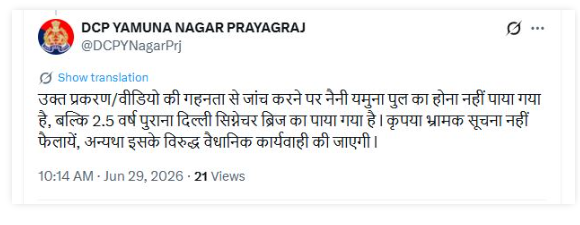
We extracted several keyframes from the viral video and searched them using the Google Lens tool. We found that this video was also quite viral on X (formerly Twitter). Responding to users, the official X handle of DCP Yamuna Nagar, Prayagraj, stated, “Upon a detailed research of the said matter/video, it has been found that it is not from the Naini Yamuna Bridge, but is a 2.5-year-old video from Delhi’s Signature Bridge. Please do not spread misleading information, otherwise legal action will be initiated against it.”
During our search, we found a post on the official X handle of the Delhi Police. Sharing the viral video, they wrote that taking cognizance of the auto-rickshaw stunt incident on the Signature Bridge, the Delhi Traffic Police seized the auto-rickshaw and issued a challan totaling ₹32,000 under various sections of the Motor Vehicles Act.
https://x.com/DelhiPolice/status/1735268792434057352?s=20

Conclusion
In our research, the viral post turned out to be fake. A video of an incident that took place on Delhi's Signature Bridge in 2023 is now being falsely circulated to spread misinformation as an incident from a bridge in Prayagraj. No such incident has taken place on the Naini Bridge in Prayagraj.

Introduction
Have you ever wondered how the internet works? Yes, there are screens and wires, but what’s going on beneath the surface? Every time you open a website, send an email, chat on messaging apps, or stream movies, you’re relying on something you probably don’t think about: the TCP/IP protocol suite. Without it, the internet as we know it wouldn’t exist. Let’s take a look at why this unassuming set of rules allows us to connect to anyone anywhere in the world.
The Problem: Networks That Couldn't Talk to Each Other
The internet is widely called a network of networks. A network is a group of devices that are connected and can share data with each other.
Researchers and governments began building early computer networks in the 1960s and 70s. But as the Cold War intensified, the U.S. military felt the need to establish a robust data-sharing infrastructure through interconnected networks that could withstand attacks. At the time, each network had different standards and protocols, which meant getting networks to communicate wasn’t easy or efficient. One network would have to be subsumed into another. This would lead to major problems in the reliability of data relay, flexibility of including more nodes, scalability of the interconnected network, and innovation.
The Breakthrough: Open Architecture Networking
This changed in the 1970s, when Bob Kahn proposed the concept of open architecture networking. It was a simple but revolutionary idea. He envisioned a system where all networks could talk to each other as equals. In this conceptualisation, all networks, even though unique in design and interface, could connect as peers to facilitate end-to-end communication. End-to-end communication helps deliver data between the source and destination without relying on intermediate nodes to control or modify it. This helps to make data relay more reliable and less prone to errors.
Along with Vint Cerf, he developed a network protocol, the TCP/IP suite, that would go on to enable different networks across satellite, wired, and non-wired domains to communicate with one another.
What Is TCP/IP?
TCP/IP stands for Transmission Control Protocol / Internet Protocol. It’s a set of communication rules that allow computers and devices to exchange information across different networks.
It’s powerful because:
- Layered and open architecture: Each function (like data delivery or routing) is handled by a specific layer. This modular design makes it easy to build new technologies like the World Wide Web or streaming services on top of it.
- Decentralisation: There's no single point of control. Any device can connect to another across the internet, making it scalable and resilient.
- Standardisation: TCP/IP works across all kinds of hardware and operating systems, making it truly universal.
The Core Components
- TCP (Transmission Control Protocol): Ensures that data is delivered accurately and in order. If any piece is lost or duplicated, TCP handles it.
- IP (Internet Protocol): Handles addressing and routing. It decides where each packet of data should go and how it gets there.
- UDP (User Datagram Protocol): A lightweight version of TCP, used when speed is more important than accuracy, such as for video calls or online gaming.
Why It Matters
The TCP/IP protocol suite introduced a set of standardised guidelines that enable networks to communicate, thereby laying the foundation of the Internet. It has made the Internet global, open, reliable, interoperable, scalable, and resilient, — features because of which the Internet has come to become the backbone of modern communication systems. So the next time you open a browser or send a message, remember: it’s TCP/IP quietly making it all possible.
References
- https://www.techtarget.com/searchnetworking/definition/ARPANET
- https://www.internetsociety.org/internet/history-internet/brief-history-internet/
- https://www.geeksforgeeks.org/tcp-ip-model/
- https://www.oreilly.com/library/view/tcpip-network-administration/0596002971/ch01.html
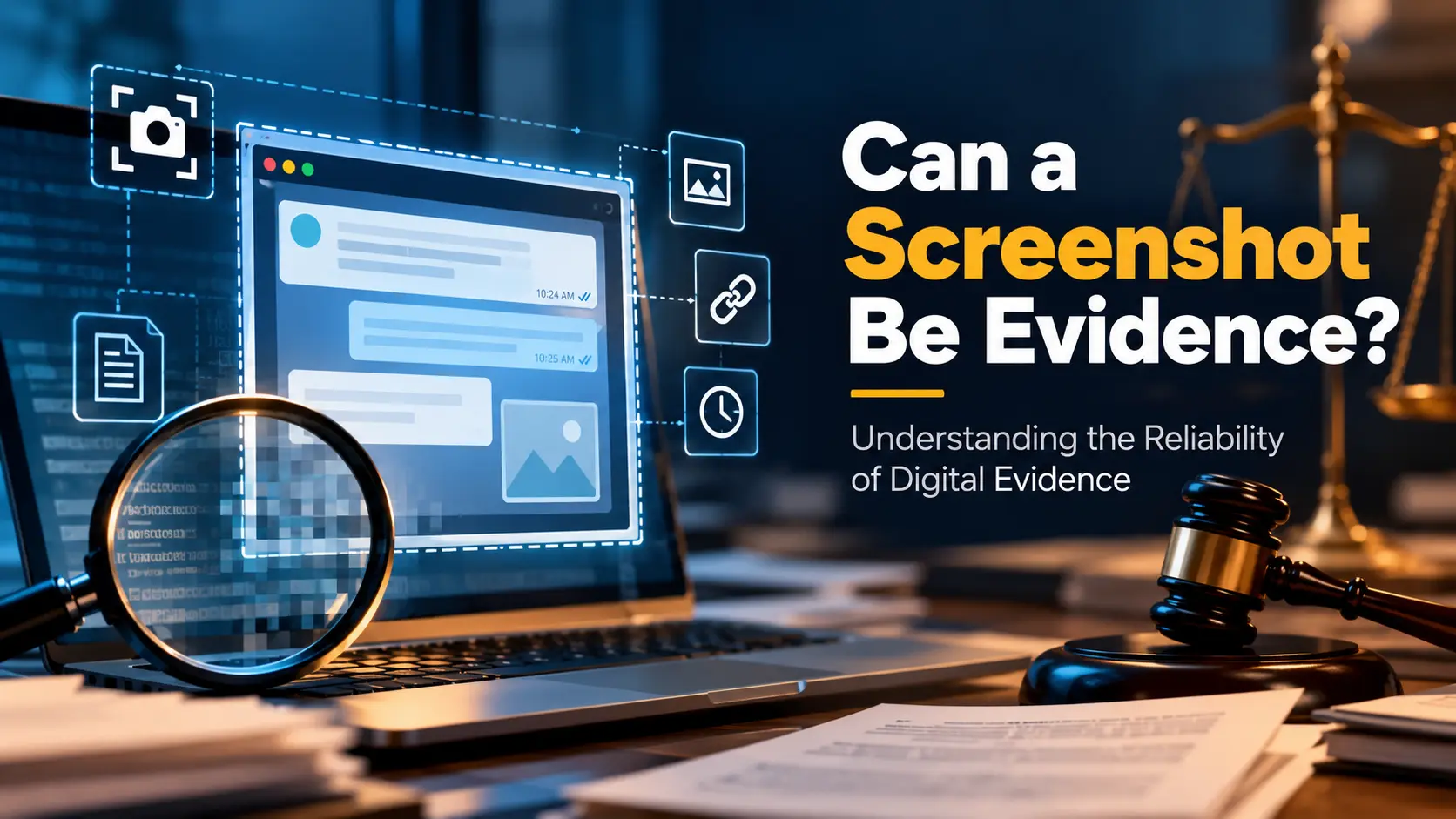
Forensic Reality Check
A screenshot shows what appeared on a screen. It does not automatically prove who created the content, whether it was altered, or what happened outside the frame.
Introduction
In today's period of time ,we observe that a screenshot seems like evidence. A screenshot can feel like proof. The screenshot comes with a name, a timestamp, a profile picture and a message all neatly placed inside an app we know well. In cases involving fraud, harassment, workplace conflicts or cybercrime individuals often send a screenshot first to the police, a company or a lawyer. This makes sense. When something troubling shows up on a phone or computer taking a screenshot feels like the thing to do. The screenshot captures the moment like a photo.
There is another side to evidence. A screenshot only shows what was on the screen at that moment. The screenshot does not tell us where the content came from. The screenshot does not show who had control of the account. The screenshot does not say if the image was edited. The screenshot does not reveal what happened before or after the screenshot was taken. The Bharatiya Sakshya Adhiniyam 2023 recognizes records. The Bharatiya Sakshya Adhiniyam also sets out rules for proving them. That means the real question is not just "Is this screenshot real?" The bigger question is, "Can we explain and verify the story behind it?”
A screenshot is evidence - but not automatically the whole story
Think of a common situation. A person receives a screenshot of a chat in which someone appears to demand money and threaten to publish private documents. The image looks genuine. Yet an investigator would still ask: Was the message actually sent? From which account or device? Does the date and time match the service records? Is the conversation complete?
Those questions do not make the screenshot useless. They make the investigation stronger.
Digital information can be copied, compressed, cropped, forwarded, or edited with little visible sign. NIST describes digital evidence as information of probative value stored or transmitted in binary form and emphasises preservation because digital files are easy to change. [3][4] The forensic mindset is simple: ask whether an image’s origin, context and integrity can be explained.
What makes a screenshot more reliable?
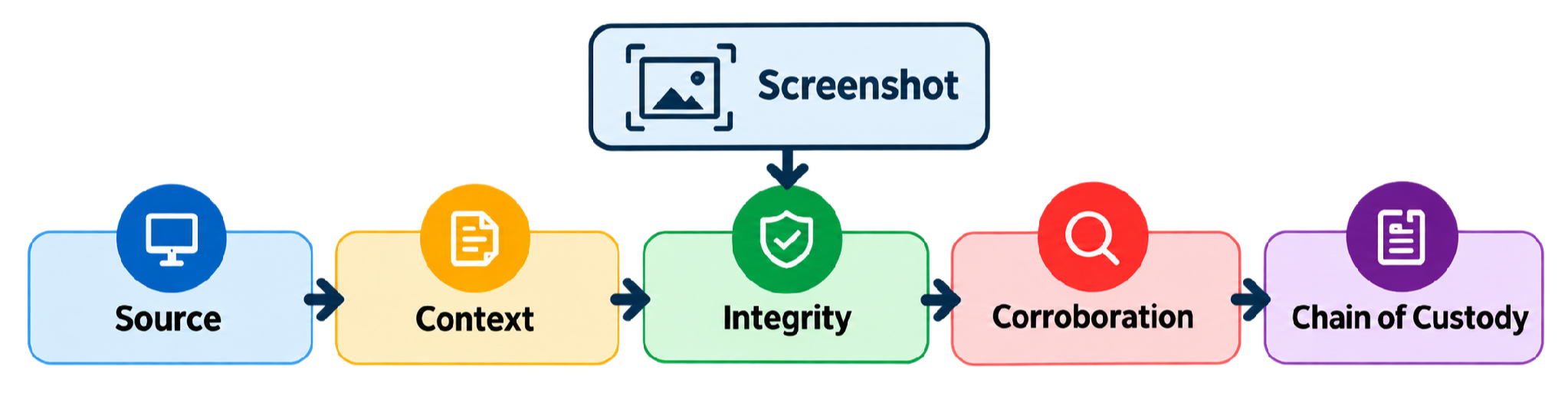
A stronger evidence package normally answers five practical questions:
• Source - Where did the image come from: a phone, laptop, messaging application, email client, cloud account, or another person?
• Context - Does it preserve the relevant username, number, URL, date, time, surrounding messages, and sequence?
• Integrity - Has the original file been retained, and can later changes be detected?
• Corroboration - Do other records support the same event, such as device artifacts, email headers, transaction data, or witness accounts?
• Chain of custody - Who collected it, when, how was it transferred, and where was it stored?
Hashing helps with integrity. A cryptographic hash acts like a digital fingerprint for a file. If the file changes, its hash value changes. NIST recommends hashing digital images and other evidence objects and securely preserving the resulting hash values. [4][5] A hash does not prove the content is truthful; it helps show that the file examined is the file that was preserved.
The Indian legal angle: admissibility is not the same as authenticity
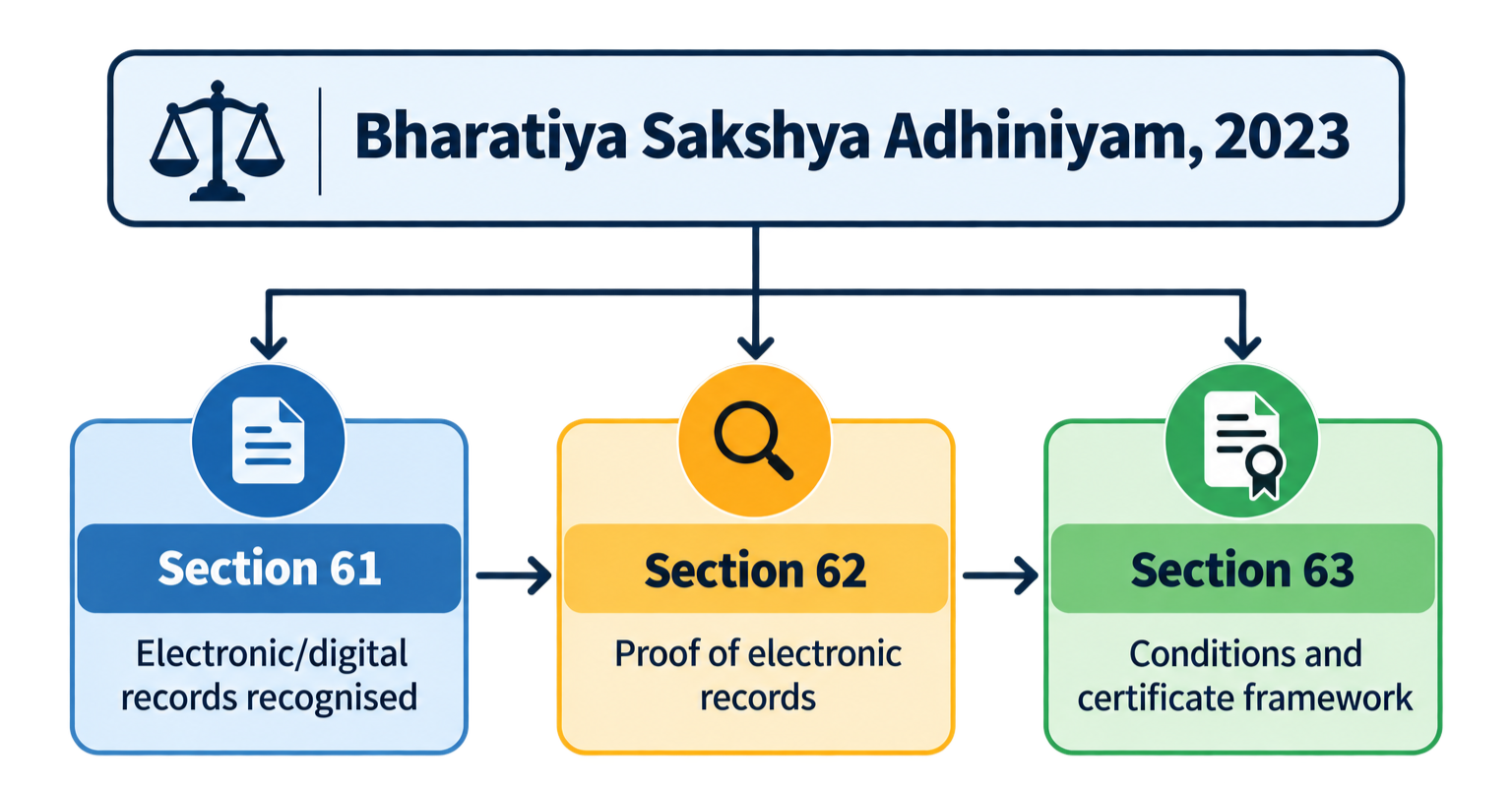
India’s current evidence framework is equally important. The Bharatiya Sakshya Adhiniyam, 2023 came into force on 1 July 2024. Section 61 says an electronic or digital record cannot be denied admissibility merely because it is electronic, subject to the Act. Section 62 directs that electronic records are proved in accordance with Section 63. [1]
Section 63 sets out conditions for admissibility and, where it applies, requires a certificate to accompany the electronic record when submitted for admission. The Schedule includes device details and fields for the relevant hash value and algorithm. [2]
There is an important practical nuance: not every screenshot automatically requires the same proof route. Treatment can depend on what is produced, how it was obtained, and how it is tendered. Investigators should preserve the underlying source wherever lawfully possible rather than treat a screenshot as a self-proving substitute for the original record.
In Pooranmal v. State of Rajasthan, decided on 10 March 2026, the Supreme Court considered call detail records rather than screenshots and held, in that case, that the certificate requirement under Section 63 was mandatory for the electronic record relied upon there. [6] The broader lesson is that digital evidence must be presented through the legal proof framework that applies to it.
REALISTIC EXAMPLE A screenshot arrives. The investigation starts.
Consider a realistic cyber-fraud complaint. A victim receives a screenshot showing what appears to be a message from a senior company executive asking an employee to transfer money urgently. The safest response is not to decide immediately whether it “looks genuine.” The investigator can preserve the original image, record its source, calculate a hash, and look for supporting material: the actual chat or email, device data, account identifiers, timestamps, transaction records, or login history.
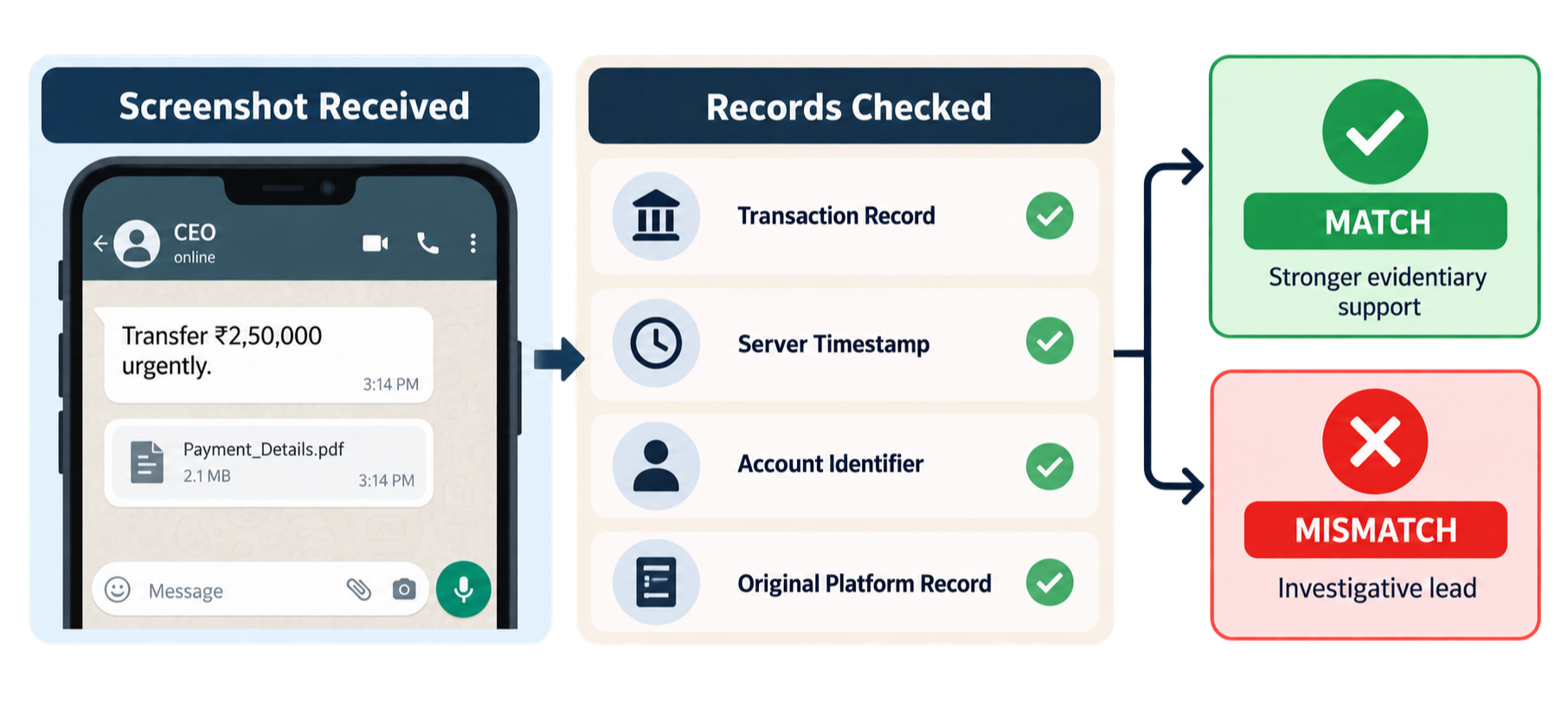
Suppose the screenshot says 3:14 p.m., but the underlying account record shows the message was never sent. That contradiction becomes an investigative lead. If the screenshot matches the original device data and independent records, its evidentiary value becomes stronger.
The human side matters too. A victim should not be criticised for taking a screenshot. In many incidents, it is the quickest way to show another person what happened. The forensic response is simply to go one step further: preserve first, verify next, interpret last.
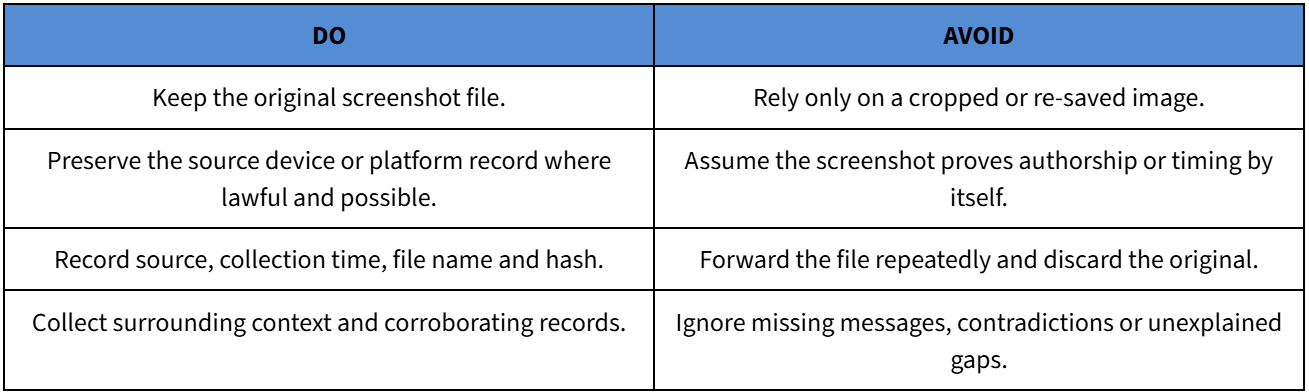
A small checklist can prevent a big evidentiary problem
The bigger lesson
Screenshots are valuable because they can preserve a moment that may later disappear: a threat, a suspicious payment instruction, a spoofed webpage, or a social-media post. But a convincing image is not the same thing as a complete digital record.
Good digital forensics connects the artifact to a source, a timeline, a method of collection, and independent facts. NIST’s work on digital evidence emphasises preservation, controlled handling, and awareness of the limits of forensic conclusions. [3][4] Confidence should follow the evidence, not replace it.
Conclusion
So, can a screenshot be evidence? The important question is whether the screenshot can be verified, put into context and backed up by evidence when the case needs it. For citizens the practical advice is clear: keep the screenshot, do not delete the screenshot, keep the screenshot and do not rely only on a forwarded copy. Preserving the source device or original platform record were lawful and possible.
For investigators and organisations, the standard is higher. Record the source and collection details preserve the screenshot, calculate and document hashes, maintain chain of custody and seek corroboration. A screenshot can open the door to an investigation. Good forensic practice is what helps establish what happened on the side of that door.
References
[1] India Code, The Bharatiya Sakshya Adhiniyam, 2023, Sections 61-62; commencement from 1 July 2024. Source
[2] India Code, The Bharatiya Sakshya Adhiniyam, 2023, Section 63 and Schedule - certificate for electronic records, including device particulars and hash value fields. Source
[3] NIST, Digital Evidence, overview of digital evidence and forensic challenges. Source
[4] NIST, Digital Evidence Preservation: Considerations for Evidence Handlers, NISTIR 8387, 2022. Source
[5] NIST / OSAC Lexicon, “Hash, Hash Value,” 2025. Source
[6] Supreme Court of India, Pooranmal v. State of Rajasthan & Anr., 2026 INSC 217, judgment dated 10 March 2026. Source
[7] NIST, ANSI/ASTM E3016-18 Standard Guide for Establishing Confidence in Digital and Multimedia Evidence Forensic Results by Error Mitigation Analysis. Source
