
#FactCheck - Viral Video Claiming Iran’s Attack on US Airbase Debunked as 9/11 Footage
Executive Summary
A video showing thick smoke rising from a building and people running in panic is being shared on social media. The video is being circulated with the claim that it shows Iran launching a missile attack on the United States.CyberPeace’s research found the claim to be misleading. Our probe revealed that the video is not related to any recent incident. The viral clip is actually from the September 11, 2001 terrorist attacks on the World Trade Center in the United States and is being falsely shared as footage of an alleged Iranian missile strike on the US.
Claim:
An Instagram user shared the video claiming, “Iran has attacked a US airbase in Qatar. Iran has fired six ballistic missiles at the Al Udeid Airbase in Qatar. Al Udeid Airbase is the largest US military base in West Asia.”
Links to the post and its archived version are provided below.

Fact Check:
To verify the claim, we extracted key frames from the viral video and ran a reverse image search using Google Lens. During the search, we found visuals matching the viral clip in a report published by Wion on September 11, 2021. The report, titled “In pics | A look back at the scenes from the 9/11 attacks,” included an image that closely resembled the visuals seen in the viral video. The caption of the image stated that it was a file photo from September 11, 2001, showing pedestrians running as one of the World Trade Center towers collapsed in New York City.

Further research led us to the same footage on the YouTube channel CBS 8 San Diego. At the 01:11 timestamp of the video, visuals matching the viral clip can be clearly seen.

We also found an Al Jazeera report dated June 23, 2025, which confirmed that Iran had attacked US forces stationed at the Al Udeid airbase in Qatar in retaliation for US strikes on Iran’s uclear facilities. However, the visuals used in the viral video do not correspond to this incident.

Conclusion
The viral video does not show a recent Iranian attack on a US airbase in Qatar. The clip actually dates back to the September 11, 2001 terrorist attacks on the World Trade Center in the United States. Old 9/11 footage has been falsely shared with a misleading claim linking it to Iran’s alleged missile strike on the US.

Related Blogs

In an era defined by perpetual technological advancement, the hitherto uncharted territories of the human experience are progressively being illuminated by the luminous glow of innovation. The construct of privacy, once a straightforward concept involving personal secrets and solitude, has evolved into a complex web of data protection, consent, and digital rights. This notion of privacy, which often feels as though it elusively ebbs and flows like the ghost of a bygone epoch, is now confronted with a novel intruder – neurotechnology – which promises to redefine the very essence of individual sanctity.
Why Neuro Rights
At the forefront of this existential conversation lie ventures like Elon Musk's Neuralink. This company, which finds itself at the confluence of fantastical dreams and tangible reality, teases a future where the contents of our thoughts could be rendered as accessible as the words we speak. An existence where machines not only decipher our mental whispers but hold the potential to echo back, reshaping our cognitive landscapes. This startling innovation sets the stage for the emergence of 'neurorights' – a paradigm aimed at erecting a metaphorical firewall around the synapses and neurons that compose our innermost selves.
At institutions such as the University of California, Berkeley, researchers, under the aegis of cognitive scientists like Jack Gallant, are already drawing the map of once-inaccessible territories within the mind. Gallant's landmark study, which involved decoding the brain activity of volunteers as they absorbed visual stimuli, opened Pandora's box regarding the implications of mind-reading. The paper published a decade ago, was an inchoate step toward understanding the narrative woven within the cerebral cortex. Although his work yielded only a rough sketch of the observed video content, it heralded an era where thought could be translated into observable media.
The Growth
This rapid acceleration of neuro-technological prowess has not gone unnoticed on the sociopolitical stage. In a pioneering spirit reminiscent of the robust legislative eagerness of early democracies, Chile boldly stepped into the global spotlight in 2021 by legislating neurorights. The Chilean senate's decision to constitutionalize these rights sent ripples the world over, signalling an acknowledgement that the evolution of brain-computer interfaces was advancing at a daunting pace. The initiative was spearheaded by visionaries like Guido Girardi, a former senator whose legislative foresight drew clear parallels between the disruptive advent of social media and the potential upheaval posed by emergent neurotechnology.
Pursuit of Regulation
Yet the pursuit of regulation in such an embryonic field is riddled with intellectual quandaries and ethical mazes. Advocates like Allan McCay articulate the delicate tightrope that policy-makers must traverse. The perils of premature regulation are as formidable as the risks of a delayed response – the former potentially stifling innovation, the latter risking a landscape where technological advances could outpace societal control, engendering a future fraught with unforeseen backlashes.
Such is the dichotomy embodied in the story of Ian Burkhart, whose life was irrevocably altered by the intervention of neurotechnology. Burkhart's experience, transitioning from quadriplegia to digital dexterity through sheer force of thought, epitomizes the utopic potential of neuronal interfaces. Yet, McCay issues a solemn reminder that with great power comes great potential for misuse, highlighting contentious ethical issues such as the potential for the criminal justice system to over extend its reach into the neural recesses of the human psyche.
Firmly ensconced within this brave new world, the quest for prudence is of paramount importance. McCay advocates for a dyadic approach, where privacy is vehemently protected and the workings of technology proffered with crystal-clear transparency. The clandestine machinations of AI and the danger of algorithmic bias necessitate a vigorous, ethical architecture to govern this new frontier.
As legal frameworks around the globe wrestle with the implications of neurotechnology, countries like India, with their burgeoning jurisprudence regarding privacy, offer a vantage point into the potential shape of forthcoming legislation. Jurists and technology lawyers, including Jaideep Reddy, acknowledge ongoing protections yet underscore the imperativeness of continued discourse to gauge the adequacy of current laws in this nascent arena.
Conclusion
The dialogue surrounding neurorights emerges, not merely as another thread in our social fabric, but as a tapestry unto itself – intricately woven with the threads of autonomy, liberty, and privacy. As we hover at the edge of tomorrow, these conversations crystallize into an imperative collective undertaking, promising to define the sanctity of cognitive liberty. The issue at hand is nothing less than a societal reckoning with the final frontier – the safeguarding of the privacy of our thoughts.
References:

Executive Summary
In the Philippines, social media users have been sharing a video and an image following complaints over sharp increases in electricity bills. The posts claim that, in exchange for higher electricity charges, low-income households are being provided free electricity and air conditioning units. However, a fact-check by CyberPeace Research Wing found no evidence to support these claims. A closer examination of the visuals revealed several inconsistencies and visual indicators suggesting that the content is likely AI-generated.
Claim
An image was also shared on Instagram on April 29, showing purported beneficiaries holding new air conditioning units allegedly provided “free by the government.”

Fact Check
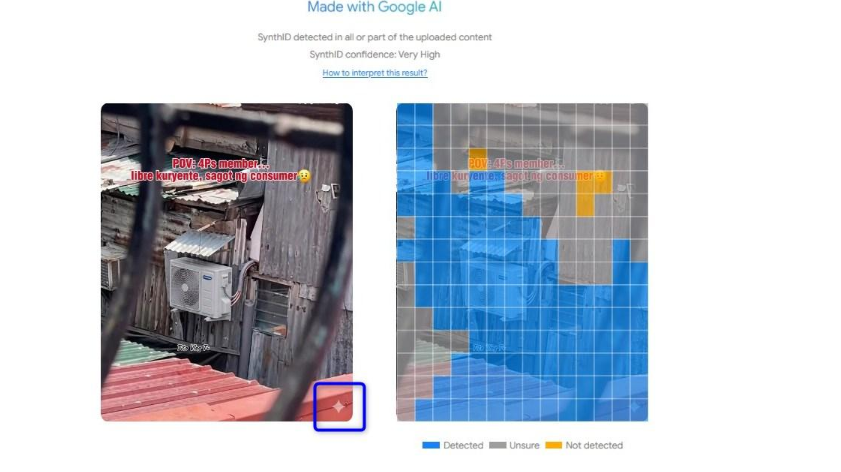
However, the video and image circulating on social media do not actually show beneficiaries receiving any subsidy. A closer analysis of the visuals indicates that the content is AI-generated. In the initial frames of the misrepresented video, a diamond-shaped icon can be seen in the bottom-right corner, which is the watermark associated with Google’s Gemini AI model.
Further analysis using Google’s SynthID Detector, a tool designed to identify AI-generated content, indicated with a “very high” level of confidence that the material was created using the company’s AI technology.
The country’s social welfare agency also issued a statement on Facebook on April 30, rejecting the claim and saying it is “not true” and intended only to “propagate wrong information.” Social welfare agency statement on Facebook
- https://www.facebook.com/photo?fbid=1373756198132587&set=a.665386155636265

Conclusion
However, the video and image circulating on social media do not actually show beneficiaries receiving any subsidy. A closer analysis of the visuals indicates that the content is AI-generated. In the initial frames of the misrepresented video, a diamond-shaped icon can be seen in the bottom-right corner, which is the watermark associated with Google’s Gemini AI model. The viral video and image are misleading. Multiple inconsistencies and visual cues suggest that the content is likely AI-generated, and the claim that low-income households are receiving free electricity and air conditioners is false.
.webp)
Introduction
The war over children and social media, once mostly waged in headlines, committee hearings, and video clips of executives begging apologies from distraught families, has officially reached to courts. This past Monday, August 26, 2026, Meta reportedly agreed to settle for an estimated $18 billion for the sprawling, multi-state class action suit that accused the social media titan of intentionally designing Instagram and Facebook to be addictive for children and of actively failing to shield them from child abuse imagery, disordered eating websites and much more. This record $18 billion, one of the largest ever obtained against a consumer-facing business, occurred just over a week into a high-profile trial in Oakland, in which four states pursued nearly $1.4 trillion in damages against Meta. Even more important than the headline figure, though, is what actually lies in the fine print (or what the settlement leaves distinctly out): the future of teen safety law.
What Meta agreed to pay and to whom
The settlement resolves claims brought jointly by 29 states in 2023, which eventually grew into a coalition of 47 states, the District of Columbia, and several U.S. territories. Just over $17 billion goes toward that multistate case, with the remainder settling claims from other states. Notably, three states, Texas, New Mexico, and Florida, settled separately. Texas alone secured over $1 billion, on top of the $1.4 billion Meta paid the state in 2024 over biometric data misuse. New Mexico had already won its own jury trial in March 2026, when jurors found Meta violated the state's consumer protection law and ordered a $375 million penalty; a judge later added further penalties, pushing that case's total past $560 million.
Under the multistate deal, there's a revealing structural detail: Meta will hand over only 70% of the total (about $12.7 billion) unless TikTok and YouTube also agree to adopt matching safety measures, daily time limits, night mode, and age assurance tools. The remaining 30% ($5.3 billion) is contingent on rivals falling in line and paying comparable sums. In other words, Meta is using its own settlement as leverage to drag competitors into the same regulatory box, a move Meta's chief legal officer, C.J. Mahoney, framed as setting "the right path forward for our whole industry".
Changes made by the Platform
Beyond the check, Meta has committed to a list of design changes for teen accounts:
- A default two-hour daily screen-time limit, with prompts every 15 minutes encouraging "intentional use"
- Accounts that Meta flags belonging to minors will be blocked from the apps overnight (midnight–6 a.m.)
- Notifications muted during school hours (8 a.m.–3 p.m.)
- Teens will no longer see "like" counts on their own or others' posts by default
- Continued investment in AI-driven age-detection technology — the "adult classifier" system Meta has been building since 2021, which scans behavioral signals (who you follow, what you engage with, even "happy birthday" posts) to guess whether an account belongs to a minor, regardless of the birthday entered at signup
Meta has also publicly called on app stores to shoulder more of the age-verification burden themselves, a signal that the next legal battleground may shift from the apps themselves to the operating systems and stores that distribute them.
Why critics say the "money machine" walks away largely intact
Here is the uncomfortable arithmetic several legal analysts have pointed out: Meta's $18 billion is being paid out over 10 years, against a company whose 2025 revenue exceeded $200 billion. As one technology litigator told TechCrunch, spreading the payment over a decade "really does blunt the financial impact of the large number". Meta did not admit wrongdoing. No executive faces personal liability. And crucially, the design changes Meta agreed to are largely features it had already begun rolling out voluntarily: teen accounts, PG-13 content defaults, and AI age detection, meaning the settlement in some ways ratifies Meta's existing roadmap rather than forcing a fundamentally different business model. Child-safety advocates have voiced similar scepticism. As one advocacy group leader put it around Meta's earlier safety announcements, such moves are as much about managing the narrative as they are about substantive protection.
Work in Progress
Perhaps the most important vulnerability in the settlement is this: nearly every protection Meta's promise depends on accurately knowing who is a teenager. Age-verification and age-prediction technology remains genuinely unreliable. Meta itself has never disclosed hard accuracy figures for its AI "adult classifier", and outside researchers have long warned that both self-declared birthdates and AI inference are trivially gamed by tech-savvy teens — and prone to misclassifying adults. If the underlying age-detection layer is porous, the two-hour limits, overnight blackouts, and muted like counts are protections that exist only for the users who show up to be counted.
Why this case is really about digital ID
This is where the story stops being just a corporate-liability story and becomes a civil-liberties one. The original complaint from California, Colorado, Kentucky, and New Jersey explicitly asked the court to compel Meta to implement "multi-layered age verification at account sign-up" going beyond birthdates to methods like submitting student IDs. As digital-rights outlet Reclaim The Net has argued, verifying that some users are minors necessarily means putting every user through an identity check because the system can't know who's underage without checking everyone. That's the quiet trade-off sitting inside nearly every child-safety proposal now moving through state legislatures and courts: protecting kids online, as currently conceived by regulators, increasingly means asking adults to prove who they are just to open an app.
Judge Yvonne Gonzalez Rogers, who is overseeing the underlying federal case, took the unusual step of empanelling an advisory jury to weigh in on specific factual questions even as settlement talks proceeded, which is a sign that courts are trying to build a durable evidentiary record regardless of how individual cases resolve. That record, which is an unsealed internal research, executive testimony, and coroners' findings cited in court filings is exactly the kind of material state and federal lawmakers will cite for years as they draft the next generation of age-verification and social media laws.
Conclusion
The Meta settlement is unlikely to be the last of its kind. Thousands of similar lawsuits from families, school districts, and other states remain active, and the California bellwether trial's findings will likely shape settlement math for TikTok, YouTube, and Snap. Expect three parallel tracks to accelerate: state legislatures pushing app-store-level age verification; plaintiffs' lawyers using unsealed Meta documents as templates for the next wave of suits; and Meta itself continuing to invest in AI-based age detection partly to protect teens and partly to insulate itself from the next $18 billion bill. Whether that technology can be built without turning every internet user into someone who has to prove their age at the door is the legal and technological question that will define this fight for the next decade.
Sources
- Meta settles landmark state child harm claims for $18 billion – CNN Business
- Meta's $18B child-safety deal hinges on age-verification tech that doesn't work well – TechCrunch
- Meta to pay 47 states up to $17.1B in landmark child safety settlement – Stateline
- Meta's $18bn settlement: How social platforms will change for child users – Al Jazeera
- Meta to pay Texas $1 billion in child safety case – The Texas Tribune
- Meta Trial Opens as States Demand Age Verification – Reclaim The Net
- States' complaint against Meta (PDF) – Reclaim The Net document archive
- Jury finds Meta's platforms harmful to children in first wave of lawsuits – PBS NewsHour / AP
- Instagram's AI-based teen account detection – TechCrunch
