#FactCheck- Brigadier Assault in Delhi Not Linked to Dance Club or Military Operation
Executive Summary
Misleading claims related to an incident in Delhi are being widely circulated on social media. Several posts allege that an Indian Army brigadier and his son were assaulted while returning from a “dance club party.” The posts further claim that the attack was triggered by remarks related to “Operation Sindoor.” However, research by the CyberPeace found that these claims are completely false and fabricated.
Claim
On social media platform X, some users (including @ManipurPost5) shared posts claiming that an Indian Army brigadier and his son were attacked after returning from a dance club. The posts also alleged that the altercation escalated after someone mocked “Operation Sindoor.”
Fact check
To verify the claim, we conducted keyword searches on Google and found a report published by Republic World on April 14, 2026, which included visuals similar to those being circulated.
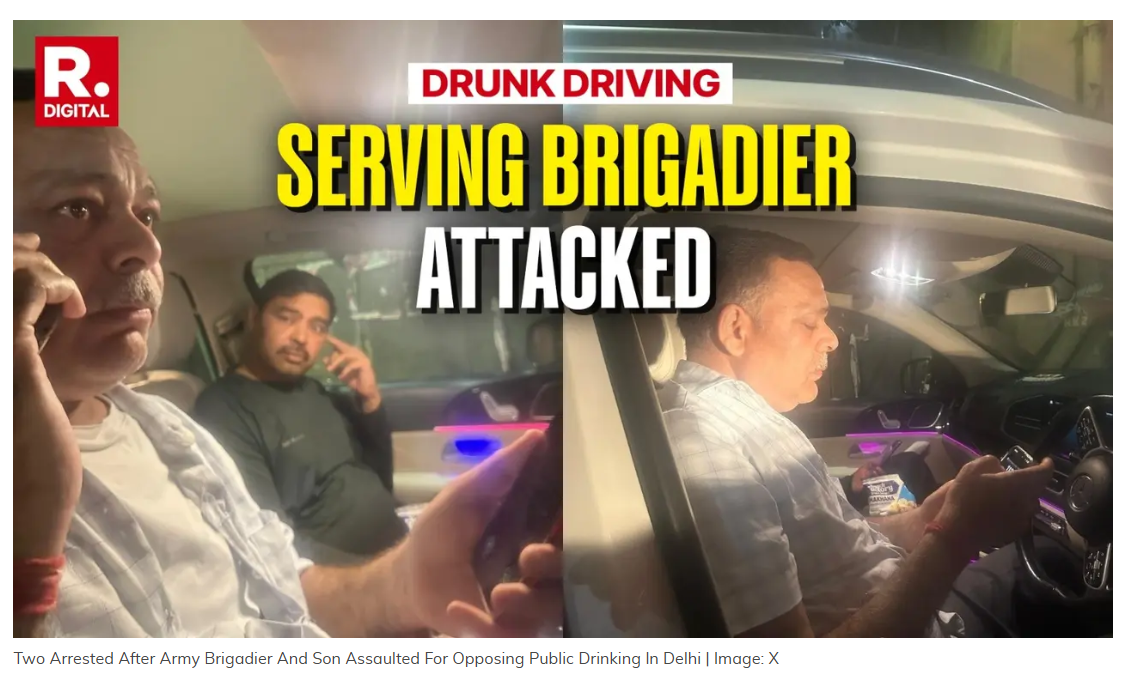
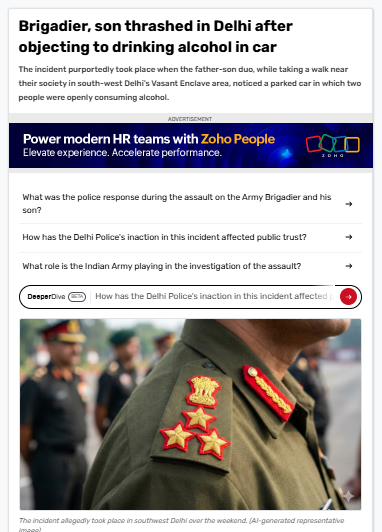
According to the report, the victims were identified as Brigadier Parminder Singh Arora, a serving Indian Army officer, and his son Tejas Arora. At the time of the incident, they were taking a walk near their residence after dinner. Reports state that they noticed a group of individuals consuming alcohol inside a parked car in a public place and objected to it. This led to an argument, which later escalated into a violent assault. Around 7–8 individuals allegedly attacked the brigadier and his son, with the son sustaining more serious injuries. Questions have also been raised about the role of police personnel present at the scene. Following the complaint, a case was registered, one police constable was suspended, and two accused individuals have been arrested so far. The vehicle involved has also been seized. Further verification led us to another report published by India Today on April 14, 2026, which corroborated the same details of the incident.
Conclusion
The viral claim is misleading and entirely false.The incident has no connection to any “dance club party” or to “Operation Sindoor.” In reality, the altercation began after the brigadier objected to public drinking near his residence.
Related Blogs

Introduction
Misinformation is no longer a challenge limited to major global platforms or widely spoken languages. In India and many other countries, false information is increasingly disseminated through local and vernacular languages, allowing it to reach communities more directly and intimately. While regional language content has played a crucial role in expanding access to information, it has also emerged as a powerful driver of misinformation by bad actors, and it often becomes harder to detect and counter. The challenge of local language misinformation is not merely digital in nature; it is deeply social, cultural, and shaped by specific local contexts.
Why Local-Language Misinformation Is More Impactful
A person’s mother tongue can be a highly effective medium for misinformation because it carries emotional resonance and a sense of authenticity. Information that aligns with an individual’s linguistic and cultural background is often trusted the most. When false narratives are framed using familiar expressions, local references, or community-specific concerns, they are more readily accepted and shared more widely.
Misinformation in a language like English, which is more heavily moderated, does not usually have the same impact as content in vernacular languages. In the latter case, such content tends to circulate within closed networks such as family WhatsApp groups, regional Facebook pages, local YouTube channels, and community forums. These spaces are often perceived as safe or trusted, which lowers scepticism and encourages the spread of unverified information.
The Role of Digital Platforms and Algorithms
Although social media platforms have opened up access to the content of regional languages, the moderation mechanisms have not kept up. The automated control systems for content are frequently trained mainly on the dominant languages, thus missing the detection of vernacular speech, slang, dialects, and code-mixing.
This results in a disparity in the enforcement of laws where misinformation in local languages:
- Doesn’t go through automated fact-checking tools
- Is subject to human moderation takes place at a slower pace
- Is less prone to being reported or flagged
- Gains unrestrained access for a longer time period than first imagined
The problem is further magnified by algorithmic amplification. Content that triggers very strong emotional reactions fear, anger, pride, or outrage, has a higher chance of being promoted, irrespective of its truthfulness. In regional situations, such content may very quickly sway public opinion even in very closely knit communities.
Forms of Vernacular Misinformation
Local-language misinformation appears in various forms:
- Health misinformation, with such examples as panic remedies, vaccine myths, and misleading medical prescriptions
- Political misinformation, which is mostly identified with regional identity, local grievances, or community narratives
- Rumours regarding disasters that are very hard to control and spread hatred during floods, earthquakes, or other public emergencies
- Economic and financial frauds that are perpetrated via the local dialect authorities or trusted institutions
- Cultural and religious untruths, which are based on exploiting the core of the beliefs
The regional aspect of such misinformation makes it very difficult to be corrected because the fact-checks in other languages may not get to that audience.
Community-Level Consequences
The effect of misinformation in local languages is not only about the misdirection of individuals. It can also:
- Negatively affect the process of public institutions gaining trust
- Support social polarisation and communal strife
- Get in the way of public health measures
- Help shape the decision-making process in elections at the grassroots level
- Take advantage of the digitally illiterate poor people
In a lot of scenarios, the damage done is not instant but rather accumulative, thus changing perceptions and supporting false worldviews more.
Why Countering Vernacular Misinformation Is Difficult
Multiple structural layers make it difficult to respond effectively:
- Variety of Languages: Just in India, there are many languages and dialects, which are very hard to monitor universally.
- Culturally Aware Systems: The local languages sometimes bear meanings that are deeply rooted in the culture, such as by using sarcasm or referring to history, and automated systems are unable to interpret it correctly.
- Reporting Not Common: Users might not spot misinformation or may not want to be a part of the struggle by showing the content shared by reliable members of the community.
- Insufficient Fact-Checking Capacity: Resources are often unavailable for fact-checking organisations to perform their duties worldwide in different languages effectively.
Building a Community-Centric Response
Overcoming misinformation in local languages needs a community-driven resilience approach instead of a platform-centric one. Some of the key actions are:
- Boosting Digital Literacy: Users will be able to question, verify, and put the content on hold before sharing it, thanks to the regional language awareness campaigns that will be conducted.
- Facilitating Local Fact-Checkers: Local journalists, educators, and NGOs are the main players in providing the context for verification.
- Accountability of Platforms: It is necessary for technology companies to support global moderation in several languages, the hiring of local experts, and the implementation of transparent enforcement mechanisms.
- Contemplating Policy and Governance: Regulatory frameworks should facilitate proactive risk assessment while controlling the right to free expression.
- Establishment of Trusted Local Intermediaries: Community leaders, health workers, teachers, and local organisations can engage in preventing misinformation among the networks that they are trusted in.
The Way Forward
Misinformation in local languages is not a minor concern; it is an issue that directly affects the future of digital trust. As the number of users accessing the internet through local language interfaces continues to grow, the volume and influence of regional content will also increase. If measures do not include all language groups, misinformation will remain least corrected and most influential at the community level, where it is also the hardest to identify and address.
Such a problem exists only if the power of language is not recognised. Therefore, one can say that it is necessary to protect the quality of information in local languages, not only for digital safety but for other factors as well, such as social cohesion, democratic participation, and public well-being.
Conclusion
Vernacular content has the potential to be very powerful in the ways it can inform, include and empower; meanwhile, if it goes unmonitored, it has the same potential to mislead, divide, and harm. Mis-disinformation in local languages calls for the cooperation of platforms, regulators, NGOs, and the communities involved. To win over the digital ecosystem, it has to speak all languages, not only for communication but also for protection.
References
- https://www.mdpi.com/2304-6775/10/2/15
- https://afpr.in/regional-languages-shaping-indias-online-discourse/
- https://medium.com/@pratikgsalvi03/how-indias-misinformation-surge-and-media-credibility-crisis-are-undermining-democracy-public-dc8ad7be8e12
- https://projectshakti.in/
- https://journals.sagepub.com/doi/10.1177/02683962211037693
- https://rsisinternational.org/journals/ijriss/Digital-Library/volume-8-issue-11/505-518.pdf
- https://www.irjmets.com/upload_newfiles/irjmets71200016652/paper_file/irjmets71200016652.pdf
%20(1).webp)
Introduction
Bumble’s launch of its ‘Opening Move’ feature has sparked a new narrative on safety and privacy within the digital dating sphere and has garnered mixed reactions from users. It was launched against the backdrop of women stating that the ‘message first’ policy of Bumble was proving to be tedious. Addressing the large-scale review, Bumble launched its ‘Opening Move’ feature, whereby users can either craft or select from pre-set questions which potential matches may choose to answer to start the conversation at first glance. These questions are a segue into meaningful and insightful conversation from the get-go and overstep the traditional effort to start engaging chats between matched users. This feature is an optional feature that users may enable and as such does not prevent a user from exercising the autonomy previously in place.
Innovative Approach to Conversation Starters
Many users consider this feature as innovative; not only does it act as a catalyst for fluid conversation but also cultivates insightful dialogue, fostering meaningful interactions that are devoid of the constraint of superficial small talk. The ‘Opening Moves’ feature may also be aligned with unique scientific research indicating that individuals form their initial attractions within 3-seconds of intimate interaction, thereby proving to be a catalyst to the decision-making process of an individual in the attraction time frame.
Organizational Benefits and Data Insights
From an organisational standpoint, the feature is a unique solution towards localisation challenges faced by apps; the option of writing a personalised ‘Opening Move’ implies setting prompts that are culturally relevant and appropriate in a specific area. Moreover, it is anticipated that Bumble may enhance and improve user experience within the platform through data analysis. Data from responses to an ‘Opening Move’ may provide valuable insights into user preferences and patterns by analysing which pre-set prompts garner more responses over others and how often is a user-written ‘Opening Move’ successful in obtaining a response in comparison with Bumble’s pre-set prompts. A quick glance at Bumble’s privacy policy[1] shows that data storing and transferring of chats between users are not shared with third parties, further safeguarding personal privacy. However, Bumble does use the chat data for its own internal purposes after removing personally identifiable information from chats. The manner of such review and removal of data has not been specified, which may raise challenges depending upon whether the reviewer is a human or an algorithm.
However, some users perceive the feature as counterproductive to the company’s principle of ‘women make the first move’. While Bumble aims to market the feature as a neutral ground for matched users based on the exercise of choice, users see it as a step back into the heteronormative gender expectations that most dating apps conform to, putting the onus of the ‘first move’ on men. Many male users have complained that the feature acts as a catalyst for men to opt out of the dating app and would most likely refrain from interacting with profiles enabled with the ‘Opening Move’ feature, since the pressure to answer in a creative manner is disproportionate with the likelihood their response actually being entertained.[2] Coupled with the female users terming the original protocol as ‘too much effort’, the preset questions of the ‘Opening Move’ feature may actively invite users to categorise potential matches according to arbitrary questions that undermine real-life experiences, perspectives and backgrounds of each individual.[3]
Additionally, complications are likely to arise when a notorious user sets a question that indirectly gleans personal or sensitive, identifiable information. The individual responding may be bullied or be subjected to hateful slurs when they respond to such carefully crafted conversation prompts.
Safety and Privacy Concerns
On the corollary, the appearance of choice may translate into more challenges for women on the platform. The feature may spark an increase in the number of unsolicited, undesirable messages and images from a potential match. The most vulnerable groups at present remain individuals who identify as females and other sexual minorities.[4] At present, there appears to be no mechanism in place to proactively monitor the content of responses, relying instead on user reporting. This approach may prove to be impractical given the potential volume of objectionable messages, necessitating a more efficient solution to address this issue. It is to be noted that in spite of a user reporting, the current redressal systems of online platforms remain lax, largely inadequate and demonstrate ineffectiveness in addressing user concerns or grievances. This lack of proactiveness is violative of the right to redressal provided under the Digital Personal Data Protection Act, 2023. It is thought that the feature may actually take away user autonomy that Bumble originally aimed to grant since Individuals who identify as introverted, shy, soft-spoken, or non-assertive may refrain from reporting harassing messages altogether, potentially due to discomfort or reluctance to engage in confrontation. Resultantly, it is anticipated that there would be a sharp uptake in cases pertaining to cyberbullying, harassment and hate speech (especially vulgar communications) towards both the user and the potential match.
From an Indian legal perspective, dating apps have to adhere to the Information Technology Act, 2000 [5], the Information Technology (Intermediary and Digital Media Ethics) Rules 2021 [6] and the Digital Personal Data Protection Act, 2023, that regulates a person’s digital privacy and set standards on the kind of content an intermediary may host. An obligation is cast upon an intermediary to uprise its users on what content is not allowed on its platform in addition to mandating intimation of the user’s digital rights. The lack of automated checks, as mentioned above, is likely to make Bumble non-compliant with the ethical guidelines.
The optional nature of the ‘Opening Move’ grants users some autonomy. However, some technical updates may enhance the user experience of this feature. Technologies like AI are an effective aid in behavioural and predictive analysis. An upgraded ‘matching’ algorithm can analyse the number of un-matches a profile receives, thereby identifying and flagging a profile having multiple lapsed matches. Additionally, the design interface of the application bearing a filter option to filter out flagged profiles would enable a user to be cautious while navigating through the matches. Another possible method of weeding out notorious profiles is by deploying a peer-review system of profiles whereby a user has a singular check-box that enables them to flag a profile. Such a checkbox would ideally be devoid of any option for writing personal comments and would bear a check box stating whether the profile is most or least likely to bully/harass. This would ensure that a binary, precise response is recorded and any coloured remarks are avoided. [7]
Governance and Monitoring Mechanisms
From a governance point of view, a monitoring mechanism on the manner of crafting questions is critical. Systems should be designed to detect certain words/sentences and a specific manner of framing sentences to disallow questions contrary to the national legal framework. An onscreen notification having instructions on generally acceptable manner of conversations as a reminder to users to maintain cyber hygiene while conversing is also proposed as a mandated requirement for platforms. The notification/notice may also include guidelines on what information is safe to share in order to safeguard user privacy. Lastly, a revised privacy policy should establish the legal basis for processing responses to ‘Opening Moves’, thereby bringing it in compliance with national legislations such as the Digital Personal Data Protection Act, 2023.
Conclusion
Bumble's 'Opening Move' feature marks the company’s ‘statement’ step to address user concerns regarding initiating conversations on the platform. While it has been praised for fostering more meaningful interactions, it also raises not only ethical concerns but also concerns over user safety. While the 'Opening Move' feature can potentially enhance user experience, its success is largely dependent on Bumble's ability to effectively navigate the complex issues associated with this feature. A more robust monitoring mechanism that utilises newer technology is critical to address user concerns and to ensure compliance with national laws on data privacy.
Endnotes:
- [1] Bumble’s privacy policy https://bumble.com/en-us/privacy
- [2] Discussion thread, r/bumble, Reddit https://www.reddit.com/r/Bumble/comments/1cgrs0d/women_on_bumble_no_longer_have_to_make_the_first/?share_id=idm6DK7e0lgkD7ZQ2TiTq&utm_content=2&utm_medium=ios_app&utm_name=ioscss&utm_source=share&utm_term=1&rdt=65068
- [3] Mcrea-Hedley, Olivia, “Love on the Apps: When did Dating Become so Political?”, 8 February 2024 https://www.service95.com/the-politics-of-dating-apps/
- [4] Gewirtz-Meydan, A., Volman-Pampanel, D., Opuda, E., & Tarshish, N. (2024). ‘Dating Apps: A New Emerging Platform for Sexual Harassment? A Scoping Review. Trauma, Violence, & Abuse, 25(1), 752-763. https://doi.org/10.1177/15248380231162969
- [5] Information Technology Act, 2000 https://www.indiacode.nic.in/bitstream/123456789/13116/1/it_act_2000_updated.pdf
- [6] Information Technology (Intermediary Guidelines and Digital Media Ethics) Rules 2021 https://www.meity.gov.in/writereaddata/files/Information%20Technology%20%28Intermediary%20Guidelines%20and%20Digital%20Media%20Ethics%20Code%29%20Rules%2C%202021%20%28updated%2006.04.2023%29-.pdf
- [7] Date Confidently: Engaging Features in a Dating App (Use Cases), Consaguous, 10 July 2023 https://www.consagous.co/blog/date-confidently-engaging-features-in-a-dating-app-use-cases

Executive Summary:
A viral video claiming to show Israelis pleading with Iran to "stop the war" is not authentic. As per our research the footage is AI-generated, created using tools like Google’s Veo, and not evidence of a real protest. The video features unnatural visuals and errors typical of AI fabrication. It is part of a broader wave of misinformation surrounding the Israel-Iran conflict, where AI-generated content is widely used to manipulate public opinion. This incident underscores the growing challenge of distinguishing real events from digital fabrications in global conflicts and highlights the importance of media literacy and fact-checking.
Claim:
A X verified user with the handle "Iran, stop the war, we are sorry" posted a video featuring people holding placards and the Israeli flag. The caption suggests that Israeli citizens are calling for peace and expressing remorse, stating, "Stop the war with Iran! We apologize! The people of Israel want peace." The user further claims that Israel, having allegedly initiated the conflict by attacking Iran, is now seeking reconciliation.

Fact Check:
The bottom-right corner of the video displays a "VEO" watermark, suggesting it was generated using Google's AI tool, VEO 3. The video exhibits several noticeable inconsistencies such as robotic, unnatural speech, a lack of human gestures, and unclear text on the placards. Additionally, in one frame, a person wearing a blue T-shirt is seen holding nothing, while in the next frame, an Israeli flag suddenly appears in their hand, indicating possible AI-generated glitches.

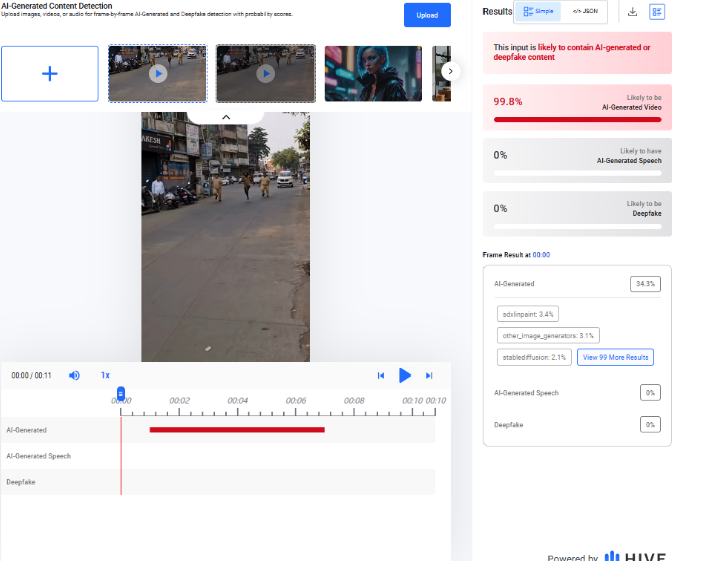
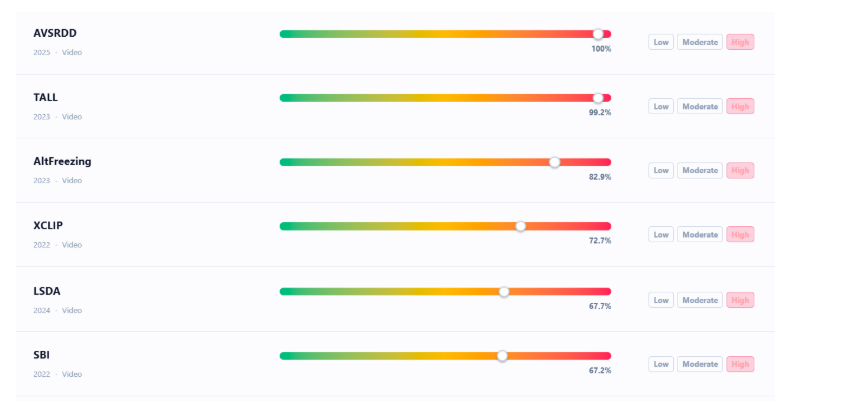
We further analyzed the video using the AI detection tool HIVE Moderation, which revealed a 99% probability that the video was generated using artificial intelligence technology. To validate this finding, we examined a keyframe from the video separately, which showed an even higher likelihood of 99% probability of being AI generated. These results strongly indicate that the video is not authentic and was most likely created using advanced AI tools.

Conclusion:
The video is highly likely to be AI-generated, as indicated by the VEO watermark, visual inconsistencies, and a 99% probability from HIVE Moderation. This highlights the importance of verifying content before sharing, as misleading AI-generated media can easily spread false narratives.
- Claim: AI generated video of Israelis saying "Stop the War, Iran We are Sorry".
- Claimed On: Social Media
- Fact Check:AI Generated Mislead