
#FactCheck - Old Wedding Fire Video Misleadingly Shared as Iranian Hypersonic Missile Strike in Tel Aviv
Executive Summary:
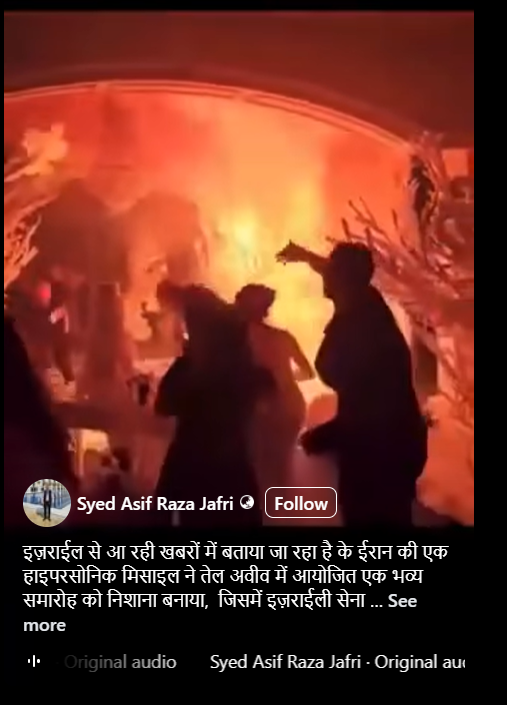
Amid the ongoing conflict involving the United States, Israel, and Iran, a video showing a building engulfed in flames is being widely circulated on social media. In the clip, a large fire can be seen inside a building while several people appear to be running in panic. The video is being shared with the claim that Iran fired a hypersonic missile targeting a ceremony in Tel Aviv, Israel, allegedly killing several Israeli military generals and other prominent figures.
However, research by the CyberPeace found that the claim is false. The video being circulated as footage of an attack in Israel actually predates the current conflict and shows a fire that broke out during a wedding ceremony.
Claim
A Facebook user named “Syed Asif Raza Jafri” shared the video on March 13, 2026, claiming that an Iranian hypersonic missile had struck a grand ceremony in Tel Aviv, where several Israeli military officers, generals, soldiers, and other important personalities were present. According to the post, the attack resulted in multiple casualties.
Source:
- https://www.facebook.com/reel/902182825912364
- https://ghostarchive.org/archive/rZryr
Fact Check
To verify the claim, we began our research using the Google Lens reverse image search tool. Several key frames from the viral video were extracted and searched online.
During the search, we found the same video shared earlier on multiple foreign social media accounts. A Facebook user named “Es de Bombero” from Chile had posted the video on January 17, 2026, describing it in Spanish as footage of a fire that broke out during a wedding celebration.

Our research shows that the viral video had been circulating on social media since at least January 15, 2026, well before the escalation of the current conflict. According to a report published on March 1, 2026, by BBC, the large-scale attacks on Iran by the United States and Israel began on February 28, 2026, after which Iran’s Supreme Leader Ali Khamenei was reported dead.
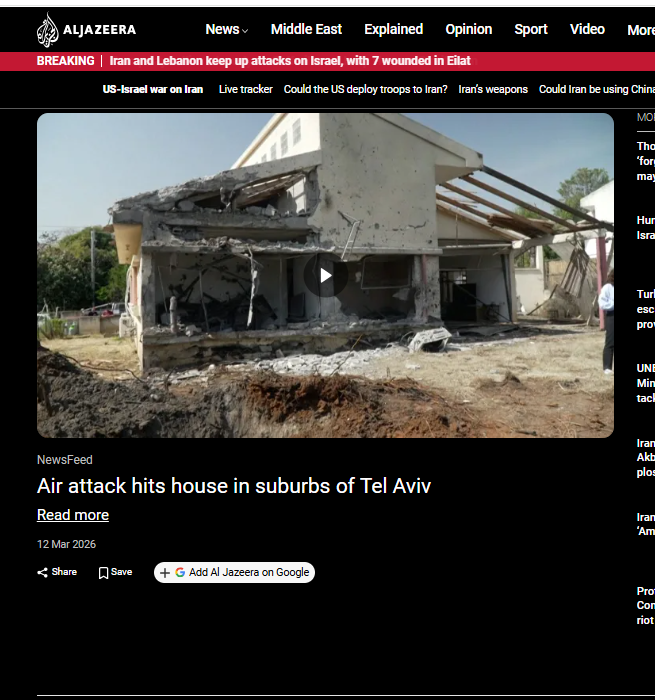
Additionally, a March 12, 2026 report by Al Jazeera stated that a house near Tel Aviv in central Israel was damaged by a rocket reportedly fired by Hezbollah, which has previously carried out joint attacks in coordination with Iran.
Conclusion
The viral video being shared as footage of an Iranian hypersonic missile strike in Tel Aviv is misleading. The clip is an older video of a fire that reportedly broke out during a wedding ceremony and was circulating online before the current conflict began.
While the exact location of the incident shown in the video cannot be independently verified, it is clear that the footage has no connection to the ongoing war between the United States, Israel, and Iran.

Related Blogs

Introduction
Intricate and winding are the passageways of the modern digital age, a place where the reverberations of truth effortlessly blend, yet hauntingly contrast, with the echoes of falsehood. Within this complex realm, the World Economic Forum (WEF) has illuminated the darkened corners with its powerful spotlight, revealing the festering, insidious network of misinformation and disinformation that snakes through the virtual and physical worlds alike. Gravely identified by the “WEF's Global Risks Report 2024” as the most formidable and immediate threats to our collective well-being, this malignant duo—misinformation and disinformation.
The report published with the solemn tone suitable for the prelude to such a grand international gathering as the Annual Summit in Davos, the report presents a vivid tableau of our shared global landscape—one that is dominated by the treacherous pitfalls of deceits and unverified claims. These perils, if unrecognised and unchecked by societal checks and balances, possess the force to rip apart the intricate tapestry of our liberal institutions, shaking the pillars of democracies and endangering the vulnerable fabric of social cohesion.
Election Mania
As we find ourselves perched on the edge of a future, one where the voices of nearly three billion human beings make their mark on the annals of history—within the varied electoral processes of nations such as Bangladesh, India, Indonesia, Mexico, Pakistan, the United Kingdom, and the United States. However, the spectre of misinformation can potentially corrode the integrity of the governing entities that will emerge from these democratic processes. The warning issued by the WEF is unambiguous: we are flirting with the possibility of disorder and turmoil, where the unchecked dispersion of fabrications and lies could kindle flames of unrest, manifesting in violent protests, hate-driven crimes, civil unrest, and the scourge of terrorism.
Derived from the collective wisdom of over 1,400 experts in global risk, esteemed policymakers, and industry leaders, the report crafts a sobering depiction of our world's journey. It paints an ominous future that increasingly endows governments with formidable power—to brandish the weapon of censorship, to unilaterally declare what is deemed 'true' and what ought to be obscured or eliminated in the virtual world of sharing information. This trend signals a looming potential for wider and more comprehensive repression, hindering the freedoms traditionally associated with the Internet, journalism, and unhindered access to a panoply of information sources—vital fora for the exchange of ideas and knowledge in a myriad of countries across the globe.
Prominence of AI
When the gaze of the report extends further over a decade-long horizon, the prominence of environmental challenges such as the erosion of biodiversity and alarming shifts in the Earth's life-support systems ascend to the pinnacle of concern. Yet, trailing closely, the digital risks continue to pulsate—perpetuated by the distortions of misinformation, the echoing falsities of disinformation, and the unpredictable repercussions stemming from the utilization and, at times, the malevolent deployment of artificial intelligence (AI). These ethereal digital entities, far from being illusory shades, are the precursors of a disintegrating world order, a stage on which regional powers move to assert and maintain their influence, instituting their own unique standards and norms.
The prophecies set forth by the WEF should not be dismissed as mere academic conjecture; they are instead a trumpet's urgent call to mobilize. With a startling 30 percent of surveyed global experts bracing for the prospect of international calamities within the mere span of the coming two years, and an even more significant portion—nearly two-thirds—envisaging such crises within the forthcoming decade, it is unmistakable that the time to confront and tackle these looming risks is now. The clarion is sounding, and the message is clear: inaction is no longer an available luxury.
Maldives and India Row
To pluck precise examples from the boundless field of misinformation, we might observe the Lakshadweep-Malé incident wherein an ordinary boat accident off the coast of Kerala was grotesquely transformed into a vessel for the far-reaching tendrils of fabricated narratives, erroneously implicating Lakshadweep in the spectacle. Similarly, the tension-laden India-Maldives diplomatic exchange becomes a harrowing testament to how strained international relations may become fertile ground for the rampant spread of misleading content. The suspension of Maldivian deputy ministers following offensive remarks, the immediate tumult that followed on social media, and the explosive proliferation of counterfeit news targeting both nations paint a stark and intricate picture of how intertwined are the threads of politics, the digital platforms of social media, and the virulent propagation of falsehoods.
Yet, these are mere fragments within the extensive and elaborate weave of misinformation that threatens to enmesh our globe. As we venture forth into this dangerous and murky topography, it becomes our collective responsibility to maintain a sense of heightened vigilance, to consistently question and verify the sources and content of the information that assails us from all directions, and to cultivate an enduring culture anchored in critical thinking and discernment. The stakes are colossal—for it is not merely truth itself that we defend, but rather the underlying tenets of our societies and the sanctity of our cherished democratic institutions.
Conclusion
In this fraught era, marked indelibly by uncertainty and perched precariously on the cusp of numerous pivotal electoral ventures, let us refuse the role of passive bystanders to unraveling our collective reality. We must embrace our role as active participants in the relentless pursuit of truth, fortified with the stark awareness that our entwined futures rest precariously on our willingness and ability to distinguish the veritable from the spurious within the perilous lattice of falsehoods of misinformation. We must continually remind ourselves that, in the quest for a stable and just global order, the unerring discernment of fact from fiction becomes not only an act of intellectual integrity but a deed of civic and moral imperative.
References
- https://www.businessinsider.in/politics/world/election-fuelled-misinformation-is-serious-global-risk-in-2024-says-wef/articleshow/106727033.cms
- https://www.deccanchronicle.com/nation/current-affairs/100124/misinformation-tops-global-risks-2024.html
- https://www.msn.com/en-in/news/India/fact-check-in-lakshadweep-male-row-kerala-boat-accident-becomes-vessel-for-fake-news/ar-AA1mOJqY
- https://www.boomlive.in/news/india-maldives-muizzu-pm-modi-lakshadweep-fact-check-24085
- https://www.weforum.org/press/2024/01/global-risks-report-2024-press-release/

Executive Summary:
A viral video has circulated on social media, wrongly showing lawbreakers surrendering to the Indian Army. However, the verification performed shows that the video is of a group surrendering to the Bangladesh Army and is not related to India. The claim that it is related to the Indian Army is false and misleading.

Claims:
A viral video falsely claims that a group of lawbreakers is surrendering to the Indian Army, linking the footage to recent events in India.


Fact Check:
Upon receiving the viral posts, we analysed the keyframes of the video through Google Lens search. The search directed us to credible news sources in Bangladesh, which confirmed that the video was filmed during a surrender event involving criminals in Bangladesh, not India.

We further verified the video by cross-referencing it with official military and news reports from India. None of the sources supported the claim that the video involved the Indian Army. Instead, the video was linked to another similar Bangladesh Media covering the news.

No evidence was found in any credible Indian news media outlets that covered the video. The viral video was clearly taken out of context and misrepresented to mislead viewers.
Conclusion:
The viral video claiming to show lawbreakers surrendering to the Indian Army is footage from Bangladesh. The CyberPeace Research Team confirms that the video is falsely attributed to India, misleading the claim.
- Claim: The video shows miscreants surrendering to the Indian Army.
- Claimed on: Facebook, X, YouTube
- Fact Check: False & Misleading
.webp)
Introduction
Personalised advertisements deploy a mechanism that derives from the collection of the user’s data. Although it allows for a more tailored user experience, one cannot ignore the method through which this is achieved. Recently, as per a report by the Indian Express on 13th November 2024, Meta has come up with a less personalised ad option on Facebook and Instagram for its users in the European Union (EU). This was done due to the incompatibility of their previous ad offer with the EU’s Digital Markets Act (DMA).
Relevant Legislation
In October 2023, Meta came up with a “Pay or Consent” option for their users in the EU. It gave the users two options: either to pay a monthly subscription fee to avail of the ad-free usage variant of Facebook and Instagram, or to give consent to see personalised ads based on the user’s data. This consent model was introduced in their attempts to comply with the EU’s DMA. However, this was found to be incompatible with the said mandate, according to the EU regulators, as they believed that the users should not only have the option to consent to ads but also have access to less personalised but equivalent alternatives. It is this decision that pushed Meta to come up with less personalised ad options for users in the EU. The less-personalised ad option claims to rely on limited data and show ads that are only based on the context of what is being viewed i.e. during a Facebook or Instagram session requiring a minimum set of data points such as location, age, gender, and the user’s engagement with the ads. However, choosing this option also allows for such ads to be less skippable.
The EU’s Digital Markets Act came into force on November 1, 2022. The purpose was to make the digital marketing sector fairer and in doing so, identify what they consider to be “Gatekeepers” (core platform services such as messenger services, search engines, and app stores) and a list of do’s and don’ts for them. One of them, applicable to the case mentioned above, is the effective consent required by the user in case the gatekeeper decides to target advertisements enabled by tracking the users' activity outside the gatekeeper's core platform services.
The Indian Context
Although no such issues have been raised in India yet, it is imperative to know that in the Indian context, the DPDP (Digital Personal Data Protection) Act 2023 governs personal data regulation. This includes rules for Data Fiduciaries (those who, alone or in partnership with others, determine the means and purpose of processing personal data), the Data Principal (those who give data), Consent Managers, and even rules regarding processing data of children.
CyberPeace Recommendations:
At the level of the user, one can take steps to ensure limited collection of personal data by following the mentioned steps:
- Review Privacy Settings- Reviewing Privacy settings for one’s online accounts and devices is a healthy practice to avoid giving unnecessary information to third-party applications.
- Private Browsing- Browsing through private mode or incognito is encouraged, as it prevents websites from tracking your activity and personal data.
- Using Ad-blockers- Certain websites have a user option to block ads when the user first visits their page. Availing of this prevents spam advertisements from the respective websites.
- Using VPN- Using Virtual Private Networks enables users to hide their IP address and their data to be encrypted, preventing third-party actors from tracking the users' online activities
- Other steps include clearing cookies and cache data and using the location-sharing feature with care.
Conclusion
Meta’s compliance with the EU’s DMA signals that social media platforms cannot circumnavigate their way around rules. Balancing the services provided while respecting user privacy is of the utmost importance. The EU has set precedence for a system that respects this and can be used as an example to help set guidelines for how other countries can continue to deal with similar issues and set standards accordingly.
References
- https://indianexpress.com/article/technology/tech-news-technology/meta-less-personalised-ads-eu-regulatory-demands-9667266/
- https://rainmaker.co.in/blog/view/the-price-of-personalization-how-targeted-advertising-breaches-data-privacy-and-challenges-the-gdprs-shield
- https://www.infosecurity-magazine.com/magazine-features/fines-data-protection-violations/
- https://www.forbes.com/councils/forbestechcouncil/2023/09/01/the-landscape-of-personalized-advertising-efficiency-versus-privacy/
- https://iapp.org/news/a/pay-or-consent-personalized-ads-the-rules-and-whats-next
- https://economictimes.indiatimes.com/news/how-to/how-to-safeguard-privacy-in-the-era-of-personalised-ads/articleshow/102748711.cms?from=mdr
- https://www.business-standard.com/technology/tech-news/facebook-instagram-users-in-europe-can-opt-for-less-personalised-ads-124111201558_1.html
- https://digital-markets-act.ec.europa.eu/about-dma_en
