
#FactCheck-AI-Generated Image Falsely Shows Iranian Soldiers Near Downed Helicopter
Executive Summary
Our research confirms that the viral image showing Iranian soldiers standing near a crashed helicopter is AI-generated and has no connection to any real-world event. It is being misleadingly shared online amid geopolitical tensions. Amid rising tensions between Iran, the United States, and Israel, a dramatic image is being widely shared on social media. The picture shows soldiers standing near the wreckage of a crashed helicopter in a desert, holding an Iranian flag. Users claim that Iranian forces shot down the aircraft. Research by CyberPeace Research Wing found that the viral image is fake and was created using AI tools.
Claim
A Facebook page named “Official Salman 09” shared the image on May 1, 2026, portraying it as a powerful symbol of victory in an ongoing conflict. The post suggested that the image reflected Iran’s military success and carried a broader political message amid regional tensions.
- https://www.facebook.com/photo/?fbid=909905332099201&set=a.522993370790401
- https://perma.cc/KCL8-7UDN

Fact Check
To verify the claim, we first conducted a reverse image search using Google Lens. The image did not appear on any credible news platforms, although it was widely circulating across social media—raising suspicion about its authenticity. We then analyzed the image using Google’s SynthID detector, which confirmed with high confidence that the image was generated using Google’s AI tools. SynthID is a technology designed to watermark and identify AI-generated content.

Further verification using AI detection tool Hive Moderation indicated a very high likelihood (up to 99.9%) that the image was AI-generated, with strong probability that it was created using Google’s Gemini.

Conclusion
Our research confirms that the viral image showing Iranian soldiers standing near a crashed helicopter is AI-generated and has no connection to any real-world event. It is being misleadingly shared online amid geopolitical tensions.

Related Blogs

Executive Summary
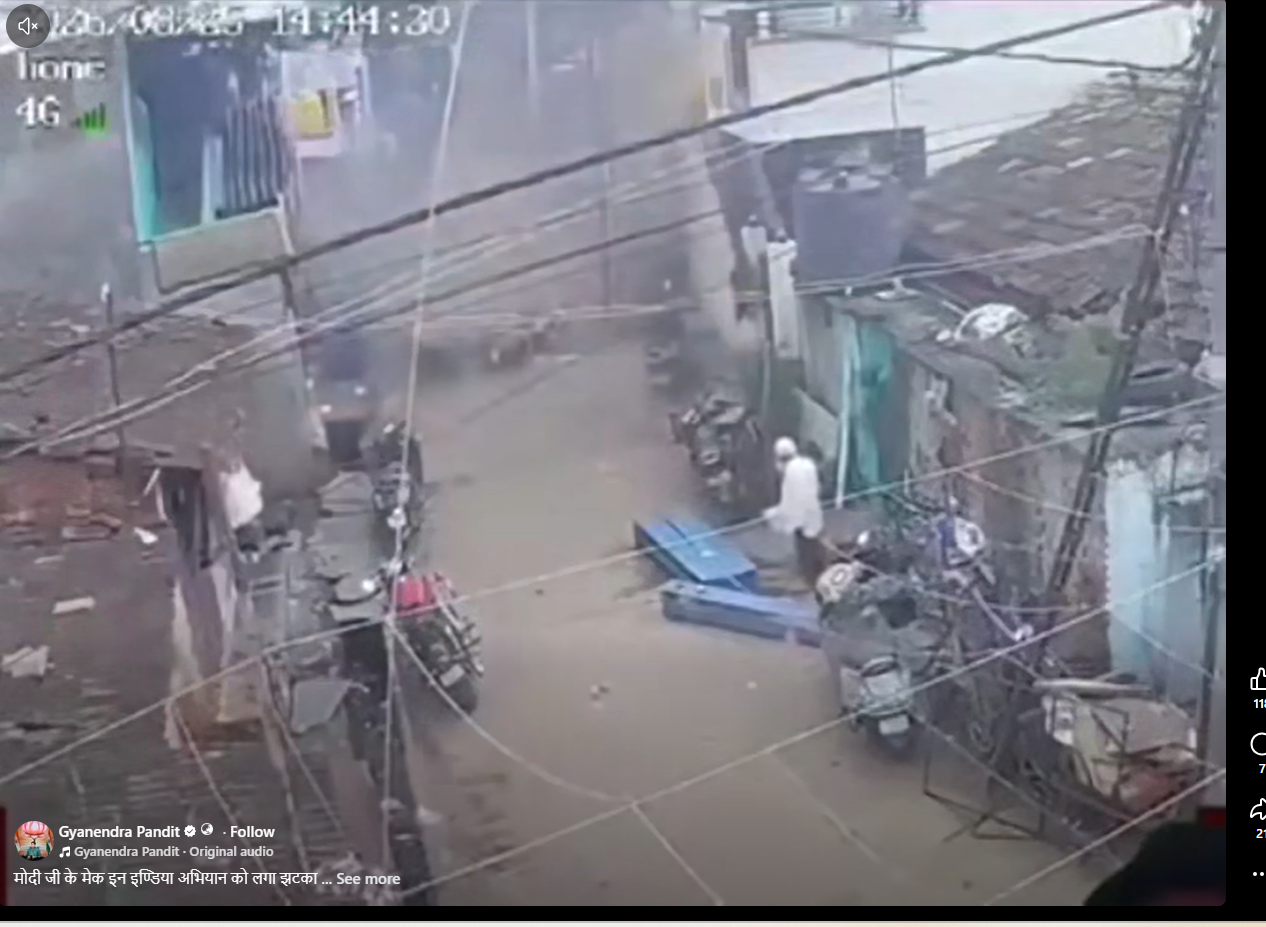
A CCTV video showing a powerful blast on a street lined with houses is going viral on social media. The video is being shared with the claim that it shows a bomb being tested. The posts also claim that the blast took place at the home of a ‘renowned madrasa scientist’ named Abdul Ghaffar and that his entire family was killed during the alleged bomb test. Research by the CyberPeace Research Wing found that the claim is false. The blast took place in Dharwad, Karnataka, on August 25 due to an LPG cylinder leak.
Claim
The video was shared on Facebook with the caption: “Setback for Modi’s ‘Make in India’ campaign: Renowned Madrasa scientist ‘Abdul Ghaffar’ has passed away along with his entire family. The incident occurred during a bomb test at home.”
https://www.facebook.com/reel/1439446978053404
Fact Check
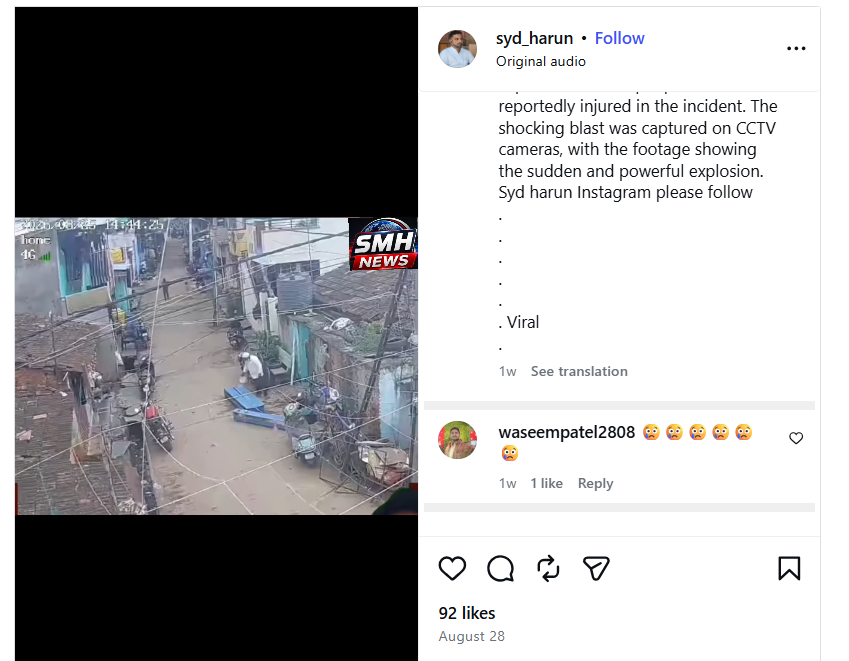
To verify the truth behind the viral claim, we conducted a Google search using relevant keywords. We did not find any news reports about a ‘madrasa teacher Abdul Ghaffar’ who died along with his family due to a bomb test at home. We also conducted a reverse image search of keyframes from the viral video. During the search, we found the same video shared on Instagram on August 28. The caption read, “A domestic LPG cylinder exploded inside a house in Dharwad, Karnataka, triggering panic in the area. The blast was so powerful that the gas cylinder was reportedly hurled out of the house at high speed.”
https://www.instagram.com/p/Dck0dlQRzMy/c/18102766577220962/
We also found the video shared on Reuters Connect, a media licensing platform. According to Reuters’ description, the incident shown in the video took place on August 25, when an LPG cylinder exploded due to a gas leak.

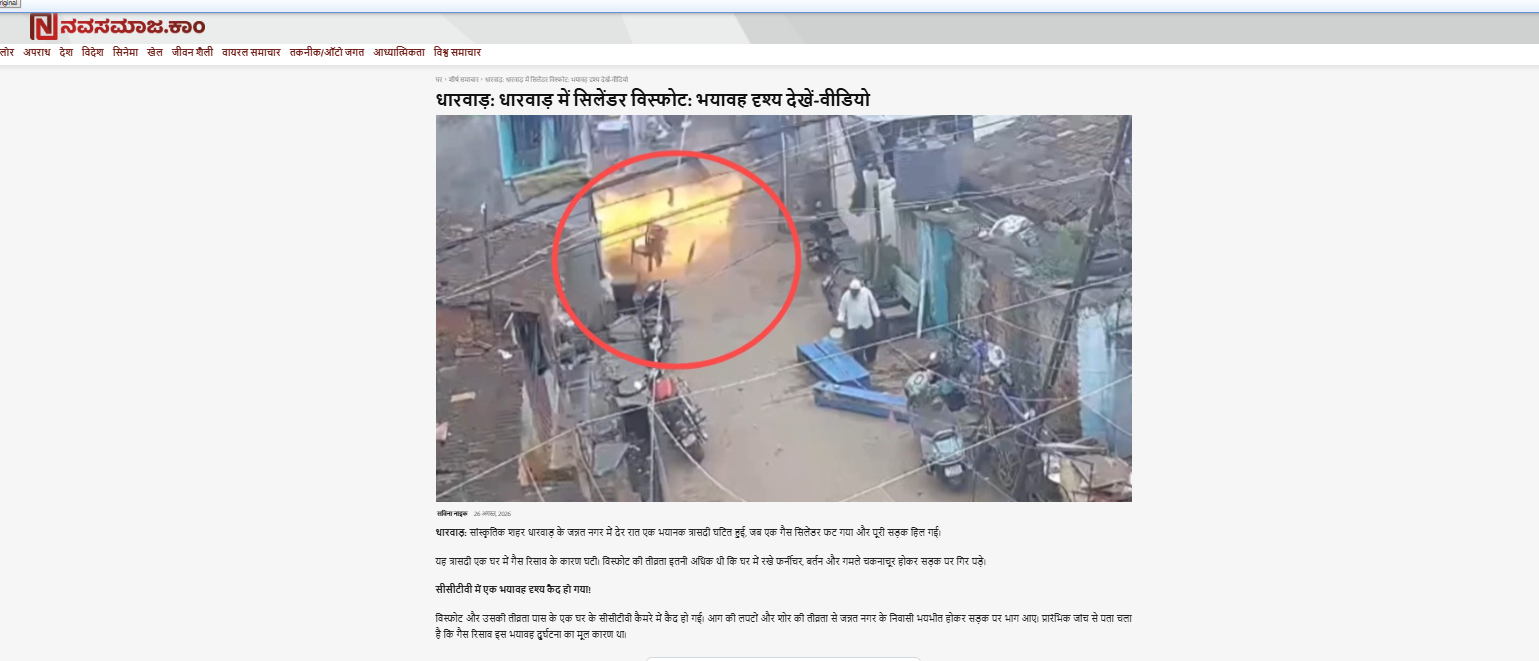
Karnataka-based website Navasamaja published a report on August 26, using a screenshot from the viral video as the cover image. According to the report, the incident took place in Jannat Nagar, Dharwad. The report states, “A young man named Rajasabh Neeralakatti was fast asleep at home when the incident occurred. The sudden blast left the young man severely burned and injured several parts of his body.”
Conclusion
Our research found that the viral claim is false. The video does not show a bomb test at the home of a ‘renowned madrasa scientist’ Abdul Ghaffar or the death of his family. The viral footage actually shows an LPG cylinder explosion that took place on August 25 in Jannat Nagar, Dharwad, Karnataka, following a gas leak. Reports about the incident, along with the original video, confirm that the blast was caused by an LPG cylinder and was unrelated to any bomb testing. Therefore, the viral video is being shared with a false and misleading claim.

Introduction
Cyber-attacks are another threat in this digital world, not exclusive to a single country, that could significantly disrupt global movements, commerce, and international relations all of which experienced first-hand when a cyber-attack occurred at Heathrow, the busiest airport in Europe, which threw their electronic check-in and baggage systems into a state of chaos. Not only were there chaos and delays at Heathrow, airports across Europe including Brussels, Berlin, and Dublin experienced delay and had to conduct manual check-ins for some flights further indicating just how interconnected the world of aviation is in today's world. Though Heathrow assured passengers that the "vast majority of flights" would operate, hundreds were delayed or postponed for hours as those passengers stood in a queue while nearly every European airport's flying schedule was also negatively impacted.
The Anatomy of the Attack
The attack specifically targeted Muse software by Collins Aerospace, a software built to allow various airlines to share check-in desks and boarding gates. The disruption initially perceived to be technical issues soon turned into a logistical nightmare, with airlines relying on Muse having to engage in horror-movie-worthy manual steps hand-tagging luggage, verifying boarding passes over the phone, and manually boarding passengers. While British Airways managed to revert to a backup system, most other carriers across Heathrow and partner airports elsewhere in Europe had to resort to improvised manual solutions.
The trauma was largely borne by the passengers. Stories emerged about travelers stranded on the tarmac, old folks left barely able to walk without assistance, and even families missing important connections. It served to remind everyone that the aviation world, with its schedules interlocked tightly across borders, can see even a localized system failure snowball into a continental-level crisis.
Cybersecurity Meets Aviation Infrastructure
In the last two decades, aviation has become one of the more digitally dependent industries in the world. From booking systems and baggage handling issues to navigation and air traffic control, digital systems are the invisible scaffold on which flight operations are supported. Though this digitalization has increased the scale of operations and enhanced efficiency, it must have also created many avenues for cyber threats. Cyber attackers increasingly realize that to target aviation is not just about money but about leverage. Just interfering with the check-in system of a major hub like Heathrow is more than just financial disruption; it causes panic and hits the headlines, making it much more attractive for criminal gangs and state-sponsored threat actors.
The Heathrow incident is like the worldwide IT crash in July 2024-thwarting activities of flights caused by a botched Crowdstrike update. Both prove the brittleness of digital dependencies in aviation, where one failure point triggering uncontrollable ripple effects spanning multiple countries. Unlike conventional cyber incidents contained within corporate networks, cyber-attacks in aviation spill on to the public sphere in real time, disturbing millions of lives.
Response and Coordination
Heathrow Airport first added extra employees to assist with manual check-in and told passengers to check flight statuses before traveling. The UK's National Cyber Security Centre (NCSC) collaborated with Collins Aerospace, the Department for Transport, and law enforcement agencies to investigate the extent and source of the breach. Meanwhile, the European Commission published a statement that they are "closely following the development" of the cyber incident while assuring passengers that no evidence of a "widespread or serious" breach has been observed.
According to passengers, the reality was quite different. Massive passenger queues, bewildering announcements, and departure time confirmations cultivated an atmosphere of chaos. The wrenching dissonance between the reassurances from official channel and Kirby needs to be resolved about what really happens in passenger experiences. During such incidents, technical restoration and communication flow are strategies for retaining public trust in incidents.
Attribution and the Shadow of Ransomware
As with many cyber-attacks, questions on its attribution arose quite promptly. Rumours of hackers allegedly working for the Kremlin escaped into the air quite possibly inside seconds of the realization, Cybersecurity experts justifiably advise against making conclusions hastily. Extortion ransomware gangs stand the last chance to hold the culprits, whereas state actors cannot be ruled out, especially considering Russian military activity under European airspace. Meanwhile, Collins Aerospace has refused to comment on the attack, its precise nature, or where it originated, emphasizing an inherent difficulty in cyberattribution.
What is clear is the way these attacks bestow criminal leverage and dollars. In previous ransomware attacks against critical infrastructure, cybercriminal gangs have extorted millions of dollars from their victims. In aviation terms, the stakes grow exponentially, not only in terms of money but national security and diplomatic relations as well as human safety.
Broader Implications for Aviation Cybersecurity
This incident brings to consideration several core resilience issues within aviation systems. Traditionally, the airports and airlines had placed premium on physical security, but today, the equally important concept of digital resilience has come into being. Systems such as Muse, which bind multiple airlines into shared infrastructure, offer efficiency but, at the same time, also concentrate that risk. A cyber disruption in one place will cascade across dozens of carriers and multiple airports, thereby amplifying the scale of that disruption.
The case also brings forth redundancy and contingency planning as an urgent concern. While BA systems were able to stand on backups, most other airlines could not claim that advantage. It is about time that digital redundancies, be it in the form of parallel systems or isolated backups or even AI-driven incident response frameworks, are built into aviation as standard practice and soon.
On the policy plane, this incident draws attention to the necessity for international collaboration. Aviation is therefore transnational, and cyber incidents standing on this domain cannot possibly be handled by national agencies only. Eurocontrol, the European Commission, and cross-border cybersecurity task forces must spearhead this initiative to ensure aviation-wide resilience.
Human Stories Amid a Digital Crisis
Beyond technical jargon and policy response, the human stories had perhaps the greatest impact coming from Heathrow. Passengers spoke of hours spent queuing, heading to funerals, and being hungry and exhausted as they waited for their flights. For many, the cyber-attack was no mere headline; instead, it was ¬ a living reality of disruption.
These stories reflect the fact that cybersecurity is no hunger strike; it touches people's lives. In critical sectors such as aviation, one hour of disruption means missed connections for passengers, lost revenue for airlines, and inculcates immense emotional stress. Crisis management must therefore entail technical recovery and passenger care, communication, and support on the ground.
Conclusion
The cybersecurity crisis of Heathrow and other European airports emphasizes the threat of cyber disruption on the modern legitimacy of aviation. The use of increased connectivity for airport processes means that any cyber disruption present, no matter how small, can affect scheduling issues regionally or on other continents, even threatening lives. The occurrences confirm a few things: a resilient solution should provide redundancy not efficiency; international networking and collaboration is paramount; and communicating with the traveling public is just as important (if not more) as the technical recovery process.
As governments, airlines, and technology providers analyse the disruption, the question is longer if aviation can withstand cyber threats, but to what extent it will be prepared to defend itself against those attacks. The Heathrow crisis is a reminder that the stake of cybersecurity is not just about a data breach or outright stealing of money but also about stealing the very systems that keep global mobility in motion. Now, the aviation industry is tested to make this disruption an opportunity to fortify the digital defences and start preparing for the next inevitable production.
References
- https://www.bbc.com/news/articles/c3drpgv33pxo
- https://www.theguardian.com/business/2025/sep/21/delays-continue-at-heathrow-brussels-and-berlin-airports-after-alleged-cyber-attack
- https://www.reuters.com/business/aerospace-defense/eu-agency-says-third-party-ransomware-behind-airport-disruptions-2025-09-22/
.webp)
Executive Summary
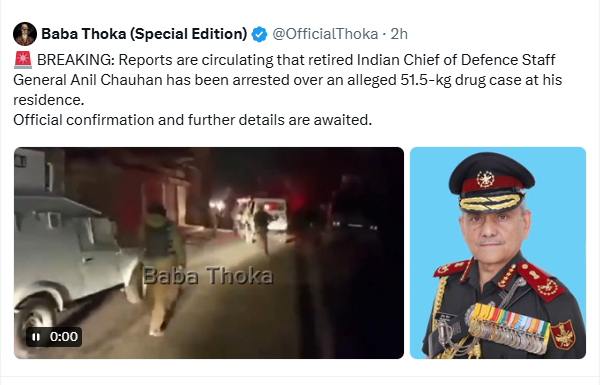
A post is being shared on social media claiming that retired Chief of Defence Staff (CDS) General Anil Chauhan was arrested from his residence in connection with a 51.5-kg drug case. The post states that official confirmation of the case is awaited. Some Army personnel can also be seen in the video, which is being shared as evidence to support the claim. CyberPeace Research found the viral claim to be false. We found that General Anil Chauhan had retired as CDS in May 2026. According to the Ministry of Defence, his tenure ended on May 30, 2026. However, we did not find any credible report confirming General Anil Chauhan’s arrest in connection with a 51.5-kg drug case. Therefore, the claim being shared on social media is misleading and false. Furthermore, according to the available information, the video is related to the December 2021 terrorist attack on a Jammu and Kashmir Police bus in the Pantha Chowk area of Srinagar.
Claim:
On September 18, 2026, a user on the social media platform X claimed that retired CDS General Anil Chauhan was arrested from his residence in connection with a 51.5-kg drug case.
https://x.com/i/birdwatch/t/2100860615887892915?source=6
Fact Check:
To verify the viral claim, we conducted a Google search using relevant keywords. During the search, we did not find any credible media report supporting the claim. As part of our research, we conducted a reverse image search of keyframes from the video. During the search, we found the same video on the Facebook page of The Kashmir Today, where it was posted on December 13, 2021. The 58-second video also contains the portion seen in the viral video in its final six seconds. According to the information accompanying the video, militants attacked a police bus near Aripora Zewan on the Srinagar-Jammu highway in the outskirts of Srinagar on Monday afternoon. At least 14 police personnel were injured in the attack, three of whom were reported to be in critical condition.
According to official sources cited in the report, the gunmen’s attack injured 14 police personnel, who were subsequently admitted to a hospital. The area was cordoned off and a search operation was underway to apprehend the attackers. At the time, there were no reports of any arrests.
https://www.facebook.com/watch/?v=422219106288318
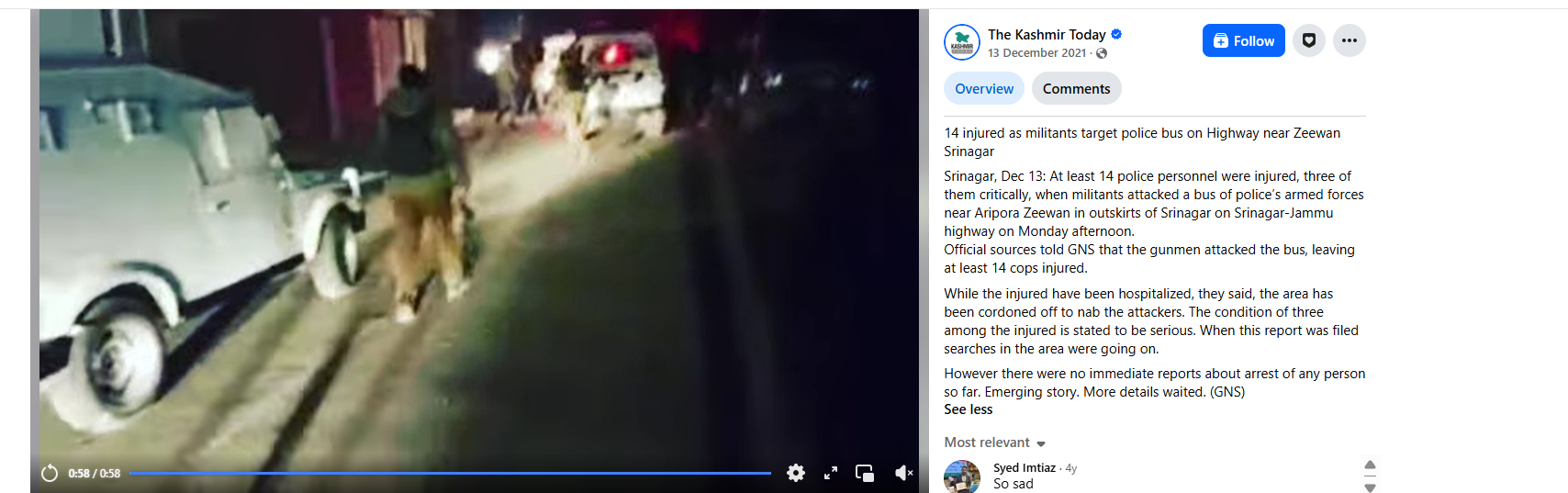
Based on the clue found on Facebook, we conducted a Google search using relevant keywords. During the search, we found a report published on The Times of India website on December 14, 2021, carrying the same claim.
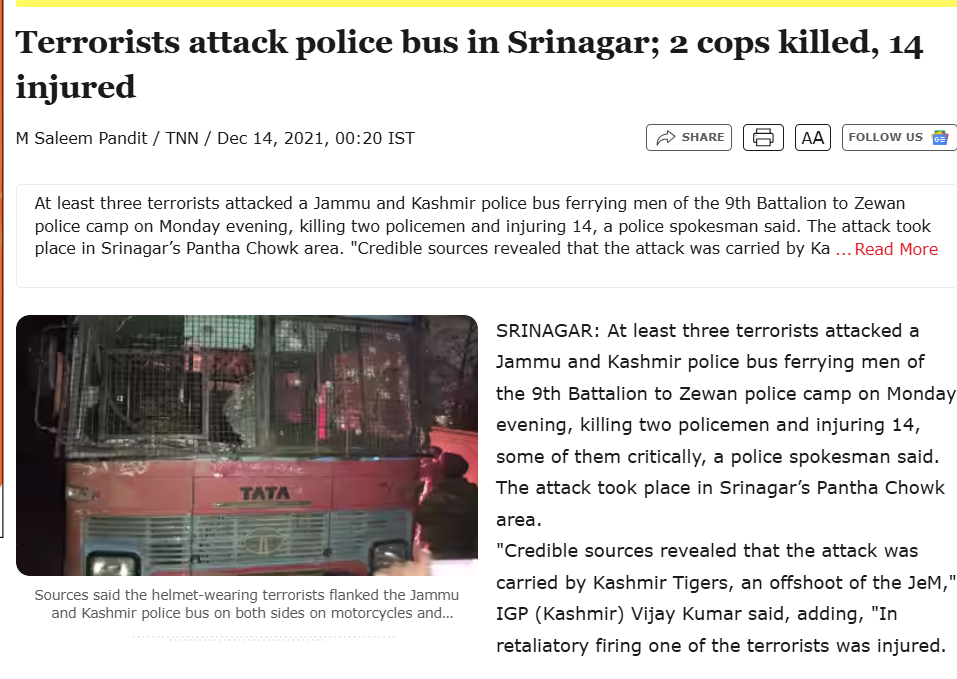
Conclusion
Our research found that the video being shared on social media is not recent but dates back to December 2021. During the reverse image search, we found the same video on The Kashmir Today’s Facebook page, where it was posted on December 13, 2021. The viral portion of the video is also present in the original 58-second clip. According to the available information, the video is related to the December 2021 terrorist attack on a Jammu and Kashmir Police bus in the Pantha Chowk area of Srinagar. The attack resulted in the deaths of two police personnel, while 14 others were injured. Therefore, the old video is being shared with a misleading claim by linking it to a recent incident.
