
#FactCheck - Viral Clip Claiming PM Modi Pushed BJP President Nitin Nabin Is Misleading
Executive Summary:
A video clip featuring Prime Minister Narendra Modi and the newly elected Bharatiya Janata Party (BJP) national president, Nitin Nabin, is going viral on social media. In the clip, PM Modi is seen apparently pushing Nitin Nabin, prompting claims that Nabin had accidentally stepped between the Prime Minister and the camera, after which Modi allegedly pushed him out of the frame. CyberPeace’s research found that the viral clip is misleading and cropped. The original, unedited video shows Prime Minister Modi gesturing for Nitin Nabin to move ahead and offer floral tributes to the statues of Bharatiya Jana Sangh founder Syama Prasad Mukherjee and Pandit Deendayal Upadhyaya at the BJP headquarters in Delhi. It is pertinent to note that on 20 January 2026, BJP leader Nitin Nabin was elected as the party’s national president. Several senior BJP leaders, including Prime Minister Narendra Modi, were present at the event. During his address, PM Modi remarked, “Nitin Nabin ji is my boss, and I am a party worker.” The statement received widespread attention, following which multiple videos linking to the remark began circulating on social media. A Facebook user shared the viral clip with a Hindi caption alleging that despite calling himself a “party worker,” PM Modi pushed his “boss” out of the camera frame. The post further mocked the position of BJP president, claiming it to be merely ceremonial. (Archived link)
To verify the claim, we conducted a reverse image and video search, which led us to a longer version of the video uploaded on news agency INS’s official X handle on 20 January 2026. The caption stated that PM Modi, BJP president Nitin Nabin, Defence Minister Rajnath Singh, Home Minister Amit Shah, Union Minister Nitin Gadkari and senior leader J.P. Nadda paid tributes to Syama Prasad Mukherjee and Pandit Deendayal Upadhyaya at the BJP headquarters.
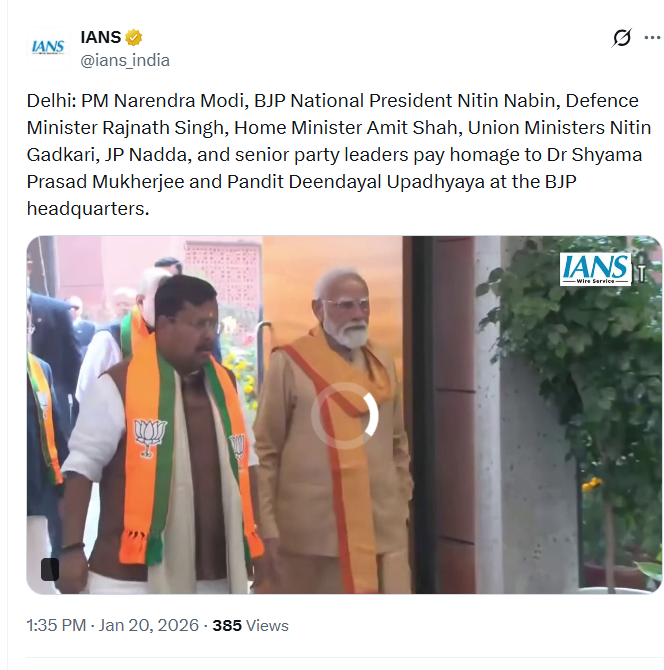
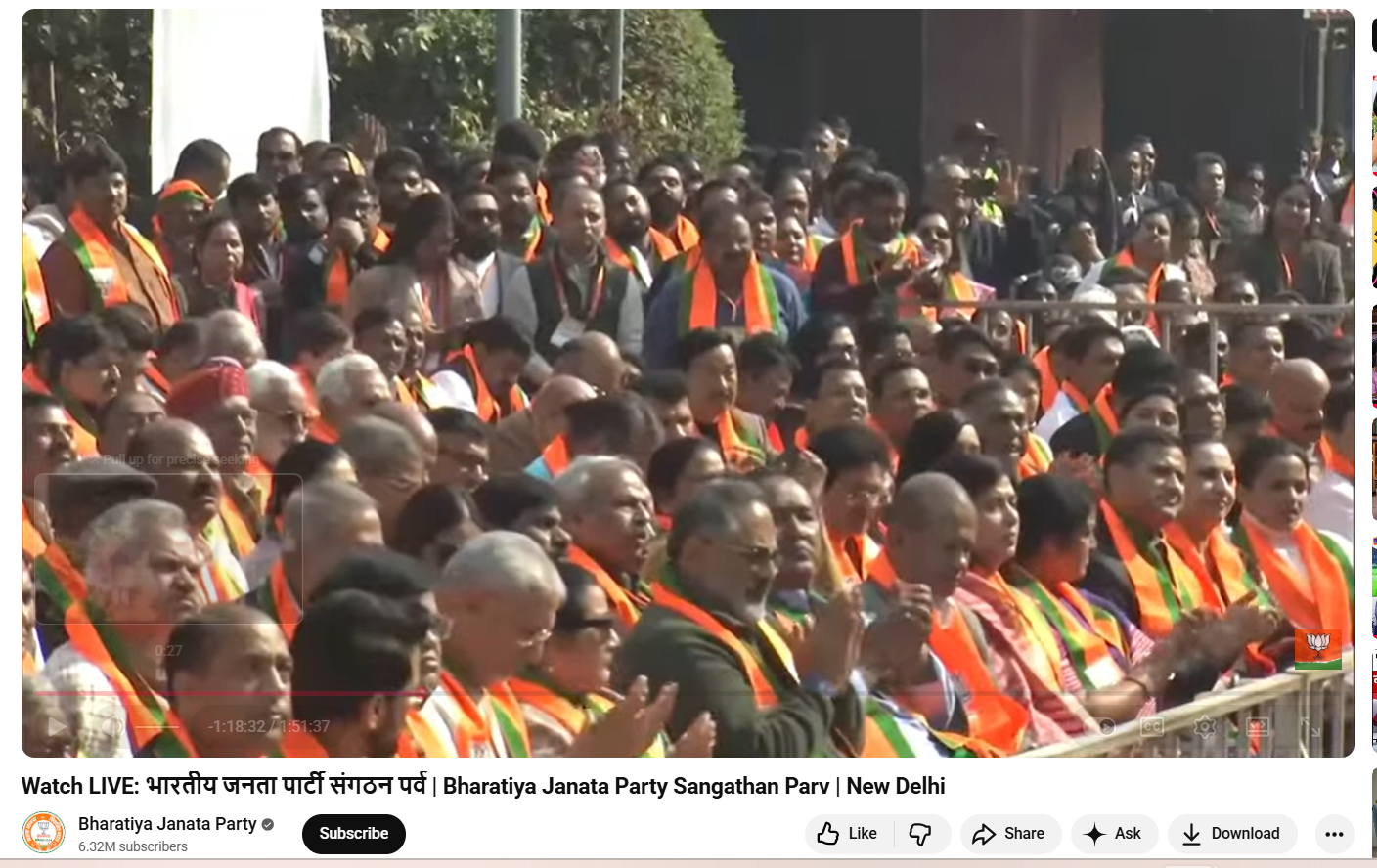
In the full video, PM Modi and Nitin Nabin are seen walking together. PM Modi then requests Nitin Nabin to proceed first for the floral tribute, placing his hand on Nabin’s back as a gesture to move forward. The viral clip selectively cuts this moment out of context and loops it to create a misleading impression. The complete footage clearly shows that PM Modi asked Nitin Nabin to offer tributes first, after which other leaders followed. There is no indication whatsoever that Nitin Nabin was pushed out of the camera frame, as claimed in the viral posts. We also found the live broadcast of the ‘Bharatiya Janata Party Sangathan Parv’ on BJP’s official YouTube channel. The same visuals appear at the end of the live stream, further confirming that PM Modi was merely gesturing for Nitin Nabin to proceed first.
Additionally, photographs available on Nitin Nabin’s official X handle show him offering floral tributes ahead of PM Modi, who is seen standing behind and waiting.
Conclusion:
CyberPeace research confirms that the viral clip has been cropped and shared with a false narrative. In the original context, Prime Minister Narendra Modi was respectfully inviting BJP national president Nitin Nabin to move ahead and pay tributes, not pushing him out of the camera frame.

Related Blogs
.webp)
Introduction
Lawyers love saying that the devil lies in the detail, and privacy professionals in India have had a neat reminder of this. The Digital Personal Data Protection (Removal of Difficulties) Order, 2026, was issued by MeitY on 5 October and published in the Official Gazette on 7 October. It is brief: it makes two editorial corrections to the Digital Personal Data Protection Act, 2023, and these are described by MeitY as textual and editorial corrections that serve to give effect to the intention of the Parliament. This is fair language, but a careful reader will note the importance of the nuances.
What the Order is and what it is not
The Order is based on section 43(1) of the Act that allows the Central Government to make provision not inconsistent with the Act if difficulty arises in giving effect to the Act. This power is subject to some conditions. Section 43(2) states that no such order can be made after the expiry of three years from the commencement, and section 43(3) says that such order shall be laid before each House of the Parliament. So, it is just a tool for tidying up and not for rewriting the Act. According to India Briefing, the Order came into operation on the date of its publication in the Gazette.
Fix one: guardian consent for children and persons with disabilities
Section 9(1) of the Act says a Data Fiduciary must obtain verifiable consent from the parent or lawful guardian before processing the personal data of “a child or a person with disability who has a lawful guardian”. The Order inserts one small preposition so that the provision reads as the personal data of a child or of a person with a disability. As reported, the missing “of” created a grammatical disjunction between the two categories and could cloud the intended meaning, and the fix puts them side by side.
Why would that matter? Here is one way to see the risk, and to be clear, this is my own illustration and not something the Order says. Read the old phrase quickly, and you could ask whether “who has a lawful guardian” qualifies only the person with a disability or whether it also hangs on the child. The Act’s own definitions point to the answer. Section 2(j) treats the parents or lawful guardian of a child and the lawful guardian of a person with a disability as part of the Data Principal in parallel terms. Parallel treatment in the definitions and slightly tangled treatment in the operative clause is exactly the kind of mismatch that invites an argument later. The extra word shuts that door.
The stakes are not small. The Schedule to the Act sets a penalty of up to Rs 200 crore for breach of the additional obligations relating to children under section 9. Nobody wants to be in a hearing where the question is what a missing preposition was supposed to mean.
Fix two: “audit” becomes “data audit"
Section 10 adds duties for Significant Data Fiduciaries. Clause (b) of sub-section (2) requires them to appoint an independent data auditor to carry out a data audit. Clause (c)(ii), a few lines later, requires a “periodic audit” and nothing more. Same section, two audit duties, two slightly different vocabularies. The Order replaces “audit” with “data audit” in section 10(2)(c)(ii).
The reasoning behind the argument given by India Briefing is that the bare word could leave the scope of the audit ambiguous and subject of different interpretations by regulatory or supervisory authorities. One can only speculate what questions an SDF may have had to answer in the meanwhile. Does a periodic audit entail a financial audit, an information security audit, a generic internal audit or something completely different? With the amendment, the periodic audit has been tied to the compliance with data protection and data processing; fitting into the overall audit framework which the Act provides for SDFs. The Order does not combine the two obligations. The independent auditor and the periodic audit remain separate obligations. What changes is that the two now share a common language. The stakes, again, are real here as the Schedule permits a penalty of up to Rs 150 crore for violation of the additional obligations of an SDF under section 10.
Is “editorial” the right label?
Mostly, yes. India Briefing concludes that the Order does not substantially expand the Act’s obligations, and Zee Business reaches a similar view, noting that it clears up wording rather than creating a new compliance system.
Nevertheless, a label is no protection. Labelling it an editorial correction will not stop a regulator or a litigant from asserting that the text previously meant something else or that the amended text now conveys something different. Section 43 only permits the inclusion of provisions that are not inconsistent with the Act, which is exactly the point that the Government takes care to make through this text. My recommendation is that you read the Gazette text (not summaries of it) and retain a copy in your compliance file.
What privacy teams can do now
Nothing here is urgent, and that is the good news. The DPDP Rules, 2025, were notified in November 2025 with a phased timeline, and as Bar and Bench reports, most operational duties are due after an 18-month transition ending on 13 May 2027. The Rules also operationalise age verification and guardian validation, including through Digital Locker based methods, and expect enhanced governance from SDFs, including audits and risk assessments, as Khurana and Khurana notes. That leaves room to make small corrections calmly. A sensible short list looks like this:
- Check the wording of your consent flows. Make sure notices and policies that deal with children and persons with disabilities use language consistent with the amended section 9(1), and that the guardian route is clearly described.
- Align your audit vocabulary. If you are or may be notified as an SDF, use “data audit” consistently in policies, audit charters, checklists and engagement letters with your independent data auditor.
- Update your statutory reference library. Many teams quote the Act in templates and training decks. Those quotes should now match the amended text.
- Set up a Gazette watch. Notifications, rules and orders under this Act will keep arriving.
Conclusion
Privacy work is often couched in terms of grand themes such as consent, accountability and cross-border transfers. In practice, a substantial part of the work takes the form of close reading. Data Fiduciaries, auditors and the Data Protection Board will all be working from the same words, so that the distinction between 'audit' and 'data audit', or between a phrase including or omitting 'of', is the sort of gap that can decide an argument.
We therefore invite you to treat this order as a prompt to read your own documents as a regulator would. Spot points at which two terms are being used for one purpose or one term is being used to cover two purposes. Rectifying such issues now costs an afternoon's work; waiting until an inquiry is underway will require significantly more resources.
Sources
- Digital Personal Data Protection Act, 2023 (official text), Ministry of Electronics and Information Technology
- DPDP (Removal of Difficulties) Order 2026 Clarifies Consent and Data Audit Requirements in India, India Briefing
- DPDP Order 2026 clarifies data protection, consent and data audit requirements for businesses in India, Zee Business
- MeitY notifies final Digital Personal Data Protection Rules 2025, Bar and Bench
- Update: MeitY Notifies Rules Operationalising the DPDP Framework in India, Khurana and Khurana
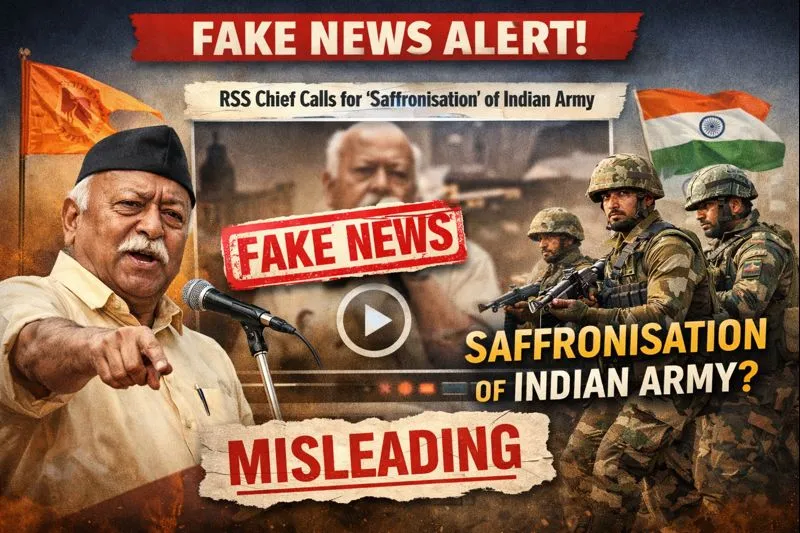
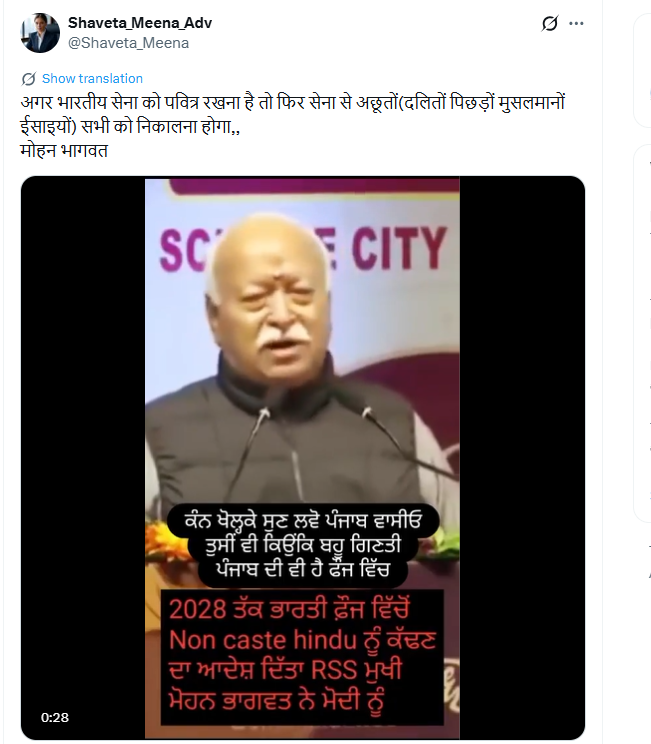
A video purportedly showing Rashtriya Swayamsevak Sangh (RSS) chief Mohan Bhagwat making remarks about the “saffronisation” of the Indian Army has been widely circulated on social media. The clip claims that Bhagwat called for the removal of non-Hindus from the armed forces and linked the issue to future political leadership changes in the country.
Claim
However, a verification by the Cyber Peace Foundation has established that the video is misleading and has been digitally manipulated.
In the video, Bhagwat is allegedly heard saying that unless more than 50 percent of non-Hindus are removed from the Indian Army by 2028, Prime Minister Narendra Modi would be replaced by Uttar Pradesh Chief Minister Yogi Adityanath. The clip further attributes another statement to him, suggesting that he would resign if the Prime Minister were to demand Nitish Kumar’s resignation.
By the time of publication, the video had been viewed over 7,000 times.( lINK, ARCHIVE Link, Screenshot
Fact Check:
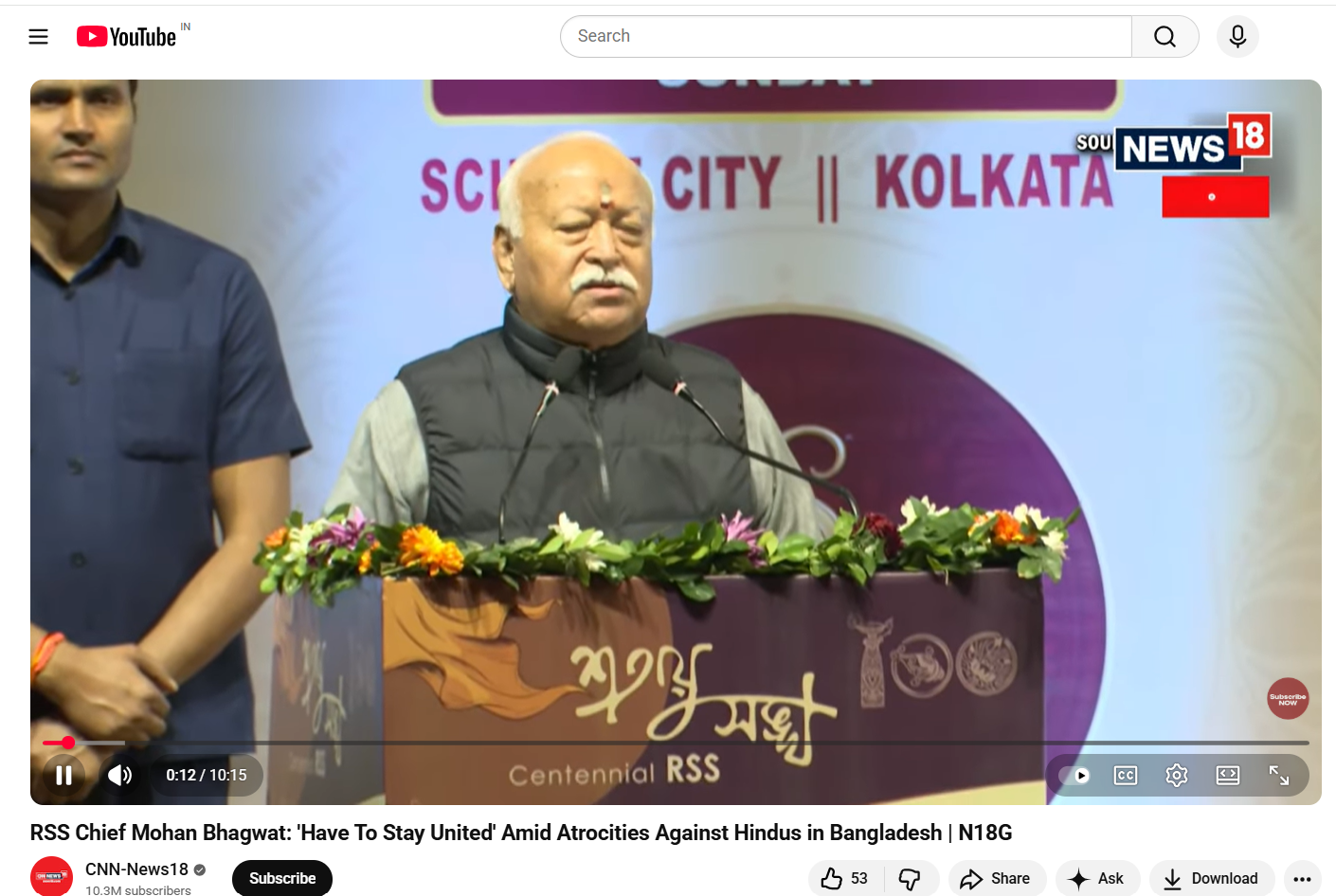
The reverse image search also directed the Desk to a video uploaded on CNN-News18’s official YouTube channel on December 21, 2025. The footage was found to be a longer version of the viral clip and was recorded at the RSS centenary event held in Kolkata on the same date. A comparison of both videos confirmed that the background visuals, stage setup and camera angles were identical.
However, a careful review of the original CNN-News18 video revealed that Mohan Bhagwat did not make any of the statements attributed to him in the viral clip.
In his original address, Bhagwat spoke about unity and referred to concerns over increasing atrocities against Hindus in Bangladesh. He made no reference to the Indian Army, nor did he comment on its composition or alleged saffronisation. Here is the link to the original video, along with a screenshot: https://www.youtube.com/watch?v=KnsAUGfBQBk&t=1s
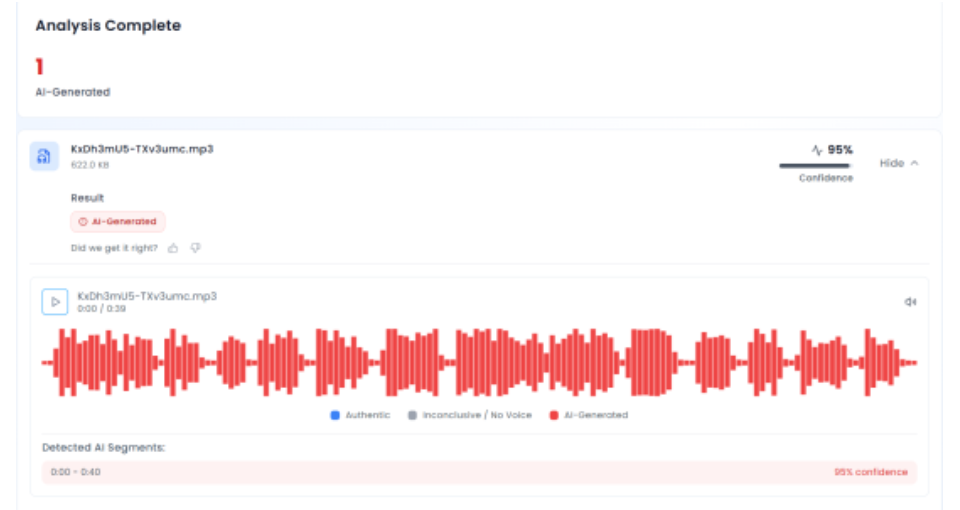
In the next phase of the investigation, the audio track from the viral video was extracted and analysed using the AI audio detection tool Aurigin. The tool’s assessment indicated that the voice heard in the clip was artificially generated, confirming that the audio did not originate from the original speech.
Conclusion
The claim that RSS chief Mohan Bhagwat called for the saffronisation of the Indian Army is false. PTI Fact Check found that the viral video was digitally manipulated, using genuine footage from an RSS centenary event but pairing it with an AI-generated audio track. The altered video was shared online to mislead viewers by falsely attributing statements Bhagwat never made.

Executive Summary:
A viral claim circulating on social media suggests that the Indian government is offering a 50% subsidy on tractor purchases under the so-called "Kisan Tractor Yojana." However, our research reveals that the website promoting this scheme, allegedly under the Ministry of Agriculture and Farmers Welfare, is misleading. This report aims to inform readers about the deceptive nature of this claim and emphasize the importance of safeguarding personal information against fraudulent schemes.


Claim:
A website has been circulating misleading information, claiming that the Indian government is offering a 50% subsidy on tractor purchases under the so-called "Kisan Tractor Yojana." Additionally, a YouTube video promoting this scheme suggests that individuals can apply by submitting certain documents and paying a small, supposedly refundable application fee.


Fact Check:
Our research has confirmed that there is no scheme by the Government of India named 'PM Kisan Tractor Yojana.' The circulating announcement is false and appears to be an attempt to defraud farmers through fraudulent means.
While the government does provide various agricultural subsidies under recognized schemes such as the PM Kisan Samman Nidhi and the Sub-Mission on Agricultural Mechanization (SMAM), no such initiative under the name 'PM Kisan Tractor Yojana' exists. This misleading claim is, therefore, a phishing attempt aimed at deceiving farmers and unlawfully collecting their personal or financial information.
Farmers and stakeholders are advised to rely only on official government sources for scheme-related information and to exercise caution against such deceptive practices.
To assess the authenticity of the “PM Kisan Tractor Yojana” claim, we reviewed the websites farmertractoryojana.in and tractoryojana.in. Our analysis revealed several inconsistencies, indicating that these websites are fraudulent.
As part of our verification process, we evaluated tractoryojana.in using Scam Detector to determine its trustworthiness. The results showed a low trust score, raising concerns about its legitimacy. Similarly, we conducted the same check for farmertractoryojana.in, which also appeared untrustworthy and risky. The detailed results of these assessments are attached below.
Given that these websites falsely present themselves as government-backed initiatives, our findings strongly suggest that they are part of a fraudulent scheme designed to mislead and exploit individuals seeking genuine agricultural subsidies.


During our research, we examined the "How it Works" section of the website, which outlines the application process for the alleged “PM Kisan Tractor Yojana.” Notably, applicants are required to pay a refundable application fee to proceed with their registration. It is important to emphasize that no legitimate government subsidy program requires applicants to pay a refundable application fee.


Our research found that the address listed on the website, “69A, Hanuman Road, Vile Parle East, Mumbai 400057,” is not associated with any government office or agricultural subsidy program. This further confirms the website’s fraudulent nature. Farmers should verify subsidy programs through official government sources to avoid scams.

A key inconsistency is the absence of a verified social media presence. Most legitimate government programs maintain official social media accounts for updates and communication. However, these websites fail to provide any such official handles, further casting doubt on their authenticity.

Upon attempting to log in, both websites redirect to the same page, suggesting they may be operated by the same entity or individual. This further raises concerns about their legitimacy and reinforces the likelihood of fraudulent activity.

Conclusion:
Our research confirms that the "PM Kisan Tractor Yojana" claim is fraudulent. No such government scheme exists, and the websites promoting it exhibit multiple red flags, including low trust scores, a misleading application process requiring a refundable fee, a false address, and the absence of an official social media presence. Additionally, both websites redirect to the same page, suggesting they are operated by the same entity. Farmers are advised to rely on official government sources to avoid falling victim to such scams.
- Claim: PM-Kisan Tractor Yojana Government Offering Subsidy on tractors.
- Claimed On: Social Media
- Fact Check: False and Misleading
