
#FactCheck - Old Video of Yogi Adityanath Edited to Push ‘Next PM 2029’ Claim
Executive Summary
A video featuring Uttar Pradesh Chief Minister Yogi Adityanath is being widely shared on social media. In the video, Adityanath can be heard saying, “Let me become the Prime Minister, and Pakistan-occupied Kashmir will also become a part of India.” The video also carries an on-screen text that reads “Next PM 2029.” By sharing this clip, social media users are claiming that Yogi Adityanath is set to become India’s Prime Minister in 2029.
However, CyberPeace research found the viral claim to be misleading. Our research revealed that the video circulating online has been edited and is being shared out of context. The original video dates back to May 2024. In the original footage, Yogi Adityanath is not speaking about himself. Instead, he is referring to Prime Minister Narendra Modi.
In the original statement, Adityanath says:
“Let Modi ji become Prime Minister for the third time, and within the next six months, Pakistan-occupied Kashmir will also become a part of India.”
It is evident that the video has been trimmed and misleading text has been added to falsely portray the statement as a declaration about Yogi Adityanath becoming Prime Minister in 2029.
Claim
A YouTube user shared the viral video on January 29, 2026, claiming that Yogi Adityanath said, “Let me become Prime Minister, and Pakistan-occupied Kashmir will be part of India.” The video carries the caption “Next PM 2029,” suggesting that Adityanath is set to become the Prime Minister in 2029.
Link to the post n archive

Fact Check:
To verify the viral claim, we first conducted a keyword search on Google. During this process, we found a report published by Aaj Tak on May 18, 2024. According to the report, Yogi Adityanath stated that if Narendra Modi becomes Prime Minister for the third time, Pakistan-occupied Kashmir would become part of India within six months.
Report link:
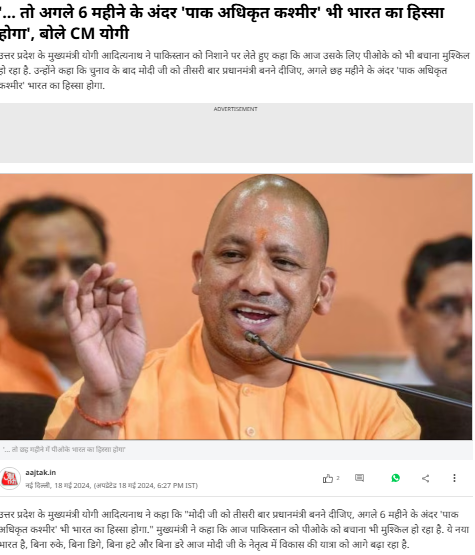
Next, we extracted keyframes from the viral video and ran them through Google Lens. This led us to the official YouTube channel of Yogi Adityanath, where the same video was uploaded on May 18, 2024.
Original video link:
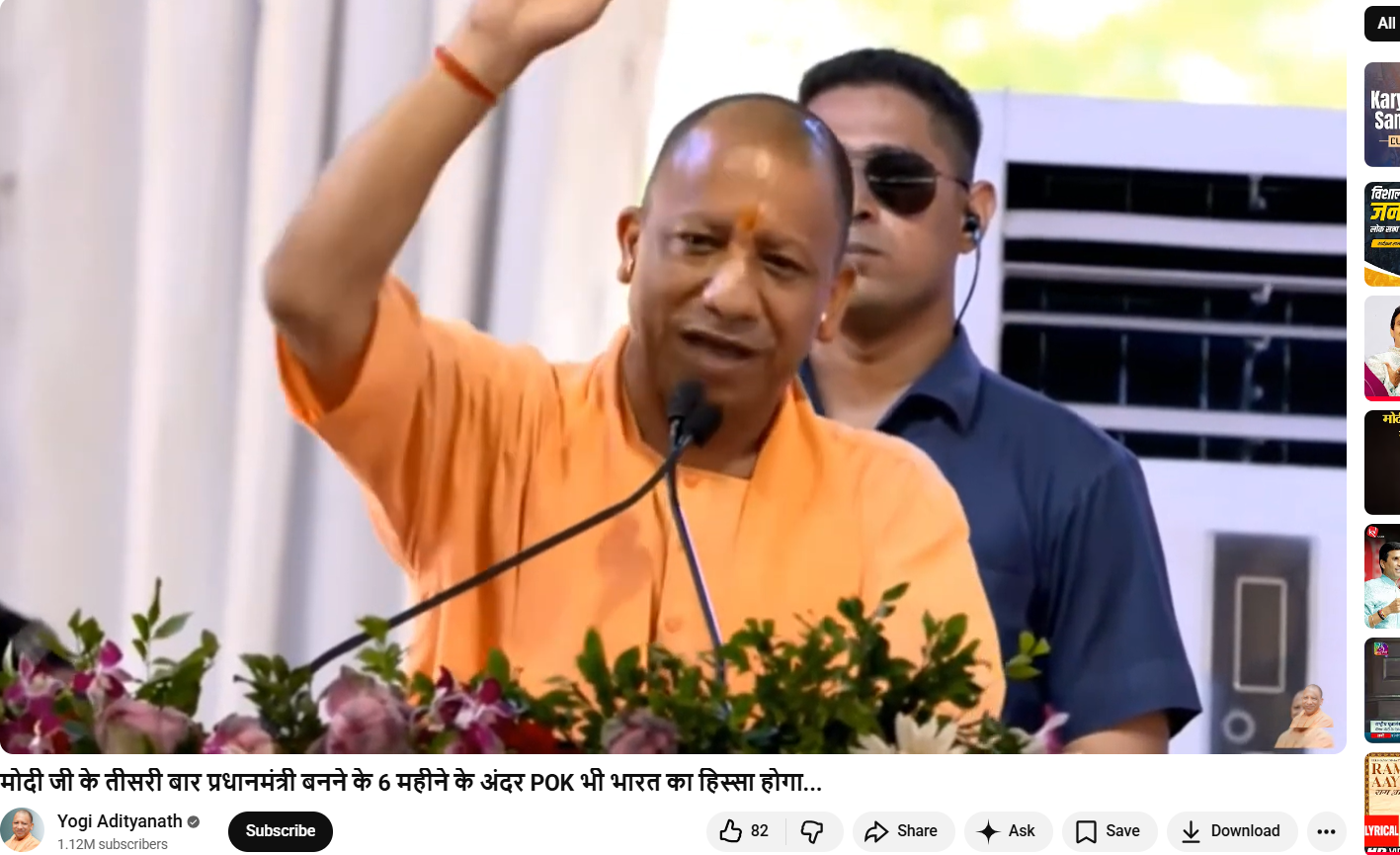
In the original video, Yogi Adityanath clearly makes the statement in reference to Prime Minister Narendra Modi, not himself.Finally, we compared the viral clip with the original footage. The visuals in both videos are identical; however, the viral version has been edited and overlaid with misleading text to change the meaning of the statement.
Conclusion
Our research confirms that the viral video is edited and misleading. The original video is from May 2024, in which Yogi Adityanath was speaking about Prime Minister Narendra Modi, not about himself becoming Prime Minister in 2029. The video has been falsely altered and shared with a deceptive claim on social media.

Related Blogs

Introduction
In a distressing incident that highlights the growing threat of cyber fraud, a software engineer in Bangalore fell victim to fraudsters who posed as police officials. These miscreants, operating under the guise of a fake courier service and law enforcement, employed a sophisticated scam to dupe unsuspecting individuals out of their hard-earned money. Unfortunately, this is not an isolated incident, as several cases of similar fraud have been reported recently in Bangalore and other cities. It is crucial for everyone to be aware of these scams and adopt preventive measures to protect themselves.
Bangalore Techie Falls Victim to ₹33 Lakh
The software engineer received a call from someone claiming to be from FedEx courier service, informing him that a parcel sent in his name to Taiwan had been seized by the Mumbai police for containing illegal items. The call was then transferred to an impersonator posing as a Mumbai Deputy Commissioner of Police (DCP), who alleged that a money laundering case had been registered against him. The fraudsters then coerced him into joining a Skype call for verification purposes, during which they obtained his personal details, including bank account information.
Under the guise of verifying his credentials, the fraudsters manipulated him into transferring a significant amount of money to various accounts. They assured him that the funds would be returned after the completion of the procedure. However, once the money was transferred, the fraudsters disappeared, leaving the victim devastated and financially drained.
Best Practices to Stay Safe
- Be vigilant and skeptical: Maintain a healthy level of skepticism when receiving unsolicited calls or messages, especially if they involve sensitive information or financial matters. Be cautious of callers pressuring you to disclose personal details or engage in immediate financial transactions.
- Verify the caller’s authenticity: If someone claims to represent a legitimate organisation or law enforcement agency, independently verify their credentials. Look up the official contact details of the organization or agency and reach out to them directly to confirm the authenticity of the communication.
- Never share sensitive information: Avoid sharing personal information, such as bank account details, passwords, or Aadhaar numbers, over the phone or through unfamiliar online platforms. Legitimate organizations will not ask for such information without proper authentication protocols.
- Use secure communication channels: When communicating sensitive information, prefer secure platforms or official channels that provide end-to-end encryption. Avoid switching to alternative platforms or applications suggested by unknown callers, as fraudsters can exploit these.
- Educate yourself and others: Stay informed about the latest cyber fraud techniques and scams prevalent in your region. Share this knowledge with family, friends, and colleagues to create awareness and prevent them from falling victim to similar schemes.
- Implement robust security measures: Keep your devices and software updated with the latest security patches. Utilize robust anti-virus software, firewalls, and spam filters to safeguard against malicious activities. Regularly review your financial statements and account activity to detect any unauthorized transactions promptly.
Conclusion:
The incident involving the Bangalore techie and other victims of cyber fraud highlights the importance of remaining vigilant and adopting preventive measures to safeguard oneself from such scams. It is disheartening to see individuals falling prey to impersonators who exploit their trust and manipulate them into sharing sensitive information. By staying informed, exercising caution, and following best practices, we can collectively minimize the risk and protect ourselves from these fraudulent activities. Remember, the best defense against cyber fraud is a well-informed and alert individual.
.webp)
Introduction
In July 2025, the Digital Defence Report prepared by Microsoft raised an alarm that India is part of the top target countries in AI-powered nation-state cyberattacks with malicious agents automating phishing, creating convincing deepfakes, and influencing opinion with the help of generative AI (Microsoft Digital Defence Report, 2025). Most of the attention in the world has continued to be on the United States and Europe, but Asia-Pacific and especially India have become a major target in terms of AI-based cyber activities. This blog discusses the role of AI in espionage, redefining the threat environment of India, the reaction of the government, and what India can learn by looking at the example of cyber giants worldwide.
Understanding AI-Powered Cyber Espionage
Conventional cyber-espionage intends to hack systems, steal information or bring down networks. With the emergence of generative AI, these strategies have changed completely. It is now possible to automate reconnaissance, create fake voices and videos of authorities and create highly advanced phishing campaigns which can pass off as genuine even to a trained expert. According to the report made by Microsoft, AI is being used by state-sponsored groups to expand their activities and increase accuracy in victims (Microsoft Digital Defence Report, 2025). Based on SQ Magazine, almost 42 percent of state-based cyber campaigns in 2025 had AIs like adaptive malware or intelligent vulnerability scanners (SQ Magazine, 2025).
AI is altering the power dynamic of cyberspace. The tools previously needing significant technical expertise or substantial investments have become ubiquitous, and smaller countries can conduct sophisticated cyber operations as well as non-state actors. The outcome is the speeding up of the arms race with AI serving as the weapon and the armour.
India’s Exposure and Response
The weakness of the threat landscape lies in the growing online infrastructure and geopolitical location. The attack surface has expanded the magnitude of hundreds of millions of citizens with the integration of platforms like DigiLocker and CoWIN. Financial institutions, government portals and defence networks are increasingly becoming targets of cyber attacks that are more sophisticated. Faking videos of prominent figures, phishing letters with the official templates, and manipulation of the social media are currently all being a part of disinformation campaigns (Microsoft Digital Defence Report, 2025).
According to the Data Security Council of India (DSCI), the India Cyber Threat Report 2025 reported that attacks using AI are growing exponentially, particularly in the shape of malicious behaviour and social engineering (DSCI, 2025). The nodal cyber-response agency of India, CERT-In, has made several warnings regarding scams related to AI and AI-generated fake content that is aimed at stealing personal information or deceiving the population. Meanwhile, enforcement and red-teaming actions have been intensified, but the communication between central agencies and state police and the private platforms is not even. There is also an acute shortage of cybersecurity talents in India, as less than 20 percent of cyber defence jobs are occupied by qualified specialists (DSCI, 2025).
Government and Policy Evolution
The government response to AI-enabled threats is taking three forms, namely regulation, institutional enhancing, and capacity building. The Digital Personal Data Protection Act 2023 saw a major move in defining digital responsibility (Government of India, 2023). Nonetheless, threats that involve AI-specific issues like data poisoning, model manipulation, or automated disinformation remain grey areas. The following National Cybersecurity Strategy will attempt to remedy them by establishing AI-government guidelines and responsibility standards to major sectors.
At the institutional level, the efforts of such organisations as the National Critical Information Infrastructure Protection Centre (NCIIPC) and the Defence Cyber Agency are also being incorporated into their processes with the help of AI-based monitoring. There is also an emerging public-private initiative. As an example, the CyberPeace Foundation and national universities have signed a memorandum of understanding that currently facilitates the specialised training in AI-driven threat analysis and digital forensics (Times of India, August 2025). Even after these positive indications, India does not have any cohesive system of reporting cases of AI. The publication on arXiv in September 2025 underlines the importance of the fact that legal approaches to AI-failure reporting need to be developed by countries to approach AI-initiated failures in such fields as national security with accountability (arXiv, 2025).
Global Implications and Lessons for India
Major economies all over the world are increasing rapidly to integrate AI innovation with cybersecurity preparedness. The United States and United Kingdom are spending big on AI-enhanced military systems, performing machine learning in security operations hubs and organising AI-based “red team” exercises (Microsoft Digital Defence Report, 2025). Japan is testing cross-ministry threat-sharing platforms that utilise AI analytics and real-time decision-making (Microsoft Digital Defence Report, 2025).
Four lessons can be distinguished as far as India is concerned.
- To begin with, the cyber defence should shift to proactive intelligence in place of reactive investigation. It is not only possible to detect the adversary behaviour after the attacks, but to simulate them in advance using AI.
- Second, teamwork is essential. The issue of cybersecurity cannot be entrusted to government enforcement. The private sector that maintains the majority of the digital infrastructure in India must be actively involved in providing information and knowledge.
- Third, there is the issue of AI sovereignty. Building or hosting its own defensive AI tools in India will diminish dependence on foreign vendors, and minimise the possible vulnerabilities of the supply-chain.
- Lastly, the initial defence is digital literacy. The citizens should be trained on how to detect deepfakes, phishing, and other manipulated information. The importance of creating human awareness cannot be underestimated as much as technical defences (SQ Magazine, 2025).
Conclusion
AI has altered the reasoning behind cyber warfare. There are quicker attacks, more difficult to trace and scalable as never before. In the case of India, it is no longer about developing better firewalls but rather the ability to develop anticipatory intelligence to counter AI-powered threats. This requires a national policy that incorporates technology, policy and education.
India can transform its vulnerability to strength with the sustained investment, ethical AI governance, and healthy cooperation between the government and the business sector. The following step in cybersecurity does not concern who possesses more firewalls than the other but aims to learn and adjust more quickly and successfully in a world where machines already belong to the battlefield (Microsoft Digital Defence Report, 2025).
References:
- Microsoft Digital Defense Report 2025
- India Cyber Threat Report 2025, DSCI
- Lucknow based organisations to help strengthen cybercrime research training policy ecosystem
- AI Cyber Attacks Statistics 2025: How Attacks, Deepfakes & Ransomware Have Escalated, SQ Magazine
- Incorporating AI Incident Reporting into Telecommunications Law and Policy: Insights from India.
- The Digital Personal Data Protection Act, 2023

In a recent ruling, a U.S. federal judge sided with Meta in a copyright lawsuit brought by a group of prominent authors who alleged that their works were illegally used to train Meta’s LLaMA language model. While this seems like a significant legal victory for the tech giant, it may not be so. Rather, this is a good case study for creators in the USA to refine their legal strategies and for policymakers worldwide to act quickly to shape the rules of engagement between AI and intellectual property.
The Case: Meta vs. Authors
In Kadrey v. Meta, the plaintiffs alleged that Meta trained its LLaMA models on pirated copies of their books, violating copyright law. However, U.S. District Judge Vince Chhabria ruled that the authors failed to prove two critical things: that their copyrighted works had been used in a way that harmed their market and that such use was not “transformative.” In fact, the judge ruled that converting text into numerical representations to train an AI was sufficiently transformative under the U.S. fair use doctrine. He also noted that the authors’ failure to demonstrate economic harm undermined their claims. Importantly, he clarified that this ruling does not mean that all AI training data usage is lawful, only that the plaintiffs didn’t make a strong enough case.
Meta even admitted that some data was sourced from pirate sites like LibGen, but the Judge still found that fair use could apply because the usage was transformative and non-exploitative.
A Tenuous Win
Chhabria’s decision emphasised that this is not a blanket endorsement of using copyrighted content in AI training. The judgment leaned heavily on the procedural weakness of the case and not necessarily on the inherent legality of Meta’s practices.
Policy experts are warning that U.S. courts are currently interpreting AI training as fair use in narrow cases, but the rulings may not set the strongest judicial precedent. The application of law could change with clearer evidence of commercial harm or a more direct use of content.
Moreover, the ruling does not address whether authors or publishers should have the right to opt out of AI model training, a concern that is gaining momentum globally.
Implications for India
The case highlights a glaring gap in India’s copyright regime: it is outdated. Since most AI companies are located in the U.S., courts have had the opportunity to examine copyright in the context of AI-generated content. India has yet to start. Recently, news agency ANI filed a case alleging copyright infringement against OpenAI for training on its copyrighted material. However, the case is only at an interim stage. The final outcome of the case will have a significant impact on the legality of these language models being able to use copyrighted material for training.
Considering that India aims to develop “state-of-the-art foundational AI models trained on Indian datasets” under the IndiaAI Mission, the lack of clear legal guidance on what constitutes fair dealing when using copyrighted material for AI training is a significant gap.
Thus, key points of consideration for policymakers include:
- Need for Fair Dealing Clarity: India’s fair-dealing provisions under the Copyright Act, 1957, are narrower than U.S. fair use. The doctrine may have to be reviewed to strike a balance between this law and the requirement of diverse datasets to develop foundational models rooted in Indian contexts. A parallel concern regarding data privacy also arises.
- Push for Opt-Out or Licensing Mechanisms: India should consider whether to introduce a framework that requires companies to license training data or provide an opt-out system for creators, especially given the volume of Indian content being scraped by global AI systems.
- Digital Public Infrastructure for AI: India’s policymakers could take this opportunity to invest in public datasets, especially in regional languages, that are both high quality and legally safe for AI training.
- Protecting Local Creators: India needs to ensure that its authors, filmmakers, educators and journalists are protected from having their work repurposed without compensation, since power asymmetries between Big Tech and local creators can lead to exploitation of the latter.
Conclusion
The ruling in Meta’s favour is just one win for the developer. The real questions about consent, compensation and creative control remain unanswered. Meanwhile, the lesson for India is urgent: it needs AI policies that balance innovation with creator rights and provide legal certainty and ethical safeguards as it accelerates its AI ecosystem. Further, as global tech firms race ahead, India must not remain a passive data source; it must set the terms of its digital future. This will help the country move a step closer to achieving its goal of building sovereign AI capacity and becoming a hub for digital innovation.
References
- https://www.theguardian.com/technology/2025/jun/26/meta-wins-ai-copyright-lawsuit-as-us-judge-rules-against-authors
- https://www.wired.com/story/meta-scores-victory-ai-copyright-case/
- https://www.cnbc.com/2025/06/25/meta-llama-ai-copyright-ruling.html
- https://www.mondaq.com/india/copyright/1348352/what-is-fair-use-of-copyright-doctrine
- https://www.pib.gov.in/PressReleasePage.aspx?PRID=2113095#:~:text=One%20of%20the%20key%20pillars,models%20trained%20on%20Indian%20datasets.
- https://www.ndtvprofit.com/law-and-policy/ani-vs-openai-delhi-high-court-seeks-responses-on-copyright-infringement-charges-against-chatgpt
