
#FactCheck - Old Video of US Soldiers’ Coffins Mislinked to Iran War
Executive Summary
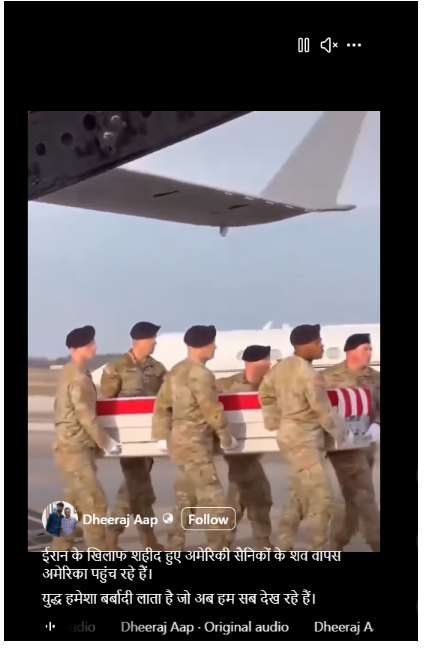
A video is being widely shared on social media showing soldiers carrying coffins with full military honours. Users are claiming that the footage shows the bodies of American soldiers who were killed in the war with Iran being brought back to the United States.
However, research by the CyberPeacefound the viral claim to be misleading. Our research revealed that the video has no connection to the recent Iran-Israel conflict. The footage actually dates back to December 2025, when an Islamic State gunman in Syria killed two US soldiers and a US civilian.
Following that incident, the bodies of the victims were transported with military honours, and the ceremony was recorded in the viral video. The clip is now being circulated online with a false claim.
Claim
On March 1, 2026, an Instagram user shared the viral video claiming that it shows the bodies of American soldiers returning to the US after being killed in the war against Iran. The caption of the post reads: “Bodies of American soldiers martyred against Iran are returning to the United States. War always brings destruction, which we are now witnessing.”
The link to the post and its archived version can be seen below.
Fact check
To verify the claim, we extracted key frames from the viral video and performed a reverse image search using Google Lens. During the search, we found the full version of the video in a report published by BBC on December 18, 2025. This confirms that the footage predates the current developments.

According to the BBC report, US President Donald Trump attended a dignified transfer ceremony for two members of the US National Guard and a US civilian who were killed in Syria. The somber ceremony took place at Dover Air Force Base in Delaware, United States. The US Central Command (Centcom) stated that the two soldiers and a civilian interpreter were killed in an ambush carried out by an Islamic State (IS) gunman in Syria. The US Army identified the two soldiers as Sgt. Edgar Brian Torres-Tovar (25) of Des Moines and Sgt. William Nathaniel Howard (29) of Marshalltown. A US civilian interpreter, Ayad Mansoor Sakat, was also killed in the attack. Officials said that three other service members were injured during the attack, and the gunman was engaged and killed. Syria’s state media also reported that two Syrian security personnel were injured in the incident.
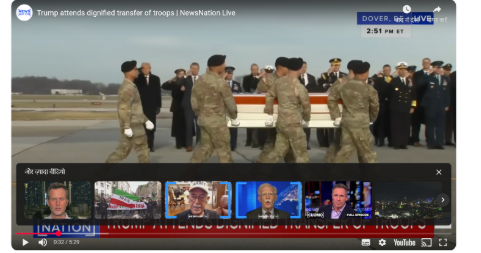
Further research led us to a report published on the News Nation YouTube channel on December 18, 2025, which also featured the same footage related to the incident.
Conclusion
Our research found that the viral video is not related to the recent Iran-Israel conflict. The footage dates back to December 2025, when two US soldiers and a US civilian were killed in an Islamic State attack in Syria. The video shows the dignified transfer of their remains and is now being shared on social media with a misleading claim.

Related Blogs
.webp)
For more than a century, cinema has evolved alongside technology. Sound transformed silent films, colour changed visual storytelling, computer-generated imagery expanded the limits of imagination, and streaming reshaped how audiences experience films. Each transformation brought uncertainty, but Artificial Intelligence represents a different kind of shift. It is not merely changing how films are made; it is beginning to challenge who, or what, gets to create and perform them.
This debate has moved from theory to reality with Tilly Norwood, an AI-generated performer created by Particle 6 through its AI talent division Xicoia. After months of discussion surrounding the role of artificial performers in entertainment, Norwood is now set to headline her own feature film, Misaligned which is a project that places artificial intelligence at the centre of both the production process and the story itself. The film is described as a comedy-drama following an AI character without a tangible existence. The story follows that, guided by another AI character, she begins developing ambitions, emotions, and a desire to understand what it means to become “human” The premise of the movie is intentionally self-reflective. An AI performer, whose very existence has raised questions about authenticity and creativity, will now portray a character experiencing those same conflicts.
AI as storyteller?
Using Artificial Intelligence in filmmaking is not recent, for years production studios have used technology for visual effects, editing assistance, restoration, recommendation systems, and production planning. The emergence of AI-generated performers, however, introduces a far more complex question, can AI replace the actors who are core to storytelling?
When Tilly was first introduced at the Zurich film festival in late 2025 by the Dutch producer Eline Van Der Velden, CEO and Founder of Particle 6, introduced it as a hybrid model of film-making, where there are directors, producers, production team but a "synthetic performer" in the lead role and a comprehensive AI-experts team. Van Der Velden argued that human creativity was not being replaced but supplemented by AI.
This was not well received by the film community. Actors like Emily Blunt and SAG-AFTRA (the Screen Actors Guild- American Federation of Television and Radio Artists) a US labor organization representing roughly 160,000 professionals across the entertainment and media industries, including actors, performers, journalists, musicians, and voice actors, released a statement condemning this project with synthetic performer. They emphasised that ‘creativity is, and should remain, human-centered. The union is opposed to the replacement of human performers by synthetics.’
The Question of Authenticity
Acting has historically been understood as an interpretation of human experience. Performers bring personal histories, emotions, cultural backgrounds, and individual perspectives into their roles. The criticism is that an AI actor does not exist in a tangible form and essentially has no real story or background of any kind. Particle 6 describes Tilly only as a twenty-something who lives in London and loves coffee which is a very shallow context and has no personality at all. The film is also set in the fictional "Tillyverse," not a real place and exists on some cloud system reinforcing the sense that there is no lived reality behind the character.
At their core, AI performers are outputs of generative systems rather than individuals with lived experience or personal artistic interpretation. These systems learn by identifying patterns from vast datasets and generating results based on existing material, which raises questions about whether such performances can be considered original creative expression at all. Tilly Norwood's music video ‘Taking the Lead’ illustrated this gap in practice, drawing attention to inconsistencies in natural emotion, visual continuity, and expression across scenes.
Human actors, by contrast, bring authenticity and emotional depth shaped by real experience and creative interpretation which are qualities that recognition and awards have traditionally been built around. If a performance is produced through algorithms trained on existing creative patterns, a fundamental question follows: what exactly is being celebrated, the technology, the final output, or the humans guiding the system?
Creativity, Consent, and the Legal Grey Areas
AI performers also raise significant questions about intellectual property, personality rights, consent, and compensation. Existing legal and contractual frameworks were primarily designed around human performers who are individuals who negotiate compensation, own aspects of their identity, and participate in the wider cultural ecosystem surrounding cinema. However, an AI actor challenges these traditional assumptions. If a digital performer does not possess legal personhood, creative ownership, or independent rights, questions emerge regarding who should receive recognition and financial benefits: the developers, production studios, directors, or the human creators involved in building the technology?
Also if a digital actor’s expressions, movements, or style are influenced by thousands of existing performers, determining ownership becomes complicated. Who controls an AI-generated performance? Who deserves credit? Should performers have rights over how their likeness, voice, or style influences future AI systems?
Any advantages?
The most significant advantage of AI-assisted filmmaking may lie in what it offers smaller production houses and independent creators. By reducing certain production costs, AI tools could let filmmakers with limited resources attempt ambitious ideas that were previously out of reach. Beyond this production advantage, however, the acceptance of AI performers themselves remains uncertain. Projects like Misaligned are therefore less a proven shift in cinema than an industry experiment testing how far technology can move into a traditionally human creative space.
The Future of Cinema: Replacement or Reinvention?
Every major technological transformation in cinema has created fears about what might be lost, yet cinema has consistently adapted by absorbing new technologies into its storytelling. AI may follow a similar path, but the stakes are different as it does not simply change the tools available to artists, it challenges the definitions of creativity, authorship, and performance itself.
Much of cinema's economic and cultural life is really built on the bond between audiences and actors. It's actors who drive ticket sales, build loyal fan followings, and become cultural figures in their own right, through interviews, public appearances, and the visible journey of training, struggle, and growth that shapes a career. An AI-generated performer can mimic parts of that celebrity image, but it can't actually show up for any of it the way a person can. Handing central creative roles to artificial personalities also raises a fairness question, especially at a time when so many human performers are already struggling to find work.
Whether audiences will really embrace fully synthetic performers as stand-ins for human actors is still an open question. Misaligned may end up being the first real test of that. Early reaction to Tilly Norwood has been largely critical within the industry and among audiences. How viewers respond to Misaligned itself will be an early test of whether that scepticism holds.
Cinema has always found ways to absorb new technology, but AI is testing something deeper than the tools filmmakers use. As machines get better at telling human stories, the real challenge is making sure the human element behind those stories doesn't get lost.
References
- https://theprint.in/feature/tilly-norwood-tillyverse-misaligned-particle6-ai-actor/2980654/
- https://www.cbsnews.com/news/tilly-norwood-ai-generated-actor-feature-film/
- https://www.sagaftra.org/sag-aftra-statement-synthetic-performer
- https://www.hollywoodreporter.com/movies/movie-news/ai-actor-tilly-norwood-movie-debut-misaligned-1236638719/
Executive Summary:
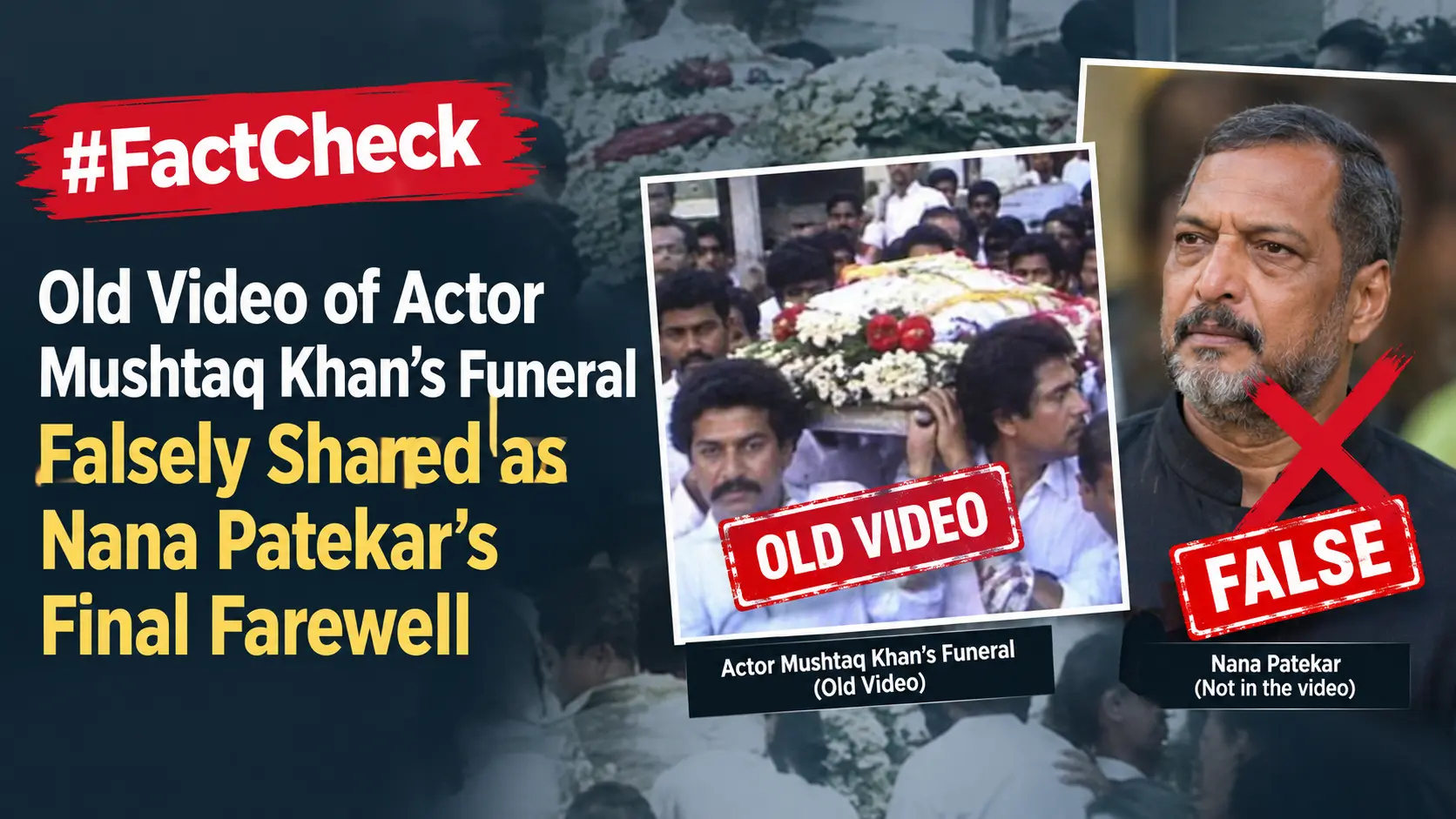
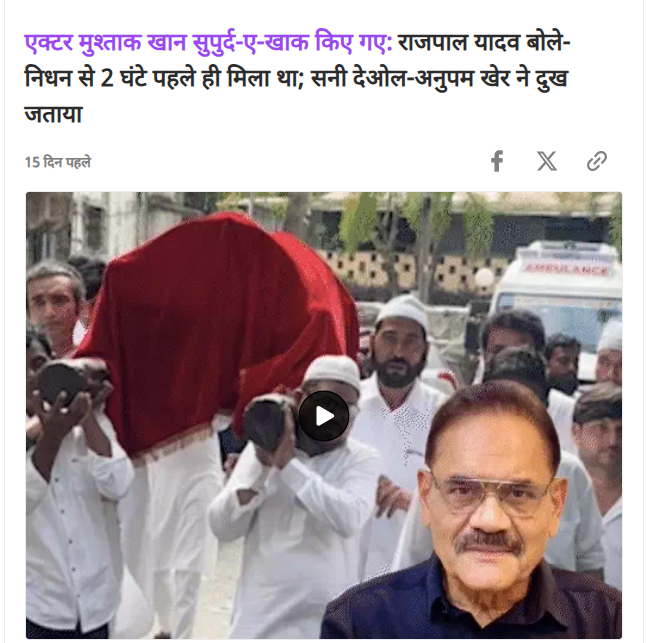
Veteran Indian actor Nana Patekar reportedly passed away early on October 8, 2026, at his residence in Goa. The 75-year-old actor allegedly suffered a sudden cardiac arrest at his home and was rushed to Manipal Hospital. According to reports, doctors attempted to revive him by administering CPR for around 45 minutes, but he was declared dead at 5:20 a.m. His family reportedly said that his last rites would be performed the same day at his farmhouse near Pune. Meanwhile, a social media post is circulating with the claim that the video shows Nana Patekar’s final farewell. CyberPeace Research found that the video actually shows the funeral of actor Mushtaq Khan.
Claim:
A Facebook user shared the viral video with the caption: “Final farewell to Nana Patekar… Veteran actor passes away at the age of 75.”
https://www.facebook.com/reel/1848305192964558

Fact Check:
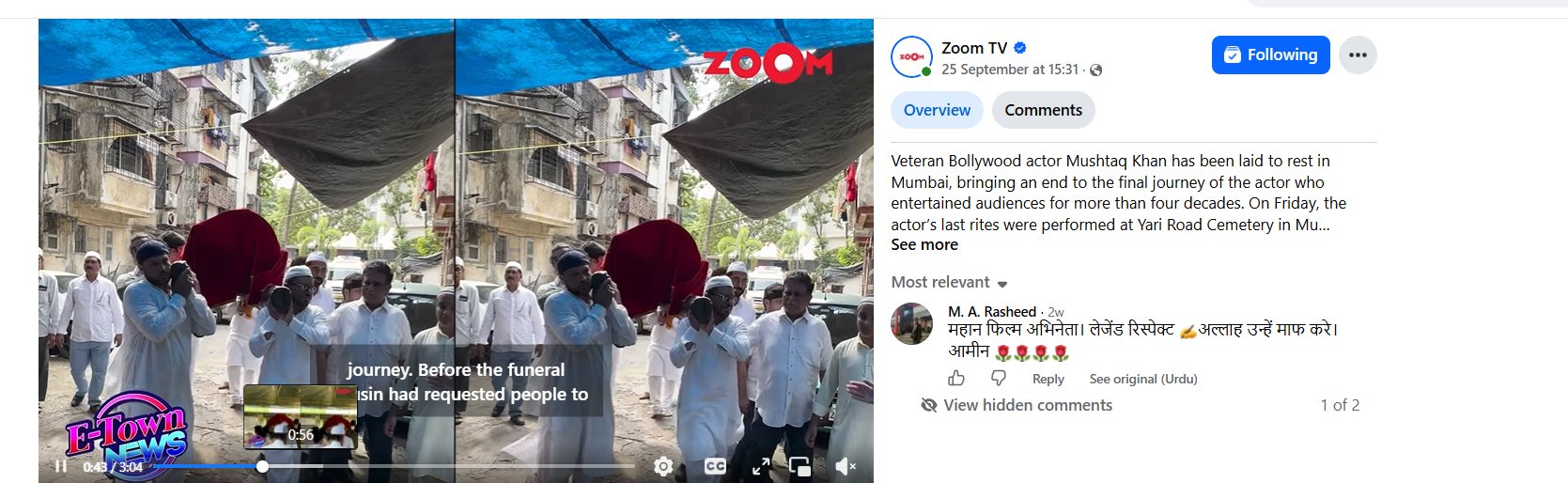
To verify the authenticity of the video, we conducted a reverse image search of its keyframes using Google Lens. During the search, we found a video report uploaded to Zoom TV’s Facebook page on September 25, 2026, which contained visuals from the viral clip.The report stated that veteran Bollywood actor Mushtaq Khan had been laid to rest in Mumbai, marking the end of the final journey of an actor who had entertained audiences for more than four decades. According to the report, the actor’s funeral rites were performed at the Yari Road cemetery in Mumbai after Friday prayers. During the funeral procession, his son and other family members were seen carrying his mortal remains.It is worth noting that actor Mushtaq Khan passed away on September 24 following a prolonged illness.
https://www.facebook.com/watch/?v=1922049222512573
During a search using relevant keywords, we found a report published on the Dainik Bhaskar website on September 25, 2026. The report also featured visuals from the video being shared with the claim that it shows Nana Patekar’s final farewell.The report stated that the video shows the funeral of actor Mushtaq Khan, who was laid to rest at the Yari Road cemetery after Friday prayers on September 25.
Conclusion:
The evidence gathered during our research establishes that the viral video does not show the final farewell of actor Nana Patekar. Instead, the video shows the funeral procession of actor Mushtaq Khan, who passed away on September 24, 2026.
Executive Summary
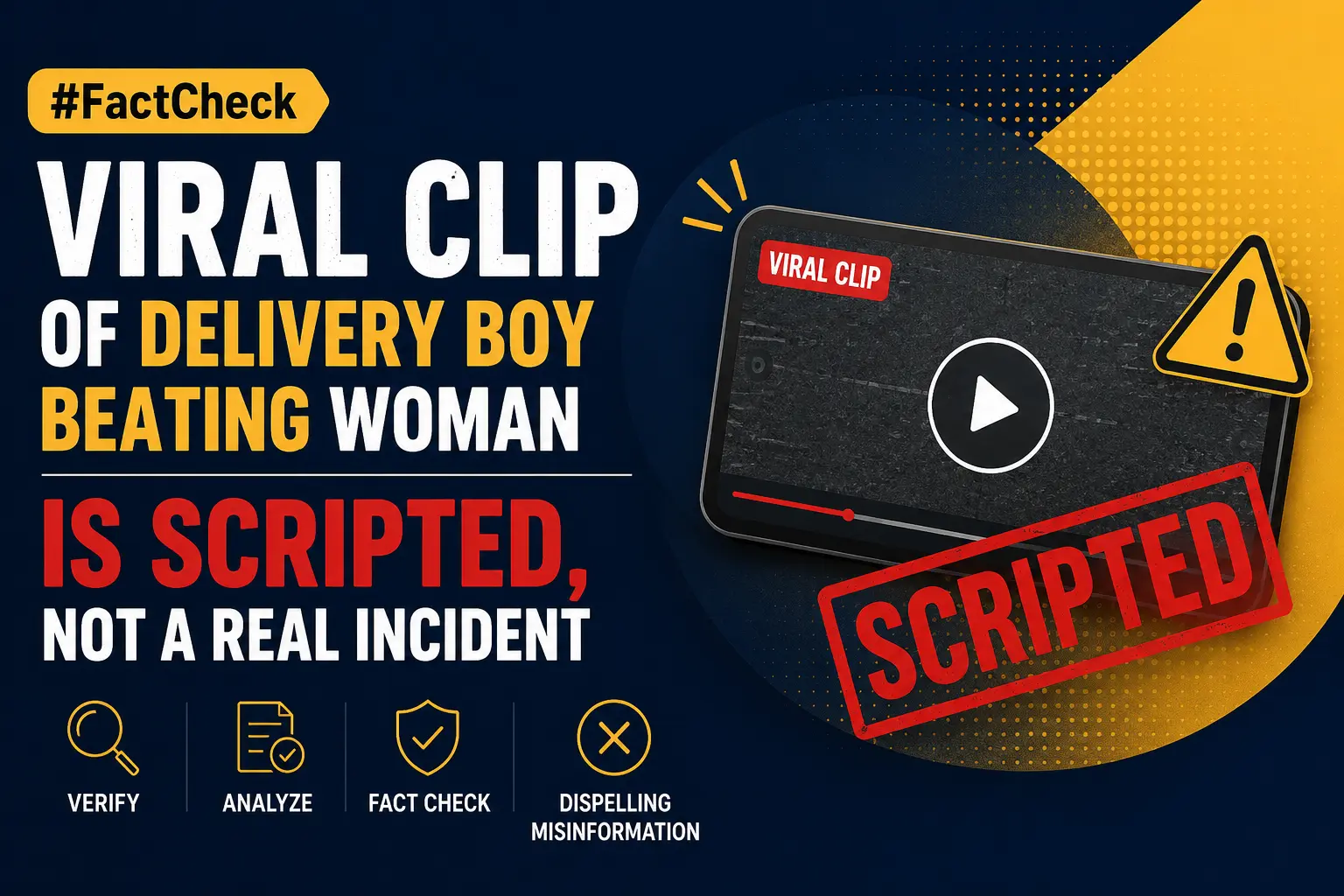
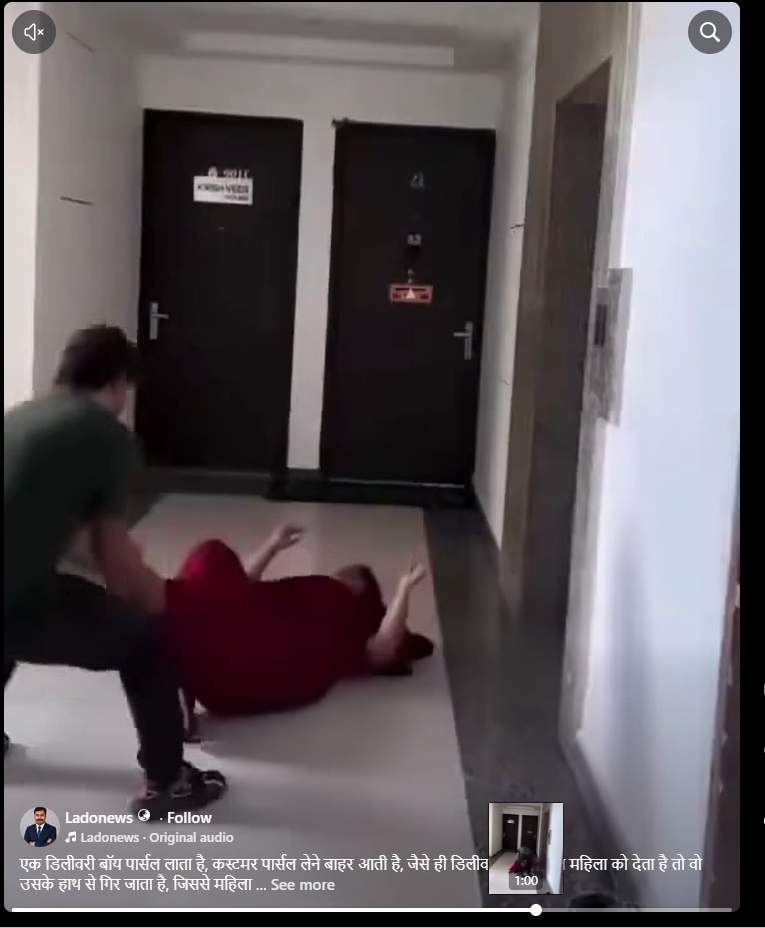
A video is being widely shared on social media claiming to show a delivery boy assaulting a woman. In the viral clip, a man approaches a woman to deliver some items. An argument soon breaks out between the two, followed by pushing and shoving that escalates into a physical fight. The purported delivery boy is then seen knocking the woman to the ground and allegedly beating her. Research by CyberPeace Research Wing found that the viral video is scripted.
Claim:
“A delivery boy brings a parcel, and the customer comes outside to collect it. As soon as the delivery boy hands the parcel to the woman, it falls from her hands, following which the female customer starts assaulting the delivery boy. In anger, the delivery boy also begins hitting the woman and knocks her to the ground, brutally beating her with kicks and slaps. Although the woman was at fault, the delivery boy should not have reacted so violently.”
https://www.facebook.com/reel/2826948067671726
Fact Check
To verify the viral video claiming to show a delivery boy assaulting a woman, we conducted a reverse image search using keyframes from the clip. During the search, we found the same video posted on the Facebook account of a user named Vipin Chauhan on August 21, 2026. The viral clip appears in the 2-minute-33-second-long video. The caption accompanying the video states that it is a pre-planned (scripted) video.
https://www.facebook.com/reel/1551896343642588
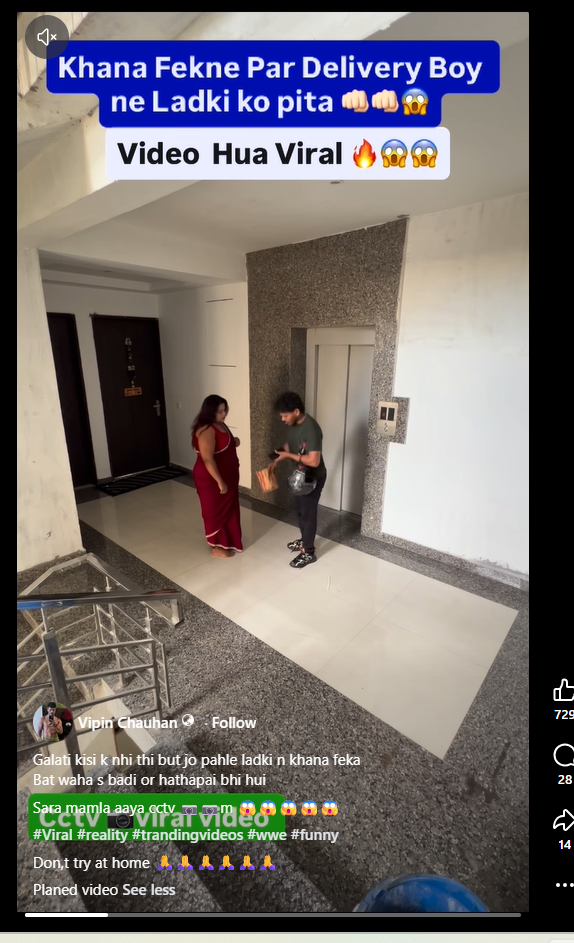
During the research, we also found the same video on the same user's Instagram account, where it was described as scripted.
https://www.instagram.com/reels/DcTAF_ZsUnv/
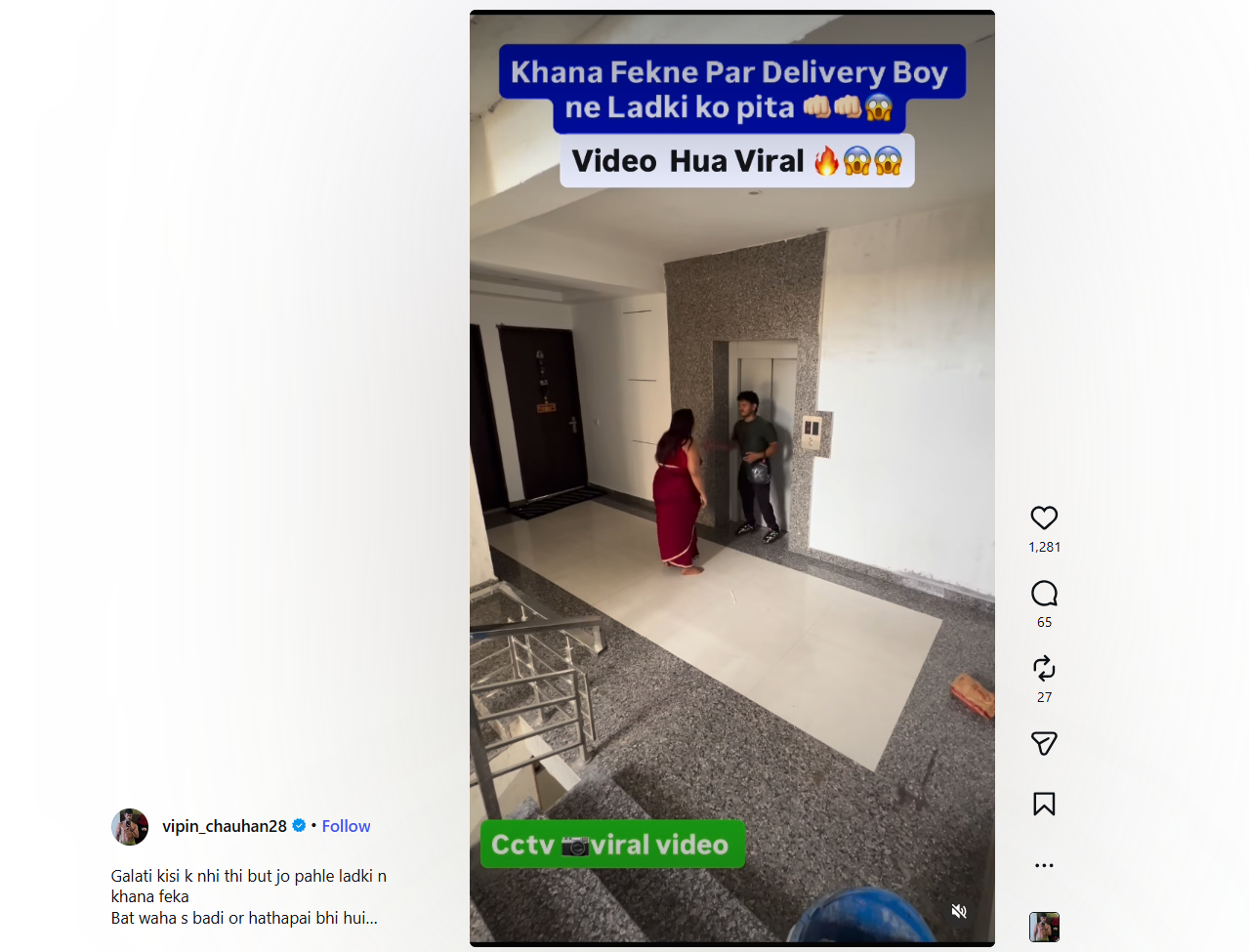
Upon reviewing the Instagram user's account, we found several other videos featuring men and women engaged in physical altercations. The captions of all these videos clearly state that they are scripted.
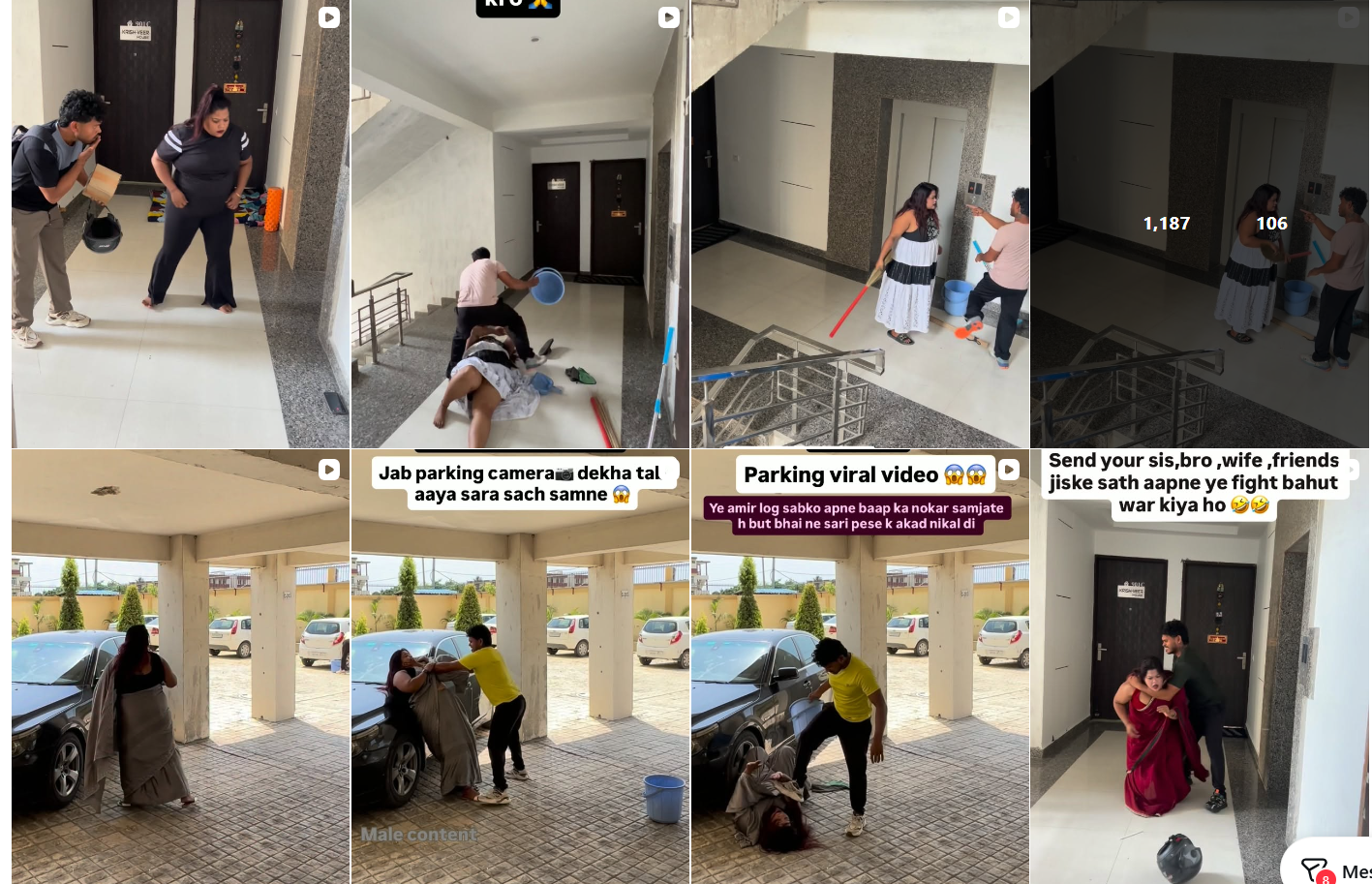
Conclusion
The evidence gathered during our research clearly establishes that the video being shared with the claim that a delivery boy assaulted a woman is scripted and does not depict a genuine incident. The same video was found on the social media accounts of the creator, where it was explicitly described as scripted. We also found several other similar videos on the user's account, all of which were identified as pre-planned or scripted content.
