
Ethical AI and Disability: Enhancing Inclusion Through Technology
AI systems have grown in both popularity and complexity on which they operate. They are enhancing accessibility for all, including people with disabilities, by revolutionising sectors including healthcare, education, and public services. We are at the stage where AI-powered solutions that can help people with mental, physical, visual or hearing impairments perform everyday and complex tasks are being created.
Generative AI is now being used to amplify human capability. The development of tools for speech-to-text and image recognition is helping in facilitating communication and interaction for visually or hearing-impaired individuals, and smart prosthetics are providing tailored support. Unfortunately, even with these developments, PWDs have continued to face challenges. Therefore, it is important to balance innovation with ethical considerations aand ensuring that these technologies are designed with qualities like privacy, equity, and inclusivity in mind.
Access to Tech: the Barriers Faced by PWDs
PWDs face several barriers while accessing technology. Identifying these challenges is important as they lack computer accessibility, in the use of hardware and software, which has become a norm in life nowadays. Website functions that only work when users click with a mouse, self-service kiosks without accessibility features, touch screens without screen reader software or tactile keyboards, and out-of-order equipment, such as lifts, captioning mirrors and description headsets, are just some difficulties that they face in their day-to-day life.
While they are helpful, much of the current technology doesn’t fully address all disabilities. For example, many assistive devices focus on visual or mobility impairments, but they fall short of addressing cognitive or sensory conditions. In addition to this, these solutions often lack personalisation, making them less effective for individuals with diverse needs. AI has significant potential to bridge this gap. With adaptive systems like voice assistants, real-time translation, and personalised features, AI can create more inclusive solutions, improving access to both digital and physical spaces for everyone.
The Importance of Inclusive AI Design
Creating an Inclusive AI design is important. It ensures that PWDs are not excluded from technological advancements because of the impairments that they are suffering from. The concept of an ‘inclusive or universal’ design promotes creating products and services that are usable for the widest possible range of people. Tech Developers have an ethical responsibility to create advancements in AI that serve everyone. Accessibility features should be built into the core design. They should be treated as a practice rather than an afterthought. However, bias in AI development often stems from data of a non-representative nature, or assumptions can lead to systems that overlook or poorly serve PWDs. If AI algorithms are trained on limited or biased data, they risk excluding marginalised groups, making ethical, inclusive design a necessity for equity and accessibility.
Regulatory Efforts to Ensure Accessible AI
In India, the Rights of Persons with Disabilities Act of 2016 impresses upon the need to provide PWDs with equal accessibility to technology. Subsequently, the DPDP Act of 2023 highlights data privacy concerns for the disabled under section 9 to process their data.
On the international level, the newly incorporated EU’s AI Act mandates measures for transparent, safe, and fair access to AI systems along with including measures that are related to accessibility.
In the US, the Americans with Disabilities Act of 1990 and Section 508 of the 1998 amendment to the Rehabilitation Act of 1973 are the primary legislations that work on promoting digital accessibility in public services.
Challenges in implementing Regulations for AI Accessibility for PWDs
Defining the term ‘inclusive AI’ is a challenge. When working on implementing regulations and compliance for the accessibility of AI, if the primary work is left undefined, it makes the task of creating tools to address the issue an issue. The rapid pace of tech and AI development has more often outpaced legal frameworks in development. This leads to the creation of enforcement gaps. Countries like Canada and tech industry giants like Microsoft and Google are leading forces behind creating accessible AI innovations. Their regulatory frameworks focus on developing AI ethics with inclusivity and collaboration with disability rights groups.
India’s efforts in creating an inclusive AI include the redesign of the Sugamya Bharat app. The app had been created to assist PWDs and the elderly. It will now be incorporating AI features specifically to assist the intended users.
Though AI development has opportunities for inclusivity, unregulated development can be risky. Regulation plays a critical role in ensuring that AI-driven solutions prioritise inclusivity, fairness, and accessibility, harnessing AI’s potential to empower PWDs and contribute to a more inclusive society.
Conclusion
AI development can offer PWDs unprecedented independence and accessibility in leading their lives. The development of AI while keeping inclusivity and fairness in mind is needed to be prioritised. AI that is free from bias, combined with robust regulatory frameworks, together are essential in ensuring that AI serves equitably. Collaborations between tech developers, policymakers, and disability advocates need to be supported and promoted to build AI systems. This will in turn work towards bridging the accessibility gaps for PWDs. As AI continues to evolve, maintaining a steadfast commitment to inclusivity will be crucial in preventing marginalisation and advancing true technological progress for all.
References
- https://www.business-standard.com/india-news/over-1-4k-accessibility-related-complaints-filed-on-govt-app-75-solved-124090800118_1.html
- https://www.forbes.com/councils/forbesbusinesscouncil/2023/06/16/empowering-individuals-with-disabilities-through-ai-technology/ .
- https://hbr.org/2023/08/designing-generative-ai-to-work-for-people-with-disabilities
- Thehttps://blogs.microsoft.com/on-the-issues/2018/05/07/using-ai-to-empower-people-with-disabilities/andensur,personalization

Related Blogs

Executive Summary
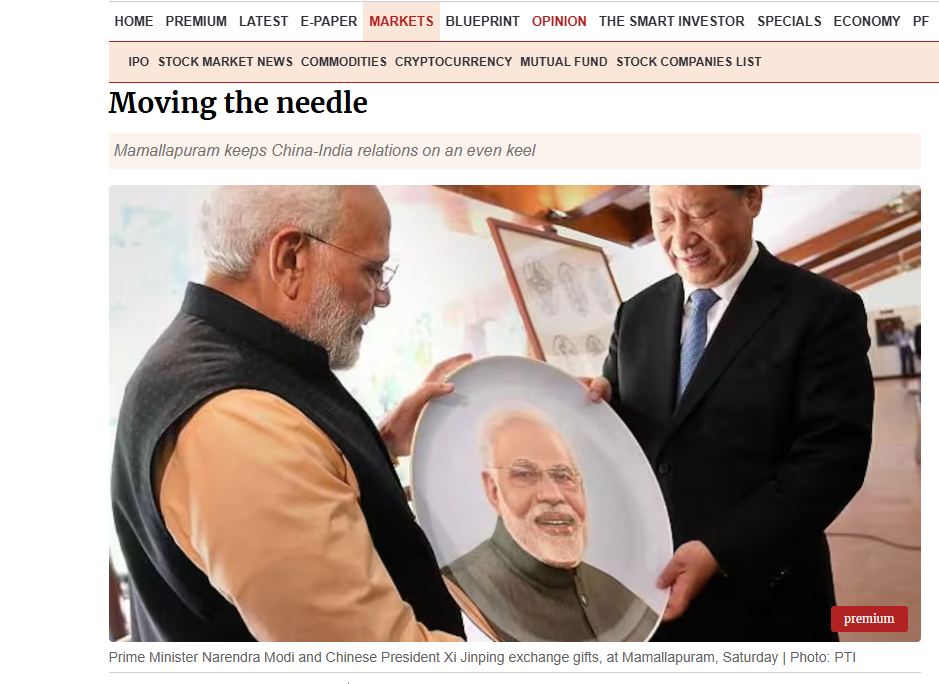
A video of Prime Minister Narendra Modi and Chinese President Xi Jinping is being shared on social media. The video is being shared with the claim that during the BRICS Summit, Prime Minister Modi gifted Xi Jinping a portrait featuring his own image. The post also takes aim at Prime Minister Modi based on this claim. Research by CyberPeace found that the video dates back to October 2019 and shows an exchange of gifts between Prime Minister Narendra Modi and Chinese President Xi Jinping. On the concluding day of the Mamallapuram Summit, Prime Minister Modi gifted Xi Jinping a large, handcrafted silk shawl. In return, Xi Jinping presented Prime Minister Modi with a porcelain souvenir bearing his portrait.
Claim:
A video of Prime Minister Narendra Modi and Chinese President Xi Jinping is being shared on Facebook with the claim that during the BRICS Summit, Prime Minister Modi gifted Xi Jinping a portrait of himself.
https://www.facebook.com/watch/?v=1109664078425193

Fact Check
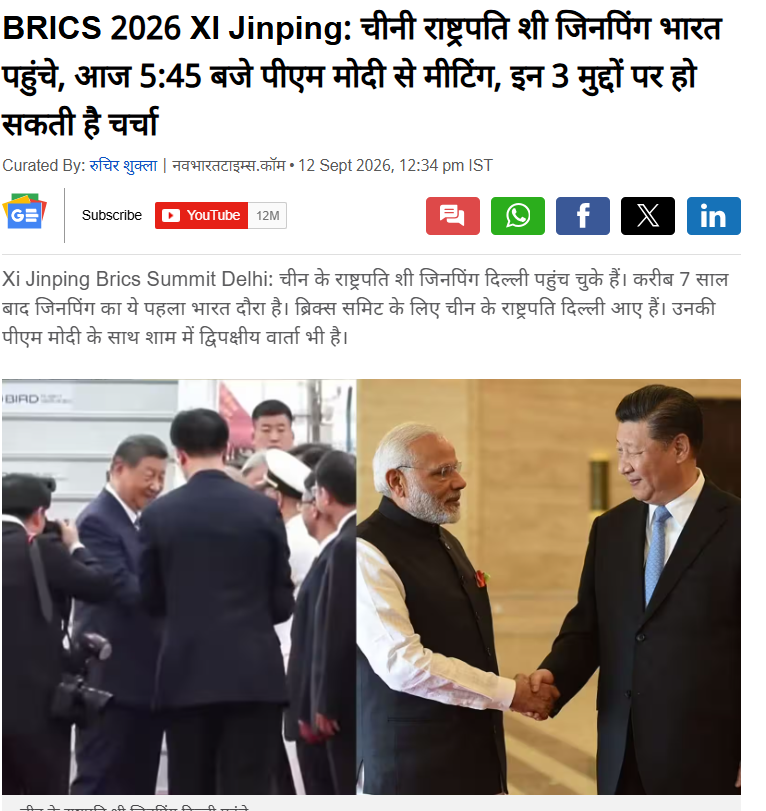
To verify the authenticity of the viral claim, we conducted a Google search using relevant keywords. During the search, we found a report published by Navbharat Times on September 12, 2026. According to the report, Chinese President Xi Jinping has arrived in Delhi to attend the 18th BRICS Summit. His aircraft landed at Palam Airport at around noon on Saturday. This is his first visit to India in nearly seven years.The report further stated that Prime Minister Narendra Modi and Xi Jinping were scheduled to meet at around 5 pm on the same day. This made it clear during our research that the video being shared on social media is not from the current BRICS Summit and is an old video.
To verify the authenticity of the viral claim, we conducted a reverse image search of the keyframes from the video. During the search, we found a report published by Business Standard on October 13, 2019, which contained visuals from the viral video. According to the report, Chinese President Xi Jinping left for Nepal on Saturday aboard an Air China aircraft, concluding his second informal summit with Prime Minister Narendra Modi, which signalled a recalibration of bilateral ties. Xi spent around 24 hours in India.During his visit, he travelled to Mamallapuram near Chennai and held informal talks with Prime Minister Narendra Modi. Delegation-level talks between the two countries were also held.
https://www.business-standard.com/article/opinion/moving-the-needle-119101300820_1.html
In the next step of our research, we found a report published by Economic Times on October 14, 2019. The report also contained the same visuals from the viral video and presented them in their original context.

Conclusion
The evidence gathered during our research makes it clear that the video being shared on social media is not from the BRICS Summit, but is an old video from 2019. This confirms that the video is being shared on social media by taking it out of its original context and falsely linking it to the BRICS Summit. Therefore, the claim that the viral video is from the BRICS Summit is misleading.
.webp)
Introduction
We were all stunned and taken aback when multiple photos of streets in the U.S. surfaced with heavily drugged individuals loosely sitting on the streets, victims of a systematically led drug operation that has recently become a target of the Trump-led “tariff” war, which he terms as a war on drug cartels. The drug is a synthetic opioid, fentanyl, which is highly powerful and addictive. The menace of this drug is found in a country that has Wall Street and the largest and most powerful economy globally. The serious implications of drug abuse are not about a certain economy; instead, it has huge costs to society in general. The estimated cost of substance misuse to society is more than $820 billion each year and is expected to continue rising.
On June 26, the International Day against Drug Abuse and Illicit Trafficking is observed globally. However, this war is waged daily for millions of people, not on streets or borders, but in bloodstreams, behind locked doors, and inside broken homes. Drug abuse is no longer a health crisis; it is a developmental crisis. The United Nations Office on Drugs and Crime has launched a campaign against this organised crime that says, “Break the Cycle’ attributing to the fact that de-addiction is hard for individuals.
The Evolving Drug Crisis: From Alleyways to Algorithms
The menace of Drug abuse and illicit trafficking has also taken strides in advancement, and what was once considered a street-side vice has made its way online in a faceless, encrypted, and algorithmically optimised sense. The online drug cartels operate in the shadows and often hide in plain sight, taking advantage of the privacy designed to benefit individuals. With the help of darknet markets, cryptocurrency, and anonymised logistics, the drug trade has transformed into a transnational, tech-enabled industry on a global scale. In an operation led by the U.S. Department of Justice’s Joint Criminal Opiod and Darknet Enforcement (JCODE) and related to Operation RapTor, an LA apartment was only to find an organised business centre that operated as a hub of one of the most prolific methamphetamine and cocaine distributors in the market. Aaron Pinder, Unit Chief of the FBI Hi-Tech Organised Crime Unit, said in his interview, “The darknet vendors that we investigate, they truly operate on a global scale.” On January 11, 2025, during the Regional Conference on “Drug Trafficking and National Security,” it was acknowledged how cryptocurrency, the dark web, online marketplaces, and drones have made drug trafficking a faceless crime. Reportedly, there has been a seven-fold increase in the drugs seized from 2004-14 to 2014-24.
India’s Response: Bridging Borders, Policing Bytes
India has been historically vulnerable due to its geostrategic placement between the Golden Crescent (Afghanistan-Iran-Pakistan) and Golden Triangle (Myanmar-Laos-Thailand), and confronts a fresh danger from “click-to-consume’ narcotics. Although India has always adopted a highly sensitised approach, it holds an optimistic future outlook for the youth. Last year, to commemorate the occasion of International Day against Drug Abuse and Illicit Trafficking, the Department of Social Justice & Empowerment organised a programme to engage individuals for the cause. The Indian authorities are often seen coming down heavily on the drug peddlers and cartels, and to aid the cause, the Home Minister Amit Shah inaugurated the new office complex of the NCB’s Bhopal zonal unit and extension of the MANAS-2 helpline to all 36 states and UTs. The primary objectives of this step are to evaluate the effectiveness of the Narcotics Coordination Mechanism (NCORD), assess the progress of states in fighting drug trafficking, and share real-time information from the National Narcotics Helpline ‘MANAS’ portal with the Anti-Narcotics Task Force (ANTF) of states and UTs.
The United Nation’s War on Narcotics: From Treaties to Technology
The United Nations Office on Drugs and Crime (UNODC) is leading the international response. It offers vital data, early warning systems, and technical support to the states fighting the drug problem. The UNODC incorporates cooperation in cross-border intelligence, overseeing the darknet activities, encouraging the treatment and harm reduction, and using anti-money laundering mechanisms to stop financial flows. India has always pledged its support to the UN led activities, and as per reports dated 26th March, 2025, India chaired the prestigious UN-backed Commission on Narcotic Drugs (CND) meeting held in vienna, wherein India highlighted the importance of opioids for medical purposes as well as the nation’s notable advancements in the field.
Resolution on June 26: From Commemoration to Commitment
Let June 26 be more than a date on the calendar- let it echo as a call to action, a day when awareness transforms into action, and resolve becomes resistance. On this day, CyberPeace resolves the following:
- To treat addicts as victims rather than criminals and to pitch for reforms to provide access to reasonably priced, stigma-free rehabilitation.
- To integrate anti-drug awareness into digital literacy initiatives and school curricula in order to teach frequently and early.
- To demand responsibility and accountability from online marketplaces and delivery services that unwittingly aid traffickers
- To tackle the demand side through employment, mental health services, and social protection, particularly for at-risk youth.
References
- https://www.gatewayfoundation.org/blog/cost-of-drug-addiction/#:~:text=The%20estimated%20cost%20for%20substance,Alcohol%3A%20%24249%20billion
- https://www.unodc.org/unodc/en/drugs/index-new.html
- https://www.fbi.gov/news/stories/global-operation-targets-darknet-drug-trafficking
- https://www.thehindu.com/news/national/dark-web-crypto-drones-emerge-as-challenges-in-fight-against-drug-trafficking-amit-shah/article69088383.ece
- https://www.pib.gov.in/PressReleaseIframePage.aspx?PRID=2028704
- https://www.newindianexpress.com/nation/2025/Mar/26/in-a-first-india-chairs-un-forum-on-narcotics-pledges-to-improve-access-to-pain-relief-and-palliative-care
.webp)
Introduction
India is confronting a wake-up call as a recent cyber incident aimed at the aviation sector underscores the fragile nature of digital systems that guide national air travel. The disclosure in Parliament has pushed the conversation on flight safety, signal integrity, and cyber readiness back into urgent focus. In a written response to a Parliamentary question, Civil Aviation Minister Ram Mohan Naidu acknowledged that GPS spoofing, a malicious method employed to alter navigation signals, had been noticed at seven major airports of the country. New Delhi flights had not been affected during the incident, but still, it was an event that again made air travel's safety, GNSS interference, and the overall cyber threat to India's airspace an issue of concern.
The Incident: What Happened?
Initial notices came from Indira Gandhi International Airport in Delhi, where the pilots of the different inbound flights talked about GPS spoofing as the reason for their landing. Spoofing is the process of sending counterfeit GPS signals which mislead the aircraft's navigation systems and may cause a wrong measure of the altitude, the position or the runway alignment. In Delhi, pilots operating under GPS-based landing procedures over Runway 10 experienced errors in their approaches and promptly switched to the alternative procedures without any delay.
The Minister said that apart from Delhi, other airports, viz. Kolkata, Amritsar, Mumbai, Hyderabad, Bengaluru, and Chennai were the 6 airports that recorded similar GNSS interference patterns consisting of both jamming and spoofing. Though no major interruptions or incidents occurred, these occurrences are a sign of a steady and enlarging threat.
Why Is GPS Spoofing So Dangerous?
Satellite navigation and communication systems are the backbone of modern aviation, which is now a matter of great precision. Signal jamming by malicious actors comes with a bunch of risks:
- Diversions and Delays: Pilots may be forced to either give up attempts to land or divert flights, which translates into higher consumption of fuel and more complicated operations due to the case of jamming.
- Threat of Safety Issue: Pilots are trained to deal with such incidents by following the prescribed fallback procedures, but still they depend very much on the GNSS signals that are accurate for safe manoeuvring, especially in low visibility situations.
- Pressure on Old Systems: Indian airports are still in the process of completely converting from ground-based navigation aids to GNSS. Signal disruptions entail the use of older technologies, which results in putting additional pressure on the already overburdened air traffic control systems.
- Opening Up Possibilities for Direct Attacks: Signal jamming can be made a tool for more clever tactics of operation that can include causing confusion during the busy traffic period or performing coordinated attacks to create chaos.
Aviation and Cyber Threats
The disturbances that have been mentioned at the seven airports are not unique. The civil aviation regulators all over the world have already reported an increase in GNSS jamming. The exemplary cases in the Middle East, Eastern Europe, and East Asia have revealed that the safety of airspace has turned into a tactical issue.
Moreover, India's quick adoption of digital technology in the aviation sector could open threat vulnerabilities from state-sponsored groups, hackers. In this instance, the government has not yet announced who was responsible for the spoofing, but the trend points to an adversary with advanced technology.
Government and Regulatory Response
The confirmation from the Civil Aviation Minister underscores a proactive stance by agencies such as:
- Directorate General of Civil Aviation (DGCA)
- Ministry of Civil Aviation
- Airports Authority of India (AAI)
The involved entities are collaborating now to do an inquiry into the cases and set up preventive measures.
The main steps that are taken in response are:
- More thorough observation of GNSS signal anomalies
- More pilot briefings and training on dealing with spoofing situations
- Improving navigation aids to set up a backup
- Working with IT security experts to find out the sources of interference
- Communicating with other global aviation authorities to share the best practices
India, being a significant player in the world aviation market, is not allowed to relax its guard. Cyberattacks on airports show how digital as well as physical security are becoming more and more intertwined.
The Bigger Picture: Protecting Critical Infrastructure
Aviation is a sector that very clearly shows that threats from cyberspace can easily translate into security issues for a nation. The airport system not only becomes more vulnerable to attacks but also the whole aviation industry as the digital ecosystems gain more complex forms together with integrated telecommunications networks, the Internet of Things (IoT)-enabled systems, and cloud-based services.
One of the many threats in the form of GNSS spoofing demonstrates so-called:
- Ransomware attacks on airport systems
- Contamination of air traffic control infrastructure
- Data breaches conducted by insiders
- Passenger data attacks
- Hinderance of airport logistics and baggage systems
What Needs to Happen Next?
India is compelled to embrace a multi-faceted approach in order to manage the intricacies of GNSS interference risk:
- Cybersecurity Measures in Aviation Enforced: New monitoring tools, anomaly detection systems, and instant response plans will be put into service.
- Redundant Technology: The non-GNSS-based navigation system will be expanded to guarantee the continuity of operations in the event of jamming.
- Cyber Drills Across all Sectors: To get pilots, air traffic control personnel, and airport operators ready, the aviation cyber drills will be conducted at the national level.
- Global Cooperation: International organisations will be approached to share the information and standardise the procedures.
- R&D and Innovations: Funding will be directed towards anti-spoofing technology, stronger satellite signals, and the domestic navigation system, like NavIC.
Conclusion
The cyberattack that targeted the seven airports serves as a clear reminder that aviation cybersecurity should not be considered a secondary issue anymore. Even though the quick reaction from the authorities managed to averted any disruptions, the event still shows the vulnerabilities of modern aviation systems. India's air travel infrastructure expansion will be a good time for the country to install its strong cybersecurity frameworks to protect its passengers, maintain the continuity of operations, and secure the airspace of its territory. At CyberPeace, we believe that a coordinated, proactive, and technology-driven approach is no longer an option, it is the new fundamental of aviation security in the digital age.
Reference
