
#FactCheck - Claim That Palki Sharma’s Viral Video Questions Jordan’s Protocol Is False; Video Is AI-Manipulated
A video clip of journalist Palki Sharma is being widely shared on social media. Along with the video, it is being claimed that during Prime Minister Narendra Modi’s recent Middle East visit, she questioned Jordan’s diplomatic protocol.
In the viral clip, Palki Sharma is allegedly seen asking why Jordan’s King Abdullah II did not come to the airport to receive Prime Minister Modi, and whether this indicated a downgrade in the level of welcome.
However, an investigation by the Cyber Peace Foundation found this claim to be misleading. The probe revealed that while the visuals in the viral video are genuine, the audio has been altered using Artificial Intelligence (AI).
On the social media platform ‘X’, a user named “Ammar Solangi” shared this video on 18 December. The post claimed that the video was related to questions raised about Jordan’s diplomatic protocol during Prime Minister Modi’s visit. According to the post, Palki Sharma questioned why King Abdullah II did not receive Prime Minister Modi at the airport. The archive link of the viral post can be seen here: https://ghostarchive.org/archive/26aK0
Verification
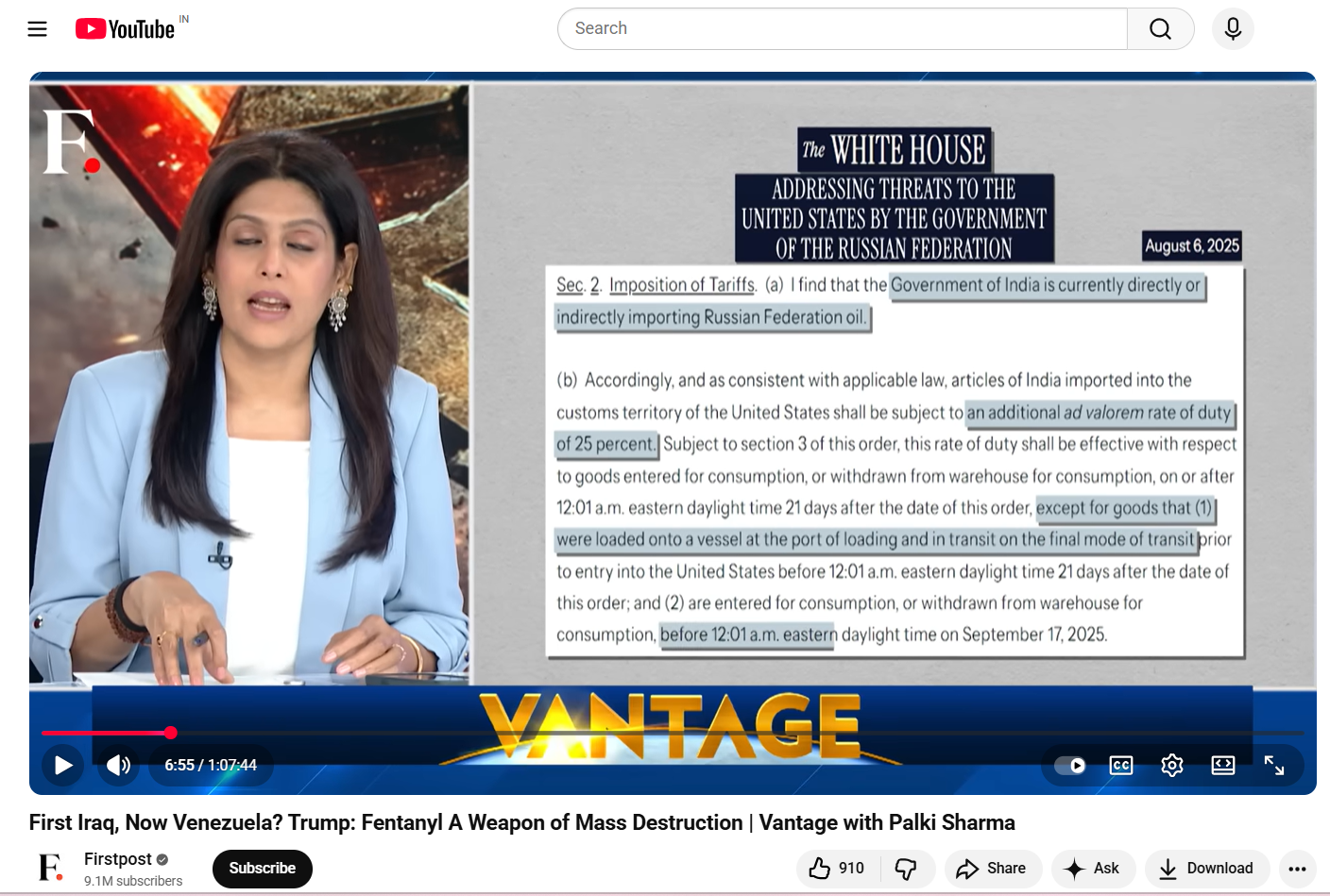
During the investigation, the fact-check desk noticed the ‘Firstpost’ logo in the top-left corner of the viral video. Based on this clue, a customized Google search was conducted, which led to the original news report.
The investigation revealed that the viral video was taken from an episode of journalist Palki Sharma’s show “Vantage with Palki Sharma”, which aired on 17 December.
Analysis of the video showed that the visuals appearing at the 33 minutes 30 seconds timestamp in the original report exactly match those used in the viral clip. However, in the original broadcast, Palki Sharma neither questioned Jordan’s protocol nor made any comment about King Abdullah II not being present at the airport.
In the original video, Palki Sharma says:
“Prime Minister Modi was on a diplomatic tour of Jordan, Ethiopia, and Oman, and in Jordan he was received at the airport by the country’s Prime Minister…” The link to the original report can be seen here: https://www.youtube.com/watch?v=-VYZYe9l6Bs
AI Audio Examination
Further investigation involved separating the audio from the viral video and analyzing it using the AI voice detection tool ‘Resemble AI’. The tool’s results confirmed that fake, AI-generated audio had been added over the real footage in the viral clip to spread a misleading claim. A screenshot of the results from this examination can be seen below.

Conclusion
The video being circulated in the name of journalist Palki Sharma has been tampered with. Her voice has been altered using AI technology, and the claim made regarding the Jordan visit is completely misleading.

Related Blogs

The UN established its first permanent Global Mechanism for cybersecurity which will begin operations in March 2026. The policy framework for Western countries exists because their current strategies are being developed. The situation in India presents greater complexity and higher levels of interest than any other country.
The Fence That Became a Vantage Point
The United Nations cybersecurity talks have seen India actively participate since their start. India brought its proposal for an open and inclusive multilateral framework which was supported by Western states who wanted to establish universal norms and responsible state behaviour but India did not accept their geopolitical viewpoint.
India did not support the Russia-led bloc which wanted a permanent open-ended working group that would focus only on plenary meetings and the country also rejected the European Union's Program of Action. India maintained its previous stance by supporting multilateralism as a general principle while showing hesitation about backing specific power structures.
The fence now provides an advantage because it no longer serves as a point of vulnerability. India's non-alignment provides him with operational power because the body operates through decision-making which requires all members to agree.
Sovereignty First, Norms Second
The digital sovereignty framework which defines India's long-standing cybersecurity diplomatic activities serves as the country's fundamental cybersecurity diplomatic framework. New Delhi has been reluctant to endorse frameworks that could constrain how it manages its own cyberspace, whether through content regulation, surveillance architecture, or incident response. The Indian government establishes its control over internet governance through its implementation of VPN regulations and CERT-In reporting requirements and data localization discussions.
The new Global Mechanism creates a situation which India must handle because it creates an uncommon diplomatic situation. The framework's five pillars, threats, norms, international law, confidence-building measures, and capacity-building, each carry embedded assumptions that don't sit neatly with India's domestic policy posture. India supports the norm which prohibits countries from attacking each other's critical infrastructure while developing offensive cyber abilities and keeping its cyber response strategies secret.
The Capacity-Building Opening
The Indian government has a definite interest in dedicated thematic group 2 which focuses on building cybersecurity capacity. India exists in two opposing states because it operates as a developing nation which lacks basic national cybersecurity systems while also maintaining advanced cyber defense capabilities. The donor table exists as a platform which gives India both funding rights and complete rights to speak for developing nations. India should serve as a connecting force for DTG 2 by sharing its experience with CERT-In development and its sectoral frameworks for finance and telecom and its National Cyber Coordination Centre programs which train cybersecurity professionals while requesting capacity-building programs that follow demand-based needs assessment and local context understanding and which do not include the typical restrictions that accompany Western technical assistance.
India has done this before in other multilateral settings. The organization maintains its independence through its role as a credible Global South representative which it uses to speak for the Global South without aligning with any particular alliance.
The DTG 1 Question: Critical Infrastructure and Strategic Ambiguity
The DTG 1 study about ICT security challenges shows how resilience and cooperation and stability work together as different themes but creates complex challenges for India.
The 2020 Mumbai power grid incident which some researchers attribute to Chinese state-linked actors has become one of three major attacks against India's critical infrastructure together with AIIMS Delhi incidents in 2022 and ongoing cyber intrusions into defence and government networks. The international standards which govern critical infrastructure protection require actual implementation from India because the country possesses vital national assets.
India has not yet established formal processes for cyberattack attribution while its officials avoid the norm-enforcement diplomacy which Western countries practice through their coordinated attribution and sanction procedures.
India must either develop deeper transparency about its operations or create specialized operational plans which can keep its needed information undercover if it wants to participate in DTG 1 about cross-border interdependencies and incident response collaboration. India will likely engage selectively, supporting the idea of critical infrastructure norms while resisting mechanisms that operationalise accountability.
Geopolitical Triangulation
The new Global Mechanism needs countries to implement their national policies because states must stop merely restating their positions. Multilateral cybersecurity forums operate as Geopolitical triangulation platforms for India. India's security system must protect its interests against its two main cyber adversaries which include China and Pakistan-based groups.
The US and EU strategic partnership between India and these Western governments requires India to show closer ties with democratic nations through its participation in international forums. The new Global Mechanism will require India to pursue its current position by participating in capacity-building activities while developing common norms through its work on general norms language.
India will maintain its current position between Western liberal order enforcement and Russia-China sovereignty-maximalist counter-narrative through its capacity-building activities and general norms language work.
What India Should Actually Do
The document establishes core argument which states early DTG development needs to be established for proper assessment of future results which applies to Indian territory and European territory. India has the credibility and technical foundation and diplomatic ties which enable it to establish itself as an agenda-setter who takes proactive actions instead of following others. India should take the following actions to achieve its goals: lead or co-lead DTG 2 discussions which focus on the capacity requirements of the Global South while advancing DG 1 areas that protect developing nations from actual threats and establish South-South cybersecurity agreements through this system which will help them bypass Western capacity development restrictions. The Global Mechanism offers an essential multilateral platform which provides advantages to countries that take initial actions. India has the ability to make an impact because it possesses strategic advantages which will be activated through its choice between active participation and total disengagement.
References
- http://interface-eu.org/publications/the-new-united-nations-mechanism-on-cybersecurity#a-european-strategy-for-the-dtgs
- https://disarmament.unoda.org/en/our-work/emerging-challenges/developments-field-information-and-telecommunications-context
- https://www.recordedfuture.com/research/redecho-targeting-indian-power-sector
- https://www.saikrishnaassociates.com/cert-in-issues-directions-for-information-security-practices-procedure-prevention-response-and-reporting-of-cyber-incidents/
.webp)
Starting on 16th February 2025, Google changed its advertisement platform program policy. It will permit advertisers to employ device fingerprinting techniques for user tracking. Organizations that use their advertising services are now permitted to use fingerprinting techniques for tracking their users' data. Originally announced on 18th December 2024, this rule change has sparked yet another debate regarding privacy and profits.
The Issue
Fingerprinting is a technique that allows for the collection of information about a user’s device and browser details, ultimately enabling the creation of a profile of the user. Not only used for or limited to targeting advertisements, data procured in such a manner can be used by private entities and even government organizations to identify individuals who access their services. If information on customization options, such as language settings and a user’s screen size, is collected, it becomes easier to identify an individual when combined with data points like browser type, time zone, battery status, and even IP address.
What makes this technique contentious at the moment is the lack of awareness regarding the information being collected from the user and the inability to opt out once permissions are granted.
This is unlike Google’s standard system of data collection through permission requests, such as accepting website cookies—small text files sent to the browser when a user visits a particular website. While contextual and first-party cookies limit data collection to enhance user experience, third-party cookies enable the display of irrelevant advertisements while users browse different platforms. Due to this functionality, companies can engage in targeted advertising.
This issue has been addressed in laws like the General Data Protection Regulation (GDPR) of the European Union (EU) and the Digital Personal Data Protection (DPDP) Act, 2023 (India), which mandate strict rules and regulations regarding advertising, data collection, and consent, among other things. One of the major requirements in both laws is obtaining clear, unambiguous consent. This also includes the option to opt out of previously granted permissions for cookies.
However, in the case of fingerprinting, the mechanism of data collection relies on signals that users cannot easily erase. While clearing all data from the browser or refusing cookies might seem like appropriate steps to take, they do not prevent tracking through fingerprinting, as users can still be identified using system details that a website has already collected. This applies to all IoT products as well. People usually do not frequently change the devices they use, and once a system is identified, there are no available options to stop tracking, as fingerprinting relies on device characteristics rather than data-collecting text files that could otherwise be blocked.
Google’s Changing Stance
According to Statista, Google’s revenue is largely made up of the advertisement services it provides (amounting to 264.59 billion U.S. dollars in 2024). Any change in its advertisement program policies draws significant attention due to its economic impact.
In 2019, Google claimed in a blog post that fingerprinting was a technique that “subverts user choice and is wrong.” It is in this context that the recent policy shift comes as a surprise. In response, the ICO (Information Commissioner’s Office), the UK’s data privacy watchdog, has stated that this change is irresponsible. Google, however, is eager to have further discussions with the ICO regarding the policy change.
Conclusion
The debate regarding privacy in targeted advertising has been ongoing for quite some time. Concerns about digital data collection and storage have led to new and evolving laws that mandate strict fines for non-compliance.
Google’s shift in policy raises pressing concerns about user privacy and transparency. Fingerprinting, unlike cookies, offers no opt-out mechanism, leaving users vulnerable to continuous tracking without consent. This move contradicts Google’s previous stance and challenges global regulations like the GDPR and DPDP Act, which emphasize clear user consent.
With regulators like the ICO expressing disapproval, the debate between corporate profits and individual privacy intensifies. As digital footprints become harder to erase, users, lawmakers, and watchdogs must scrutinize such changes to ensure that innovation does not come at the cost of fundamental privacy rights
References
- https://www.techradar.com/pro/security/profit-over-privacy-google-gives-advertisers-more-personal-info-in-major-fingerprinting-u-turn
- https://www.ccn.com/news/technology/googles-new-fingerprinting-policy-sparks-privacy-backlash-as-ads-become-harder-to-avoid/
- https://www.emarketer.com/content/google-pivot-digital-fingerprinting-enable-better-cross-device-measurement
- https://www.lewissilkin.com/insights/2025/01/16/google-adopts-new-stance-on-device-fingerprinting-102ju7b
- https://www.lewissilkin.com/insights/2025/01/16/ico-consults-on-storage-and-access-cookies-guidance-102ju62
- https://www.bbc.com/news/articles/cm21g0052dno
- https://www.techradar.com/features/browser-fingerprinting-explained
- https://fingerprint.com/blog/canvas-fingerprinting/
- https://www.statista.com/statistics/266206/googles-annual-global-revenue/#:~:text=In%20the%20most%20recently%20reported,billion%20U.S.%20dollars%20in%202024
Introduction
Microchips are the invisible foundation of the modern economy. From consumer electronics and automotive manufacturing to military defense and artificial intelligence, virtually every critical industry relies on semiconductor supply chains. Yet, despite their ubiquity, chip manufacturing remains one of the most complex and concentrated supply networks on the planet. This explainer breaks down the global semiconductor ecosystem: how chips are produced, where the primary vulnerabilities lie, and why control over silicon has become the defining geopolitical battleground of our time.
A Chip Crosses More Borders Than Most People Do
Chipmaking is a relay race across continents. Engineers design the layout, then factories carve it onto silicon wafers so precisely that a particle of dust can ruin a batch. A single chip may be designed in the United States, made in Taiwan on Dutch equipment, assembled in Malaysia or Vietnam, and soldered in China or India. Thus, the entire link in the chain is vulnerable, and the failure of one weak element will lead to the stoppage of the entire chain. The forecast for the industry in 2021 was complicated by pandemic-related constraints and record demand, resulting in the disruption of automakers’ production costs by $210 billion and the loss of 7.7 million vehicles, according to AlixPartners
The Geography of Silicon Power
Manufacturing clusters in East Asia: Taiwan is focused on advanced manufacturing, South Korea – on memory (Samsung, SK Hynix), Japan – on chemicals and equipment. South Korea is ready to double its DRAM production in 2026 by increasing it 5 times than 2025. China is seeking to reduce its dependence on imports, but it is not as far along in advanced manufacturing as many analysts believe. The US holds much of the underlying IP but manufactures a smaller share of it — TSMC's Arizona campus shows the shift, growing from $12 billion to over $165 billion, with a further $100 billion expansion announced in mid-2026 that could push the total to $265 billion, potentially the largest foreign direct investment in US history.
Foundry, Fabless, or Both?
The semiconductor industry runs on three primary business models:
- Fabless (Design-Only): Companies like NVIDIA, AMD, and Qualcomm focus exclusively on architecture, intellectual property, and circuit design. They outsource all physical fabrication to specialised manufacturers, which helps them stay agile.
- Pure-Play Foundries (Manufacturing-Only): Dedicated contract manufacturers, most prominently TSMC (Taiwan Semiconductor Manufacturing Company), take designs from fabless firms and produce the physical wafers. They invest billions annually in advanced lithography and don’t compete in product design.
- Integrated Device Manufacturers (IDMs): Legacy companies like Intel and Samsung manage the entire lifecycle, from designing and fabricating to packaging their own chips. However, maintaining both cutting-edge design and manufacturing capabilities has become more and more difficult, leading IDMs to adopt hybrid foundry strategies.
Advanced Packaging: The New Frontier
For decades, the primary driver of semiconductor performance was Moore’s Law: shrinking transistor dimensions on a single silicon die. But physical limitations are making traditional scaling prohibitively expensive, making the industry shift its focus to Advanced Packaging. Techniques like 2.5D and 3D stacking combine multiple chips with short, dense wiring, boosting speed and efficiency without shrinking transistors, which are crucial for AI hardware. TSMC's CoWoS platform is now considered as critical as fabrication itself, with demand regularly outpacing supply. Because packaging needs far less capital than a leading-edge fab, more countries are racing to build local packaging capacity.
Who Actually Runs This Industry
A few companies dominate the market. TSMC is the biggest contract manufacturer of chips, while Samsung is both a designer and a manufacturer. Intel is re-establishing its foundry business, while Nvidia has taken over the market for AI and graphics processing units. Qualcomm and MediaTek dominate the market for mobile phone chips, and AMD competes in the personal computer market. Finally, there is one tiny Dutch company, ASML, which has a monopoly on the most advanced lithography tools, called extreme ultraviolet, or EUV. Each such machine costs more than $15 billion, so there is no real competition for now. Broadcom, Micron, and SK Hynix are other important players, as they are major suppliers of memory chips for computers and cars, as well as AI chips.
Where Things Are Headed
AI remains central, pushing advanced packaging and high-bandwidth memory to the top of every strategy; SEMI projects 300mm memory equipment investment will exceed $50 billion in 2026. Trade policy now matters as much as technology. In January 2026, the U.S. imposed a 25 per cent tariff on advanced semiconductors and began applying case-by-case reviews to previously near-automatic rejections of requests for Chinese firms to buy state-of-the-art chips for use in artificial intelligence computers. The U.S. is incentivizing Taiwanese manufacturers to make semiconductors in America while South Korea, Japan, and the European Union have made efforts to encourage investment in their own display technology. According to an article from Bloomberg published in July 2026, new fabrication plants face a danger of being delayed for years due to a shortage of skilled workers, resulting in billions of dollars wasted on investments.
Conclusion
Ultimately, semiconductors represent the ultimate convergence of technology, commerce, and geopolitics. A single speck of silicon now carries the weight of global GDP, national security, and the future of artificial intelligence. As trade barriers rise and supply chains re-align, control over these micro-foundations will decide which economies lead and which get left behind. The next decade will be won by mastering advanced packaging, talent management, and forging strategic alliances.
References
AlixPartners. "Semiconductor Shortages to Cost the Auto Industry Billions." September 2021
TSMC. "TSMC Arizona." Company overview
World Semiconductor Trade Statistics (WSTS). "Global Semiconductor Market Surges Beyond $1.5T 2026."
