
#FactCheck-AI-generated video falsely shared as Saudi airstrike on Yemen's Sanaa International Airport
Executive Summary
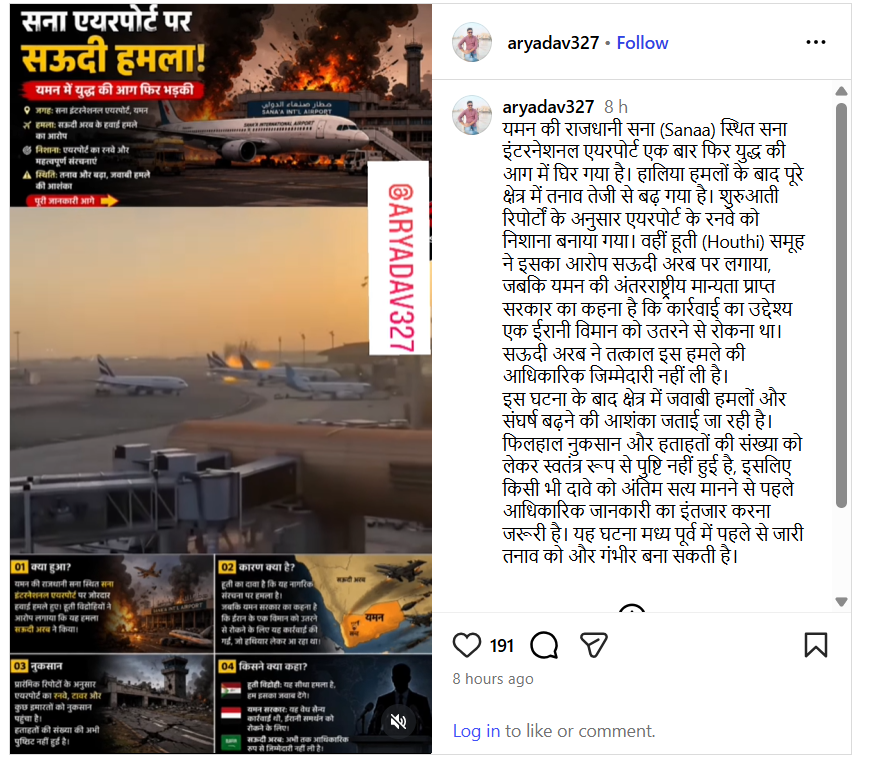
A video is being widely shared on social media claiming to show a Saudi Arabian F-15 fighter jet carrying out an airstrike on Sanaa International Airport in Yemen's capital. The footage shows several aircraft parked at what appears to be an airport before explosions erupt, followed by flames, thick smoke and people running in panic. The CyberPeace Research Wing found that the viral claim is false. Our research revealed that the circulating video is AI-generated and does not depict the actual airstrike. While it is true that Saudi Arabia carried out an airstrike at Sanaa International Airport, the viral footage is unrelated to that incident and is being shared with a misleading claim.
Claim
An Instagram post shared on July 15, 2026, claims that Saudi Arabia's F-15 fighter jets bombed Sanaa International Airport in Yemen. The post can be viewed here:
https://www.instagram.com/reel/DayBwufzn2N/?utm_source=ig_web_button_share_sheet
Fact Check
To verify the claim, we searched using relevant keywords but found no credible news reports or authentic footage matching the viral video. However, we found verified footage of the actual Saudi airstrike on The New York Post's YouTube channel. A comparison showed that the genuine footage is entirely different from the viral clip in terms of visuals, sequence and overall content.
https://www.instagram.com/reel/DawHCM_s_fn/?utm_source=ig_web_button_share_sheet

During our research, we also found the same viral video on an Instagram account named "warfarenextgen", which regularly publishes AI-generated war-related videos

We further examined the video using multiple AI detection tools: Hive Moderation assessed the video as 99.9% likely to be AI-generated.

DetectVideo AI found a 76% probability that the video was AI-generated.

Sightengine also concluded that the video was approximately 99% likely to be AI-generated.

Conclusion
Our research found that Saudi Arabia did carry out an airstrike on Sanaa International Airport to prevent an Iranian aircraft carrying a Houthi delegation from landing. However, the viral video does not show that attack. It is an AI-generated video that is being falsely circulated as footage of the real incident, making the viral claim misleading.

Related Blogs

Executive Summary
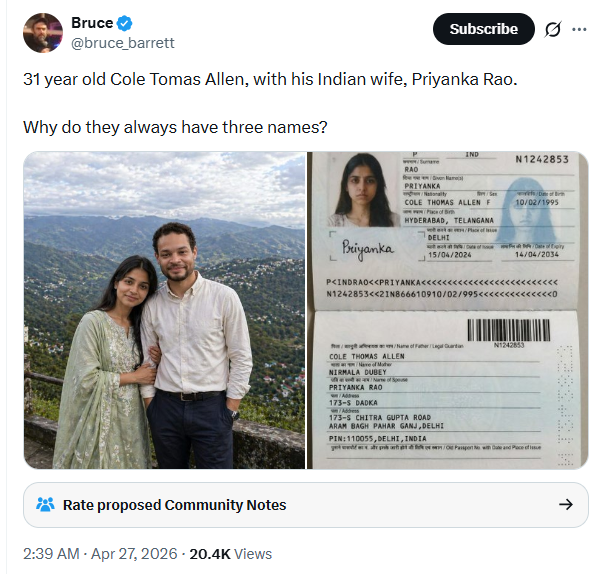
After reports identifying Cole Thomas Allen as the accused in the shooting incident at the White House Correspondents’ Association (WHCA) dinner, several Pakistani propaganda-linked social media accounts began circulating a new claim alleging that the suspect’s wife is an Indian woman named Priyanka Rao. Users shared a photo purportedly showing Cole Thomas Allen with Priyanka Rao, along with an alleged Indian passport in her name. One user posted the image with the caption: “31-year-old Cole Thomas Allen with his Indian wife Priyanka Rao. Why do they always have three names?”
However, research by the CyberPeace Research Wing found the claim to be fake. The viral passport and accompanying image appear to be AI-generated.
Claim:
Social media users claimed that Cole Thomas Allen, accused in the WHCA dinner shooting, is married to an Indian woman named Priyanka Rao.
Fact Check:
During the research, multiple inconsistencies were found in the viral passport image, strongly indicating it is fabricated. A close review of the document revealed several obvious errors commonly seen in AI-generated content. For instance, in the “Nationality” field, the name “Cole Thomas Allen” was written instead of a country name. Such a basic mistake would not appear in any genuine government-issued passport.
The Hindi text on the document was also highly inaccurate and unnatural. Examples included:
- “राष्ट्रीयता” misspelled as “राष्ट्रीयाय”
- “जन्मतिथि” replaced with meaningless text
- “जन्म स्थान” incorrectly written
- “Issue” mistranslated as unrelated wording
- “Date of Expiry” left untranslated in Hindi format
Further analysis using an AI detection tool indicated that the viral passport image had a 69 percent probability of being AI-generated.

Conclusion:
The claim that WHCA dinner shooting accused Cole Thomas Allen has an Indian wife named Priyanka Rao is fake. The viral passport and image being shared online are likely AI-generated and part of a misinformation campaign.

Introduction
In the labyrinthine corridors of the digital age, where information zips across the globe with the ferocity of a tempest, the truth often finds itself ensnared in a web of deception. It is within this intricate tapestry of reality and falsehood that we find ourselves examining two distinct yet equally compelling cases of misinformation, each a testament to the pervasive challenges that beset our interconnected world.
Case 1: The Deceptive Video: Originating in Malaysia, Misattributed to Indian Railway Development
A misleading video claiming to showcase Indian railway construction has been debunked as footage from Malaysia's East Coast Rail Link (ECRL). Fact-checking efforts by India TV traced the video's origin to Malaysia, revealing deceptive captions in Tamil and Hindi. The video was initially posted on Twitter on January 9, 2024, announcing the commencement of track-laying for Malaysia's East Coast Railway. Further investigation reveals the ECRL as a joint venture between Malaysia and China, involving the laying of tracks along the east coast, challenging assertions of Indian railway development. The ECRL's track-laying initiative, initiated in December 2023, is part of China's Belt and Road initiative, covering 665 kilometers across states like Kelantan, Terengganu, Pahang, and Selangor, with a completion target set for 2025.
The video in question, a digital chameleon, had its origins not in the bustling landscapes of India but within the verdant bounds of Malaysia. Specifically, it was a scene captured from the East Coast Rail Link (ECRL) project, a monumental joint venture between Malaysia and China, unfurling across 665 kilometers of Malaysian terrain. This ambitious endeavor, part of the grand Belt and Road initiative, is a testament to the collaborative spirit that defines our era, with tracks stretching from Kelantan to Selangor, and a completion horizon set for the year 2025.
The unveiling of this grand project was graced by none other than Malaysia’s King Sultan Abdullah Sultan Ahmad Shah, in Pahang, underscoring the strategic alliance with China and the infrastructural significance of the ECRL. Yet, despite the clarity of its origins, the video found itself cloaked in a narrative of Indian development, a falsehood that spread like wildfire across the digital savannah.
Through the meticulous application of keyframe analysis and reverse image searches, the truth was laid bare. Reports from reputable sources such as the Associated Press and the Global Times, featuring the very same machinery, corroborated the video's true lineage. This revelation not only highlighted the ECRL's geopolitical import but also served as a clarion call for the critical role of fact-checking in an era where misinformation proliferates with reckless abandon.
Case 2: Kerala's Incident: Investigating Fake Narratives
Kerala Chief Minister Pinarayi Vijayan has registered 53 cases related to spreading fake narratives on social media to incite communal sentiments following the blasts at a Christian religious gathering in October 2023. Vijayan said cases have been registered against online news portals, editors, and Malayalam television channels. The state police chief has issued directions to monitor social media to stop fake news spread and take appropriate actions.
In a different corner of the world, the serene backdrop of Kerala was shattered by an event that would ripple through the fabric of its society. The Kalamassery blast, a tragic occurrence at a Christian religious gathering, claimed the lives of eight individuals and left over fifty wounded. In the wake of this calamity, a man named Dominic Martin surrendered, claiming responsibility for the heinous act.
Yet, as the investigation unfolded, a different kind of violence emerged—one that was waged not with explosives but with words. A barrage of fake narratives began to circulate through social media, igniting communal tensions and distorting the narrative of the incident. The Kerala Chief Minister, Pinarayi Vijayan, informed the Assembly that 53 cases had been registered across the state, targeting individuals and entities that had fanned the flames of discord through their digital utterances.
The Kerala police, vigilant guardians of truth, embarked on a digital crusade to quell the spread of these communally instigative messages. With a particular concentration of cases in Malappuram district, the authorities worked tirelessly to dismantle the network of fake profiles that propagated religious hatred. Social media platforms were directed to assist in this endeavor, revealing the IP addresses of the culprits and enabling the cyber cell divisions to take decisive action.
In the aftermath of the blasts, the Chief Minister and the state police chief ordered special instructions to monitor social media platforms for content that could spark communal uproar. Cyber patrolling became the order of the day, as a 20-member probe team was constituted to deeply investigate the incident.
Conclusion
These two cases, disparate in their nature and geography, converge on a singular point: the fragility of truth in the digital age. They highlight the imperative for vigilance and the pursuit of accuracy in a world where misinformation can spread like wildfire. As we navigate this intricate cyberscape, it is imperative to be mindful of the power of fact-checking and the importance of media literacy, for they are the light that guides us through the fog of falsehoods to the shores of veracity.
These narratives are not merely stories of deception thwarted; they are a call to action, a reminder of our collective responsibility to safeguard the integrity of our shared reality. Let us, therefore, remain steadfast in our quest for the truth, for it is only through such diligence that we can hope to preserve the sanctity of our discourse and the cohesion of our societies.
References:
- https://www.indiatvnews.com/fact-check/fact-check-misleading-video-claims-malaysian-rail-project-indian-truth-ecrl-india-railway-development-pm-modi-2024-01-29-914282
- https://sahilonline.org/kalamasserry-blast-53-cases-registered-across-kerala-for-spreading-fake-news

Executive Summary
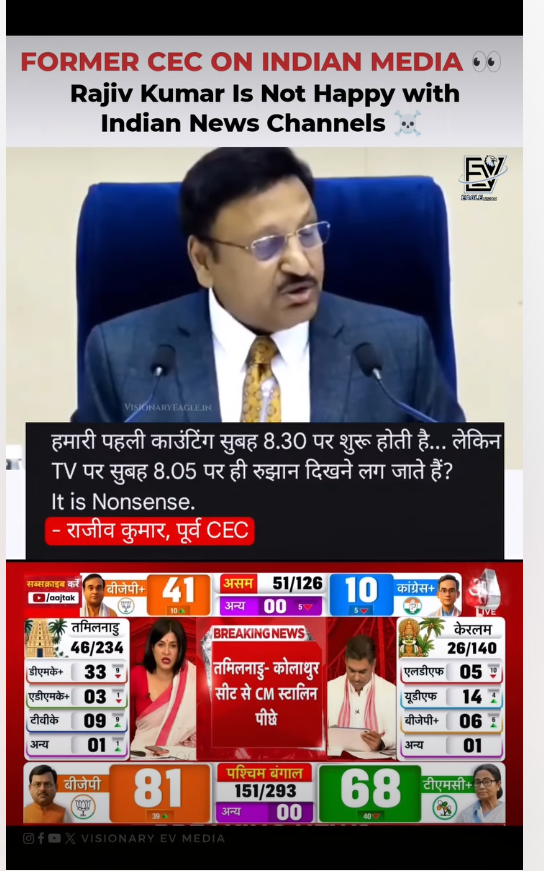
Following the results of the recent West Bengal elections, a video of former Chief Election Commissioner Rajiv Kumar has gone viral on social media. In the clip, Kumar is seen questioning television news channels over their election-result coverage and alleged early “trends” before the actual counting process begins. In the viral video, Rajiv Kumar can be heard saying, “When counting begins, channels start showing trends from 8:05 AM itself, which is nonsense. The first round of counting starts only at 8:30 AM. We have evidence that leads were being shown before that. Is it possible that these early trends are shown just to justify exit polls?”The video is being widely shared with the claim that Kumar made these remarks after the recently concluded West Bengal Assembly elections Research conducted by CyberPeace Research Wing found that a 2024 video of former Chief Election Commissioner Rajiv Kumar is being misleadingly shared as a recent statement made after the West Bengal election results.
Claim
An Instagram user shared the viral clip suggesting that the former Election Commissioner made these comments in the context of the latest West Bengal poll results.
Fact Check
Using relevant keyword searches, we traced the original source of the clip to an official post shared by the Election Commission of Indiaon Facebook on October 15, 2024. The video was part of a press conference announcing the Assembly election schedule for Maharashtra and Jharkhand.
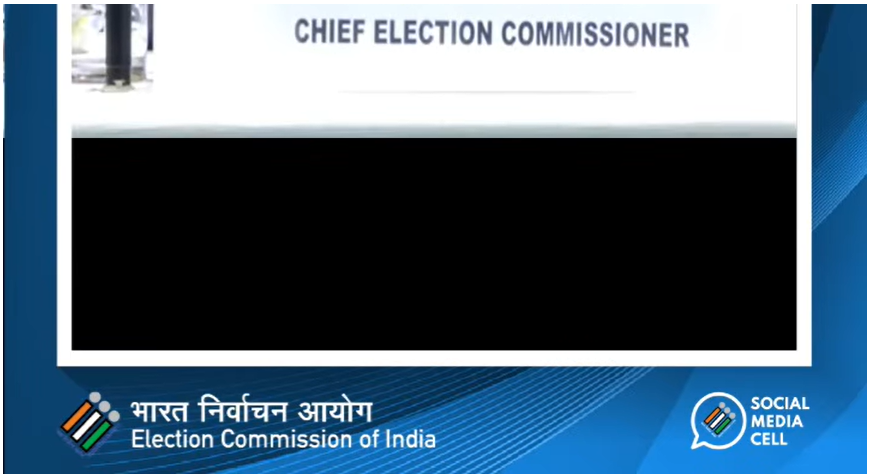
We also found the complete live-streamed press conference on the official YouTube channel of the Election Commission.
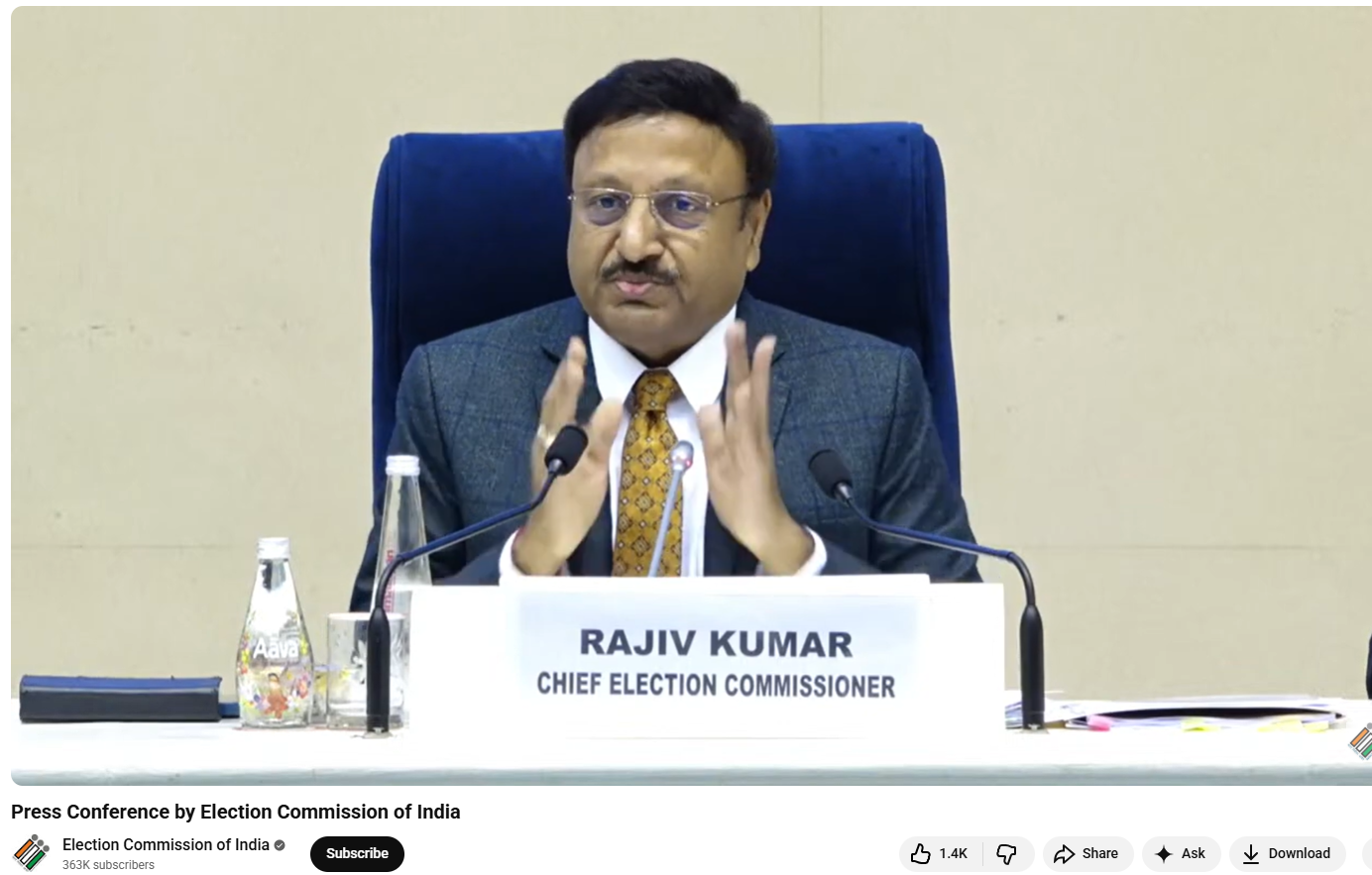
During the press conference, around the 26:45-minute mark, an ANI journalist referred to discrepancies between exit polls and actual Lok Sabha election results and asked whether such situations fuel doubts over EVMs among the public. Responding to the question at around 30:27 minutes, Rajiv Kumar spoke about the need for self-regulation in electronic media and concerns over premature “trends” shown during counting day. He said that exit polls often create public expectations despite lacking a clear scientific basis and questioned why TV channels begin displaying leads even before the first official counting round starts.
Conclusion
The viral claim is misleading. The video of former Chief Election Commissioner Rajiv Kumar is not related to the recent West Bengal election results. The clip is from an October 15, 2024 press conference held to announce the Maharashtra and Jharkhand Assembly election schedule and is now being falsely shared in a misleading context after the West Bengal polls.
