
#FactCheck-Fake Quote Falsely Attributed to Mojtaba Khamenei on India’s Prime Minister and Indira Gandhi
Executive Summary
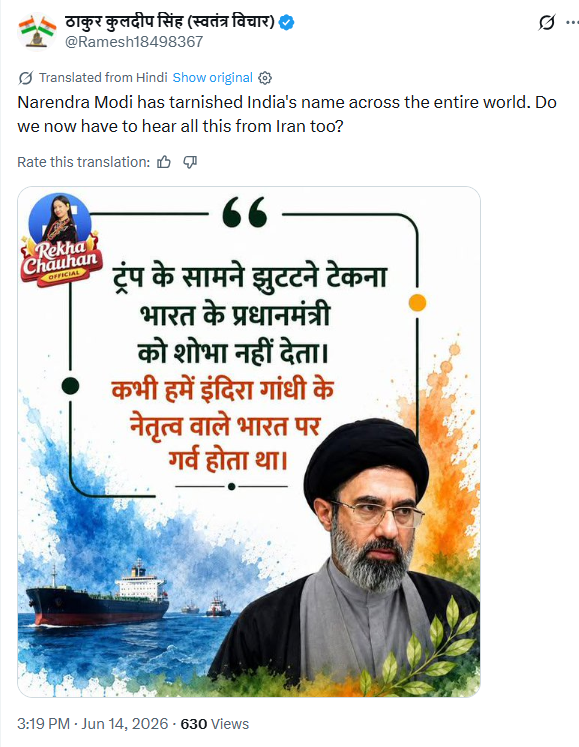
A graphic featuring a photograph of Mojtaba Khamenei, the son of Iran’s Supreme Leader Ayatollah Ali Khamenei, is being widely circulated on social media. The graphic carries a statement attributed to him: “It is not appropriate for the Prime Minister of India to bow before Trump, and India was a matter of pride under Indira Gandhi.” The graphic claims that Mojtaba Khamenei made this statement. CyberPeace Research Wing’s research found that Mojtaba Khamenei did not make any such statement. The research revealed that there is no credible evidence, official statement, interview, or verified social media post supporting the claim. Had such a statement been made by him, it would have been reported by credible media outlets.
Claim
Sharing the graphic, an X user named Thakur Kuldeep Singh wrote:“Narendra Modi has tarnished India’s name across the entire world. Do we now have to hear all this from Iran too?”
https://x.com/Ramesh18498367/status/2066095602954649607?s=20
Fact Check
As part of our fact-checking process, we conducted a keyword search on Google using terms such as “Mojtaba Khamenei criticized India’s Prime Minister for bowing before Trump” and “Mojtaba Khamenei praised India under Indira Gandhi.” However, we found no credible news reports, official statements, interviews, or verified social media posts supporting the claim that Mojtaba Khamenei made such remarks. During our research, we also found a report published by NDTV on March 12, 2026, which mentioned remarks made by a representative of Iran’s Supreme Leader regarding Iran-India relations.

According to the report, the representative stated that Mojtaba Khamenei “loves India” and values the long-standing civilizational ties between the two countries. He further said that Iran’s leadership has historically admired India’s culture, philosophy, and history and has consistently supported stronger relations between the two nations.
Conclusion
Our research found that the claim attributing a statement to Mojtaba Khamenei criticizing India’s Prime Minister for bowing before Trump and praising India during Indira Gandhi’s tenure is false. There is no credible news report, official statement, interview, or verified social media post confirming that Mojtaba Khamenei made such a statement. The viral graphic is being circulated with a false attribution.

Related Blogs

Introduction
Romance scams have been rised in India. A staggering 66 percent of individuals in India have been ensnared by the siren songs of deceitful online dating schemes. These are not the attempts of yesteryears but rather a new breed of scams, seamlessly weaving the threads of traditional deceit with the sinew of cutting-edge technologies such as generative AI and deep fakes. A report by Tenable highlights the rise of romance scams in India, which now combine traditional tactics with advanced technologies like generative AI and deepfakes. Over 69% of Indians struggle to distinguish between artificial and authentic human voices. Scammers are using celebrity impersonations and platforms like Facebook to lure victims into a false sense of security.
The Romance Scam
A report by Tenable, the exposure management company, illuminates the disturbing evolution of these romance scams. It reveals a reality: AI-generated deep lakes have attained a level of sophistication where an astonishing 69 percent of Indians confess to struggling to discern between artificial and authentic human voices. This technological prowess has armed scammers with the tools to craft increasingly convincing personas, enabling them to perpetrate their nefarious acts with alarming success.
In 2023 alone, 43 percent of Indians reported falling victim to AI voice scams, with a staggering 83 percent of those targeted suffering financial loss. The scammers, like puppeteers, manipulate their digital marionettes with a deftness that is both awe-inspiring and horrifying. They have mastered the art of impersonating celebrities and fabricating personas that resonate with their targets, particularly preying on older demographics who may be more susceptible to their charms.
Social media platforms, which were once heralded as the town squares of the 21st century, have unwittingly become fertile grounds for these fraudulent activities. They lure victims into a false sense of security before the scammers orchestrate their deceitful symphonies. Chris Boyd, a staff research engineer at Tenable, issues a stern warning against the lure of private conversations, where the protective layers of security are peeled away, leaving individuals exposed to the machinations of these digital charlatans.
The Vulnerability of Individuals
The report highlights the vulnerability of certain individuals, especially those who are older, widowed, or experiencing memory loss. These individuals are systematically targeted by heartless criminals who exploit their longing for connection and companionship. The importance of scrutinising requests for money from newfound connections is underscored, as is the need for meticulous examination of photographs and videos for any signs of manipulation or deceit.
'Increasing awareness and maintaining vigilance are our strongest weapons against these heartless manipulations, 'safeguarding love seekers from the treacherous web of AI-enhanced deception.'
The landscape of love has been irrevocably altered by the prevalence of smartphones and the deep proliferation of mobile internet. Finding love has morphed into a digital odyssey, with more and more Indians turning to dating apps like Tinder, Bumble, and Hinge. Yet, as with all technological advancements, there lurks a shadowy underbelly. The rapid adoption of dating sites has provided potential scammers with a veritable goldmine of opportunity.
It is not uncommon these days to hear tales of individuals who have lost their life savings to a person they met on a dating site or who have been honey-trapped and extorted by scammers on such platforms. A new study, titled 'Modern Love' and published by McAfee ahead of Valentine's Day 2024, reveals that such scams are rampant in India, with 39 percent of users reporting that their conversations with a potential love interest online turned out to be with a scammer.
The study also found that 77 percent of Indians have encountered fake profiles and photos that appear AI-generated on dating websites or apps or on social media, while 26 percent later discovered that they were engaging with AI-generated bots rather than real people. 'The possibilities of AI are endless, and unfortunately, so are the perils,' says Steve Grobman, McAfee’s Chief Technology Officer.
Steps to Safeguard
Scammers have not limited their hunting grounds to dating sites alone. A staggering 91 percent of Indians surveyed for the study reported that they, or someone they know, have been contacted by a stranger through social media or text message and began to 'chat' with them regularly. Cybercriminals exploit the vulnerability of those seeking love, engaging in long and sophisticated attempts to defraud their victims.
McAfee offers some steps to protect oneself from online romance and AI scams:
- Scrutinise any direct messages you receive from a love interest via a dating app or social media.
- Be on the lookout for consistent, AI-generated messages which often lack substance or feel generic.
- Avoid clicking on any links in messages from someone you have not met in person.
- Perform a reverse image search of any profile pictures used by the person.
- Refrain from sending money or gifts to someone you haven’t met in person, even if they send you money first.
- Discuss your new love interest with your trusted friend. It can be easy to overlook red flags when you are hopeful and excited.
Conclusion
The path is fraught with illusions, and only by arming oneself with knowledge and scepticism can one hope to find true connection without falling prey to the mirage of deceit. As we navigate this treacherous terrain, let us remember that the most profound connections are often those that withstand the test of time and the scrutiny of truth.
References
- https://www.businesstoday.in/technology/news/story/valentine-day-alert-deepfakes-genai-amplifying-romance-scams-in-india-warn-researchers-417245-2024-02-13
- https://www.indiatimes.com/amp/news/india/valentines-day-around-40-per-cent-indians-have-been-scammed-while-looking-for-love-online-627324.html
- https://zeenews.india.com/technology/valentine-day-deepfakes-in-romance-scams-generative-ai-in-scams-romance-scams-in-india-online-dating-scams-in-india-ai-voice-scams-in-india-cyber-security-in-india-2720589.html
- https://www.mcafee.com/en-us/consumer-corporate/newsroom/press-releases/2023/20230209.html
Introduction
India is reaching a turning point in its technological development when the AI Impact Summit 2026 is held in New Delhi. Artificial Intelligence (AI)is transforming economies, labour markets, governance structures and even the grammar of public discourse. It is no longer a frontier of speculation. The challenge facing the Summit is not whether AI will change our societies, it has already done so but rather whether inclusiveness and human dignity will serve as the foundation for this change.
India’s AI journey is defined by scale. The nation has one of the biggest user bases for cutting edge AI systems worldwide. According to projections, AI may create millions of new technology-driven occupations by 2030 and change the nature of millions more. This is a structural reconfiguration rather than an incremental alteration. The stakes are high for a country with a large youth population and diverse socioeconomic diversity.
India’s Tryst with Artificial Intelligence
India’s tryst with AI is a developmental imperative occurring at a civilisational scale not a show put on for a western favour. AI is still portrayed in many international storylines as a competition between China’s state backed rapidity, Europe’s sophisticated regulations and Silicon Valley’s capital. India is far too frequently a huge consumer market rather than a significant force behind the AI era. Such evaluations undervalue a nation that has already proven its capacity to implement technology at a democratic scale through its digital public infrastructure. AI in India is about more than just improving algorithms, it’s about giving millions more people access to social safety, healthcare, agriculture and education.
The scepticism overlooks a deeper truth, India innovates not from abundance but from urgency. India remains certain that technical advancement must be in line with social justice and inclusive growth. The recollections from history suggest that India’s greatest technological strides have often followed underestimation.
A Conclave of Contagious Ideas
India has long been the favourite underestimation of certain western observers, a nation of 1.4 billion people, the world’s fifth largest economy, a noisy democracy with inconvenient geopolitical realities, often assessed by counterparts governing populations smaller than many of its states. Advice follows in spades, sometimes from cities that mastered the art of strategic improvisation long before they preached restraint and sometimes with lectures on innovation, governance and order.
However, there are times when hierarchies need to be rearranged. It was hard to overlook the symbolism when Ranvir Sachdeva, the youngest keynote speaker at the AI Impact Summit, 2026, took the stage, “I’m here as the youngest keynote speaker at the Indian AI Impact Summit,” he said, discussing how he’s connecting ancient Indian beliefs to contemporary technology and the various strategies that other countries are doing to develop AI. In that simple articulation lay a quiet rebuttal, a civilization that once debated metaphysics under banyan trees is now debating ethics in plenary halls. History constantly demonstrates that India’s permanent address has never been underestimation.
From New Delhi to Geneva: The Global Arc of AI Governance
Now that the AI Impact Summit, 2026 is coming to an end, what’s left is not just the recollection of its size but also the form of new international dialogue. The New Delhi Declaration, a remarkable highlight of the Summit, was signed by eighty-eight nations and international organisations to support the democratic spread of AI.
The increasing complexity of the AI order was also made clear by the Summit. Pledges for investments totalled hundred of billions. The U.S. led Pax Silica effort was joined by India. SovereignLLMs in the country were introduced. At the same time, spectators were reminded that the politics of AI are inextricably linked to its promise via logistical challenges, protest disruptions and business rivalries. Although nations are not bound by the New Delhi Declaration it does represent a growing consensus that acceleration must be accompanied by governance.
The revelation that the 2027 AI Impact Summit will be in Geneva represents a significant shift in this regard. Guy Parmelin, the president of Switzerland, described the upcoming chapter as one that is primarily concerned with international law and good governance in an attempt to guarantee that the future of AI is not entirely in the hands of powerful nations. From scale and ambition in New Delhi to normative consolidation in Europe, Geneva, longtime hotbed of multilateral diplomacy, provides symbolic continuity.
Concluding Confluence
It is tempting to view the Global CyberPeace Summit (GCS), a Pre-Summit Event of AI Impact Summit held in close succession at Bharat Mandapam on 10th February, 2026. They formed a strong intellectual arc. At GCS, inclusion was not ornamental. A deeper message was conveyed by India Signing Hands’ involvement and purposeful emphasis on accessibility, digital systems must be created with, not just for, those on margins. Resilience must start at the economic level, according to the AI-enabled cybersecurity engagement for MSMEs. Participants were reminded during the talks on Technology Facilitated Gender-Based Violence (TFGBV), CSAM prevention and child safety that technological arguments only gain significance when they are connected to real-world outcomes.
When Geneva takes over in 2027, the issue will not just be how AI should be regulated, but also what ethical foundation that governance is built upon. New Delhi’s belief that wisdom and power must coexist may be its contribution to this developing narrative. That persistence has content than spectacle, as well as possibly the faint form of technical conscience.
Executive Summary:
New Linux malware has been discovered by a cybersecurity firm Volexity, and this new strain of malware is being referred to as DISGOMOJI. A Pakistan-based threat actor alias ‘UTA0137’ has been identified as having espionage aims, with its primary focus on Indian government entities. Like other common forms of backdoors and botnets involved in different types of cyberattacks, DISGOMOJI, the malware allows the use of commands to capture screenshots, search for files to steal, spread additional payloads, and transfer files. DISGOMOJI uses Discord (messaging service) for Command & Control (C2) and uses emojis for C2 communication. This malware targets Linux operating systems.
The DISCOMOJI Malware:
- The DISGOMOJI malware opens a specific channel in a Discord server and every new channel corresponds to a new victim. This means that the attacker can communicate with the victim one at a time.
- This particular malware connects with the attacker-controlled Discord server using Emoji, a form of relay protocol. The attacker provides unique emojis as instructions, and the malware uses emojis as a feedback to the subsequent command status.
- For instance, the ‘camera with flash’ emoji is used to screenshots the device of the victim or to steal, the ‘fox’ emoji cracks all Firefox profiles, and the ‘skull’ emoji kills the malware process.
- This C2 communication is done using emojis to ensure messaging between infected contacts, and it is almost impossible for Discord to shut down the malware as it can always change the account details of Discord it is using once the maliciou server is blocked.
- The malware also has capabilities aside from the emoji-based C2 such as network probing, tunneling, and data theft that are needed to help the UTA0137 threat actor in achieving its espionage goals.
Specific emojis used for different commands by UTA0137:
- Camera with Flash (📸): Captures a picture of the target device’s screen as per the victim’s directions.
- Backhand Index Pointing Down (👇): Extracts files from the targeted device and sends them to the command channel in the form of attachments.
- Backhand Index Pointing Right (👉): This process involves sending a file found on the victim’s device to another web-hosted file storage service known as Oshi or oshi[. ]at.
- Backhand Index Pointing Left (👈): Sends a file from the victim’s device to transfer[. ]sh, which is an online service for sharing files on the Internet.
- Fire (🔥): Finds and transmits all files with certain extensions that exist on the victim’s device, such as *. txt, *. doc, *. xls, *. pdf, *. ppt, *. rtf, *. log, *. cfg, *. dat, *. db, *. mdb, *. odb, *. sql, *. json, *. xml, *. php, *. asp, *. pl, *. sh, *. py, *. ino, *. cpp, *. java,
- Fox (🦊): This works by compressing all Firefox related profiles in the affected device.
- Skull (💀): Kills the malware process in windows using ‘os. Exit()’
- Man Running (🏃♂️): Execute a command on a victim’s device. This command receives an argument, which is the command to execute.
- Index Pointing up (👆) : Upload a file to the victim's device. The file to upload is attached along with this emoji
Analysis:
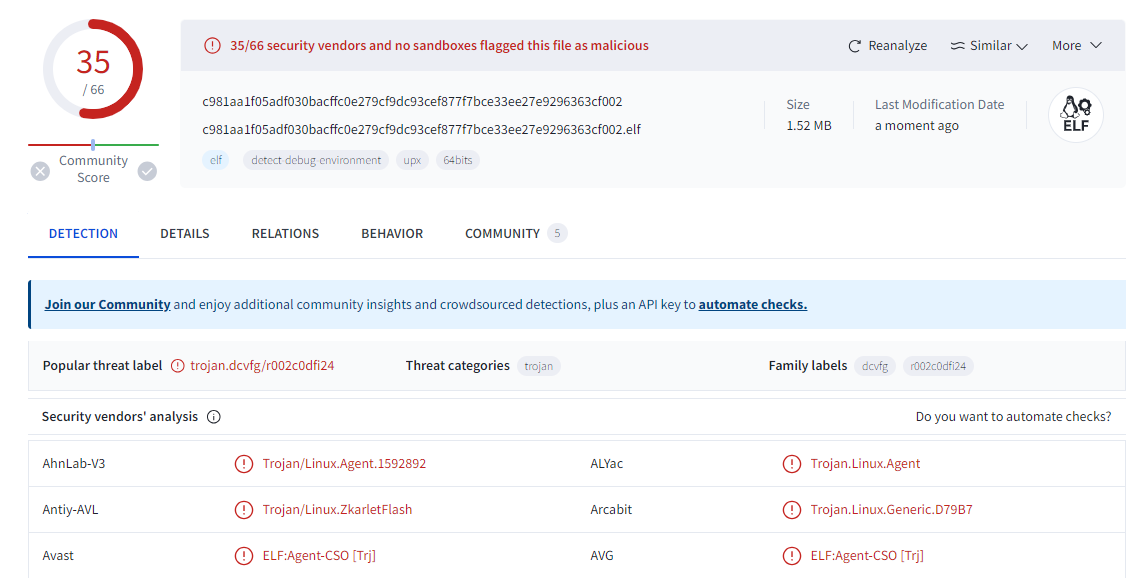
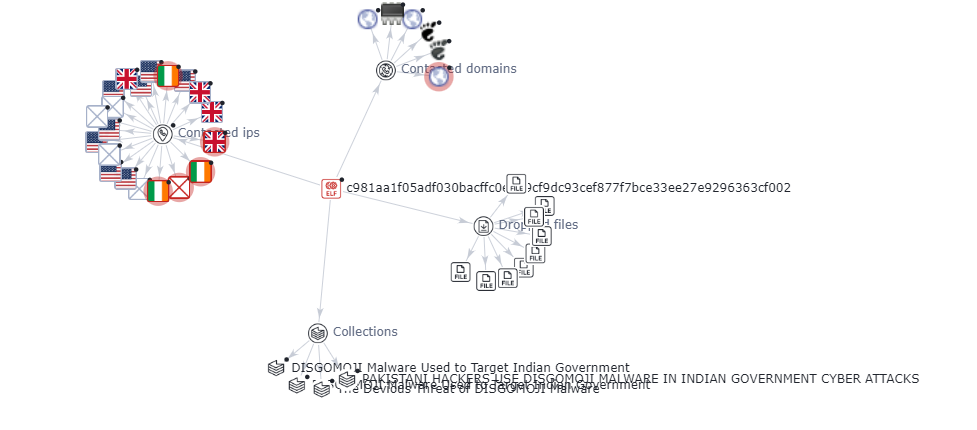
The analysis was carried out for one of the indicator of compromised SHA-256 hash file- C981aa1f05adf030bacffc0e279cf9dc93cef877f7bce33ee27e9296363cf002.
It is found that most of the vendors have marked the file as trojan in virustotal and the graph explains the malicious nature of the contacted domains and IPs.
Discord & C2 Communication for UTA0137:
- Stealthiness: Discord is a well-known messaging platform used for different purposes, which means that sending any messages or files on the server should not attract suspicion. Such stealthiness makes it possible for UTA0137 to remain dormant for greater periods before launching an attack.
- Customization: UTA0137 connected to Discord is able to create specific channels for distinct victims on the server. Such a framework allows the attackers to communicate with each of the victims individually to make a process more accurate and efficient.
- Emoji-based protocol: For C2 communication, emojis really complicates the attempt that Discord might make to interfere with the operations of the malware. In case the malicious server gets banned, malware could easily be recovered, especially by using the Discord credentials from the C2 server.
- Persistence: The malware, as stated above, has the ability to perpetually exist to hack the system and withstand rebooting of systems so that the virus can continue to operate without being detected by the owner of the hacked system.
- Advanced capabilities: Other features of DISGOMOJI are the Network Map using Nmap scanner, network tunneling through Chisel and Ligolo and Data Exfiltration by File Sharing services. These capabilities thus help in aiding the espionage goals of UTA0137.
- Social engineering: The virus and the trojan can show the pop-up windows and prompt messages, for example the fake update for firefox and similar applications, where the user can be tricked into inputting the password.
- Dynamic credential fetching: The malware does not write the hardcoded values of the credentials in order to connect it to the discord server. This also inconveniences analysts as they are unable to easily locate the position of the C2 server.
- Bogus informational and error messages: They never show any real information or errors because they do not want one to decipher the malicious behavior easily.
Recommendations to mitigate the risk of UTA0137:
- Regularly Update Software and Firmware: It is essential to regularly update all the application software and firmware of different devices, particularly, routers, to prevent hackers from exploiting the discovered and disclosed flaws. This includes fixing bugs such as CVE-2024-3080 and CVE-2024-3912 on ASUS routers, which basically entails solving a set of problems.
- Implement Multi-Factor Authentication: There are statistics that show how often user accounts are attacked, it is important to incorporate multi-factor authentication to further secure the accounts.
- Deploy Advanced Malware Protection: Provide robust guard that will help the user recognize and prevent the execution of the DISGOMOJI malware and similar threats.
- Enhance Network Segmentation: Utilize stringent network isolation mechanisms that seek to compartmentalize the key systems and data from the rest of the network in order to minimize the attack exposure.
- Monitor Network Activity: Scanning Network hour to hour for identifying and handling the security breach and the tools such as Nmap, Chisel, Ligolo etc can be used.
- Utilize Threat Intelligence: To leverage advanced threats intelligence which will help you acquire knowledge on previous threats and vulnerabilities and take informed actions.
- Secure Communication Channels: Mitigate the problem of the leakage of developers’ credentials and ways of engaging with the discord through loss of contact to prevent abusing attacks or gaining control over Discord as an attack vector.
- Enforce Access Control: Regularly review and update the user authentication processes by adopting stricter access control measures that will allow only the right personnel to access the right systems and information.
- Conduct Regular Security Audits: It is important to engage in security audits periodically in an effort to check some of the weaknesses present within the network or systems.
- Implement Incident Response Plan: Conduct a risk assessment, based on that design and establish an efficient incident response kit that helps in the early identification, isolation, and management of security breaches.
- Educate Users: Educate users on cybersecurity hygiene, opportunities to strengthen affinity with the University, and conduct retraining on threats like phishing and social engineering.
Conclusion:
The new threat actor named UTA0137 from Pakistan who was utilizing DISGOMOJI malware to attack Indian government institutions using embedded emojis with a command line through the Discord app was discovered by Volexity. It has the capability to exfiltrate and aims to steal the data of government entities. The UTA0137 was continuously improved over time to permanently communicate with victims. It underlines the necessity of having strong protection from viruses and hacker attacks, using secure passwords and unique codes every time, updating the software more often and having high-level anti-malware tools. Organizations can minimize advanced threats, the likes of DISGOMOJI and protect sensitive data by improving network segmentation, continuous monitoring of activities, and users’ awareness.
References:
https://otx.alienvault.com/pulse/66712446e23b1d14e4f293eb
https://thehackernews.com/2024/06/pakistani-hackers-use-disgomoji-malware.html?m=1
https://cybernews.com/news/hackers-using-emojis-to-command-malware/
https://www.volexity.com/blog/2024/06/13/disgomoji-malware-used-to-target-indian-government/
