
#FactCheck -AI-Generated Video Falsely Shows Car Stuck on Delhi–Jaipur Highway Signboard
Executive Summary
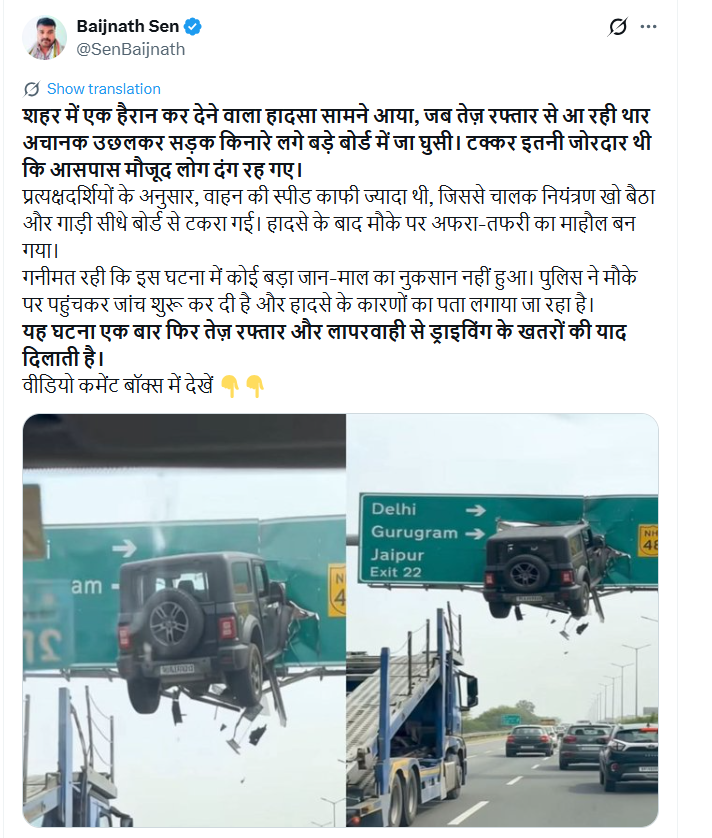
A shocking video showing a car hanging from a highway signboard is going viral on social media. The clip allegedly shows a black Mahindra Thar stuck on an overhead direction signboard on the Delhi–Jaipur Highway (NH-48). Social media users are widely sharing the video, claiming it shows a real road accident. However, a research by CyberPeace found the viral claim to be false. Our findings reveal that the circulating video is not real but AI-generated.
Claim
Social media users are sharing the clip as footage of an actual road accident. A viral post on X (formerly Twitter) claims that the incident took place on the Delhi–Jaipur Highway, showing a black Mahindra & Mahindra Thar lodged in a highway signboard.
- https://x.com/SenBaijnath/status/2024098520006029504
- https://archive.ph/cmr5e
Fact Check
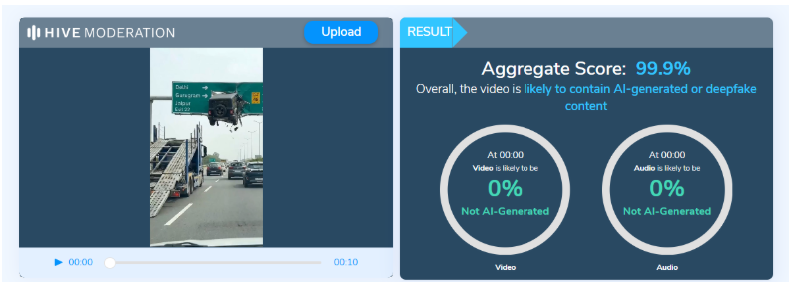
On closely examining the viral video, several inconsistencies were observed that are commonly associated with AI-generated content. For instance, it appears highly improbable for a heavy vehicle to get stuck precisely at the center of a signboard at such a height. Despite the scale of the alleged incident, traffic on the highway below continues moving normally without any disruption. Additionally, the text visible on the right side of the signboard appears distorted and unusually written. To further verify the authenticity of the video, we analysed it using the AI detection tool Hive Moderation, which indicated a 99.9% probability that the video was AI-generated.
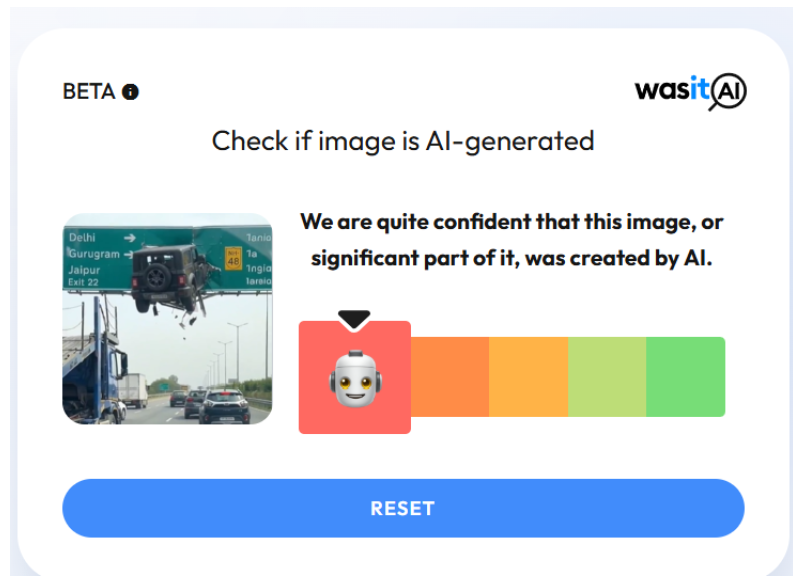
Another AI image detection tool, WasitAI, also found that the visuals in the viral clip were largely AI-generated.
Conclusion
Based on our research and available evidence, it is clear that the viral video showing a Mahindra Thar hanging from a highway signboard is not real but AI-generated.

Related Blogs

Introduction
The Indian Computer Emergency Response Team, CERT-In, is the national statutory agency that responds to Cybersecurity Incidents under the Ministry of Electronics and Information Technology (MeitY) of the Government of India. CERT-In and Information Sharing and Analysis Center (ISAC) have joined hands to develop a focused pool of Cybersecurity Leaders through the National Cyber Security Scholar Program (NCSSP). This National Cyber Security Scholar Program is to create a pool of credible and ethical cybersecurity leaders in the country who prioritise national cyber security in their professional endeavours. This program allows both organisations to jointly issue joint certifications for Cohort 6 of the National Cyber Security Scholar Program (NCSSP). This certification is provided to cybersecurity professionals who complete one of the world’s leading cybersecurity management programs.
About the Program
The National Cybersecurity Scholar (NCSS) is a comprehensive 18-week, 160-hour Instructor-led program for emerging cybersecurity leaders. The ISAC will conduct the program with CERT-IN and KDEM as knowledge partners. This Cyber Security Scholar program aims to provide an extraordinary opportunity, for scholars, to gain hands-on experience in real-world scenarios through activities such as war games. It will allow scholars to acquaint themselves with roles such as that of stakeholders, including attackers, Security Operations Centre (SOC) teams, Forensicators, Chief Information Security Officers (CISOs), and CEOs, and engage in tabletop exercises that simulate a cyber crisis. This program would allow scholars to understand how responses to cyber crises impact the financial performance of an organisation, including, stock prices and sales. It offers a treasure trove of insights into the economic impact of cybersecurity decisions and the importance of proactive risk management.
The program invites applications from various scholars including Mid to senior-level leaders, diplomats and diplomatic corps officers, mid to senior-level government officials involved in homeland and cybersecurity operations, experienced executives from Managed Security Services Providers (MSSPs), faculty members who specialise in new and emerging technologies, cybersecurity professionals in CII sectors and post-doctoral or research scholars in cybersecurity.
CyberPeace Outlook
The National Cyber Security Scholar Program subsumes several key dimensions working towards building a resilient cybersecurity ecosystem for India.
- The program focuses on skill development and enhancing scholars’ knowledge in domains of network security, ethical hacking, cyber forensics, incident response, malware analysis, and threat intelligence.
- The partnership between CERT-In and ISAC, government and Industry entities, ensures that scholars are exposed to different policy-level frameworks and technical expertise, offering a unique blend of perspectives that cater to the country's national security goals and industry best practices.
- The scholar program encourages the development of new methodologies, tools, and frameworks that could be instrumental in tackling future cyber challenges and advancing India's position as a global leader in cybersecurity research and development. Research and innovation in cybersecurity are critical to the program.
- It plays a significant role in providing opportunities for career development by further providing networking platforms with professionals, researchers, and thought leaders in the cybersecurity field, giving them exposure to internships, job placements, and further academic pursuits.
This program aims to support upskilling India’s broader cyber defence strategy through the creation of highly skilled professionals. The scholars are expected to contribute actively to national cybersecurity efforts, whether through roles in government, private sector, or academia, helping to create a more secure and resilient cyberspace. The National Cyber Security Scholar Program is a major advancement in strengthening cybersecurity resilience in India. In a digital world where cyber threats crossing boundaries, such programs are essential for maintaining our national security and economic stability.
References
- https://theprint.in/ani-press-releases/cert-in-and-isac-collaborate-to-develop-focussed-pool-of-cybersecurity-leaders-through-the-national-cyber-security-scholar-program-ncssp/2318021/
- https://isacfoundation.org/national-cyber-security-scholar/
- https://cyberversefoundation.org/national-cyber-security-scholar/

Executive Summary:
Social media has been overwhelmed by a viral post that claims Indian Railways is beginning to install solar panels directly on railway tracks all over the country for renewable energy purposes. The claim also purports that India will become the world's first country to undertake such a green effort in railway systems. Our research involved extensive reverse image searching, keyword analysis, government website searches, and global media verification. We found the claim to be completely false. The viral photos and information are all incorrectly credited to India. The images are actually from a pilot project by a Swiss start-up called Sun-Ways.

Claim:
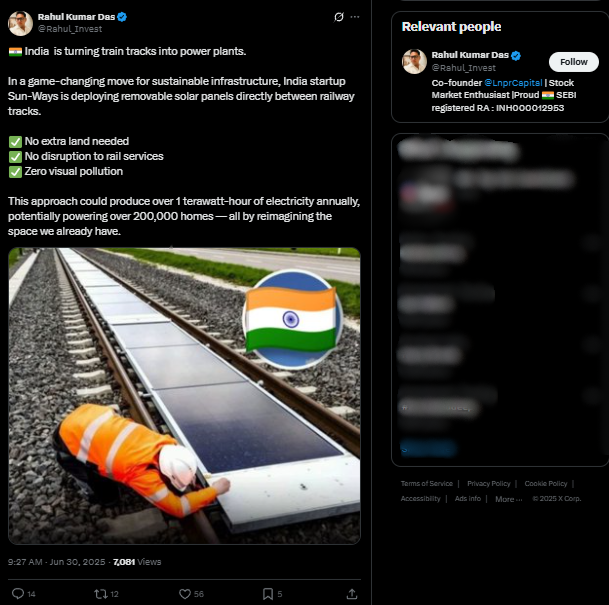
According to a viral post on social media, Indian Railways has started an all-India initiative to install solar panels directly on railway tracks to generate renewable energy, limit power expenses, and make global history in environmentally sustainable rail operations.
Fact check:
We did a reverse image search of the viral image and were soon directed to international media and technology blogs referencing a project named Sun-Ways, based in Switzerland. The images circulated on Indian social media were the exact ones from the Sun-Ways pilot project, whereby a removable system of solar panels is being installed between railway tracks in Switzerland to evaluate the possibility of generating energy from rail infrastructure.

We also thoroughly searched all the official Indian Railways websites, the Ministry of Railways news article, and credible Indian media. At no point did we locate anything mentioning Indian Railways engaging or planning something similar by installing solar panels on railway tracks themselves.
Indian Railways has been engaged in green energy initiatives beyond just solar panel installation on program rooftops, and also on railway land alongside tracks and on train coach roofs. However, Indian Railways have never installed solar panels on railway tracks in India. Meanwhile, we found a report of solar panel installations on the train launched on 14th July 2025, first solar-powered DEMU (diesel electrical multiple unit) train from the Safdarjung railway station in Delhi. The train will run from Sarai Rohilla in Delhi to Farukh Nagar in Haryana. A total of 16 solar panels, each producing 300 Wp, are fitted in six coaches.


We also found multiple links to support our claim from various media links: Euro News, World Economy Forum, Institute of Mechanical Engineering, and NDTV.

Conclusion:
After extensive research conducted through several phases including examining facts and some technical facts, we can conclude that the claim that Indian Railways has installed solar panels on railway tracks is false. The concept and images originate from Sun-Ways, a Swiss company that was testing this concept in Switzerland, not India.
Indian Railways continues to use renewable energy in a number of forms but has not put any solar panels on railway tracks. We want to highlight how important it is to fact-check viral content and other unverified content.
- Claim: India’s solar track project will help Indian Railways run entirely on renewable energy.
- Claimed On: Social Media
- Fact Check: False and Misleading

Introduction
Since the inception of the Internet and social media platforms like Facebook, X (Twitter), Instagram, etc., the government and various other stakeholders in both foreign jurisdictions and India have looked towards the intermediaries to assume responsibility for the content floated on these platforms, and various legal provisions showcase that responsibility. For the first time in many years, these intermediaries come together to moderate the content by setting a standard for the creators and propagators of this content. The influencer marketing industry in India is at a crucial juncture, with its market value projected to exceed Rs. 3,375 crore by 2026. But every industry is coupled with its complications; like in this scenario, there is a section of content creators who fail to maintain the standard of integrity and propagate content that raises concerns of authenticity and transparency, often violating intellectual property rights (IPR) and privacy.
As influencer marketing continues to shape digital consumption, the need for ethical and transparent content grows stronger. To address this, the India Influencer Governing Council (IIGC) has released its Code of Standards, aiming to bring accountability and structure to the fast-evolving online space.
Bringing Accountability to the Digital Fame Game
The India Influencer Governing Council (IIGC), established on 15th February, 2025, is founded with the objective to empower creators, advocate for fair policies, and promote responsible content creation. The IIGC releases the Code of Standard, not a moment too soon; it arrives just in time, a necessary safeguard before social media devolves into a chaotic marketplace where anything and everything is up for grabs. Without effective regulation, digital platforms become the marketplace for misinformation and exploitation.
The IIGC leads the movement with clarity, stating that the Code is a significant piece that spans across 20 crucial sections governing key areas such as paid partnership disclosures, AI-generated personas, content safety, and financial compliance.
Highlights from the Code of Standard
- The Code exhibits a technical understanding of the industry of content creation and influencer marketing. The preliminary sections advocate for accuracy, transparency, and maintaining credibility with the audience that engages with the content. Secondly, the most fundamental development is with regard to the “Paid Partnership Disclosure” included in Section 2 of the Code that mandates disclosure of any material connection, such as financial agreements or collaboration with the brand.
- Another development, which potently comes at a befitting hour, is the disclosure of “AI Influencers”, which establishes that the nature of the influencer has to be disclosed, and such influencers, whether fully virtual or partially AI-enhanced, must maintain the same standards as any human influencer.
- The code ranges across various other aspects of influencer marketing, such as expressing unpaid “Admiration” for the brand and public criticism of the brand, being free from personal bias, honouring financial agreements, non-discrimination, and various other standards that set the stage for a safe and fair digital sphere.
- The Code also necessitates that the platform users and the influencers handle sexual and sensitive content with sincere deliberation, and usage of such content shall be for educational and health-related contexts and must not be used against community standards. The Code includes various other standards that work towards making digital platforms safer for younger generations and impressionable minds.
A Code Without Claws? Challenges in Enforcement
The biggest obstacle to the effective implementation of the code is distinguishing between an honest promotion and a paid brand collaboration without any explicit mention of such an agreement. This makes influencer marketing susceptible to manipulation, and the manipulation cannot be tackled with a straitjacket formula, as it might be found in the form of exaggerated claims or omission of critical information.
Another hurdle is the voluntary compliance of the influencers with the advertising standards. Influencer marketing is an exercise in a borderless digital cyberspace, where the influencers often disregard the dignified standards to maximise their earnings and commercial motives.
The debate between self-regulation and government oversight is constantly churning, where experience tells us that overreliance on self-regulation has proven to be inadequate, and succinct regulatory oversight is imperative in light of social media platforms operating as a transnational commercial marketplace.
CyberPeace Recommendations
- Introduction of a licensing framework for influencers that fall into the “highly followed” category with high engagement, who are more likely to shape the audience’s views.
- Usage of technology to align ethical standards with influencer marketing practices, ensuring that misleading advertisements do not find a platform to deceive innocent individuals.
- Educating the audience or consumers on the internet about the ramifications of negligence and their rights in the digital marketplace. Ensuring a well-established grievance redressal mechanism via digital regulatory bodies.
- Continuous and consistent collaboration and cooperation between influencers, brands, regulators, and consumers to establish an understanding and foster transparency and a unified objective to curb deceptive advertising practices.
References
- https://iigc.org/code-of-standards/influencers/code-of-standards-v1-april.pdf
- https://legalonus.com/the-impact-of-influencer-marketing-on-consumer-rights-and-false-advertising/
- https://exhibit.social/news/india-influencer-governing-council-iigc-launched-to-shape-the-future-of-influencer-marketing/
