
#FactCheck: Viral Video Showing Bus Stuck Between Two Flyovers Is AI-Generated
Executive Summary
A video purportedly showing a bus stuck between two flyovers is going viral across various social media platforms. The video shows a bus carrying several passengers trapped between two flyovers. Some passengers can also be seen climbing out through the roof of the bus. Several social media users are sharing the video, believing it to be genuine. CyberPeace Research found the viral video to be fake. Our research revealed that the video is AI-generated.
Claim:
A Facebook user shared the viral video with the caption: "Friends, a bus is stuck between two flyovers, leaving passengers in panic! How could such a major negligence occur? The passengers' lives were put at risk after the bus got stuck in this manner. Who do you think is responsible for this incident?"
https://www.facebook.com/groups/272961377150654/posts/1798861331227310/

Fact Check
Upon closely examining the viral video, we noticed several inconsistencies. These irregularities raised suspicions that the video might be AI-generated.We then scanned the viral video using the AI detection tool AI Video Detector. According to the results, the viral video is AI-generated.
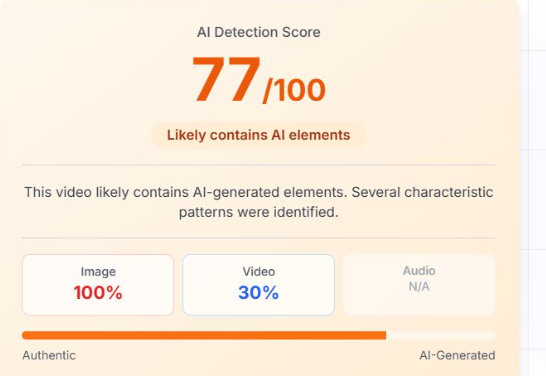
We also used an AI detection tool, Bit Mind, to analyse the video. The tool indicated an 84 per cent likelihood that the video was AI-generated.

Conclusion
Our research found that the viral video is fake and AI-generated. The results from two AI detection tools also indicated that the video was created using artificial intelligence.

Related Blogs

Introduction
The Data Protection Data Privacy Act 2023 is the most essential step towards protecting, prioritising, and promoting the users’ privacy and data protection. The Act is designed to prioritize user consent in data processing while assuring uninterrupted services like online shopping, intermediaries, etc. The Act specifies that once a user provides consent to the following intermediary platforms, the platforms can process the data until the user withdraws the rights of it. This policy assures that the user has the entire control over their data and is accountable for its usage.
A keen Outlook
The Following Act also provides highlights for user-specific purpose, which is limited to data processing. This step prevents the misuse of data and also ensures that the processed data is being for the purpose for which it was obtained at the initial stage from the user.
- Data Fudiary and Processing of Online Shopping Platforms: The Act Emphasises More on Users’ Consent. Once provided, the Data Fudiary can constantly process the data until it is specifically withdrawn by the Data Principal.
- Detailed Analysis
- Consent as a Foundation: The Act places the user's consent as a backbone to the data processing. It sets clear boundaries for data processing. It can be Collecting, Processing, and Storing, and must comply with users’ consent before being used.
- Uninterrupted Data processing: With the given user consent, the intermediaries are not time-restrained. As long as the user does not obligate their consent, the process will be ongoing.
- Consent and Order Fulfillment: Consent, once provided, encloses all the activities related to the specific purpose for which it was meant to the data it was given for subsequent actions such as order fulfilment.
- Detailed Analysis
- Purpose-Limited Consent: The consent given is purpose-limited. The platform cannot misuse the obtained data for its personal use.
- Seamless User Experience: By ensuring that the user consent covers the full transactions, spared from the unwanted annoyance of repeated consent requests from the actual ongoing activities.
- Data Retention and Rub Out on Online Platforms: Platforms must ensure data minimisation post its utilisation period. This extends to any kind of third-party processors they might take on.
- Detailed Analysis
- Minimization and Security Assurance: By compulsory data removal on post ultization,This step helps to reduce the volume of data platforms hold, which leads to minimizing the risk to data.
- Third-Party Accountability, User Privacy Protection.
Influence from Global frameworks
The impactful changes based on global trends and similar legislation( European Union’s GDPR) here are some fruitful changes in intermediaries and social media platforms experienced after the implementation of the DPDP Act 2023.
- Solidified Consent Mechanism: Platforms and intermediatries need to ensure the users’ consent is categorically given, and informed, and should be specific to which the data is obtained. This step may lead to user-friendly consent forms activities and prompts.
- Data Minimizations: Platforms that tend to need to collect the only data necessary for the specific purpose mentioned and not retain information beyond its utility.
- Transparency and Accountability: Data collecting Platforms need to ensure transparency in data collecting, data processing, and sharing practices. This involves more detailed policy and regular audits.
- Data Portability: Users have the right to request for a copy of their own data used in format, allowing them to switch platforms effectively.
- Right to Obligation: Users can have the request right to deletion of their data, also referred to as the “Right to be forgotten”.
- Prescribed Reporting: Under circumstances of data breaches, intermediary platforms are required to report the issues and instability to the regulatory authorities within a specific timeline.
- Data Protection Authorities: Due to the increase in data breaches, Large platforms indeed appoint data protection officers, which are responsible for the right compliance with data protection guidelines.
- Disciplined Policies: Non-compliance might lead to a huge amount of fines, making it indispensable to invest in data protection measures.
- Third-Party Audits: Intermediaries have to undergo security audits by external auditors to ensure they are meeting the expeditions of the following compliances.
- Third-Party Information Sharing Restrictions: Sharing personal information and users’ data with third parties (such as advertisers) come with more detailed and disciplined guideline and user consent.
Conclusion
The Data Protection Data Privacy Act 2023 prioritises user consent, ensuring uninterrupted services and purpose-limited data processing. It aims to prevent data misuse, emphasising seamless user experiences and data minimisation. Drawing inspiration from global frameworks like the EU's GDPR, it introduces solidified consent mechanisms, transparency, and accountability. Users gain rights such as data portability and data deletion requests. Non-compliance results in significant fines. This legislation sets a new standard for user privacy and data protection, empowering users and holding platforms accountable. In an evolving digital landscape, it plays a crucial role in ensuring data security and responsible data handling.
References:
- https://www.meity.gov.in/writereaddata/files/Digital%20Personal%20Data%20Protection%20Act%202023.pdf
- https://www.mondaq.com/india/privacy-protection/1355068/data-protection-law-in-india-analysis-of-dpdp-act-2023-for-businesses--part-i
- https://www.hindustantimes.com/technology/explained-indias-new-digital-personal-data-protection-framework-101691912775654.html

Introduction
Google India announced sachet loans on the Google Pay application to help small businesses in the country. Google India said that merchants in India often need smaller loans, hence, the tech giant launched sachet loans on the Gpay application. The company will provide loans to small businesses, which can be repaid in easier repayment instalments. To provide the load services, Google Pay has partnered with DMI Finance. This move comes at the Google for India, 2023, the flagship event to launch the Indian interventions planned by the big tech.
What is a Sachet Loan?
The loan system is the primary backbone of the global banking system. Since we have seen a massive transition towards the digital mode of transactions and banking operations, many online platforms have emerged. With the advent of QR codes, the Unified Payment Interface (UPI) has been rampantly used by Indians for making small or petty payments. Seeing this, Sachet loans made an advent as well, Sachet loans are essentially small-ticket loans ranging from Rs 10,000 to Rs 1 lakh, with repayment tenures between 7 days and 12 months. This nano-credit addresses immediate financial needs and is designed for swift approval and disbursement. Satchel loans are one of the most sought-after loan forms in the Western world. The ease of accessibility and easy repayment options have made it a successful form of money lending, which in turn has sparked the interest of the tech giant Google to execute similar operations in India.
Google Pay
Pertaining to the fact that UPI payments are the most preferred form of online payment, google came out with GPay in 2013 and now enjoys a user base of 67 million Indians. Google Pay has a 36.10% mobile application market share in India, and 26% of the UPI payments made have been through Google Pay. Google Pay adoption for in-store payments in India was higher in 2023 than it was in early 2019, signalling a growing use among consumers. The numbers shown here refer to the share of respondents who indicated they used Google Pay in the last 12 months, either for POS transactions with a mobile device in stores and restaurants or for online shopping. Eight out of 10 respondents from India indicated they had used Google Pay in a POS setting between April 2022 and March 2023, with an additional seven out of 10 saying they used Google Pay during this same time for online payments.
Pertaining to the Indian spectrum, the following aspects should be kept into consideration:
- PhonePe, Google Pay and Paytm accounted for nearly 96% of all UPI transactions by value in March
- PhonePe remained the top UPI app, processing 407.63 Cr transactions worth INR 7.07 Lakh Cr
- While Google Pay and Paytm retained second and third positions, respectively, Amazon Pay pushed CRED to the fifth spot in terms of the number of transactions
- Walmart-owned PhonePe, Google Pay and Paytm continued their dominance in India’s UPI payments space, together processing 94% of payments in March 2023.
- According to data from the National Payments Corporation of India (NPCI), the top three apps accounted for nearly 96% of all UPI transactions by value. This translates to about 841.91 Cr transactions worth INR 13.44 Lakh Cr between the three apps.
Conclusion
The big tech giant Google.org has been fundamental in creating and provisioning best-in-class services which are easily accessible to all the netizens. Satchel loans are the new services introduced by the platform and the widespread access of Gpay will go a long way in providing financial services and ease to the deprived and needy lot of the Indian population. This transition can also be seen by other payment portals like Paypal and Paytm, which clearly shows India's massive potential in leading the world of online banking and UPI transactions. As per stats, 40% of global online banking transactions take place in India. These aspects, coupled with the cores of Digital India and Make in India, clearly show how India is the global destination for investment in the current era.
References
- https://www.livemint.com/companies/news/google-enters-retail-loan-business-in-india-11697697999246.html
- https://www.statista.com/statistics/1389649/google-pay-adoption-in-india/#:~:text=Eight%20out%20of%2010%20respondents,same%20time%20for%20online%20payments
- https://playtoday.co/blog/stats/google-pay-statistics/#:~:text=67%20million%20active%20users%20of%20Google%20Pay%20are%20in%20India.&text=Google%20Pay%20users%20in%20India,in%2Dstore%20and%20online%20purchases.
- https://inc42.com/buzz/phonepe-google-pay-paytm-process-94-of-upi-transactions-march-2023/

Introduction
In the digital realm of social media, Meta Platforms, the driving force behind Facebook and Instagram, faces intense scrutiny following The Wall Street Journal's investigative report. This exploration delves deeper into critical issues surrounding child safety on these widespread platforms, unravelling algorithmic intricacies, enforcement dilemmas, and the ethical maze surrounding monetisation features. Instances of "parent-managed minor accounts" leveraging Meta's subscription tools to monetise content featuring young individuals have raised eyebrows. While skirting the line of legality, this practice prompts concerns due to its potential appeal to adults and the associated inappropriate interactions. It's a nuanced issue demanding nuanced solutions.
Failed Algorithms
The very heartbeat of Meta's digital ecosystem, its algorithms, has come under intense scrutiny. These algorithms, designed to curate and deliver content, were found to actively promoting accounts featuring explicit content to users with known pedophilic interests. The revelation sparks a crucial conversation about the ethical responsibilities tied to the algorithms shaping our digital experiences. Striking the right balance between personalised content delivery and safeguarding users is a delicate task.
While algorithms play a pivotal role in tailoring content to users' preferences, Meta needs to reevaluate the algorithms to ensure they don't inadvertently promote inappropriate content. Stricter checks and balances within the algorithmic framework can help prevent the inadvertent amplification of content that may exploit or endanger minors.
Major Enforcement Challenges
Meta's enforcement challenges have come to light as previously banned parent-run accounts resurrect, gaining official verification and accumulating large followings. The struggle to remove associated backup profiles adds layers to concerns about the effectiveness of Meta's enforcement mechanisms. It underscores the need for a robust system capable of swift and thorough actions against policy violators.
To enhance enforcement mechanisms, Meta should invest in advanced content detection tools and employ a dedicated team for consistent monitoring. This proactive approach can mitigate the risks associated with inappropriate content and reinforce a safer online environment for all users.
The financial dynamics of Meta's ecosystem expose concerns about the exploitation of videos that are eligible for cash gifts from followers. The decision to expand the subscription feature before implementing adequate safety measures poses ethical questions. Prioritising financial gains over user safety risks tarnishing the platform's reputation and trustworthiness. A re-evaluation of this strategy is crucial for maintaining a healthy and secure online environment.
To address safety concerns tied to monetisation features, Meta should consider implementing stricter eligibility criteria for content creators. Verifying the legitimacy and appropriateness of content before allowing it to be monetised can act as a preventive measure against the exploitation of the system.
Meta's Response
In the aftermath of the revelations, Meta's spokesperson, Andy Stone, took centre stage to defend the company's actions. Stone emphasised ongoing efforts to enhance safety measures, asserting Meta's commitment to rectifying the situation. However, critics argue that Meta's response lacks the decisive actions required to align with industry standards observed on other platforms. The debate continues over the delicate balance between user safety and the pursuit of financial gain. A more transparent and accountable approach to addressing these concerns is imperative.
To rebuild trust and credibility, Meta needs to implement concrete and visible changes. This includes transparent communication about the steps taken to address the identified issues, continuous updates on progress, and a commitment to a user-centric approach that prioritises safety over financial interests.
The formation of a task force in June 2023 was a commendable step to tackle child sexualisation on the platform. However, the effectiveness of these efforts remains limited. Persistent challenges in detecting and preventing potential child safety hazards underscore the need for continuous improvement. Legislative scrutiny adds an extra layer of pressure, emphasising the urgency for Meta to enhance its strategies for user protection.
To overcome ongoing challenges, Meta should collaborate with external child safety organisations, experts, and regulators. Open dialogues and partnerships can provide valuable insights and recommendations, fostering a collaborative approach to creating a safer online environment.
Drawing a parallel with competitors such as Patreon and OnlyFans reveals stark differences in child safety practices. While Meta grapples with its challenges, these platforms maintain stringent policies against certain content involving minors. This comparison underscores the need for universal industry standards to safeguard minors effectively. Collaborative efforts within the industry to establish and adhere to such standards can contribute to a safer digital environment for all.
To align with industry standards, Meta should actively participate in cross-industry collaborations and adopt best practices from platforms with successful child safety measures. This collaborative approach ensures a unified effort to protect users across various digital platforms.
Conclusion
Navigating the intricate landscape of child safety concerns on Meta Platforms demands a nuanced and comprehensive approach. The identified algorithmic failures, enforcement challenges, and controversies surrounding monetisation features underscore the urgency for Meta to reassess and fortify its commitment to being a responsible digital space. As the platform faces this critical examination, it has an opportunity to not only rectify the existing issues but to set a precedent for ethical and secure social media engagement.
This comprehensive exploration aims not only to shed light on the existing issues but also to provide a roadmap for Meta Platforms to evolve into a safer and more responsible digital space. The responsibility lies not just in acknowledging shortcomings but in actively working towards solutions that prioritise the well-being of its users.
References
- https://timesofindia.indiatimes.com/gadgets-news/instagram-facebook-prioritised-money-over-child-safety-claims-report/articleshow/107952778.cms
- https://www.adweek.com/blognetwork/meta-staff-found-instagram-tool-enabled-child-exploitation-the-company-pressed-ahead-anyway/107604/
- https://www.tbsnews.net/tech/meta-staff-found-instagram-subscription-tool-facilitated-child-exploitation-yet-company
