#FactCheck-Viral video of police parading accused is from Gujarat, not linked to Rajasthan's Sriganganagar rape case
Executive Summary
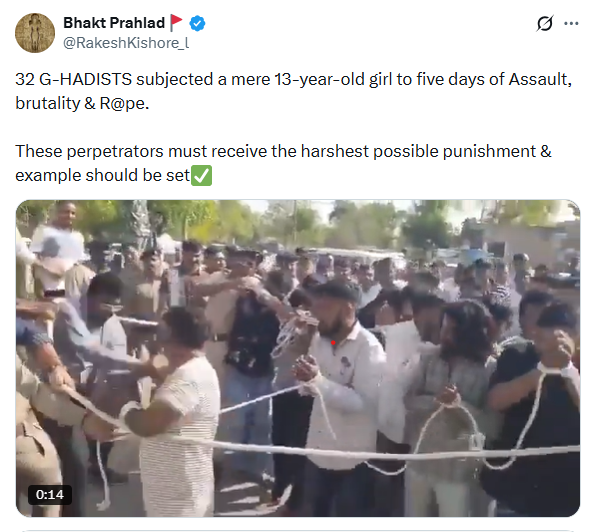
Amid nationwide outrage over the gang-rape of a 13-year-old minor in Sriganganagar, Rajasthan, a video is circulating on social media. The clip shows police officers tying the hands of several accused individuals and parading them publicly on the streets. Users sharing the video claim that these are the culprits from the Sriganganagar case being beaten by the police.
A fact-check by the CyberPeace Research Wing found this claim to be misleading. The viral video has no connection to the Rajasthan incident; it actually depicts a separate event from Patan, Gujarat, dating back to March 2026.
The Claim
On July 7, 2026, a user on X (formerly Twitter) shared the video with the caption: "32 jihadis assaulted, brutalized, and raped a 13-year-old girl for five days. These criminals must get the harshest punishment to set an example."
https://x.com/RakeshKishore_l/status/2074400280352084129
Fact Check
To verify the viral claim, keyframes from the video were extracted and analysed using Google Lens for reverse image search. During the research, we found a report published by NDTV on March 19, 2026, which carried visuals matching the viral video. The report link and screenshot are provided below:

According to the NDTV report, a video showing police personnel publicly assaulting 18 alleged accused persons in Gujarat’s Patan district had surfaced. The incident was reported to have taken place during a crime scene reconstruction exercise.
The report stated that the accused, allegedly linked to an extortion gang, were taken to Chanasma for the reconstruction process. During the exercise, police personnel were seen assaulting them. Witnesses claimed that the accused were paraded through areas where they had allegedly created fear among locals.
The accused were reportedly linked to the alleged Jhiliya gang. The incident occurred days after a violent clash in which members of the same group allegedly attacked a police team, forcing officers to retreat from the spot.
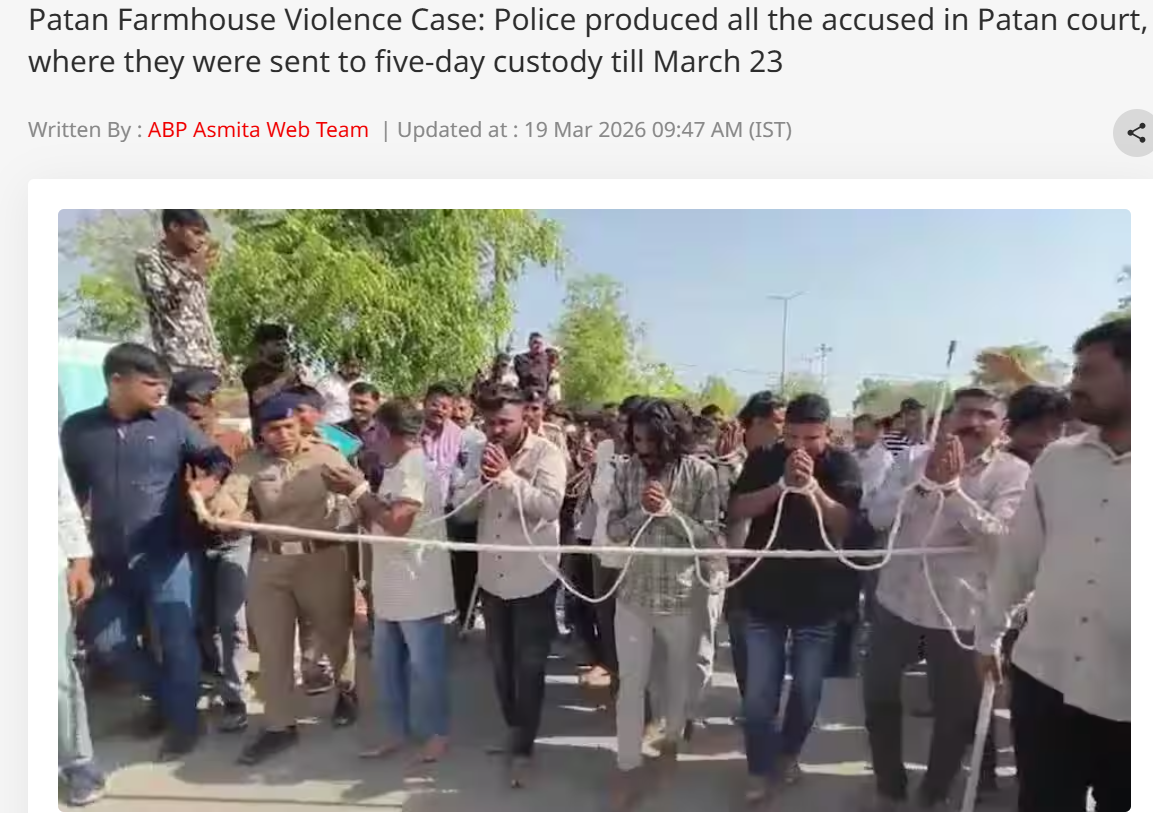
During further research, we found a report published by ABP Asmita on March 19, 2026. According to the report, the incident was linked to an old dispute over temple donations.
The report stated that the accused were produced before a court, which sent them to five days of police custody until March 23, 2026. The report link and screenshot are provided below:
Conclusion
The research found that the viral video is not related to the alleged gang rape case in Sri Ganganagar, Rajasthan. The video is being shared with a false context. The footage actually belongs to a separate incident from Gujarat’s Patan district reported in March 2026.
Related Blogs

Introduction
The two-day Apple’s Worldwide Developer Conference (WWDC) 2023, which was held on the 6th & 7th of June, has become an essential and highly anticipated part of our calendar as frequently as the trend. This year’s keynote announcements will include all of the usual enhancements for iOS, iPadOS, watchOS, macOS, and more. However, this year is also unique due to the unveiling of the Vision Pro headset, a brand-new Apple product.
In this blog, we will examine the exciting announcements made at Apple WWDC 2023, which was a ground-breaking event.
macOS Sonoma
macOS Sonoma, the new presentation of macOS disclosed at the WWDC full of exciting features. It comes with stunning video screensavers that show stunning scenes from all over the world. Gadgets can now be added genuinely to the work area and adjusted totally based on the client’s action. Also, it changes variety and blurring out of the spotlight while utilising applications. In addition, Death Stranding: Directors Cut for Mac announced that the Game Mode is added to make Macs more suitable for gaming. A presenter overlay enhances video presentations, and viewers can respond to them with interactive responses. Updated Safari is also included in the WebApp feature that turns frequently used websites into dedicated windows, a new Profile system for separating browsing history, and secure password sharing. Currently, the developer beta is available and the public beta will be available in July, and the final release is anticipated for the fall.
ios 16
Apple WWDC 2023 shows the following iOS, and iOS 16 replication, offering plenty of energising highlights for iPhone and iPad clients. Apple maintains its commitment to privacy with iOS 16, which introduces enhanced privacy settings that give users even more control over their data and online privacy. Users can also personalise their devices according to their preferences thanks to the new operating system’s refinement and customisable user interface.Improved multitasking capabilities like redesigned Files app and advanced note-taking features are just a few of the productivity enhancements included in the iOS 16. With iOS 16, Apple also improves its AR capabilities, allowing developers to develop even more immersive and interactive AR experiences.

WatchOS 9
Apple WWDC 2023 carried energising updates to the Apple Watch with the presentation of watchOS 9. The Apple Watch is an essential companion for sustaining a healthy lifestyle because the most recent version of the operating system includes cutting-edge health and fitness features. WatchOS 9 gives users unprecedented control over their health, offering personalised fitness recommendations and advanced sleep tracking.
Additionally, new watch faces were added, enhancing communication capabilities and improving app performance in watchOS 9, making the Apple Watch even easier to use daily.
ios 17
Rather than focusing on major features, Apple focused on quality-of-life enhancements when it announced iOS 17 at WWDC 2023. Live Voicemail with real-time transcripts of voicemails, personalised personal contact “posters,” and video voicemails for FaceTime are all part of the update. Search filters, a catch-up arrow, live location sharing, and a safety feature called Check-In are all available in Messages. AirDrop now supports NameDrop for transferring contact information; stickers have been expanded. The autocorrect and recording features on the keyboard have been improved for accuracy. Standby in the lock screen is an intelligent home display that shows the weather, upcoming appointments, and notifications. Siri works on Standby and adjusts itself for the night. The developer beta is currently available now, and a public beta will take place next month before the full release is in the fall.
Vision Pro VR Headset
Apple unveiled the Vision Pro AR headset, their first foray into virtual reality (VR), during the WWDC keynote. The Vision Pro is a virtual reality headset that competes with PlayStation VR2 and Meta Quest 3. This is in contrast to the long-awaited Apple smart glasses. Apple put a lot of effort into making a thin and light headset by using premium materials when needed. Voice, hand, and eye commands are all used to operate the Digital Crown-equipped device. The showcases offer extraordinary clarity, which is fueled by Apple’s M2 processor with a committed R1 chip. The Vision Pro combines virtual reality (VR) and augmented reality (AR), enabling users to interact with Apple apps and gain access to the company’s existing ecosystem. The expanded reality space created by the headset’s sensors and cameras allows users to place apps in real-world environments and adjust their level of concentration. Optic ID is a security and unlocking eye-tracking technology that is incorporated into the Vision Pro. It allows for a more immersive screen experience because it is compatible with Apple accessories like Magic Keyboard and Mac. At launch, the Vision Pro supports over a hundred Apple game galleries. Disney gave a hint that Apple and Disney might work together in the future by announcing support for the Vision Pro and making the Disney Plus app available immediately. The show highlighted the headset’s lightweight plan and recommended Apple clients wear it for extended periods. However, widespread adoption may be difficult due to the high price of $3,499 (₹289,093.01 approx). Apple is expected to release the Vision Pro for public use in 2024.

15-inch MacBook Air
At the WWDC event, Apple revealed a new MacBook Air with a larger 15-inch model instead of the standard 13-inch model. The 15-inch MacBook Air features a powerful Apple M2 processor, a thin, light, and long-lasting design, and a stunning 15.3-inch Retina display. It comes in four colours and has a headphone jack, two USB-C ports, and MagSafe charging. The display has six spatial speakers, a 1080p webcam, and 500 nits of brightness. Apple claims a battery life of up to 18 hours.
Conclusion
At Apple’s 2023 WWDC, the company demonstrated its commitment to developing technology that is user-friendly and accessible to all. Apple’s commitment to improving the user experience across all of its products is demonstrated in the updates to operating systems, improvements of Siri, breakthroughs in augmented reality, and enhancements to health and fitness.By making complex innovations more like-minded and easy to understand, Apple is enabling people to use the maximum capacity of their gadgets. Apple’s innovations at WWDC 2023 are expected to shape the future of technology, simplifying everyday tasks and revolutionising how we interact with the digital world.As we push ahead, it is exciting to guess what these advancements will proceed to develop and decidedly mean for our lives. The future holds even more incredible possibilities for all of us because of Apple’s focus on privacy, user-centric design, and pushing the boundaries of innovation. Thus, prepare to embrace a future where innovation flawlessly incorporates into our lives because of the endeavours displayed at Apple WWDC 2023.
.webp)
The world of Artificial Intelligence is entering a new phase with the rise of Agentic AI, often described as the third wave of AI evolution. Unlike earlier systems that relied on static models (that learn from the information that is fed) and reactive outputs, Agentic AI introduces intelligent agents that can make decisions, take initiative, and act autonomously in real time. These systems are designed to require minimal human oversight while actively collaborating and learning continuously. Such capabilities indicate an incoming shift, especially in the ways in which Indian businesses can function. For better understanding, Agentic AI is capable of streamlining operations, personalising services, and driving innovations at scale.
India and Agentic AI
Building as we go, India is making continuous strides in the AI revolution- deliberating on government frameworks, and simultaneously adapting. At Microsoft's Pinnacle 2025 summit in Hyderabad, India's pivotal role in shaping the future of Agentic AI was brought to the spotlight. With over 17 million developers on GitHub and ambitions to become the world's largest developer community by 2028, India's tech talent is gearing up to lead global AI innovations. Microsoft's Azure AI Foundry, also highlighted the country's growing influence in the AI landscape.
Indian companies are actively integrating Agentic AI into their operations to enhance efficiency and customer experience. Zomato is leveraging AI agents to optimise delivery logistics, ensuring timely and efficient service. Infosys has developed AI-driven copilots to assist developers in code generation, reducing development time, requiring fewer people to work on a particular project, and improving software quality.
As per a report by Deloitte, the Indian AI market is projected to grow potentially $20 billion by 2028. However, this is accompanied by significant challenges. 92% of Indian executives identify security concerns as the primary obstacle to responsible AI usage. Additionally, regulatory uncertainties and privacy risks associated with sensitive data were also highlighted.
Challenges in Adoption
Despite the enthusiasm, several barriers hinder the widespread adoption of Agentic AI in India:
- Skills Gap: While the AI workforce is expected to grow to 1.25 million by 2027, the current growth rate of 13% is considered to be insufficient with respect to the demands of the market.
- Data Infrastructure: Effective AI systems require robust, structured, and accessible datasets. Many organisations lack the necessary data maturity, leading to flawed AI outputs and decision-making failures.
- Trust and Governance: Building trust in AI systems is crucial. Concerns over data privacy, ethical usage, and regulatory compliance require robust governance frameworks to ensure the adoption of AI in a responsible manner.
- Looming fear of job loss: As AI continues to take up more sophisticated roles, a general feeling of hesitancy with respect to the loss of employment/human labour might come in the way of adopting such measures.
- Outsourcing: Currently, most companies prefer outsourcing or buying AI solutions rather than building them in-house. This gives rise to the issue of adapting to evolving needs.
The Road Ahead
To fully realise the potential of Agentic AI, India must address the following challenges :
- Training the Workforce: Initiatives and workshops tailored for employees that provide AI training can prove to be helpful. Some relevant examples are Microsoft’s commitment to provide AI training to 2 million individuals by 2025 and Infosys's in-house AI training programs.
- Data Readiness: Investing in modern data infrastructure and promoting data literacy are essential to improve data quality and accessibility.
- Establishing Governance Frameworks: Developing clear regulatory guidelines and ethical standards will foster trust and facilitate responsible AI adoption. Like the IndiaAI mission, efforts regarding evolving technology and keeping up with it are imperative.
Agentic AI holds unrealised potential to transform India's business landscape when coupled with innovation and a focus on quality that enhances global competitiveness. India is at a position where by proactively addressing the existing challenges, this potential can be realised and set the foundation for a new technological revolution (along with in-house development), solidifying its position as a global AI leader.
References
- https://economictimes.indiatimes.com/tech/artificial-intelligence/india-facing-shortage-of-agentic-ai-professionals-amid-surge-in-demand/articleshow/120651512.cms?from=mdr
- https://economictimes.indiatimes.com/tech/artificial-intelligence/india-a-global-leader-in-agentic-ai-adoption-deloitte-report/articleshow/119906474.cms?from=mdr
- https://inc42.com/features/from-zomato-to-infosys-why-indias-biggest-companies-are-betting-on-agentic-ai/
- https://www.hindustantimes.com/india-news/agentic-ai-next-big-leap-in-workplace-automation-101742548406693.html
- https://www.deloitte.com/in/en/about/press-room/india-rides-the-agentic-ai-wave.html
- https://www.businesstoday.in/tech-today/news/story/ais-next-chapter-starts-in-india-microsoft-champions-agentic-ai-at-pinnacle-2025-474286-2025-05-01
- https://www.hindustantimes.com/opinion/calm-before-ai-storm-a-moment-to-prepare-101746110985736.html
- https://www.financialexpress.com/life/technology/why-agentic-ai-is-the-next-big-thing/3828357/

Introduction
In May 2025, at Mumbai’s first-ever World Audio Visual and Entertainment Summit (WAVES), PM Narendra Modi marked a turning point: the rise of what he called India's Orange Economy. Here lies a new path to growth - one built less on factories, more on invention, artistry, and spreading thought globally. While aiming for massive economic scale, India finds its creative industries movies, sound, games, cartoons, clothing design, books, online media stepping forward.
First appearing in a 2013 guide from the Inter-American Development Bank, the phrase 'orange economy' emerged through work by Felipe Buitrago Restrepo and Iván Duque Márquez, suggesting past neglect in defining how culture connects with economic activity. Because orange stands for imagination and heritage in many societies, it became the label for this particular sector of economic life..
According to UNESCO’s 2022 Global Report Reshaping Policies for Creativity, the cultural and creative sectors account for 3.1% of world GDP and employ 6.2% of the global workforce – more than the total number of people employed in car manufacturing in Europe, Japan and the U.S. Meanwhile, UNCTAD's 2024 Creative Economy Outlook shows cross-border trade in creative services hit $1.4 trillion in 2022, up nearly a third from five years ago, demonstrating how imagination is remaking modern commerce.
In his book The Creative Economy, economist John Howkins states that the creative economy is essentially about the relationship between creativity and economics, where ideas themselves are products, and imagination becomes a form of capital.
India’s Slice of Orange
The Scale of Opportunity
Despite its potential, India’s role in the global creative economy remains largely untapped. According to the FICCI-EY Media and Entertainment Report, the country’s media and entertainment sector ranks among the world’s most rapidly expanding, fueled by a youthful demographic that is increasingly online and earning more. Boasting over 600 million people using the internet, it hosts a vibrant network of creators - musicians in Guwahati, podcasters in Kochi, game developers in Bengaluru, filmmakers in Punjab - who together form a rich pool of talent unlike any other.
Now comes a shift at the WAVES Summit, where PM Modi framed content, creativity, and culture as core to an emerging economy. Not just products but ideas take center stage here, he suggested, during what he described as the ideal time to build from India for global impact. While earlier efforts pushed factory output under Make in India, this approach turned toward thinking work - where stories, visual forms, and online expression shape progress. Thought becomes product; imagination fuels industry.
Creative Industries Leading Change
What many people don’t know is that India makes more films than any other country. The films made in Tamil, Telugu, Malayalam or Kannada are also widely circulated outside India, not just the output of Mumbai. Streaming services such as Netflix and Amazon Prime carry these works, reaching far beyond local audiences. Furthermore, India’s gaming industry is nascent but growing rapidly, and is attracting increasing attention from policy makers. Until recently, studios around the world have not relied on Indian teams for animation and visual effects. Now, local creators are slowly building their own game franchises. Momentum is shifting - original ideas once rare now appear more often across the country. Deep within India’s craft traditions handwoven textiles, carved block patterns, intricate metallic threadwork lies a quiet fusion of legacy and modern expression. Viewed anew through the framework of creative enterprise, such practices reveal dual value: access to global markets alongside sustenance for village-based makers. Rather than mere relics, they function as living systems where art meets income. Changes in perception make them economic opportunities, rather than local crafts. Every stitch, every weave, is not just technique but the weight of continuity in the face of change. And today, streaming platforms allow independent musicians in India to connect directly to listeners worldwide.
The Three T’s: Technology Talent Tolerance
Richard Florida, an economist, in his work The Rise of the Creative Class once proposed a model where city progress ties closely to innovation, skilled individuals, and openness. His idea - crafted originally for U.S. urban areas fits well when viewing India today. Growth now depends less on old industries, more on environments that attract capable minds through flexibility. Regions thrive not just by building tech hubs but by welcoming diverse lifestyles. One factor feeds another: talent flows where freedom exists, ideas grow where tools are available. A place gains momentum only if it supports all three at once.
Technology
A tool opens doors. Low-cost internet, budget phones, together with government-backed digital expansion, made making content possible for nearly anyone. The focus should be on accessibility and last mile delivery.
Talent
Home to the youngest population on Earth, it sees countless imaginative minds emerge yearly from schools that now encourage original thinking. Still, despite rising worldwide interest in what these individuals produce, many cannot cover basic needs - a gap highlighted by UNESCO’s 2022 findings. But this contradiction lacks for systems that ensure fair pay, protect ideas, and offer stability beyond fleeting projects.
Tolerance
Openness to difference, trial, and unusual thinking shapes the trickier part of the equation. The wide mix of tongues, beliefs, and cultural expressions in India adds real value. Still, fostering innovation demands systems willing to adapt with rules safeguarding free expression, fair access for women in arts sectors, smoother paths for excluded groups.
Challenges on the Path to “Create in India”
India has millions of creators who influence culture but struggle to make a regular income from their work. Platforms take the lion’s share of profits, but those creating content, especially outside the big cities, often don’t have legal help, fair contracts or links with brands.
Another issue is Intellectual Property Literacy, IP rules such as copyright, trademark and patent systems empower the creative economy. Still, uneven understanding and spotty enforcement across India put many creators at risk of unfair use. Surprisingly, UNESCO’s 2022 assessment points to missing global standards for measuring creative sectors. Because of this gap, India faces challenges in shaping precise policy moves. Without detailed cultural satellite accounts, tracking progress remains uneven. Sector-specific figures would help fill these blind spots. Otherwise, decisions rely on incomplete information.Lastly, across the world, female professionals in artistic fields hold fewer top roles while earning less than men - a gap clearly seen in India too. To shape a fairer cultural sector, intentional strategies must elevate women, indigenous makers, and creators with disabilities.
Conclusion
In India, where young energy meets tradition through digital tools. Stories once shared locally now move across borders, carried by platforms that turn art into income. Because of this shift, music and fashion gain reach but only if creators can protect their work. Without fair pay or legal backing, even brilliant ideas fade quietly. Support systems matter, not just ambition. Recognition from society shapes whether fresh voices endure. In 2022, UNESCO’s report showed that although more people want to do creative work, those who create it still find it hard to make a living. New ideas offer a way forward, not to copy what exists, culture is then voice and value all at once.
References
- https://sprf.in/from-make-in-india-to-create-in-india-charting-indias-orange-economy-frontier/
- https://www.unesco.org/reports/reshaping-creativity/2022/en
- https://iasscore.in/current-affairs/indias-orange-economy
- https://indiasworld.in/the-dawn-of-indias-orange-economy/
- Marta-Christina Suciu, "The Creative Economy" (Academy of Economic Studies, Bucharest)
- John Howkins, The Creative Economy: How People Make Money from Ideas (2001)
- Richard Florida, The Rise of the Creative Class (2002)
- UNCTAD, Creative Economy Outlook 2024
- SPRF, "From Make in India to Create in India" (December 2025)
- IDB, The Orange Economy: An Infinite Opportunity (2013)