
#FactCheck - Viral Video of Salman Khan and Govinda Falsely Linked to Mithun Chakraborty’s Death
Executive Summary:
A video is being circulated on social media claiming that veteran actor Mithun Chakraborty has passed away. The viral clip shows actors Salman Khan and Govinda leaving in their respective cars. Social media users are sharing this footage while claiming that the actors were seen after the alleged demise of Mithun Chakraborty. However, research by the CyberPeace found the claim to be false. Our research revealed that Mithun Chakraborty is completely healthy and the claim about his death is misleading.
Claim
On March 6, 2026, an Instagram user shared the viral video claiming that actor Mithun Chakraborty had passed away.

Fact Check:
To verify the claim, we searched relevant keywords on Google. During this search, we did not find any credible media report confirming the death of Mithun Chakraborty.
We further checked the social media accounts of Mithun Chakraborty’s son Mahaakshay Chakraborty, but found no information related to the viral claim. This indicated that the posts circulating on social media about the actor’s death were false. To trace the origin of the viral footage, we extracted key frames from the video showing Salman Khan and Govinda and conducted a reverse image search using Google Lens. During the search, we found the clip featuring Salman Khan on the Facebook page of Times Now, posted on November 11, 2025.

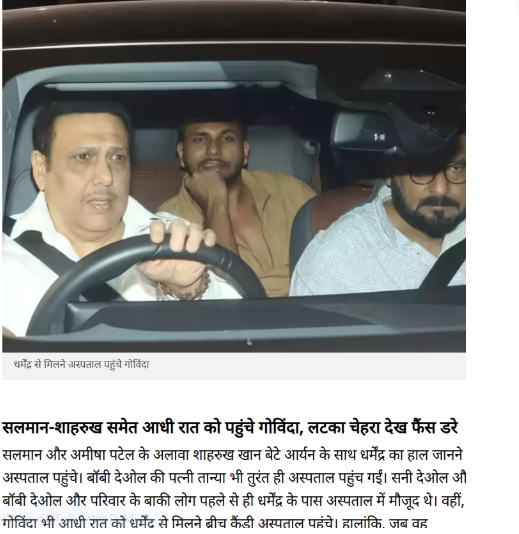
According to the report, Salman Khan and Shah Rukh Khan were seen leaving Breach Candy Hospital in Mumbai, where veteran actor Dharmendra had been admitted on November 10 after his health suddenly deteriorated. The clip featuring Govinda was also found on the website of Navbharat Times, published on November 11, 2025. According to the report, Govinda had arrived late at night at Breach Candy Hospital to visit Dharmendra after he was hospitalized due to health issues.
Conclusion
Our research found that the viral claim is false. Actor Mithun Chakraborty is alive and healthy. The video circulating on social media actually shows Salman Khan and Govinda visiting Breach Candy Hospital in November 2025 when actor Dharmendra was admitted, and it has been wrongly linked to Mithun Chakraborty’s death.

Related Blogs

Executive Summary:
Amid the ongoing tensions and conflict involving the United States, Israel, and Iran, an image of a heavily damaged industrial facility is circulating widely on social media. Several users are sharing the picture claiming that it shows an Iranian water treatment or desalination plant destroyed in a US–Israel attack. Some media reports have also used the same image while reporting on the alleged attack on a freshwater desalination plant in Iran.
However, a research by the CyberPeace found that the claim is misleading. The viral image is not from Iran. It actually shows the aftermath of a drone attack on a warehouse belonging to a US company in Basra, Iraq.
Claim
X user “Shashank Shekhar Jha” shared the image on March 8, 2026, claiming that a freshwater desalination plant in Qeshm, Iran, had been destroyed.
Fact check
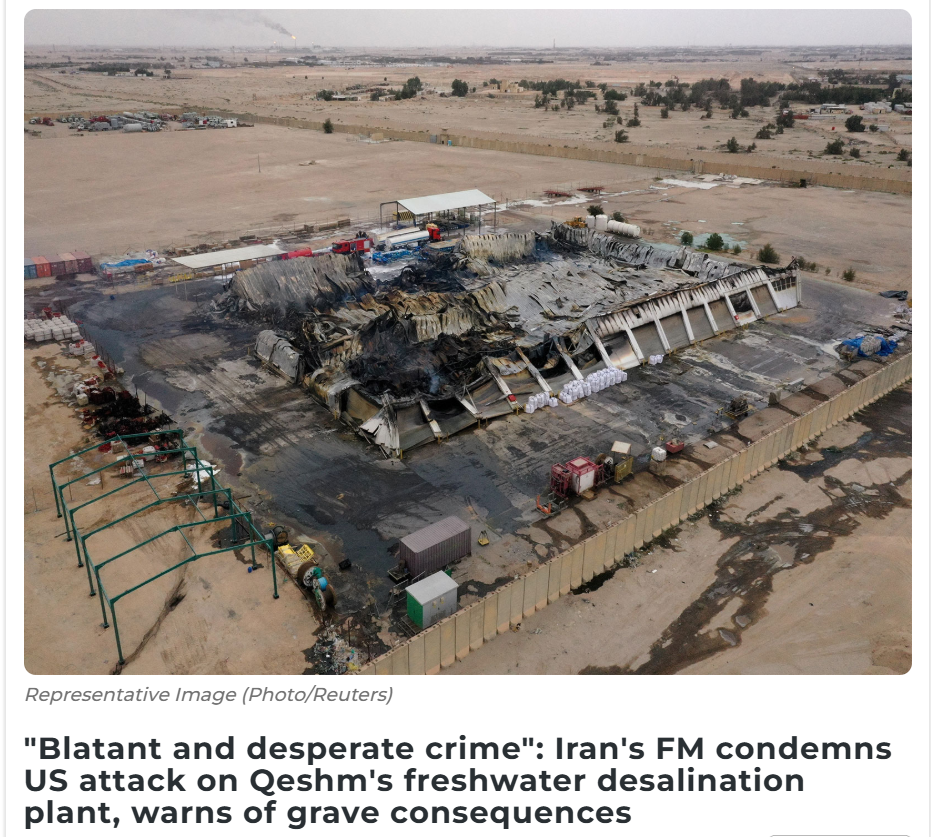
To verify the claim, we conducted a reverse image search using Google Lens. During the search, we found a report published on March 7, 2026, on the website of Asian News International (ANI). The report stated that Iran’s Foreign Minister Seyed Abbas Araghchi condemned a US attack on a freshwater desalination plant on Qeshm Island, calling it a “blatant and desperate crime.”
The report used the same viral image; however, the caption clearly mentioned that it was a representational image credited to Reuters.
https://www.aninews.in/news/world/middle-east/blatant-and-desperate-crime-irans-fm-condemns-us-attack-on-qeshms-freshwater-desalination-plant-warns-of-grave-consequences20260307212645/
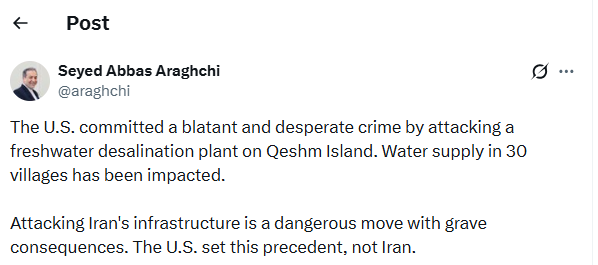
To further confirm the claim, we checked the official X account of Seyed Abbas Araghchi. In a post on March 7, he condemned the alleged attack on the desalination plant in Qeshm and stated that the strike had disrupted water supply to around 30 villages. However, the post did not include any image of the incident.
Conclusion
The viral image being shared as evidence of a US–Israel attack on Iran’s water treatment plant is misleading. The photo actually shows the aftermath of a drone strike on a warehouse belonging to a US company in Basra, Iraq, and has been wrongly linked to the situation in Iran.

Over the last decade, battlefields have percolated from mountains, deserts, jungles, seas, and the skies into the invisible networks of code and cables. Cyberwarfare is no longer a distant possibility but today’s reality. The cyberattacks of Estonia in 2007, the crippling of Iran’s nuclear program by the Stuxnet virus, the SolarWinds and Colonial Pipeline breaches in recent years have proved one thing: that nations can now paralyze economies and infrastructures without firing a bullet. Cyber operations now fall beyond the traditional threshold of war, allowing aggressors to exploit the grey zone where full-scale retaliation may be unlikely.
At the same time, this ambiguity has also given rise to the concept of cyber deterrence. It is a concept that has been borrowed from the nuclear strategies during the Cold War era and has been adapted to the digital age. At the core, cyber deterrence seeks to alter the adversary’s cost-benefit calculation that makes attacks either too costly or pointless to pursue. While power blocs like the US, Russia, and China continue to build up their cyber arsenals, smaller nations can hold unique advantages, most importantly in terms of their resilience, if not firepower.
Understanding the concept of Cyber Deterrence
Deterrence, in its classic sense, is about preventing action through the fear of consequences. It usually manifests in four mechanisms as follows:
- Punishment by threatening to impose costs on attackers, whether by counter-attacks, economic sanctions, or even conventional forces.
- Denial of attacks by making them futile through hardened defences, and ensuring the systems to resist, recover, and continue to function.
- Entanglement by leveraging interdependence in trade, finance, and technology to make attacks costly for both attackers and defenders.
- Norms can also help shape behaviour by stigmatizing reckless cyber actions by imposing reputational costs that can exceed any gains.
However, great powers have always emphasized the importance of punishment as a tool to showcase their power by employing offensive cyber arsenals to instill psychological pressure on their rivals. Yet in cyberspace, punishment has inherent flaws.
The Advantage of Asymmetry
For small states, smaller geographical size can be utilised as a benefit. Three advantages of this exist, such as:
- With fewer critical infrastructures to protect, resources can be concentrated. For example, Denmark, with a modest population of $40 million cyber budget, is considered to be among the most cyber-secure nations, despite receiving billions of US spending.
- Smaller bureaucracies enable faster response. The centralised cyber command of Singapore allows it to ensure a rapid coordination between the government and the private sector.
- Smaller countries with lesser populations can foster a higher public awareness and participation in cyber hygiene by amplifying national resilience.
In short, defending a small digital fortress can be easier than securing a sprawling empire of interconnected systems.
Lessons from Estonia and Singapore
The 2007 crisis of Estonia remains a case study of cyber resilience. Although its government, bank, and media were targeted in offline mode, Estonia emerged stronger by investing heavily in cyber defense mechanisms. Another effort in this case stood was with the hosting of NATO’s Cooperative Cyber Defence Centre of Excellence to build one of the world’s most resilient e-governance models.
Singapore is another case. Where, recognising its vulnerability as a global financial hub, it has adopted a defense-centric deterrence strategy by focusing on redundancy, cyber education, and international partnership rather than offensive capacity. These approaches can also showcase that deterrence is not always about scaring attackers with retaliation, it is about making the attacks meaningless.
Cyber deterrence and Asymmetric Warfare
Cyber conflict is understood through the lens of asymmetric warfare, where weaker actors exploit the unconventional and stronger foes. As guerrillas get outmanoeuvred by superpowers in Vietnam or Afghanistan, small states hold the capability to frustrate the cyber giants by turning their size into a shield. The essence of asymmetric cyber defence also lies in three principles, which can be mentioned as;
- Resilience over retaliation by ensuring a rapid recovery to neutralise the goals of the attackers.
- Undertaking smart investments focusing on limited budgets over critical assets, not sprawling infrastructures.
- Leveraging norms to shape the international opinions to stigmatize the aggressors and increase the reputational costs.
This also helps to transform the levels of cyber deterrence into a game of endurance rather than escalating it into a domain where small states can excel.
There remain challenges as well, as attribution problems persist, the smaller nations still depend on foreign technology, which the adversaries have sought to exploit. Issues over the shortage of talent have plagued the small states, as cyber professionals have migrated to get lucrative jobs abroad. Moreover, building deterrence capability through norms requires active multilateral cooperation, which may not be possible for all small nations to sustain.
Conclusion
Cyberwarfare represents a new frontier of asymmetric conflict where size does not guarantee safety or supremacy. Great powers have often dominated the offensive cyber arsenals, where small states have carved their own path towards security by focusing on defence, resilience, and international collaboration. The examples of Singapore and Estonia demonstrate the fact that the small size of a state can be its identity of a hidden strength in capabilities like cyberspace, allowing nimbleness, concentration of resources and societal cohesion. In the long run, cyber deterrence for small states will not rest on fearsome retaliation but on making attacks futile and recovery inevitable.
References
- https://bluegoatcyber.com/blog/asymmetric-warfare/
- https://digitalcommons.usf.edu/cgi/viewcontent.cgi?article=2268&context=jss
- https://www.linkedin.com/pulse/rising-tide-cyberwarfare-battle-between-superpowers-hussain/
- https://digitalcommons.odu.edu/cgi/viewcontent.cgi?article=1243&context=gpis_etds
- https://www.scirp.org/journal/paperinformation?paperid=141708
- https://digitalcommons.odu.edu/cgi/viewcontent.cgi?article=1243&context=gpis_etds

Introduction
The Ministry of Electronics and Information Technology (MeitY) issued an advisory on March 1 2024, urging platforms to prevent bias, discrimination, and threats to electoral integrity by using AI, generative AI, LLMs, or other algorithms. The advisory requires that AI models deemed unreliable or under-tested in India must obtain explicit government permission before deployment. While leveraging Artificial Intelligence models, Generative AI, software, or algorithms in their computer resources, Intermediaries and platforms need to ensure that they prevent bias, discrimination, and threats to electoral integrity. As Intermediaries are required to follow due diligence obligations outlined under “Information Technology (Intermediary Guidelines and Digital Media Ethics Code)Rules, 2021, updated as of 06.04.2023”. This advisory is issued to urge the intermediaries to abide by the IT rules and regulations and compliance therein.
Key Highlights of the Advisories
- Intermediaries and platforms must ensure that users of Artificial Intelligence models/LLM/Generative AI, software, or algorithms do not allow users to host, display, upload, modify, publish, transmit, store, update, or share unlawful content, as per Rule 3(1)(b) of the IT Rules.
- The government emphasises intermediaries and platforms to prevent bias or discrimination in their use of Artificial Intelligence models, LLMs, and Generative AI, software, or algorithms, ensuring they do not threaten the integrity of the electoral process.
- The government requires explicit permission to use deemed under-testing or unreliable AI models, LLMs, or algorithms on the Indian internet. Further, it must be deployed with proper labelling of potential fallibility or unreliability. Further, users can be informed through a consent popup mechanism.
- The advisory specifies that all users should be well informed about the consequences of dealing with unlawful information on platforms, including disabling access, removing non-compliant information, suspension or termination of access or usage rights of the user to their user account and imposing punishment under applicable law. It entails that users are clearly informed, through terms of services and user agreements, about the consequences of engaging with unlawful information on the platform.
- The advisory also indicates measures advocating to combat deepfakes or misinformation. The advisory necessitates identifying synthetically created content across various formats, advising platforms to employ labels, unique identifiers, or metadata to ensure transparency. Furthermore, the advisory mandates the disclosure of software details and tracing the first originator of such synthetically created content.
Rajeev Chandrasekhar, Union Minister of State for IT, specified that
“Advisory is aimed at the Significant platforms, and permission seeking from Meity is only for large platforms and will not apply to startups. Advisory is aimed at untested AI platforms from deploying on the Indian Internet. Process of seeking permission , labelling & consent based disclosure to user about untested platforms is insurance policy to platforms who can otherwise be sued by consumers. Safety & Trust of India's Internet is a shared and common goal for Govt, users and Platforms.”
Conclusion
MeitY's advisory sets the stage for a more regulated Al landscape. The Indian government requires explicit permission for the deployment of under-testing or unreliable Artificial Intelligence models on the Indian Internet. Alongside intermediaries, the advisory also applies to digital platforms that incorporate Al elements. Advisory is aimed at significant platforms and will not apply to startups. This move safeguards users and fosters innovation by promoting responsible AI practices, paving the way for a more secure and inclusive digital environment.
References
- https://regmedia.co.uk/2024/03/04/meity_ai_advisory_1_march.pdf
- https://economictimes.indiatimes.com/tech/technology/govts-ai-advisory-will-not-apply-to-startups-mos-it-rajeev-chandrasekhar/articleshow/108197797.cms?from=mdr
- https://www.meity.gov.in/writereaddata/files/Advisory%2015March%202024.pdf
