
#FactCheck-Viral Video Claiming a Shooting Incident at Patna High School is Actually From a Film Set
Executive Summary
A 22-second video is circulating on social media platform X (formerly Twitter) with a claim that a shooting incident took place at Patna High School in Bihar. The video shows several masked men running around with weapons in their hands, accompanied by the sound of gunfire. A text overlay on the video reads "Patna High School." However, an research by the CyberPeace Research Wing has revealed that this claim is entirely fake and misleading. The video does not depict a real shooting; it captures an authorized movie/web series shooting on the school premises.
The Claim
Social media users are sharing the video claiming that a real firing incident occurred at Patna High School in Patna, Bihar. https://x.com/IraRuhi/status/2070334893830357499

Fact Check
Keyframes from the viral video were analyzed using reverse image search. This led to identical videos uploaded on Facebook and Instagram on June 25, 2026. The captions on both uploads explicitly stated that the footage was from a movie and web series shoot. Furthermore, a closer inspection of the videos revealed professional filmmaking equipment, such as a black flag and a skimmer, visible on the set. https://www.facebook.com/reel/2160248068089642

https://www.instagram.com/p/DaBE0gQglUF/

A targeted keyword search led to a YouTube video uploaded on June 20, 2026. The visuals in this video perfectly matched the viral footage, and the individuals seen in the viral clip could be spotted wearing the exact same clothes. "Regarding the video/photo being circulated on social media (Patna High School, Gardanibagh), it is clarified that this is part of an authorized film shooting, for which due permission was previously granted by the competent authority."

To verify further, official statements were checked. The Patna Police issued a formal press release on June 26, 2026, completely dismissing the viral rumors. https://x.com/PatnaPolice24x7/status/2070501501529960581

Conclusion
The evidence gathered confirms that there was no shooting incident at Patna High School. The viral video is behind-the-scenes footage from a pre-approved film production.

Related Blogs
.webp)
The Equitable Growth Approach of AI and Digital Twins
Digital Twins can be simply described as virtual replicas of physical assets or systems, powered by real-time data and advanced simulations. When this technology is combined with AI, the impact it has on enabling real-time monitoring, predictive maintenance, optimised operations, and improved design processes through the creation of virtual replicas of physical assets becomes even greater. The greatest value of AI is its ability to make data actionable. And when combined with digital twins, these data can be collated, analysed, inefficiencies removed, and better decisions can be taken to improve efficiency and quality.
This intersection between AI and Digital Twins holds immense potential for addressing key challenges, particularly in countries like India, which is rapidly embracing digital adoption to achieve its economic ambitions and sustainability goals. According to Salesforce’s most recent survey on generative AI use among the general population within the U.S., UK, Australia and India, 75% of generative AI users are looking to automate repetitive tasks and use generative AI for work communications. India is particularly looking towards a rapid digital adoption, economic ambitions, and sustainable developments to be achieved through AI adoption. This blog discuss the intersection of equitable growth, sustainability, and AI-driven policies in India.
Sustainability and the Path Ahead: Digital Twin and AI-Driven Solutions
India faces sustainability challenges which are mainly associated with issues such as urban congestion, the rising demand for energy along with climate change and environmental degradation. AI and Digital Twins provide solutions for real-time simulations and predictive analysis. Some of the examples are its applications in sustainable urban planning such as smart cities like the Indore Smart City Initiative and traffic optimisation, energy efficiency/optimisation through AI-driven renewable energy projects and power grid optimisation and even water resource management through leak detection, equitable distribution and conservation.
The need is to balance innovation with regulation, particularly, underscoring the importance of ethical and sustainable deployment of AI and digital twins and addressing data privacy with AI ethics with recent developments such as the India’s evolving AI policy landscape, including the National Strategy for Artificial Intelligence and its focus on AI for All, regulatory frameworks such as DPDP Act and the manner in which they address AI ethics, data privacy, and digital governance.
The need is to initiate targeted policies that promote research and development in AI and digital twin technologies, skill development and partnerships with the private sector, think tanks, nonprofits and others. Also, collaborations at the global level would include aligning our domestic policies with global AI and sustainability initiatives and leveraging the international frameworks for climate tech and smart infrastructure.
Cyberpeace Outlook
As part of specific actions, policymakers need to engage in proactive governance to ensure the responsible use and development of AI. This includes enacting incentive schemes for sustainable AI projects and strengthening the enforcement of data privacy laws. Industry leaders must support equitable access to AI and digital twin technologies and develop tailored AI tools for resource-constrained settings, particularly in India. Finally, researchers need to drive innovation in alignment with sustainability goals, such as those related to agriculture and groundwater management.
References
- https://economictimes.indiatimes.com/tech/artificial-intelligence/technologies-like-ai-and-digital-twins-can-tackle-challenges-like-equitable-growth-to-sustainability-wef/articleshow/117121897.cms
- https://www.salesforce.com/news/stories/generative-ai-statistics/
- https://www.mdpi.com/2673-2688/4/3/38
- https://www.ibm.com/think/topics/generative-ai-for-digital-twin-energy-utilities

Introduction
Indian Cybercrime Coordination Centre (I4C) was established by the Ministry of Home Affairs (MHA) to provide a framework and eco-system for law enforcement agencies (LEAs) to deal with cybercrime in a coordinated and comprehensive manner. The Indian Ministry of Home Affairs approved a scheme for the establishment of the Indian Cyber Crime Coordination Centre (I4C) in October2018, which was inaugurated by Home Minister Amit Shah in January 2020. I4C is envisaged to act as the nodal point to curb Cybercrime in the country. Recently, on 13th March2024, the Centre designated the Indian Cyber Crime Coordination Centre (I4C) as an agency of the Ministry of Home Affairs (MHA) to perform the functions under the Information Technology Act, 2000, to inform about unlawful cyber activities.
The gazetted notification dated 13th March 2024 read as follows:
“In exercise of the powers conferred by clause (b) of sub-section (3) of section 79 of the Information Technology Act 2000, Central Government being the appropriate government hereby designate the Indian Cybercrime Coordination Centre (I4C), to be the agency of the Ministry of Home Affairs to perform the functions under clause (b) of sub-section (3) of section79 of Information Technology Act, 2000 and to notify the instances of information, data or communication link residing in or connected to a computer resource controlled by the intermediary being used to commit the unlawful act.”
Impact
Now, the Indian Cyber Crime Coordination Centre (I4C) is empowered to issue direct takedown orders under 79(b)(3) of the IT Act, 2000. Any information, data or communication link residing in or connected to a computer resource controlled by any intermediary being used to commit unlawful acts can be notified by the I4C to the intermediary. If an intermediary fails to expeditiously remove or disable access to a material after being notified, it will no longer be eligible for protection under Section 79 of the IT Act, 2000.
Safe Harbour Provision
Section79 of the IT Act also serves as a safe harbour provision for the Intermediaries. The safe harbour provision under Section 79 of the IT Act states that "an intermediary shall not be liable for any third-party information, data, or communication link made available or hosted by him". However, it is notable that this legal immunity cannot be granted if the intermediary "fails to expeditiously" take down a post or remove a particular content after the government or its agencies flag that the information is being used to commit something unlawful. Furthermore, Intermediaries are also obliged to perform due diligence on their platforms and comply with the rules & regulations and maintain and promote a safe digital environment on the respective platforms.
Under the Information Technology (Intermediary Guidelines and Digital Media Ethics Code) Rules, 2021, The government has also mandated that a ‘significant social media intermediary’ must appoint a Chief Compliance Officer (CCO), Resident Grievance Officer (RGO), and Nodal Contact Person and publish periodic compliance report every month mentioning the details of complaints received and action taken thereon.
I4C's Role in Safeguarding Cyberspace
The Indian Cyber Crime Coordination Centre (I4C) is actively working towards initiatives to combat the emerging threats in cyberspace. I4C is one of the crucial extensions of the Ministry of Home Affairs, Government of India, working extensively to combat cyber crimes and ensure the overall safety of netizens. The ‘National Cyber Crime Reporting Portal’ equipped with a 24x7 helpline number 1930, is one of the key component of the I4C.
Components Of The I4C
- National Cyber Crime Threat Analytics Unit
- National Cyber Crime Reporting Portal
- National Cyber Crime Training Centre
- Cyber Crime Ecosystem Management Unit
- National Cyber Crime Research and Innovation Centre
- National Cyber Crime Forensic Laboratory Ecosystem
- Platform for Joint Cyber Crime Investigation Team.
Conclusion
I4C, through its initiatives and collaborative efforts, plays a pivotal role in safeguarding cyberspace and ensuring the safety of netizens. I4C reinforces India's commitment to combatting cybercrime and promoting a secure digital environment. The recent development by designating the I4C as an agency to notify the instances of unlawful activities in cyberspace serves as a significant step to counter cybercrime and promote an ethical and safe digital environment for netizens.
References
- https://www.deccanherald.com/india/centre-designates-i4c-as-agency-of-mha-to-notify-unlawful-activities-in-cyber-world-2936976
- https://www.business-standard.com/india-news/home-ministry-authorises-i4c-to-issue-takedown-notices-under-it-act-124031500844_1.html
- https://www.hindustantimes.com/india-news/it-ministry-empowers-i4c-to-notify-instances-of-cybercrime-101710443217873.html
- https://i4c.mha.gov.in/about.aspx#:~:text=Objectives%20of%20I4C,identifying%20Cybercrime%20trends%20and%20patterns
Introduction
The trajectory of India's digital economy is growing at an unprecedented rate, and so is India's cybercrime ecosystem. Parliamentary data tabled before the Rajya Sabha in May 2024 by the MHA suggests an overwhelming 900% growth in cybercrime complaints from 2021 to '25, while annual losses crossed 22,800 crore in 2024. The structural issues like the low victim restitution rate, the lack of forensic infrastructure, issues of jurisdiction related to offshore fraud factories targeting Indian citizens, and the huge disparity in awareness levels amongst India's youngest online citizens continue to exist. This brief brings out the clear trends in cybercrime, the role of institutional mechanisms in its prevention and response, failure points, and recommends appropriate policy interventions from the perspective of CyberPeace.
The Data Imperative
Since its operationalisation in 2019 by the Indian Cyber Crime Coordination Centre (I4C), the NCRP serves as India's most significant institutional apparatus for cybercrime reporting and response. Data placed before the Rajya Sabha by the Ministry of Home Affairs on 30 July 2025 show that, with almost no exception, complaints of cybercrime have increased far more quickly than most traditional indicators of public safety. Between 2021 and June 2025, the NCRP received 6.59 million complaints, evidence of both a sustained and escalating expansion of India's cyber threat profile. Complaints per year more than quadrupled from 4.52 lakh in 2021 to 19.18 lakh in 2024 (324% over the period); by 2025, the NCRP had received 28.15 lakh complaints, a 523 percent rise compared with the 2021 baseline:
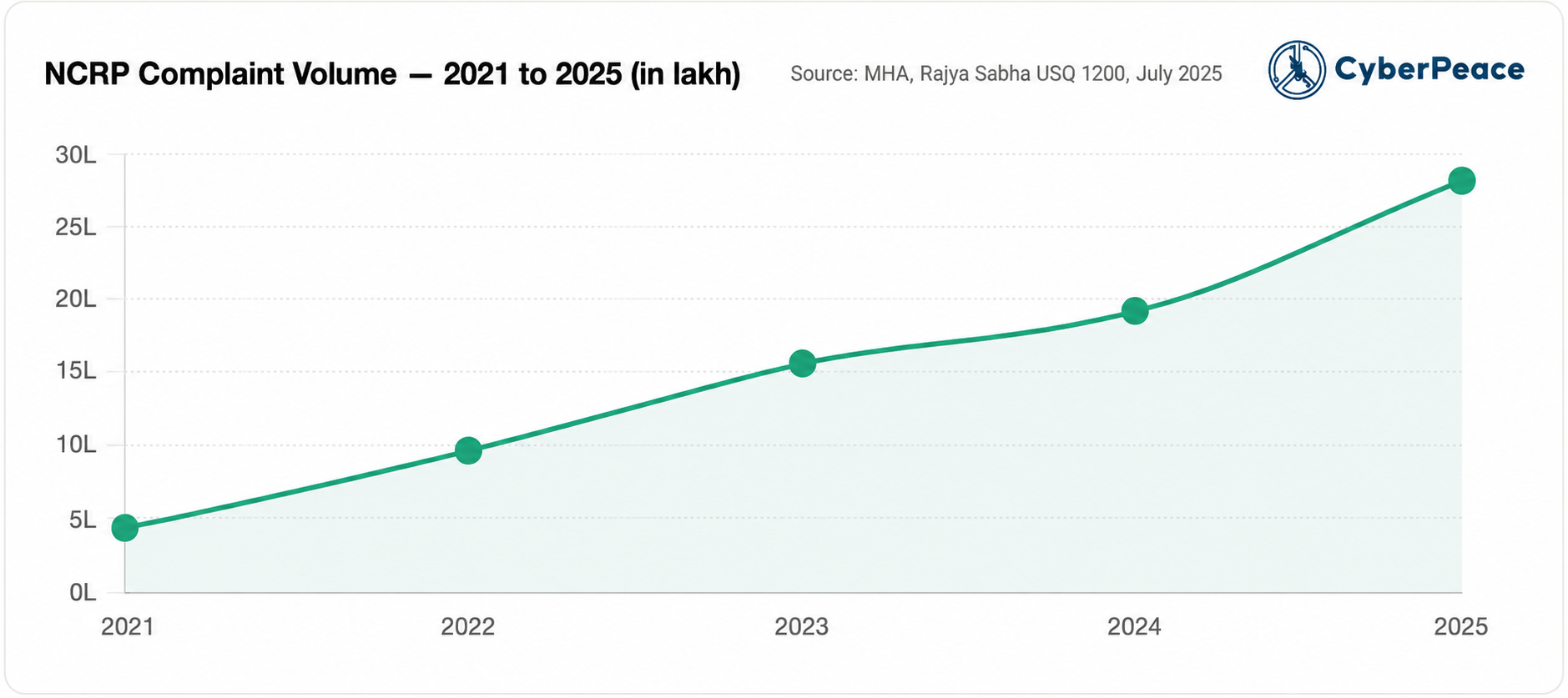
Clearly, cyber-enabled crime is no longer an occasional crisis but a systemic governance issue requiring consistent regulation and institution-building.
The financial fallout has also accelerated dramatically. Figures indicate that reported financial losses due to cybercrime jumped from 2,290 crore in 2022 to 22,812 crore in 2024 a 895% leap in two years:
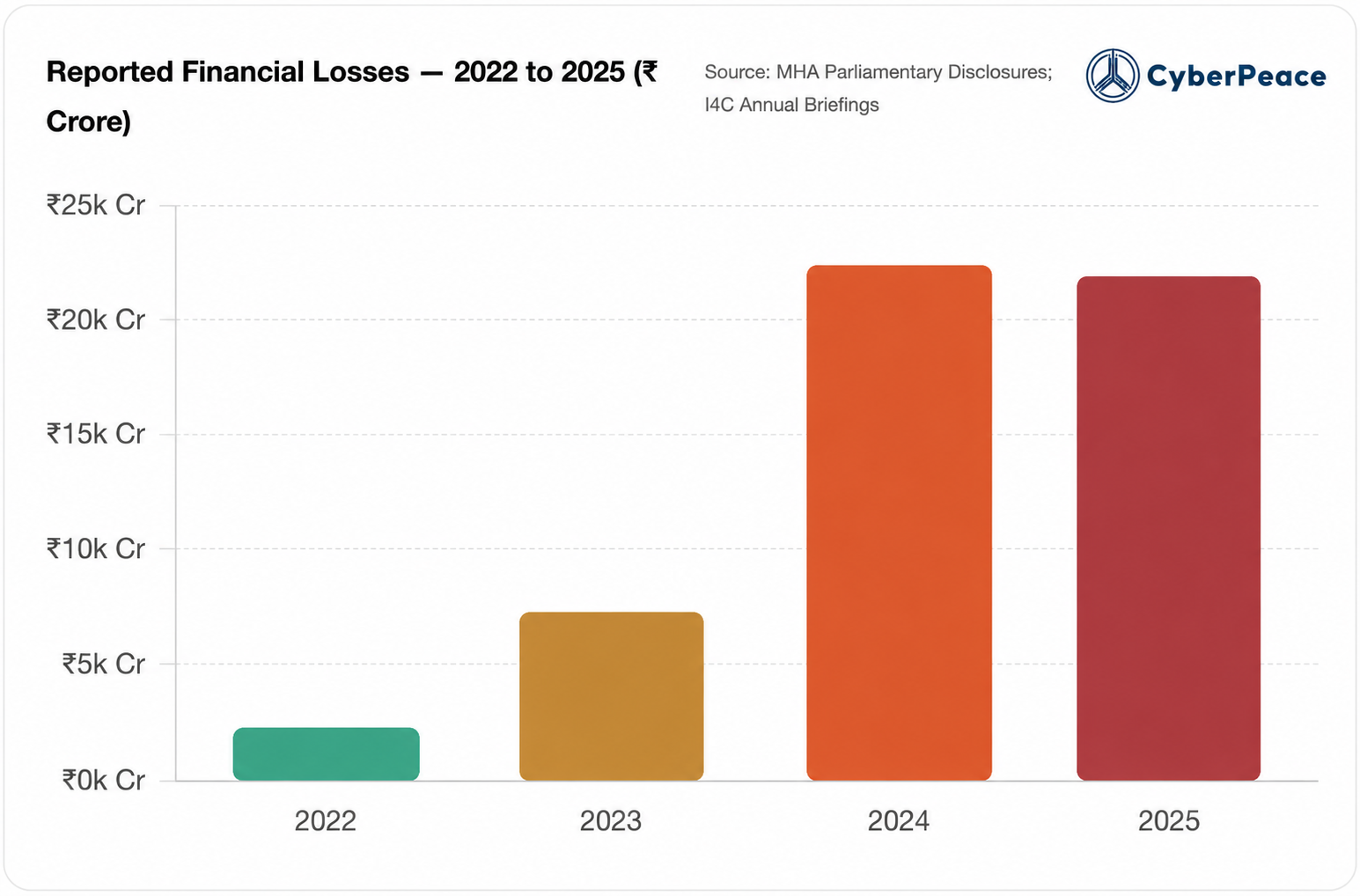
Though response mechanisms such as the Citizen Financial Cyber Fraud Reporting and Management System (CFCFRMS) successfully blocked or recovered close to 8,690 crore as of January 2026, victims appear to get back only about 2.18 percent of the losses they report.
In most areas, reporting and response have expanded greatly, but both the rate and scale of cyber-enabled financial fraud continue to outstrip India's remediation and law enforcement capacity.
Threat Typology of India’s Fraud Ecosystem
The nature of cyber crime in India has evolved from an opportunistic volume-based activity to a layered transnational criminal environment. I4C intelligence as tabled in Parliament reveals investment scams as the biggest threat: they accounted for 76% of the financial fraud lost in 2025 (although only 35% of complaints were filed, thus, a very high value per case was lost).
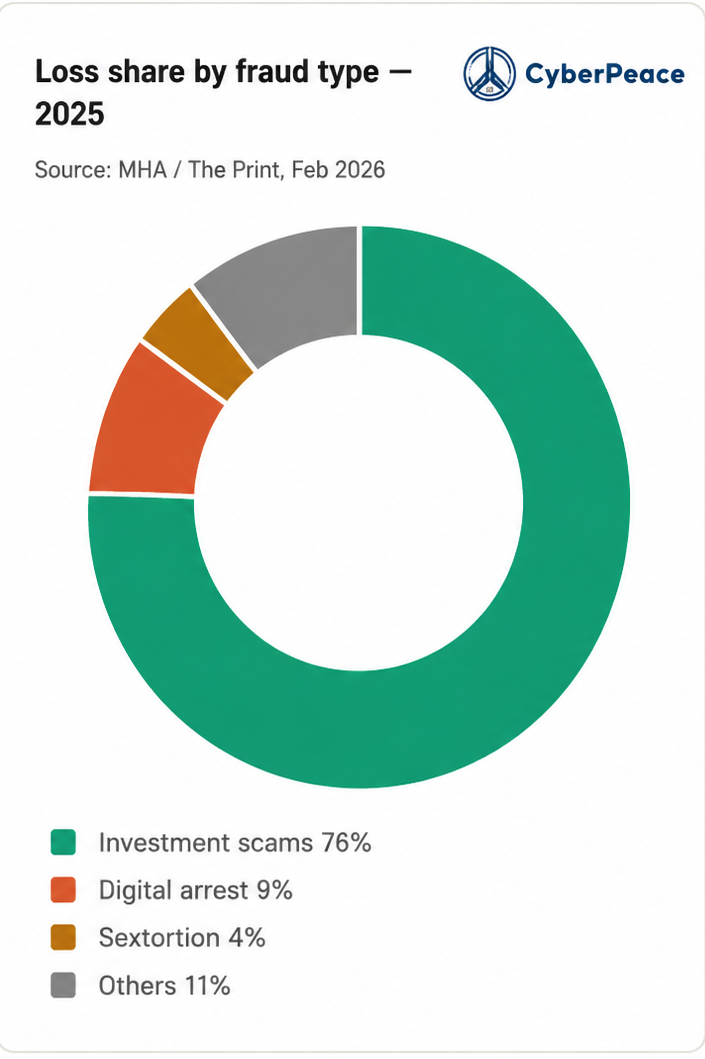
Digital arrest frauds, which tap on citizens' unawareness that "digital arrest" is not permissible under Indian law, rose from 39,925 cases (91 crore) in 2022 to 123,672 cases (1,935crore) in 2024.
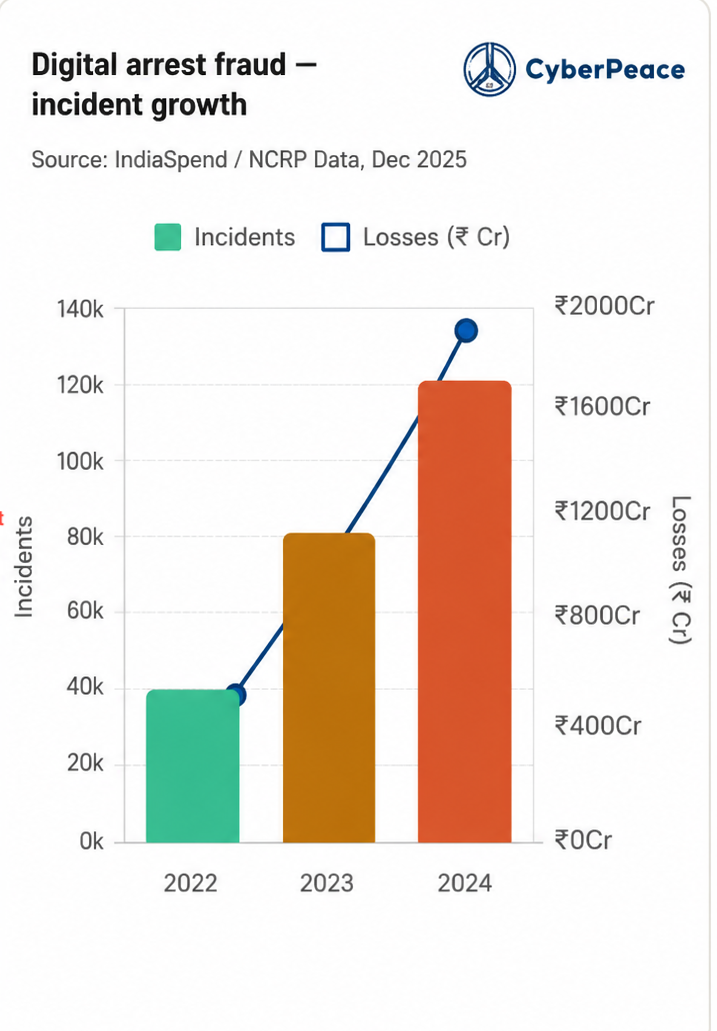
The fast rise in the number of incidents as well as in the volume of fraud clearly points out that digital arrest fraud has moved away from the phase of novel scam typology to a formidable cyber-extortion landscape. The main orchestrators of investment, trading, dating, and digital arrest scams targeting Indian citizens were recently identified by the I4C CEO Rajesh Kumar as transnational criminal scam networks in Cambodia, Myanmar, and Laos. Hence, this issue does not only fall within the domain of domestic law enforcement but constitutes a transnational cybercrime requiring parallel financial intelligence, diplomatic initiative, platform responsibility, and international investigative collaboration.
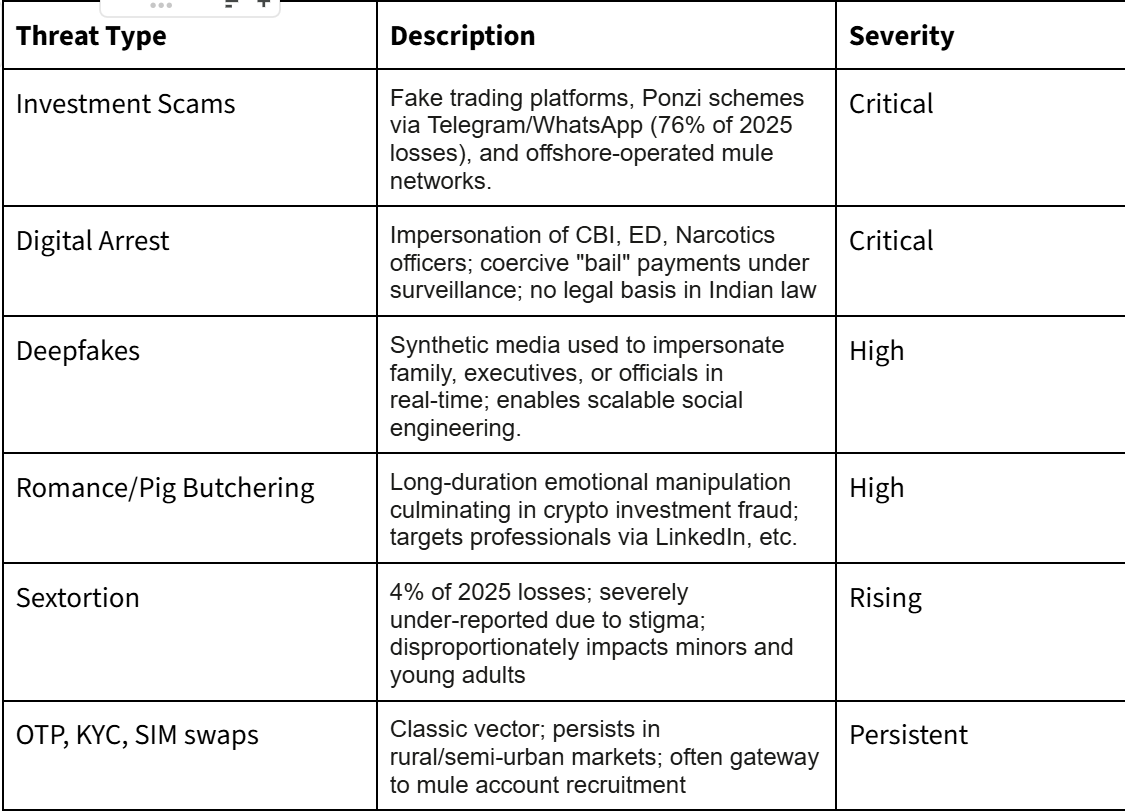
Geographic Concentration
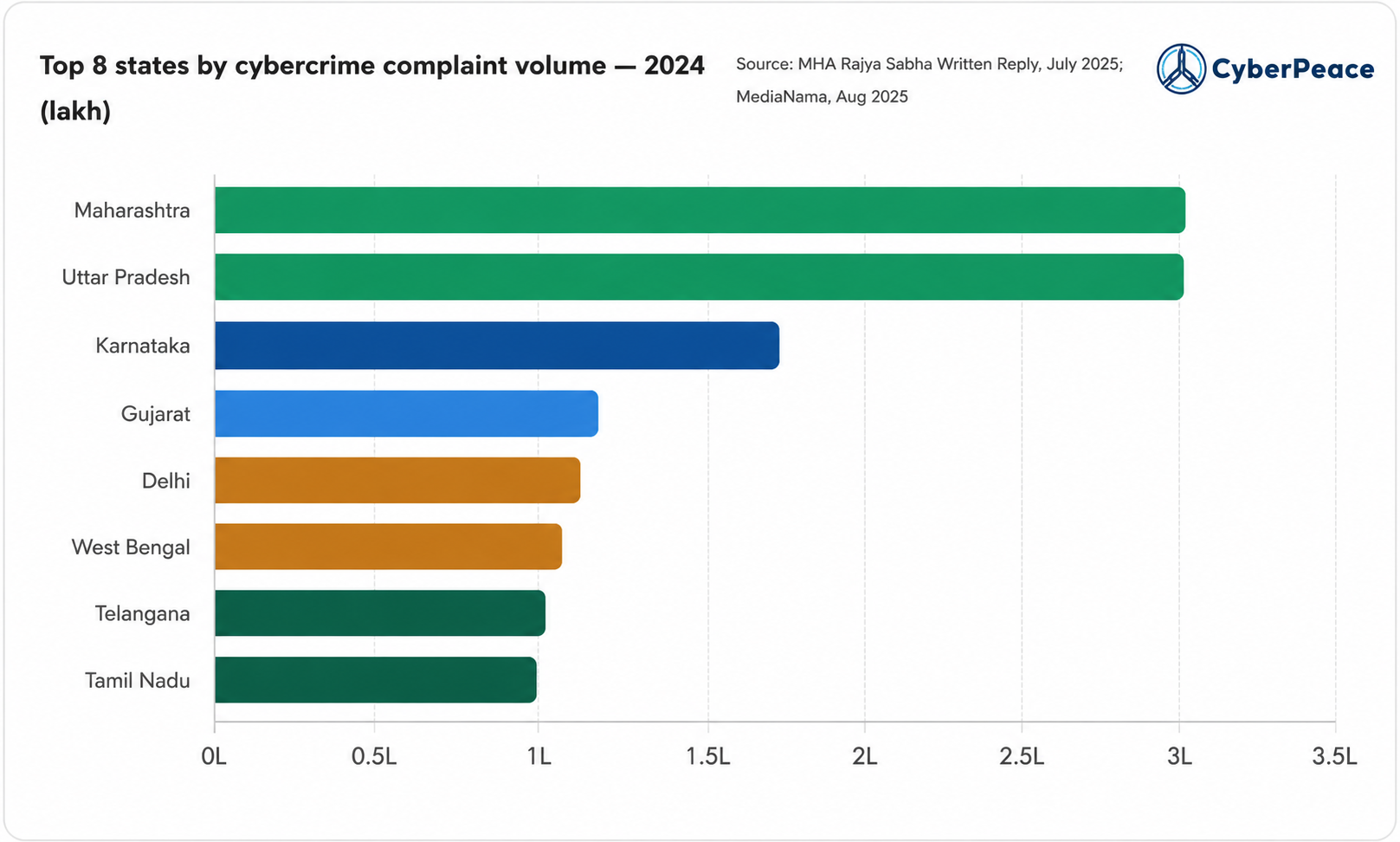
Maharashtra and UP register the highest volumes in total complaints at 3.03 lakh and 3.01 lakh, owing to them being the financial capital and most populous state, respectively. Karnataka, Gujarat, Delhi, WB, Telangana, TN, Rajasthan, and Haryana register above 1 lakh complaints each. However, the critical information that is being missed is that while complaint rate growth is the fastest in Tier 2 and 3 geographies (Haryana leads per-capita complaint rate with 381/100k people in 2023; Telangana (261); Uttarakhand (243)), this signifies rural digital growth as a risk multiplier.
Institutional Architecture: Mechanisms and Performances
India's institutional response to cybercrime, led by the Ministry of Home Affairs' Indian Cyber Crime Coordination Centre (I4C), is one of the world's largest real-time fraud detection and prevention ecosystems. The backbone of this is the Citizen Financial Cyber Fraud Reporting and Management System (CFCFRMS), which has onboarded over 700 banks, payment service providers, e-commerce portals, digital wallets, and, since the Standard Operating Procedure was issued on 2nd January 2026, virtual asset service providers and crypto exchanges. This interconnected network allows for prompt freezing of funds and timely fraud intervention during the 'golden hour' of a cybercrime report.
Institutional capacity is robust, with approximately 8,690 crore saved via the CFCFRMS since its inception for over 24.65 lakh complaints. The national cybercrime helpline (1930) receives close to 10,000 calls daily, while the Suspect Registry has enabled the rejection of 9,519 crore via the detection of 23.05 lakh suspect entities and 27.37 lakh mule accounts. In parallel, the CyTrain platform has expanded training by registering 151,081 police and judicial officers and issuing 142,025 certificates. Cyberforensic labs in all 33 States and Union Territories have received central assistance totalling 132.93 crore, and data-driven interstate crime analytics and offender linkages through the Samanvaya and Pratibimb platforms have led to 21,857 arrests.
Ecosystem Gaps
Through I4C, CFCFRMS, CyTrain, and the establishment of forensic infrastructure in states, India’s cybercrime ecosystem has greatly grown. But due to the rapid proliferation of cybercrime, systemic shortcomings are revealed regarding the restoration of victims, investigation, forensic capacity, cross-border enforcement, awareness, and stakeholder coordination:
- Victim Restitution Deficit: Although the total of ₹ 8,690 crore frozen has increased, the refund for victim compensation is limited to only ₹ 167 crore (2.18%) due to lengthy restoration processes relying on court orders.
- Forensic Capacity Limitations: 2 national, state-level, unevenly equipped cyber forensic labs can’t match the needs of over 10 million cybercrime complaints per year.
- Low conviction rate: The investigations of cybercrimes suffer from evidence collection and criminal proceedings, leading to limited conviction rates.
- Cross-border enforcement challenges: Many of the investment and digital arrest scams, in fact, are originating from Cambodia, Myanmar, and Laos, rendering the cybercrime response mechanisms of India helpless.
- Lack of Awareness: First-time digital users are quite prone to online scams and fraud, and many of the victims continue not reporting due to social stigma and lack of confidence.
- Partial Stakeholder Integration: Banks and small financial institutions, small companies, and emerging virtual asset providers not yet on board allow the money to slip through without being tracked.
CyberPeace Insights: Strategic Way Forward
India has already built a relatively mature response structure for cybercrime with I4C, CFCFRMS, and CyTrain and is coordinating the financial sector on it. The way ahead lies in outcome-oriented improvements and not just in the ability to report and intercept more. Here are the priority interventions that address the most important institutional shortcomings identified in the current ecosystem:
- Fast-track victim restoration: Introduce time-bound victim restoration mechanisms for low-value incidents through simplified processes and mandate national-level roll-out of successful Lok Adalat-based settlement mechanisms.
- District-level cyber forensics: Establish cyber forensic support units at the district level and enhance access to mobile, cloud, and blockchain forensic capabilities.
- AI-powered fraud prevention: Mandate deep-fake and voice-clone detection mechanisms across all financial institutions and telecom networks; embed predictive risk analytics into transaction screening frameworks.
- Cyber Suraksha Gram initiative: Increase digital fraud awareness across all common service centres, Jan Dhan enrollment schemes, and rural banking channels, and tackle the awareness asymmetry.
- Regional cybercrime coordination: Establish real-time, operational intelligence-sharing mechanisms with Southeast Asian economies, which have become home to large scam networks preying on Indian citizens.
- Specialised cyber prosecution ecosystem: Develop exclusive cyber courts, standardise digital evidence procedures, and broaden the scope of CyTrain to include the development of specialised cadres of investigators and prosecutors capable of handling increasingly complex cybercrime cases.
Conclusion
The 22,812 crore lost due to cybercrime in 2024 was more than a mere figure; it signifies a serious concern regarding citizen trust, economic security, and digital inclusion. Though India's institutional response to cybercrime is one of the largest, with an operational I4C and a CFCFRMS functioning in real time, the victim compensation and prosecution mechanism falls short. It's time for implementation: faster recovery of resources, increased enforcement, a larger scale of awareness, and finally, translating the institutional innovations into concrete justice for victims nationwide.
References
- https://sansad.in/getFile/annex/270/AU1341_tmaxdx.pdf?source=pqars
- https://www.mha.gov.in/MHA1/Par2017/pdfs/par2025-pdfs/LS02122025/452.pdf
- https://www.pib.gov.in/PressReleasePage.aspx?PRID=2244504®=3&lang=2
- https://static.pib.gov.in/WriteReadData/specificdocs/documents/2025/oct/doc2025107659501.pdf
- https://www.medianama.com/2025/08/223-india-cybercrime-500-percent-increase-2021-2024/
- https://theprint.in/india/cybercrime-saw-24-spike-in-2025-indians-lost-rs-22495-crore-mainly-in-investment-scams/2859930/
