
#FactCheck-Fake post falsely attributes EVM-related remark to US Secretary Marco Rubio
Executive Summary
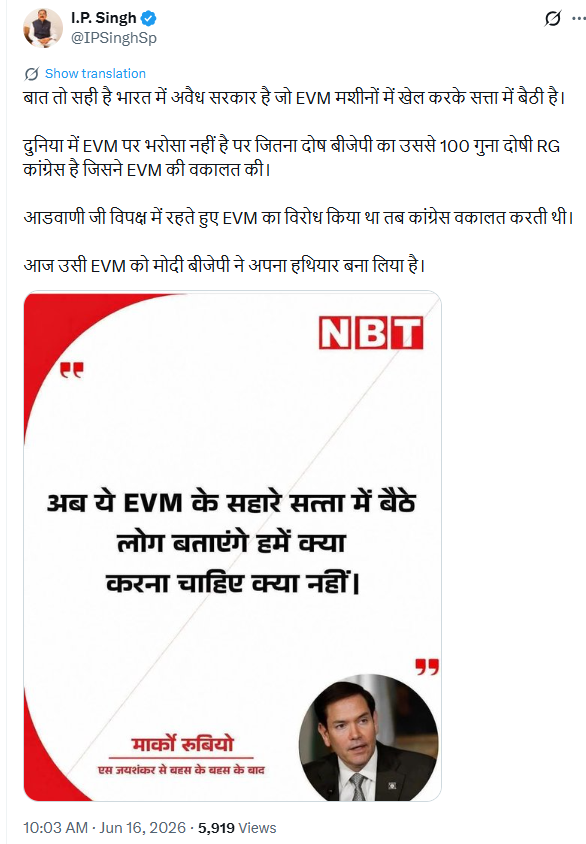
A social media post card featuring a photo of US Secretary of State Marco Rubio, carrying the logo of Navbharat Times, is being widely circulated online. The post claims that Rubio made a remark criticizing the Indian government, allegedly stating that “those in power through EVMs should tell us what to do and what not to do.” CyberPeace Research Wing research found the claim to be false. There is no evidence of Marco Rubio making any such statement, and the viral post card is fabricated.
Claim:
A post shared by SP leader IP Singh alleged that the US Secretary made comments questioning the legitimacy of the Indian government and EVM-based elections, further linking it to broader political criticism of EVMs.
Post link: https://x.com/IPSinghSp/status/2066740933396492706?s=20, https://archive.ph/submit/?url
Fact Check:
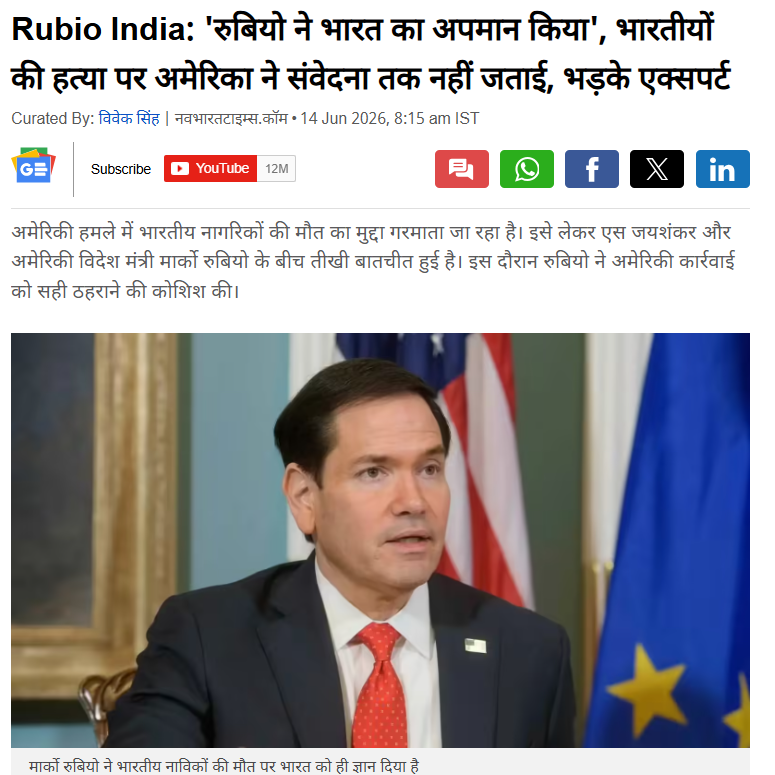
A keyword search of the alleged statement revealed no credible reports or official records of Marco Rubio making any such remark. Additionally, a review of Navbharat Times’ official social media handles did not show any such post card being published, indicating that the viral graphic is not authentic. Further examination of recent statements by Marco Rubio showed no reference to EVMs or the Indian electoral system. Instead, a Navbharat Times report dated June 14 covered a different issue related to tensions in the Hormuz Strait, where Rubio commented on the killing of Indian sailors during a maritime incident and emphasized compliance with US directives for commercial vessels. https://navbharattimes.indiatimes.com/world/america/marco-rubio-remarks-on-killing-of-indian-sailors-in-hormuz-strait-insult-of-india-says
Conclusion:
The research confirms that US Secretary of State Marco Rubio did not make any statement regarding EVMs or the Indian government. The viral post card is fake and misleading.

Related Blogs
Executive Summary
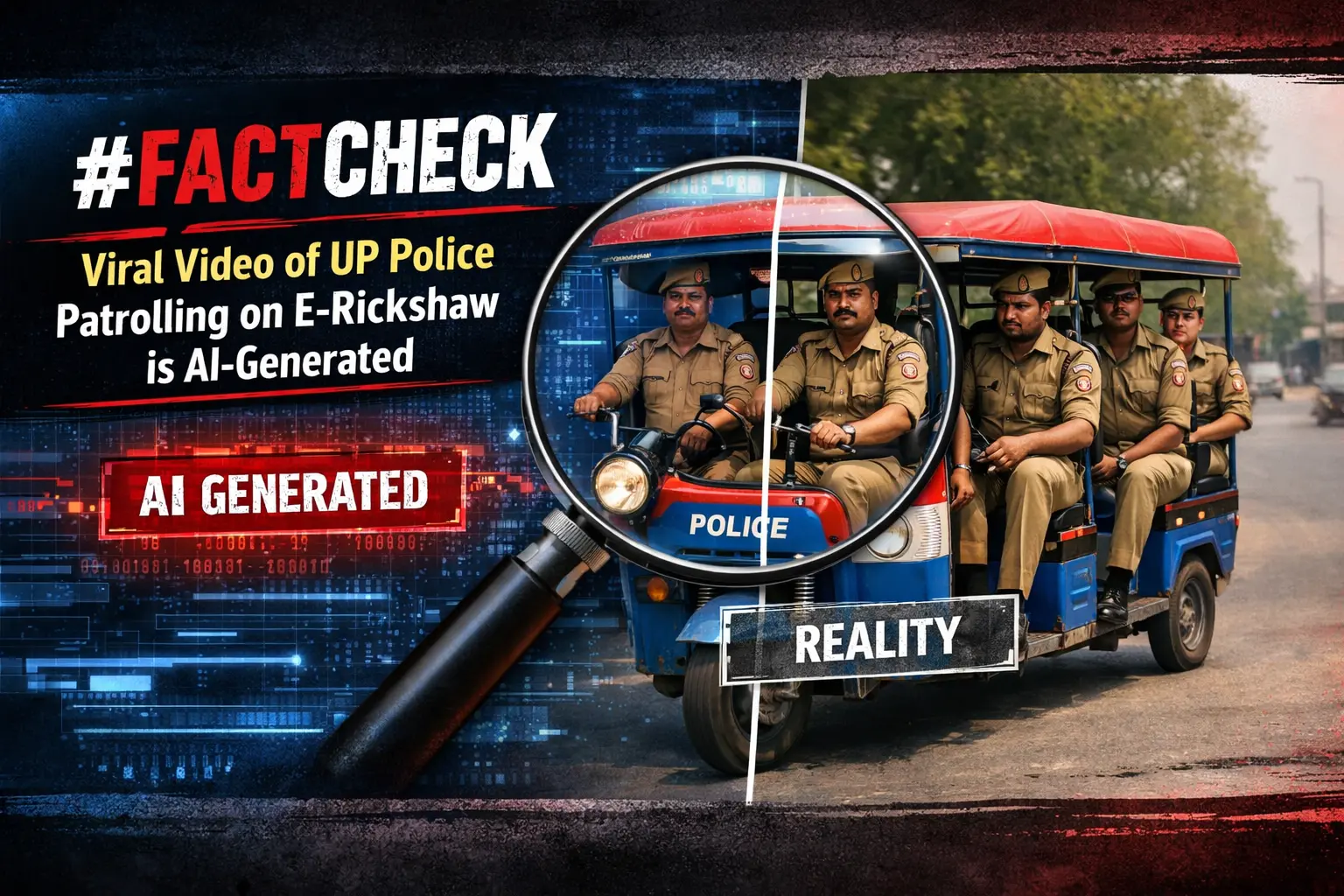
A video is being widely shared on social media showing a police officer driving an e-rickshaw, while two other policemen are seen in the back seat. Users sharing the clip claim that, due to a shortage of petrol, this is a new initiative by the Uttar Pradesh Police. However, research by CyberPeace found the viral claim to be false. Our research also confirms that the video is not real but AI-generated.
Claim
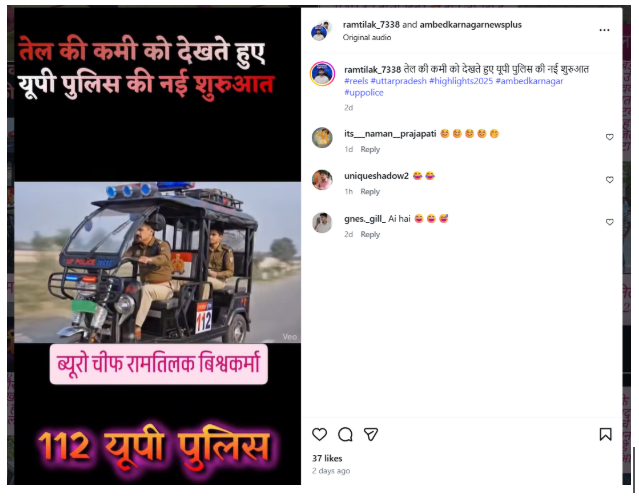
An Instagram user shared the viral video claiming that due to fuel shortages, Uttar Pradesh Police has started patrolling using e-rickshaws.
- Post link: https://www.instagram.com/reel/DWepKWXAeiE/
- Archive: https://archive.ph/QBNXs
Fact Check
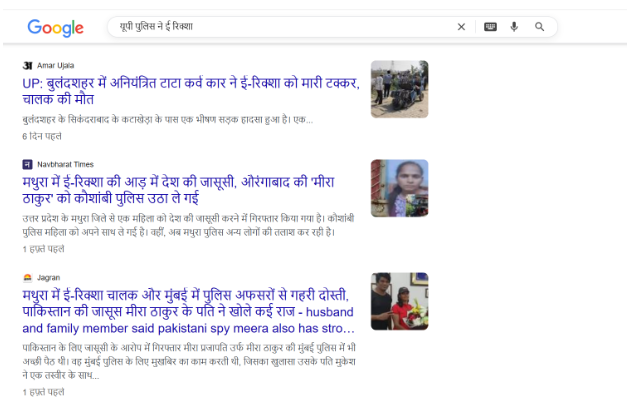
To verify the claim, we first conducted a keyword search on Google but found no credible media reports supporting this claim.
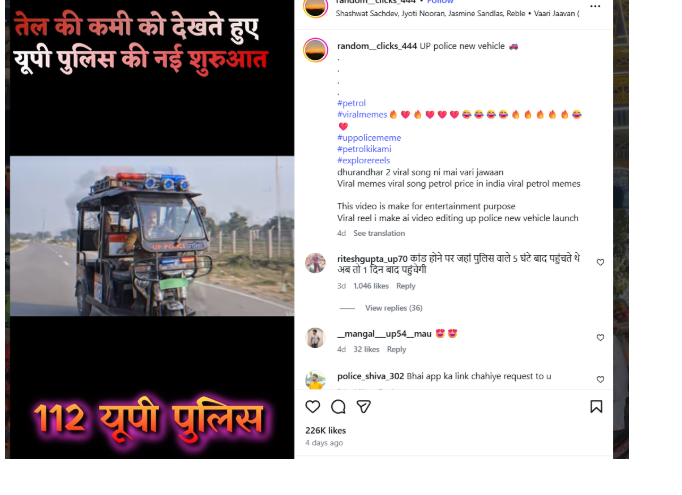
Next, we extracted keyframes from the viral video and performed a reverse image search using Google Lens. During this process, we found the same video uploaded on an Instagram channel on March 28, 2026. The uploader clearly mentioned that the video was created purely for entertainment purposes.
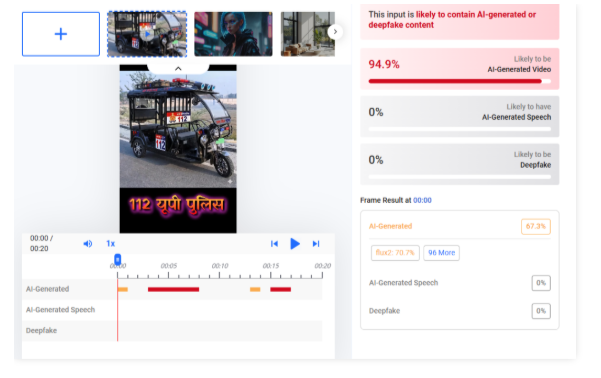
We further analyzed the video using AI detection tools. When scanned with Hive Moderation, the results indicated that the video is approximately 94% AI-generated.
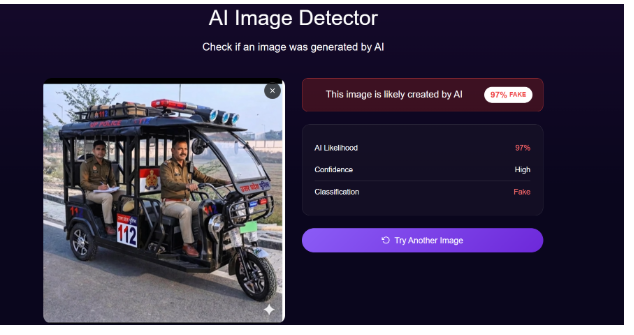
In the next step, we also tested the clip using DeepAI. According to its analysis, the video is about 97% AI-generated.
Conclusion
Our research clearly shows that the viral video is not authentic. It is an AI-generated clip created for entertainment purposes, and the claim that Uttar Pradesh Police has started e-rickshaw patrolling due to petrol shortage is false.

Introduction
A recent massive scam has been uncovered in the Indian state of Gujarat, where the Criminal Investigation Department (CID) has blacklisted 30,000 SIM cards that were used for illegal activities. The scam has created a huge uproar in the state, and its implications are significant. In this blog, we will discuss the details of the Gujarat scam and its impact on the state.
What is sim card fraud?
Sim card fraud occurs when someone uses a fake or cloned sim card to impersonate someone else. This allows the fraudster to gain access to sensitive information or conduct transactions on behalf of the victim. The use of fraudulent sim cards has become increasingly common in recent years, with scammers targeting individuals and businesses around the world.
The Gujarat Scam: The Gujarat scam involves the use of SIM cards for illegal activities such as extortion, blackmail, and cybercrime. The CID has identified that the SIM cards were obtained using fake documents and were used for illegal activities. The scam has been happening for a while, involving several individuals, including businessmen, politicians, and government officials.
The CID has conducted raids across the state and has arrested several individuals involved in the scam. They have also seized a significant amount of cash, mobile phones, and other electronic devices used for illegal activities. The investigation is ongoing, and more arrests are expected in the coming days.
The Gujarat scam is not an isolated incident, as similar scams have been reported in other parts of the country. The Telecom Regulatory Authority of India (TRAI) has also reported that several telecom operators are not following the regulations and are not verifying the authenticity of documents used to obtain SIM cards.
Impact on the State: The Gujarat scam has caused significant damage to the state’s reputation, and it has also affected the economy. The scam has highlighted the lack of regulation in the telecom industry, and it has exposed the loopholes in the system that criminals are exploiting.
The blacklisting of 30,000 SIM cards will affect several individuals who may have obtained them legally but were unaware of their use for illegal activities. The blacklisting may also impact businesses that rely on mobile phones for their operations.
The scam has also raised concerns about personal information and data safety. With the use of fake documents to obtain SIM cards, it is evident that personal information is not secure and can be easily misused. The government needs to take steps to ensure that personal information is protected and that the telecom industry is regulated to prevent such scams from happening in the future.
Steps Taken by the Government: The Gujarat scam has prompted the government to take action to prevent such incidents from happening in the future. The government has announced that it will implement stricter regulations in the telecom industry to prevent the misuse of SIM cards. The government has also announced that it will introduce a system to verify the authenticity of documents used to obtain SIM cards.
The government has also urged citizens to be vigilant and report any suspicious activity related to the misuse of SIM cards. The government has assured citizens that it will take strict action against those involved in the scam and that it will ensure the safety of personal information and data.
The TRAI has also taken steps to address the issue. It has directed telecom operators to verify the authenticity of documents used to obtain SIM cards and to follow the regulations. The TRAI has also introduced a new system to identify and deactivate inactive SIM cards.
Here are some key takeaways from the Gujarat Sim scam: These takeaways should be kept in mind to prevent such incidents from happening in the future and to ensure the safety of citizens and businesses.
Need for Stricter Regulations: The Gujarat Sim scam has highlighted the need for stricter regulations in the telecom industry. The government needs to ensure that telecom operators follow the regulations and verify the authenticity of documents used to obtain SIM cards. This will help prevent the misuse of SIM cards and illegal activities.
Importance of Personal Information Security: The scam has raised concerns about personal information and data safety. It is important to ensure that personal information is protected and that the telecom industry is regulated to prevent such scams from happening in the future.
Impact on Reputation and Economy: The Gujarat scam has caused significant damage to the state’s reputation, and it has also affected the economy. The blacklisting of 30,000 SIM cards will impact several individuals who may have obtained them legally but were unaware of their use for illegal activities. The scam has also raised concerns about the safety of businesses that rely on mobile phones for their operations.
Need for Vigilance: The government has urged citizens to be vigilant and report any suspicious activity related to the misuse of SIM cards. It is important for citizens to be aware of the regulations and to report any illegal activities to prevent such incidents from happening in the future.
Strong Action Against Criminals: The blacklisting of 30,000 SIM cards and the arrests made by the CID sends a strong message to those involved in illegal activities that they will not be spared. It is important for the government to take strict action against those involved in the scam to deter others from engaging in such activities.
Conclusion
The Gujarat scam has exposed vulnerabilities in the telecom industry and highlighted the need for stricter regulations to prevent such incidents from happening in the future. The blacklisting of 30,000 SIM cards has sent a strong message to those involved in illegal activities that they will not be spared. The government’s efforts to implement stricter regulations and ensure the safety of personal information and data are commendable. It is now up to the citizens to be vigilant and report any suspicious activity to prevent such incidents from happening in the future.
The telecom industry plays a vital role in the country’s development, and it is important to ensure that it is regulated to prevent the misuse of its services. Overall, the Gujarat Sim scam has highlighted the need for stricter regulations, personal information security, vigilance, and strong action against criminals.
Reference:

2025 is knocking firmly at our door and we have promises to make and resolutions to keep. Time you make your list for the New Year and check it twice.
- Lifestyle targets 🡪 Check
- Family targets 🡪 Check
- Social targets 🡪 Check
Umm, so far so good, but what about your cybersecurity targets for the year? Hey, you look confused and concerned. Wait a minute, you do not have one, do you?
I get it. Though the digital world still puzzles, and sometimes outright scares us, we still are not in the ‘Take-Charge-Of-Your-Digital-Safety Mode. We prefer to depend on whatever software security we are using and keep our fingers crossed that the bad guys (read threat actors) do not find us.
Let me illustrate why cybersecurity should be one of your top priorities. You know that stress is a major threat to our continued good health, right? However, if your devices, social media accounts, office e-mail or network, or God forbid, bank accounts become compromised, would that not cause stress? Think about it and the probable repercussions and you will comprehend why I am harping on prioritising security.
Fret not. We will keep it brief as we well know you have 101 things to do in the next few days leading up to 01/01/2025. Just add cyber health to the list and put in motion the following:
- Install and activate comprehensive security software on ALL internet-enabled devices you have at home. Yes, including your smartphones.
- Set yourself a date to change and create separate unique passwords for all accounts. Or use the password manager that comes with all reputed security software to make life simpler.
- Keep home Wi-Fi turned off at night
- Do not set social media accounts to auto-download photos/documents
- Activate parental controls on all the devices used by your children to monitor and mentor them. But keep them apprised.
- Do not blindly trust anyone or anything online – this includes videos, speeches, emails, voice calls, and video calls. Be aware of fakes.
- Be aware of the latest threats and talk about unsafe cyber practices and behaviour often at home.
Short and sweet, as promised.
We will be back, with more tips, and answers to your queries. Drop us a line anytime, and we will be happy to resolve your doubts.
Ciao!
