
#FactCheck-Viral Image of ‘New Iranian Banknote’ Featuring Khamenei Is Misleading; Likely AI-Generated
Executive Summary
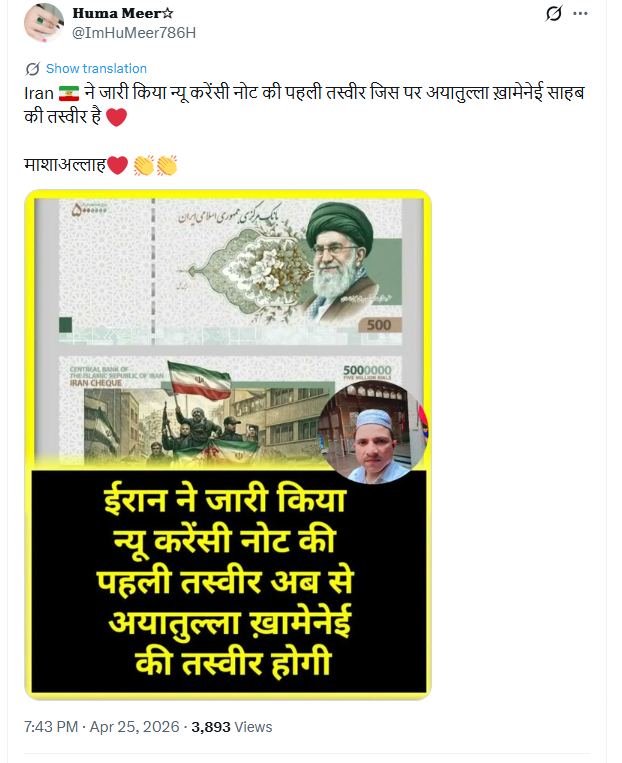
An image of a banknote featuring Iran’s Supreme Leader Ayatollah Khamenei is going viral on social media, with claims that Iran’s central bank has issued a newly designed 5 million rial note bearing his portrait. However, a fact-check by the CyberPeace Research Wing has found the claim to be misleading.
Claim
The image was shared by a verified user, “Sprinter Press Agency,” on X (formerly Twitter), claiming that the Central Bank had introduced a new banknote design featuring the leader of the Islamic Revolution.
Fact Check
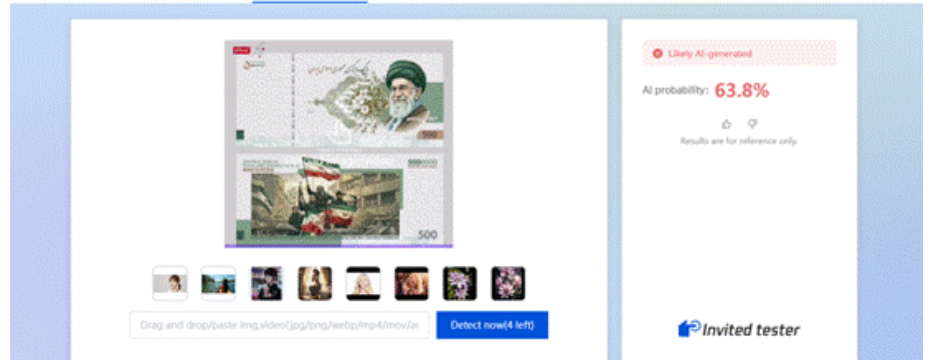
To verify the claim, relevant keywords were searched across multiple credible sources. No reports were found from any reputable international media outlet, Iranian government platform, or the Central Bank of Iran confirming the release of such a banknote. A technical analysis of the viral image was also conducted. According to the AI detection tool Zhuque AI Detection Assistant, there is a 63.8% probability that the image is AI-generated, raising further doubts about its authenticity.
Conclusion:
The claim that Iran’s central bank has issued a new 5 million rial banknote featuring Ayatollah Khamenei is misleading. There is no official confirmation of such a release, and available evidence suggests that the viral image is either edited or AI-generated.

Related Blogs

Executive Summary
A video is being widely shared on social media showing a monk walking through a dense forest, with several lions seen around him. Users sharing the video claim that the monk is fearlessly walking among lions. CyberPeace Research Wing’s research found that the viral claim is false. The research revealed that the video is not real and was created using artificial intelligence (AI).
Claim
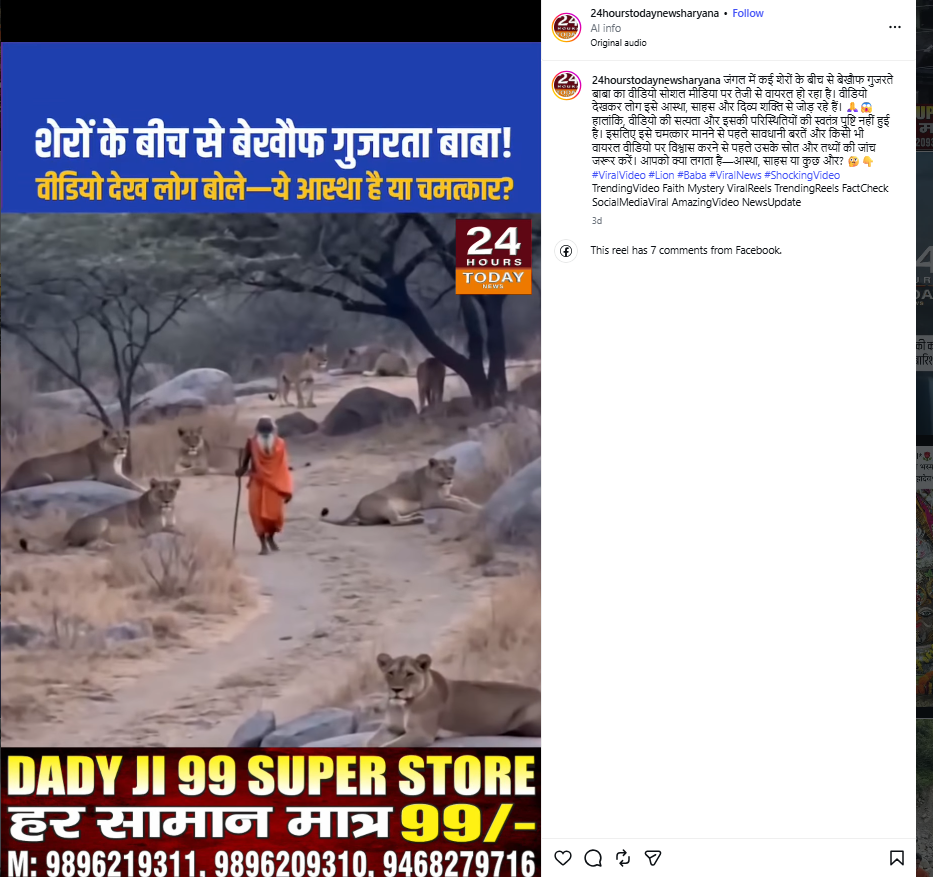
An Instagram user shared the viral video on July 27, 2026, claiming that a video of a monk fearlessly walking among several lions in a forest is going viral on social media. The caption accompanying the post reads:
"A video of a baba fearlessly passing through several lions in the jungle is rapidly going viral on social media. After watching the video, people are linking it with faith, courage and divine power. However, the authenticity of the video and the circumstances shown in it have not been independently verified.
Therefore, before considering it a miracle, viewers should exercise caution and verify the source and facts before believing any viral video. What do you think—faith, courage or something else?"
The post link, archive link and screenshot are provided below:
https://www.instagram.com/reel/DbTOIuRRYFe/
FactCheck
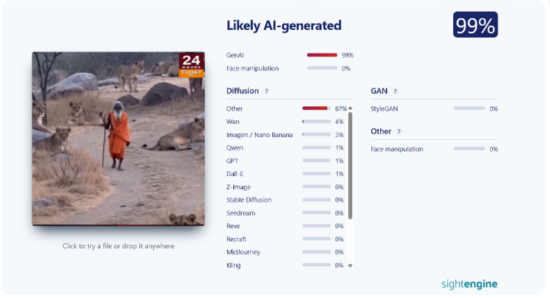
To verify the claim, we conducted a keyword search on Google. During the search, we did not find any credible media reports confirming the viral claim. Upon closely examining the viral video, we suspected that it could have been created using AI. We then analysed the video using the AI detection tool Sightengine. According to the tool’s analysis, the video has a 99 per cent probability of being AI-generated.
In the next step of our research , we scanned the viral video using another AI detection tool, WasIt AI. The results indicated that the video was generated using artificial intelligence.

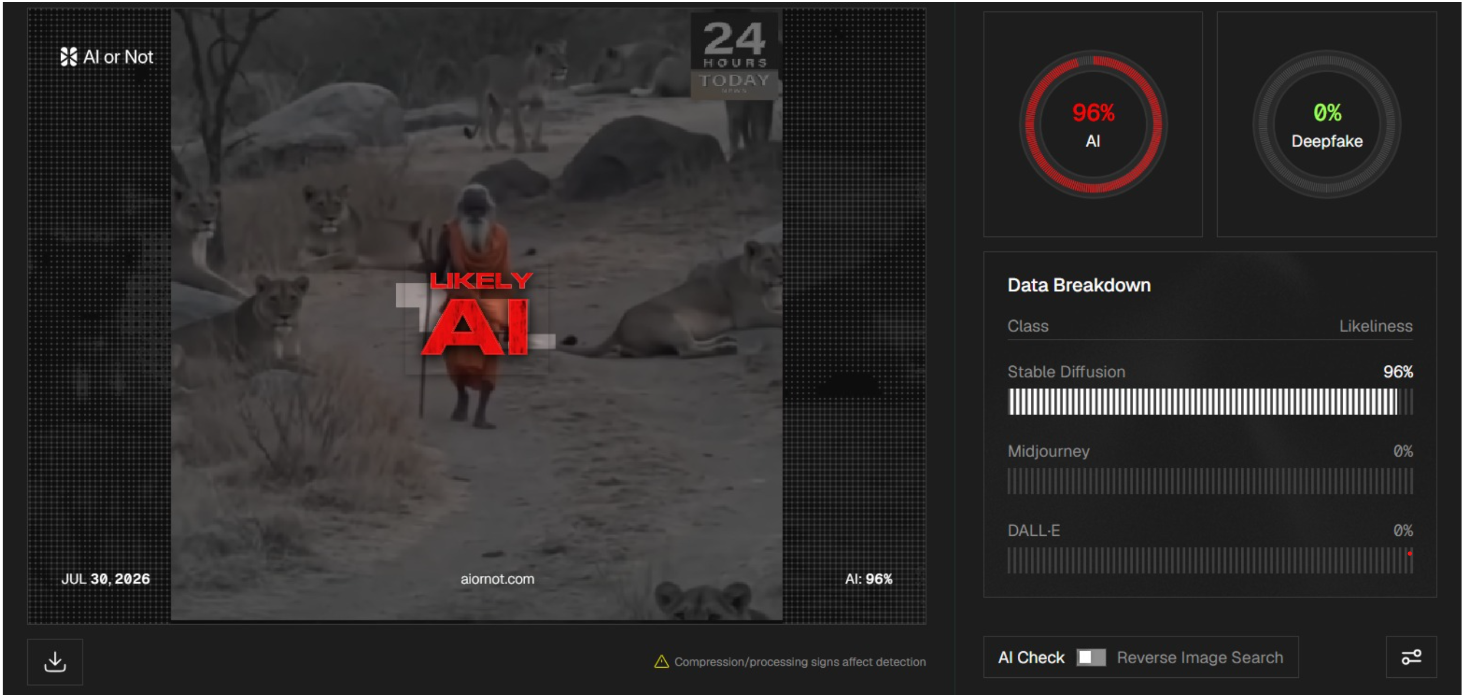
Finally, we analysed the video using the AI detection tool AI or Not, which also concluded that the viral video was created with the help of AI.
Conclusion
CyberPeace Research Wing’s research found that the viral claim is false. The video showing a monk walking among lions in a dense forest is not authentic but an AI-generated creation. The video is being shared with a misleading claim.
Executive Summary
A video is going viral on social media in which Defence Minister Rajnath Singh is seen allegedly saying, “During Operation Sindoor, we initially hid the losses of jets and soldiers so that Pakistan could not use them for propaganda. Later, a documentary was made to reveal the truth.” Research by the CyberPeace Research Wing found that the video is completely fake and was created using artificial intelligence (AI). Defence Minister Rajnath Singh never made any such statement. The video has primarily been circulated by Pakistani accounts.
Claim:
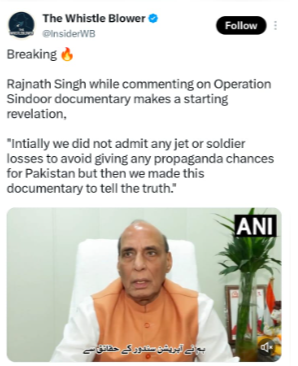
A video of Rajnath Singh has been shared by a Pakistani user on the social media platform X, with the caption: “Rajnath Singh while commenting on Operation Sindoor documentary makes a starting revelation, Initially we did not admit any jet or soldier losses to avoid giving any propaganda chances for Pakistan but then we made this documentary to tell the truth.” The post link and screenshot are provided below.
https://x.com/i/status/2091095915021193252
Fact Check:
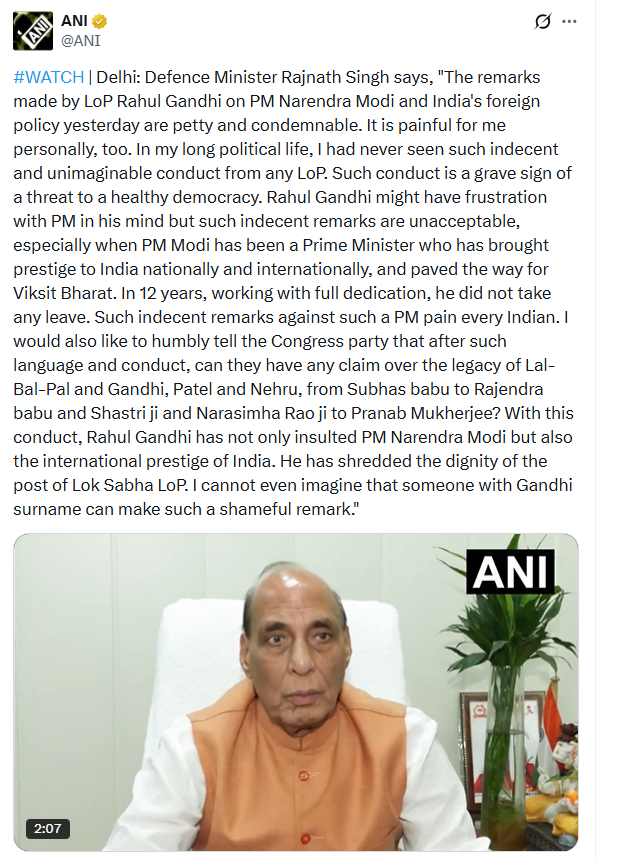
To investigate the viral claim, we first extracted keyframes from the video and conducted a reverse image search using Google Lens. During this process, we found the original video on ANI’s X account, in which Defense Minister Rajnath Singh can be seen saying: Defense Minister Rajnath Singh said, “The remarks made yesterday in the Lok Sabha by Leader of Opposition Rahul Gandhi regarding Prime Minister Narendra Modi and India’s foreign policy are extremely cheap and condemnable. Personally, this is painful for me as well. In my long political life, I have never seen such unbecoming and unthinkable behavior from any Leader of Opposition. Such conduct poses a serious threat to a healthy democracy. Rahul Gandhi may feel disappointment toward the Prime Minister, but such improper remarks are unacceptable—especially when PM Modi has elevated India’s national and international prestige and paved the way for a ‘Viksit Bharat’.
Working with complete dedication for 12 years, he has not taken a single day off. Such unbecoming remarks against such a Prime Minister pain every Indian I would also humbly like to ask the Congress Party: after such language and conduct, can it still claim the legacy of great stalwarts ranging from Lal-Bal-Pal and Gandhi, Patel, Nehru to Subhas Babu, Rajendra Babu, Shastri Ji, Narasimha Rao Ji, and Pranab Mukherjee? Through this behavior, Rahul Gandhi has not only insulted Prime Minister Narendra Modi but also damaged India’s international reputation. He has tarnished the dignity of the post of Leader of Opposition in the Lok Sabha. I cannot even imagine that anyone carrying the surname 'Gandhi' could make such a shameful remark.” Throughout the entire video, he never made the statement attributed to him in the viral claim. The post link and screenshot are provided below.
https://x.com/ANI/status/2088230045102002466
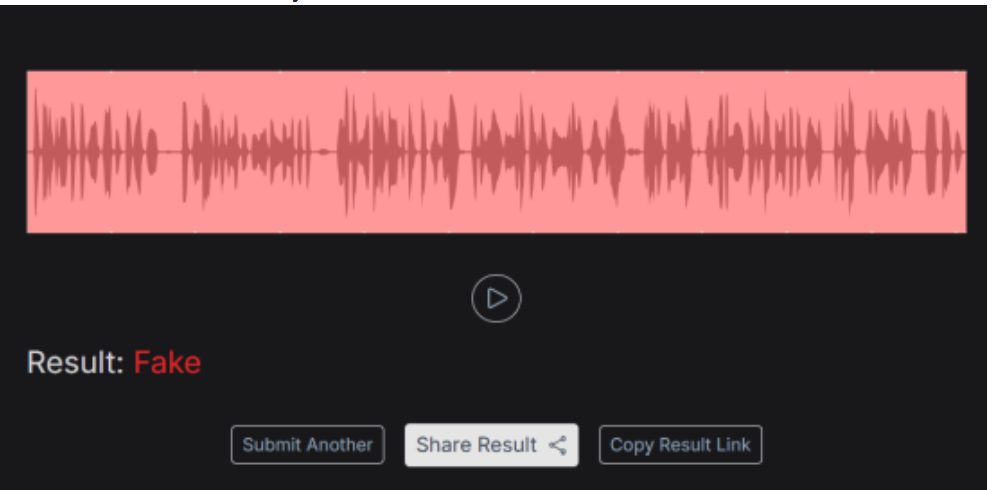
We scanned the audio on the AI detection tool Resemble AI, where the results confirmed that the voice is AI-generated.
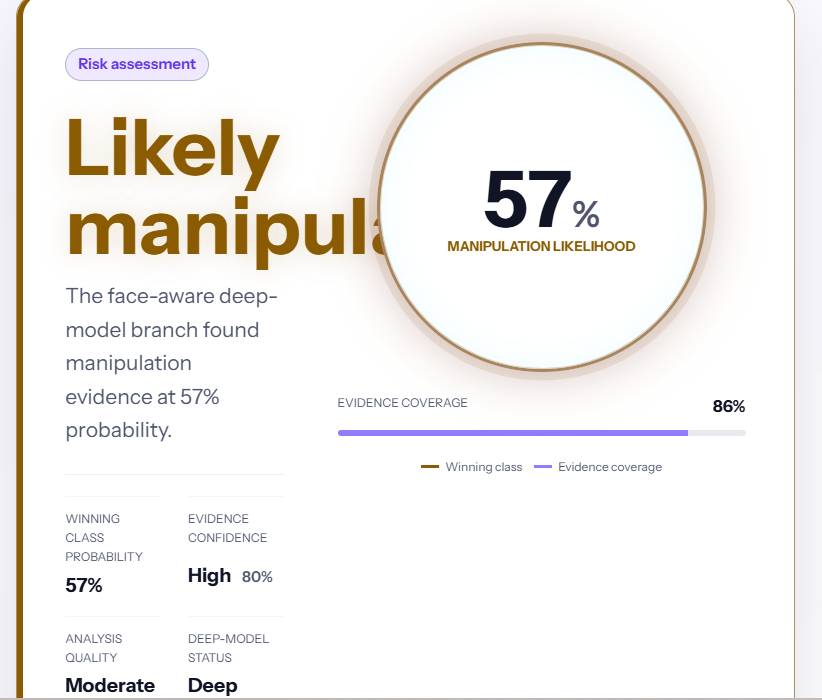
We also scanned the clip on another AI detection tool, Detect Video AI, where the results indicated that the viral video is 57 percent AI-generated.
Conclusion:
Our research revealed that the viral video is completely fake and was created using Artificial Intelligence (AI). The research confirmed that Defense Minister Rajnath Singh made no such statement. It was also revealed during the fact-check that this fake video is being primarily circulated on social media through Pakistani accounts.

Biological data includes biometric information such as fingerprints, facial recognition, DNA sequences, and behavioral traits. Genetic data can be extracted from an individual’s remains long after their death and can continue to identify both that individual and an expanding pool of their living relatives. This persistent identification can significantly reduce privacy over time, revealing genetic characteristics and familial relationships across successive generations.
Key Developments in Privacy Protection for Biological Data:
Legal texts have been created relating to personal data protection and privacy broadly, and can sometimes prove to be poor adaptations specifically for ‘biometric data’ and its safety. Some examples are mentioned below:
- EU and UK- GDPR
GDPR focuses primarily on biometrics in Biological Data while deciphering the technology's immense potential. The EU describes “personal data” under the General Data Protection Regulation (GDPR) including any identifiable information about a particular person. For example, this can include names, identification numbers, location data, and other structured and unstructured data. In addition, the GDPR has more specific requirements around processing sensitive or “special categories of personal data.” These “special categories” include things like genetic and biometric data. For biometric security to work well, citizens' rights must be protected appropriately, and the data collected by private and public concerns must be managed carefully and sensibly.
- USA
California Consumer Privacy Act (CCPA) grants Californian consumers the right to protect their personal information and biometric data including the right to disclosure or access, the right to be forgotten, and data portability. The sale of personal information and the option of opt-out is also given to consumers. Additionally, it contains the right to take legal action, with penalties imposed for violations.
The California Privacy Rights Act was passed on November 3, 2020, and took effect on January 1, 2023, with a lookback period starting January 1, 2022. It introduces sensitive personal information which includes biometric data and other sensitive details.
Virginia's Consumer Data Protection Act, effective from January 1, 2023, designates genetic and biometric data as sensitive data that must be protected.
Illinois' Biometric Information Privacy Act is recognised as the most robust biometric privacy law in the United States. The significance of the Rosenbach v. Six Flags case lies in the Illinois Supreme Court's ruling that a plaintiff does not need to demonstrate additional harm to impose penalties on a BIPA violator. A mere loss of statutory biometric privacy rights is sufficient to warrant penalties.
- India
As per Rule 2(1)(b) of the SPDI Rules, Sensitive Personal Data or Information, including biometric data is included under its meaning. The term ‘biometric data’ has not been defined in the Digital Personal Data Protection Act, 2023. The need for data privacy under the DPDP Act emerges only if such data is subsequently digitised under extraction and manipulation, including notice and consent requirements and penalties.
The Biotech-PRIDE (Promotion of Research and Innovation through Data Exchange) Guidelines of 2021 are aimed at fostering an exchange of information which would thereby enhance research and innovation among various research groups nationwide. These guidelines do not deal with the generation of biological data but are a mechanism to share and exchange information and knowledge generated according to existing laws, rules, regulations and norms of the country. They will ensure data-sharing benefits, maximise use, avoid duplication, maximise integration, ownership of information, better decision-making and equity of access
How is Biological Data vulnerable?
- Biological data is often immutable, meaning it cannot be altered once compromised. Unlike other authentications that can be changed, compromised biometric data poses a permanent risk, making its protection paramount.
- The use of facial recognition technology by law enforcement agencies and the creation of databases by the same also highlights the urgent need for stringent privacy protections.
- Advances in technology, particularly AI and ML, make it easier to collect, analyse, and utilise biometric data by manipulating biometric data. This in turn is leading to new forms of identity theft and fraud that make it necessary to enhance security measures and ethical considerations to prevent abuse.
- Cross-border data transfers raise serious privacy concerns, especially as countries have varying levels and standards of data protection.
- Wearable health-related biometric devices lack the required privacy protections which ends up making the data they collect vulnerable to misuse and breaches.
Future Outlook
With the growing use of biological data, there is likely to be increased pressure on regulatory bodies to strengthen privacy protections. This necessitates a need for enhanced security measures to protect users' identities and further prevent any form of unauthorised access. Future developments should be aimed at including strict consent requirements, and enhanced data security measures, especially for wearable devices. A new legal framework specifically designed to address the challenges posed by biometric data would be welcome. Biological data protection is an emerging need in the digital environment that we live in today.
References
- https://www.cnbc.com/2024/08/17/new-privacy-battle-is-underway-as-tech-gadgets-capture-our-brain-waves.html
- https://www.snrlaw.in/sense-and-sensitivity-sensitive-information-under-indias-new-data-regime/
- https://www.thalesgroup.com/en/markets/digital-identity-and-security/government/biometrics/biometric-data
- https://www.business-standard.com/article/economy-policy/govt-releases-guideline-to-provide-framework-for-sharing-of-biological-data-121073001467_1.html
