
#FactCheck - AI-Generated Video Falsely Claims Israeli PM Netanyahu Announced Aid for Afghanistan at PM Modi’s Request
Executive Summary:
A video is widely circulating on social media in which Israel’s Prime Minister Benjamin Netanyahu appears to praise India’s Prime Minister Narendra Modi. The viral clip is being shared with the claim that during a speech delivered on February 25, 2026, Netanyahu announced a special aid package for Afghanistan at the request of PM Modi. However, research by CyberPeace found the claim to be false. The research revealed that the circulating video was generated using artificial intelligence. The probe also confirmed that Netanyahu did not make any announcement related to Afghanistan or the Taliban during the speech.
Claim
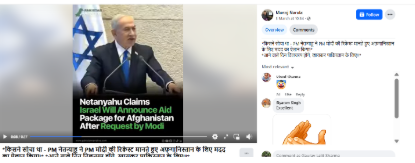
On March 1, 2026, a social media user shared the viral video on Facebook claiming that Netanyahu praised PM Modi and announced a special assistance package for Afghanistan following India’s request. The links to the post and its archive are provided below, along with a screenshot.
Fact Check:
To verify the claim, we first searched Google using relevant keywords. However, we did not find any credible media reports supporting the claim that Israel had announced such an aid package for Afghanistan. Next, we extracted key frames from the viral video and performed a reverse image search using Google Lens. During this process, we found the original video on the YouTube channel of VERTEX, which had been uploaded on February 25, 2026.
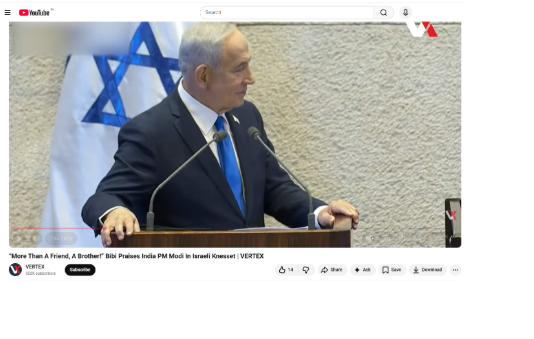
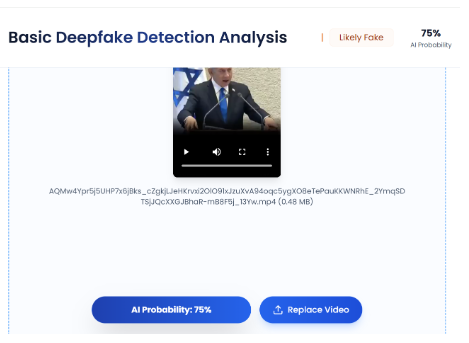
A detailed review of the original video revealed that the viral clip circulating on social media is not part of the original footage. This indicates that the circulating clip has been manipulated and shared with a misleading claim. In the original video, Netanyahu was addressing a special parliamentary session in Jerusalem, where he spoke about the growing trade, strategic cooperation, and strengthening diplomatic relations between India and Israel. He described the partnership between the two democracies as a significant and historic milestone in bilateral relations. Upon carefully listening to the viral clip, we noticed irregularities in the voice and tone, which raised suspicions that it might be AI-generated. We then analyzed the video using the AI detection tool TruthScan. The results indicated that the viral video has approximately a 75% probability of being AI-generated.
Conclusion
Our research found that the viral video was created using artificial intelligence. Moreover, Israel’s Prime Minister Benjamin Netanyahu did not make any announcement regarding Afghanistan or the Taliban during the speech being referenced. The claim circulating on social media is therefore false.

Related Blogs

Introduction
The Information Technology (IT) Ministry has tested a new parental control app called ‘SafeNet’ that is intended to be pre-installed in all mobile phones, laptops and personal computers (PCs). The government's approach shows collaborative efforts by involving cooperation between Internet service providers (ISPs), the Department of School Education, and technology manufacturers to address online safety concerns. Campaigns and the proposed SafeNet application aim to educate parents about available resources for online protection and safeguarding their children.
The Need for SafeNet App
SafeNet Trusted Access is an access management and authentication service that ensures no user is a target by allowing you to expand authentication to all users and apps with diverse authentication capabilities. SafeNet is, therefore, an arsenal of tools, each meticulously crafted to empower guardians in the art of digital parenting. With the finesse of a master weaver, it intertwines content filtering with the vigilant monitoring of live locations, casting a protective net over the vulnerable online experiences of the children. The ability to oversee calls and messages adds another layer of security, akin to a watchful sentinel standing guard over the gates of communication. Some pointers regarding the parental control app that can be taken into consideration are as follows.
1. Easy to use and set up: The app should be useful, intuitive, and easy to use. The interface plays a significant role in achieving this goal. The setup process should be simple enough for parents to access the app without any technical issues. Parents should be able to modify settings and monitor their children's activity with ease.
2. Privacy and data protection: Considering the sensitive nature of children's data, strong privacy and data protection measures are paramount. From the app’s point of view, strict privacy standards include encryption protocols, secure data storage practices, and transparent data handling policies with the right of erasure to protect and safeguard the children's personal information from unauthorized access.
3. Features for Time Management: Effective parental control applications frequently include capabilities for regulating screen time and establishing use limitations. The app will evaluate if the software enables parents to set time limits for certain applications or devices, therefore promoting good digital habits and preventing excessive screen time.
4. Comprehensive Features of SafeNet: The app's commitment to addressing the multifaceted aspects of online safety is reflected in its robust features. It allows parents to set content filters with surgical precision, manage the time their children spend in the digital world, and block content that is deemed age-inappropriate. This reflects a deep understanding of the digital ecosystem's complexities and the varied threats that lurk within its shadows.
5. Adaptable to the needs of the family: In a stroke of ingenuity, SafeNet offers both parent and child versions of the app for shared devices. This adaptability to diverse family dynamics is not just a nod to inclusivity but a strategic move that enhances its usability and effectiveness in real-world scenarios. It acknowledges the unique tapestry of family structures and the need for tools that are as flexible and dynamic as the families they serve.
6. Strong Support From Government: The initiative enjoys a chorus of support from both government and industry stakeholders, a symphony of collaboration that underscores the collective commitment to the cause. Recommendations for the pre-installation of SafeNet on devices by an industry consortium resonate with the directives from the Prime Minister's Office (PMO),creating a harmonious blend of policy and practice. The involvement of major telecommunications players and Internet service providers underscores the industry's recognition of the importance of such initiatives, emphasising a collaborative approach towards deploying digital safeguarding measures at scale.
Recommendations
The efforts by the government to implement parental controls a recommendable as they align with societal goals of child welfare and protection. This includes providing parents with tools to manage and monitor their children's Internet usage to address concerns about inappropriate content and online risks. The following suggestions are made to further support the government's initiative:
1. The administration can consider creating a verification mechanism similar to how identities are verified when mobile SIMS are issued. While this certainly makes for a longer process, it will help address concerns about the app being misused for stalking and surveillance if it is made available to everyone as a default on all digital devices.
2. Parental controls are available on several platforms and are designed to shield, not fetter. Finding the right balance between protection and allowing for creative exploration is thus crucial to ensuring children develop healthy digital habits while fostering their curiosity and learning potential. It might be helpful to the administration to establish updated policies that prioritise the privacy-protection rights of children so that there is a clear mandate on how and to what extent the app is to be used.
3. Policy reforms can be further supported through workshops, informational campaigns, and resources that educate parents and children about the proper use of the app, the concept of informed consent, and the importance of developing healthy, transparent communication between parents and children.
Conclusion
Safety is a significant step towards child protection and development. Children have to rely on adults for protection and cannot identify or sidestep risk. In this context, the United Nations Convention on the Rights of the Child emphasises the matter of protection efforts for children, which notes that children have the "right to protection". Therefore, the parental safety app will lead to significant concentration on the general well-being and health of the children besides preventing drug misuse. On the whole, while technological solutions can be helpful, one also needs to focus on educating people on digital safety, responsible Internet use, and parental supervision.
References
- https://www.hindustantimes.com/india-news/itministry-tests-parental-control-app-progress-to-be-reviewed-today-101710702452265.html
- https://www.htsyndication.com/ht-mumbai/article/it-ministry-tests-parental-control-app%2C-progress-to-be-reviewed-today/80062127
- https://www.varindia.com/news/it-ministry-to-evaluate-parental-control-software
- https://www.medianama.com/2024/03/223-indian-government-to-incorporate-parental-controls-in-data-usage/
Executive Summary
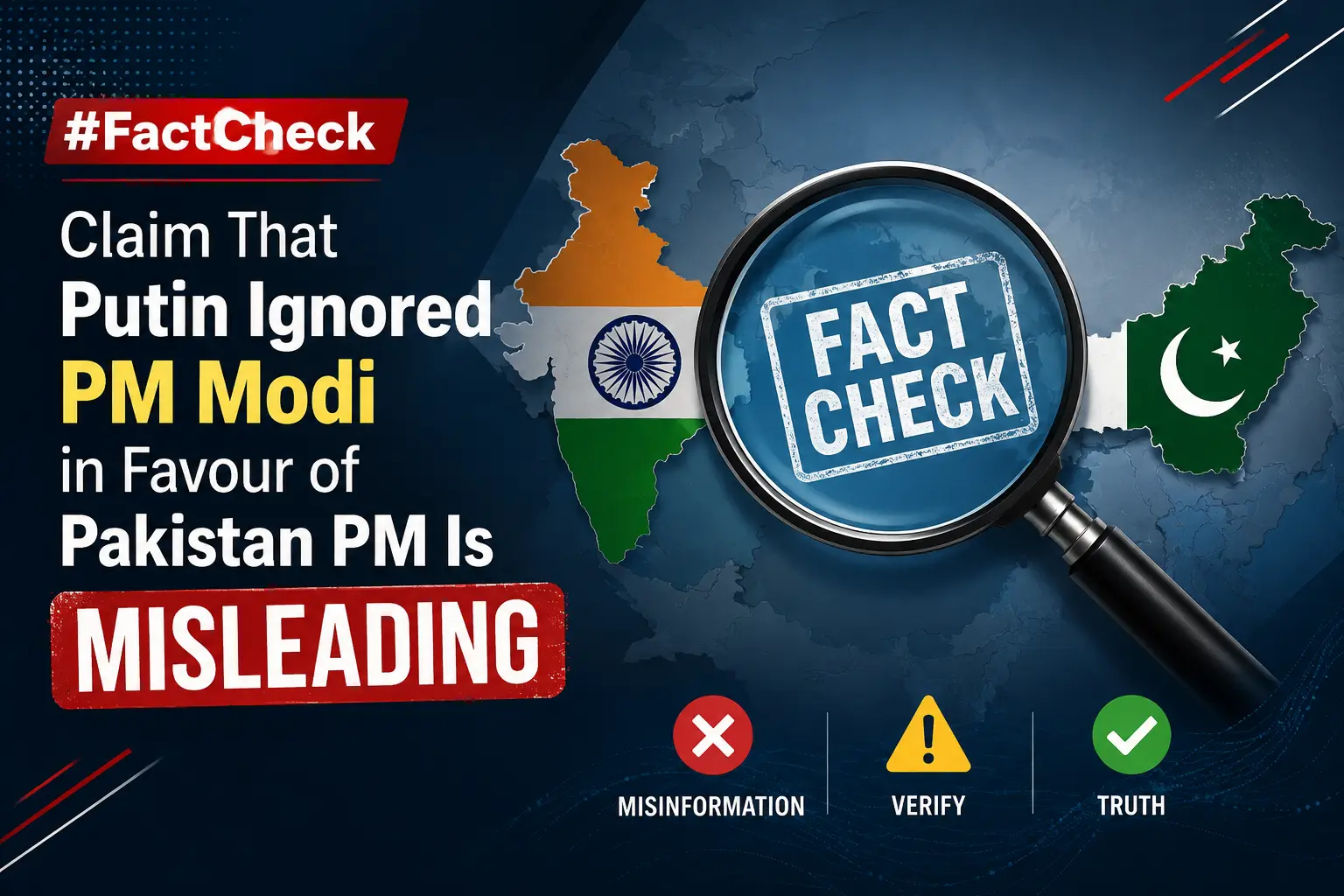
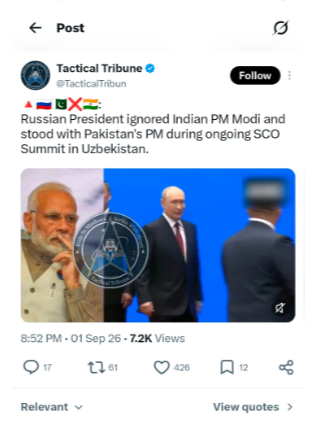
A Pakistani propaganda account on social media has claimed that Russian President Vladimir Putin ignored Indian Prime Minister Narendra Modi and stood alongside the Pakistani Prime Minister. Research by CyberPeace’s research wing found that PM Modi and President Putin held a bilateral meeting on the sidelines of the SCO Summit in Bishkek, Kyrgyzstan. During the meeting, the two leaders exchanged warm greetings and discussed several issues, including the India-Russia strategic partnership.
Claim:
A social media post claims that Russian President Vladimir Putin ignored Prime Minister Narendra Modi and stood alongside the Pakistani Prime Minister.
https://x.com/TacticalTribun/status/2094808040973172786
Fact Check:
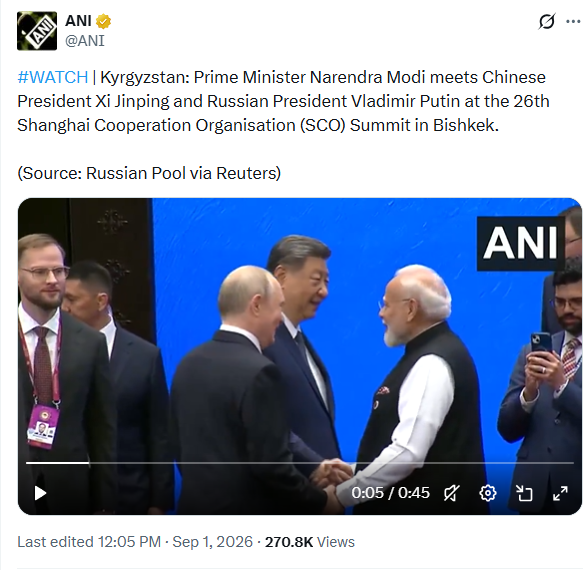
To verify the truth behind the viral claim, we searched Google using relevant keywords related to Prime Minister Narendra Modi’s official visit to Kyrgyzstan. During the search, we found a video posted on ANI’s X handle on September 1, 2026. According to the video, Prime Minister Narendra Modi met Chinese President Xi Jinping and Russian President Vladimir Putin in Bishkek during the 26th Shanghai Cooperation Organisation (SCO) Summit.
https://x.com/ANI/status/2094675518897692896
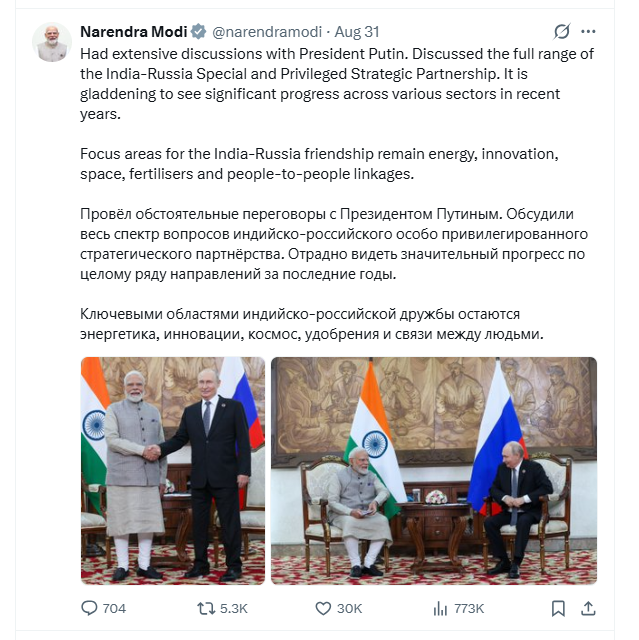
In the next step of our research, we scanned Prime Minister Narendra Modi’s X account, where we found a post dated August 31, 2026. In the post, PM Modi wrote, “Had extensive discussions with President Putin. Discussed the full range of the India-Russia Special and Privileged Strategic Partnership. It is gladdening to see significant progress across various sectors in recent years. Focus areas for the India-Russia friendship remain energy, innovation, space, fertilisers and people-to-people linkages.”
https://x.com/narendramodi/status/2094433881714032725?s=20
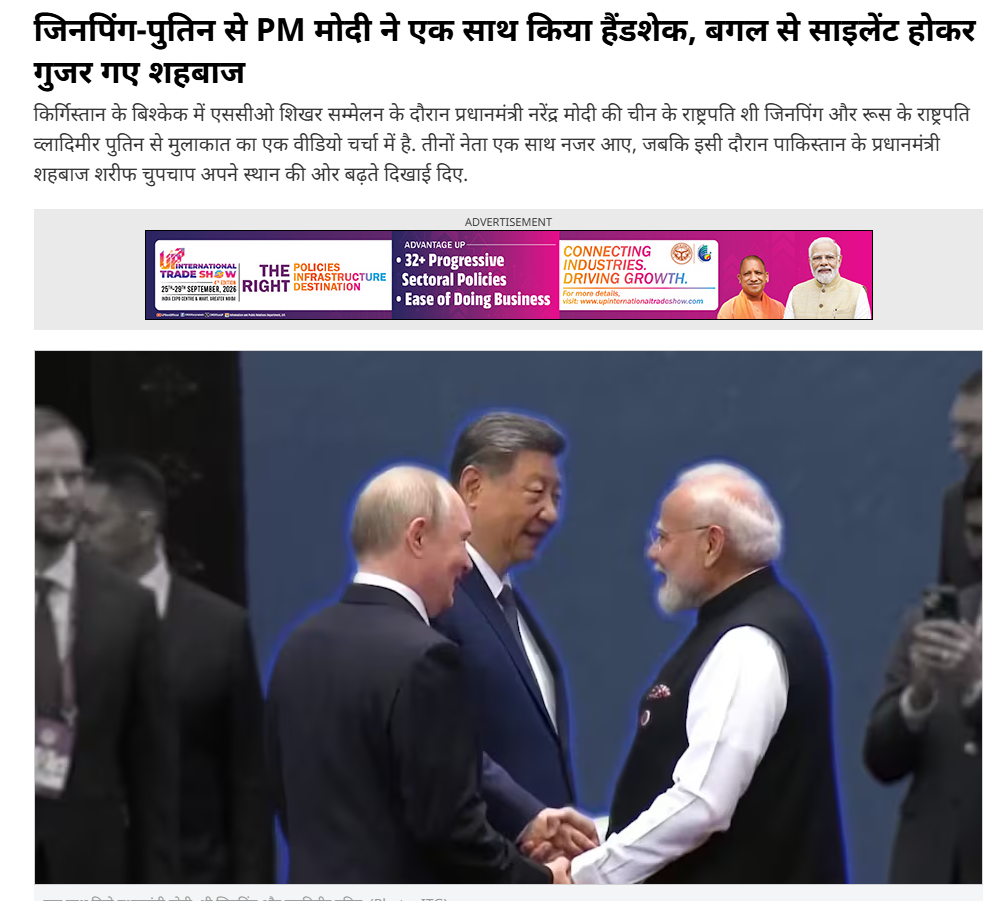
At the end of our research, we found a report published on the Aaj Tak website on September 1, 2026. According to the report, Prime Minister Narendra Modi was in Bishkek, the capital of Kyrgyzstan, where he attended the Shanghai Cooperation Organisation (SCO) Summit. Several leaders of the organisation, including Chinese President Xi Jinping, Russian President Vladimir Putin and Pakistani Prime Minister Shehbaz Sharif, also attended the summit. During the summit, a moment was captured in which PM Modi warmly greeted Chinese President Xi Jinping and Russian President Vladimir Putin together, while Shehbaz Sharif was seen quietly walking past them.
Conclusion:
Our research established that the claim that Russian President Vladimir Putin ignored Prime Minister Narendra Modi and gave preference to the Pakistani Prime Minister is misleading. The viral post presents video footage from different occasions out of context. In reality, Prime Minister Narendra Modi and President Putin held a bilateral meeting, during which the two leaders discussed several key issues, including the India-Russia strategic partnership.

Introduction
Google Play has announced its new policy which will ensure trust and transparency on google play by providing a new framework for developer verification and app details. The new policy requires that new developer accounts on Google Play will have to provide a D-U-N-S number to verify the business. So when an organisation will create a new Play Console developer account the organisation will need to provide a D-U-N-S number. Which is a nine-digit unique identifier which will be used to verify their business. The new google play policy aims to enhance user trust. And the developer will provide detailed developer details on the app’s listing page. Users will get to know who is behind the app which they are installing.
Verifying Developer Identity with D-U-N-S Numbers
To boost security the google play new policy requires the developer account to provide the D-U-N-S number when creating a new Play Console developer account. The D-U-N-S number assigned by Dun & Bradstreet will be used to verify the business. Once the developer creates his new Play Console developer account by providing a D-U-N-S number, Google Play will verify the developer’s details, and he will be able to start publishing the apps. Through this step, Google Play aims to validate the business information in a more authentic way.
If your organisation does not have a D-U-N-S number, you may check on or request for it for free on this website (https://www.dnb.com/duns-number/lookup.html). The request process for D-U-N-S can take up to 30 days. Developers are also required to keep the information up to date.
Building User Trust with Enhanced App Details
In addition to verifying developer identities in a more efficient way, google play also requires that developer provides sufficient app details to the users. There will be an “App Support” section on the app’s store listing page, where the developer will display the app’s support email address and even can include their website and phone number for support.
The new section “About the developer” will also be introduced to provide users with verified identity information, including the developer’s name, address, and contact details. Which will make the users more informed about the valuable information of the app developers.
Key highlights of the Google Play Polic
- Google Play came up with the policy to keep the platform safe by verifying the developers’ identity and it will also help to reduce the spread of malware apps and help the users to make confident informed decisions about the apps they download. Google Play announced the policy by expanding its developer verification requirement to strengthen Google Play as a platform and build user trust. When you create a new Play Console Developer account and choose organisation as your account type you will now need to provide a D-U-N-S number.
- Users will get detailed information about the developers’ identities and contact information, building more transparency and encouraging responsible app development practices.
- This policy will enable the users to make informed choices about the apps they download.
- The new “App support” section will provide enhanced communication between users and developers by displaying support email addresses, website and support phone numbers, streamlining the support process and user satisfaction.
Timeline and Implementation
The new policy requirements for D-U-N-S numbers will start rolling out on 31 August 2023 for all new Play Console developer accounts. The “About the developer” section will be visible to users as soon as a new app is published. and In October 2023, existing developers will also be required to update and verify their existing accounts to comply with the new verification policy.
Conclusion
Google Play’s new policy will aim to enhance the more transparent app ecosystem. This new policy will provide the users with more information about the developers. Google Play aims to establish a platform where users can confidently discover and download apps. This new policy will enhance the user experience on google play in terms of a reliable and trustworthy platform.
