
#FactCheck-Video From Arunachal Pradesh Floods Falsely Shared as Nepal’s Rasuwa Floods
Executive Summary
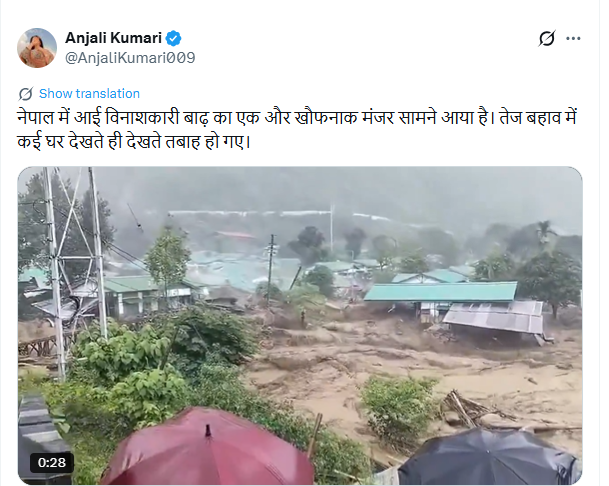
A video showing several houses being swept away by floodwaters is being shared on social media, claiming that it shows flooding in the Rasuwa area of Nepal. Research done by the CyberPeace research wing found that the video is not from Nepal, but is from the floods that occurred in Keyi Panyor district of Arunachal Pradesh in June.
Claim
The video was shared on X with the caption: “Another horrifying scene from the devastating floods in Nepal has emerged. Several houses were destroyed within moments by the strong current.”
https://x.com/anjalikumari009/status/2093257147094335652
FactCheck
During our research of the video being shared as footage of floods in Nepal’s Rasuwa area, we conducted a reverse image search using keyframes and found a longer version of the video posted on an X account on June 24, 2026. The caption accompanying the video identified it as footage of a flash flood and the resulting devastation in Nipko Colony, Possa, in Arunachal Pradesh’s Keyi Panyor district, on June 24.
https://x.com/NagaZapu/status/2069747140608331962
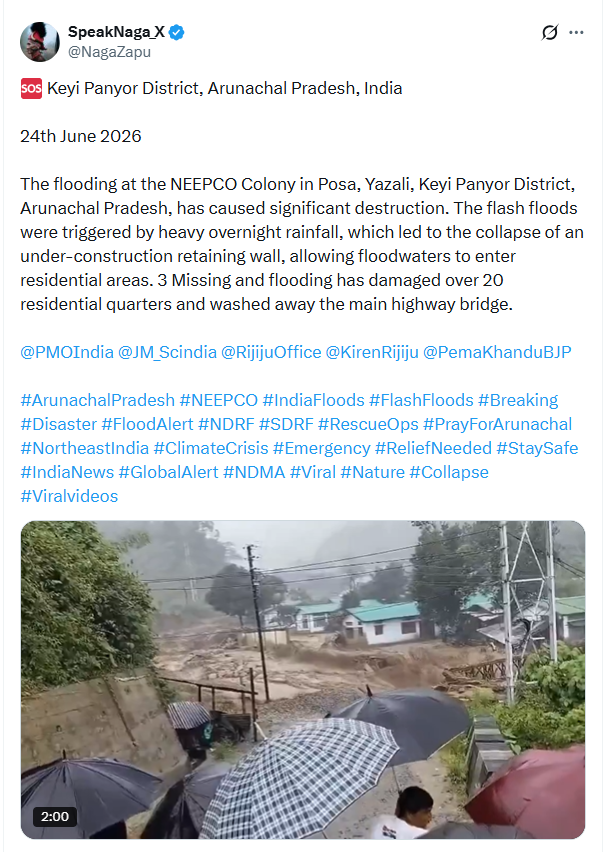
During the research, we also found videos of the flooding in Nipko Colony uploaded on several social media accounts from Arunachal Pradesh on June 24. These posts contained visuals matching those seen in the viral video.
https://www.facebook.com/reel/977442025167230

Additionally, we found a video report uploaded on June 24, 2026, on the Facebook account of a media outlet from Arunachal Pradesh. The report featured footage of the flooding in Nipko Colony. In the audio accompanying the video, the person recording the footage can also be heard describing the devastation caused by the floods.
https://www.facebook.com/reel/1571580381035813

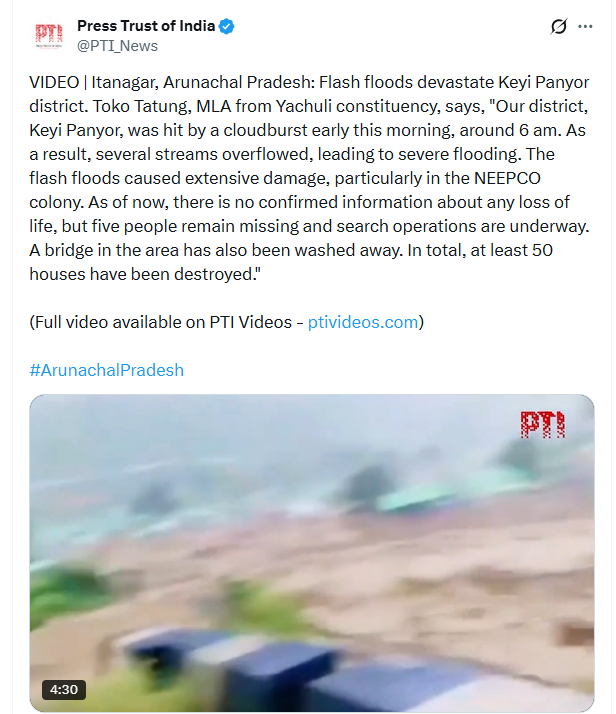
Additionally, we found visuals matching those in the viral video in a 4-minute-35-second video posted on the Press Trust of India’s X account on June 24, 2026. According to media reports, around three people were killed in the floods in Nipko Colony, while approximately 18 houses were swept away.
https://x.com/PTI_News/status/2069747746525835341
Conclusion
The evidence gathered during our research clearly establishes that the video being shared as footage of the floods in Nepal’s Rasuwa area is actually from the floods that struck Keyi Panyor district in Arunachal Pradesh on June 24.

Related Blogs
Introduction
There has been a recent surge of misinformation all over social media, claiming that every Indian ought to receive an allowance of ₹2,000 under some "Prime Minister's scheme." The message, which has been circulated far and wide on almost all platforms-WhatsApp, Facebook, Telegram, etc.-has urged users to click on an unfamiliar link to claim the allowance in their bank accounts.
It would seem like a very attractive offer, especially at a time when common citizens are coping with rising costs of living. But upon further examination, it turns out to be an outright online scam. NewsMobile fact-checked the claim and confirmed that no such scheme exists. Thus, the message circulating is a scam that aims to mislead common citizens.
Such an incident is not isolated. Over the years, fraudulent posts falsely offering benefits in the name of the government or well-known brands have been on the rise. These scams are not just about misinformation-they take advantage of trust, lure people into clicking, and sharing personal info that poses serious risks to financial and personal security.
Anatomy of the Viral PM Scheme Scam
The viral message received attention and was written in Hindi. It read:
“सभी नागरिकों को PM योजना के तहत दो हज़ार रुपए का भत्ता प्रदान किया गया है अपने bank खाते में प्राप्त करने के लिए click करें."
(English: “All citizens have been provided an allowance of ₹2000 under the PM scheme. Click to receive it in your bank account.”)
Beneath this was an odd link that, upon clicking through investigation, turned out to be not working and invalid. An examination of government sites, official handle accounts, and other such was done and no announcement for any such allowance was found.
This provides a neat explanation of a phishing attempt by which a scammer induces urgency and temptation in order to lure citizens into clicking a malicious link. While the link may no longer be active, it could very well have once redirected users to websites that harvest personal information such as Aadhaar numbers, bank details, or login credentials.
The Broader Problem: Fake Government Scheme Scams
Some scams have been exploiting the hoax gimmick of the ₹2,000 PM scheme into the wider trend. How do the con men work? They leverage the credibility of governmental initiatives to scam citizens. In the past, fake promises were made concerning free gas cylinders, cash allowances, subsidised rations, or even job opportunities.
During the COVID times, for instance, fake vaccination registration links and so-called relief scheme offers went viral, preying on the fears and vulnerabilities of ill-informed citizens. Likewise, false schemes associated with reputed companies such as Amazon, Flipkart, TATA Group, and Hermès have also gone viral, promising free gifts or allowances.
The one thing that makes scams associated with the government very dangerous is the exploitation of people's trust in authority. The common citizen is predisposed to believe the PM scheme or the Government Yojana because of the social credibility accorded to these announcements.
How These Scams Operate
These are scams where the creators intend deception and in the end, gain from defrauding a person. Fraudsters first create clickbait messages that are duly recorded to resemble official communications and often bear the government logos and bear a mix of Hindi-English text with the phrase "Pradhan Mantri Yojana" to make it sound legitimate. The messages then redirect users to bogus websites that really look very much like the government's portals, asking sick persons to enter personal information. Finally, as soon as they have obtained this data, the scammer uses it for identity theft, bank fraud, or sells it on the dark web. Social engineering does play a large role in these scams: here terms of urgency like limited time, last chance, and whatnot get created with the aim of pushing the targets to act on these without thinking. For maximum reach, victims are also asked to forward the message to their friends and family, causing the scammer to go viral across WhatsApp, Facebook, and Telegram.
Risks to Citizens
Risks are serious and manifold to falling prey to these scams. The immediate kind of risk is financial loss: divulging bank account details, an OTP, or credentials may constitute providing attackers the power to drain funds therefrom. Another prevalent kind of identity theft occurs through hijacked Aadhaar, PAN, or personal information that subsequently finds its way into fake loans or SIM activations. Apart from monetary losses, opening malicious links might also make devices infected with spyware or ransomware, thereby invading privacy and security. Victims tend to experience a form of psychological trauma due to feelings of betrayal or humiliation of being deceived, thus discouraging them from reporting, which in turn enables such scams to go undetected.
Best Practices for Prevention
It is prudent to exercise good cyber hygiene and be on the lookout for such scams. The citizens should verify each statement against government-authorised websites like https://www.mygov.in or through press statements of the ministries prior to believing it. One should not click on suspicious links offering money, gifts, or subsidies. Red flags like poor grammar, an unofficial domain name, or too-good-to-be-true offers can enable one to identify the scam in time. Two-factor authentication, antivirus software updates, and securing devices can drastically lower the threat from the technical angle. Equally important is the reporting of issues: always report any suspicious activities to cybercrime.gov.in or to the nearest cyber cell so that the authorities may trace some pattern and issue advisories accordingly. Finally, one can do some good by sharing verified fact checks within their circles to build added strength against misinformation and scams.
Policy and Community Role
While individual awareness is important, collective action must be taken against these fake government scheme scams. Platforms such as WhatsApp, Facebook, and X (Twitter) must tune up fraudsters' message detection mechanisms. In the meantime, Government Bodies must alert citizens periodically on new scams through their official handles/schemes and through community outreach.
Civil society and fact-checking agencies play an important role in dispelling frequently viral hoaxes. This work must be amplified to reach people's consciousness in regional languages for the very reason that in these terrain zones, forwarded messages are much more trusted.
Conclusion
The viral ₹2,000 PM scheme scam is a reminder that everything that is viral online cannot be trusted in toto. The scammers of the day are inventing newer scams to gain trust, spread misinformation, and extort innocent citizens.
The best defence will be awareness and alertness. Citizens must verify any claims through official channels before clicking on a link, sharing their data, or even acting upon it in any way. With proper cyber hygiene and avoiding suspicious messages, we can counterattack by reducing the percentage of impact that these scams may have and collaboratively build a secure digital environment.
As India pushes itself further into a digital ecosystem, both empowering and being resilient to cyber fraud is not a state of individual security, but a national agenda.
References
- https://www.newsmobile.in/nm-fact-checker/fact-check-viral-post-claiming-pm-scheme-offering-rs-2000-allowance-is-a-scam/
- https://timesofindia.indiatimes.com/business/financial-literacy/investing/beware-of-deepfake-scams-fraudsters-using-ai-videos-to-push-schemes-promising-unrealistic-returns-red-flags-to-watch-out-for/articleshow/124085155.cms
- https://www.business-standard.com/finance/personal-finance/invest-rs-21-000-to-earn-rs-20-lakh-monthly-viral-videos-of-fm-are-fake-125082000517_1.html
- https://www.pib.gov.in/PressReleasePage.aspx?PRID=2124728

Executive Summary
A video featuring India’s External Affairs Minister S. Jaishankar is being widely circulated on social media with the claim that he urged US Secretary of State Marco Rubio and US President Donald Trump to hand over the “handlers” of the so-called “Cockroach Janata Party” to India. The viral post further alleges that Jaishankar described the organisation as a “Pakistani and Iranian proxy group.” CyberPeace Research Wing research found the viral claim to be fake. External Affairs Minister S. Jaishankar did not make any statement regarding the “Cockroach Party” or its alleged handlers during the press conference. The viral video has been edited and is being shared with a misleading claim.
Claim
A verified X (formerly Twitter) user shared the viral clip and claimed that during a joint press conference, Jaishankar said:“I request Marco Rubio and Trump to hand over the handlers of the Cockroach Party because they are Pakistani and Iranian proxy groups.”
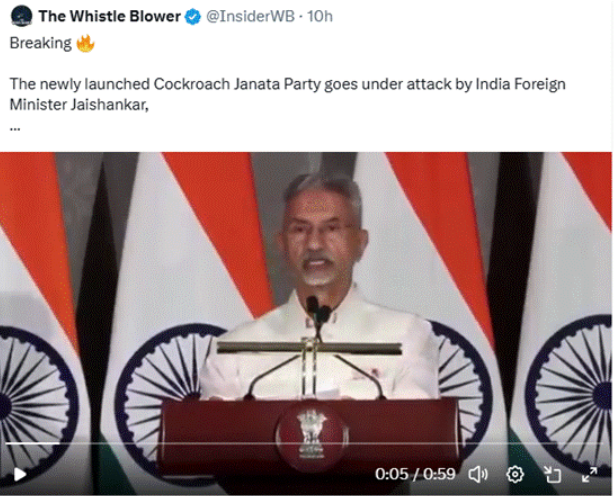
Fact Check
To verify the claim, we converted the viral clip into key frames and conducted a reverse image search. During the research, we found the original video uploaded on May 24, 2026, on the official YouTube channel of the Ministry of External Affairs.
The video was captioned:“Press conference of EAM Dr S Jaishankar and US Secretary of State Marco Rubio.”
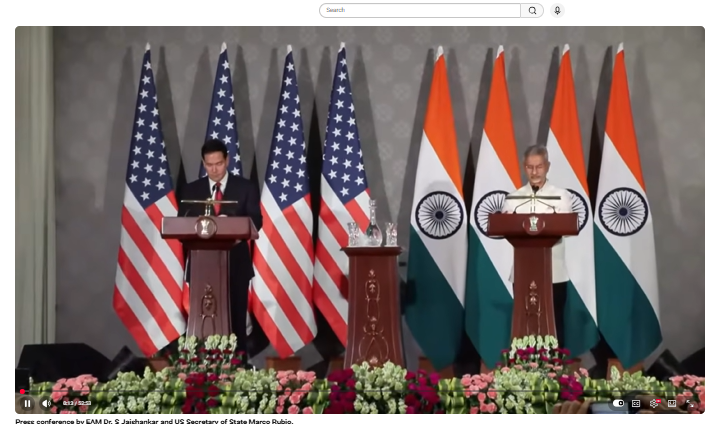
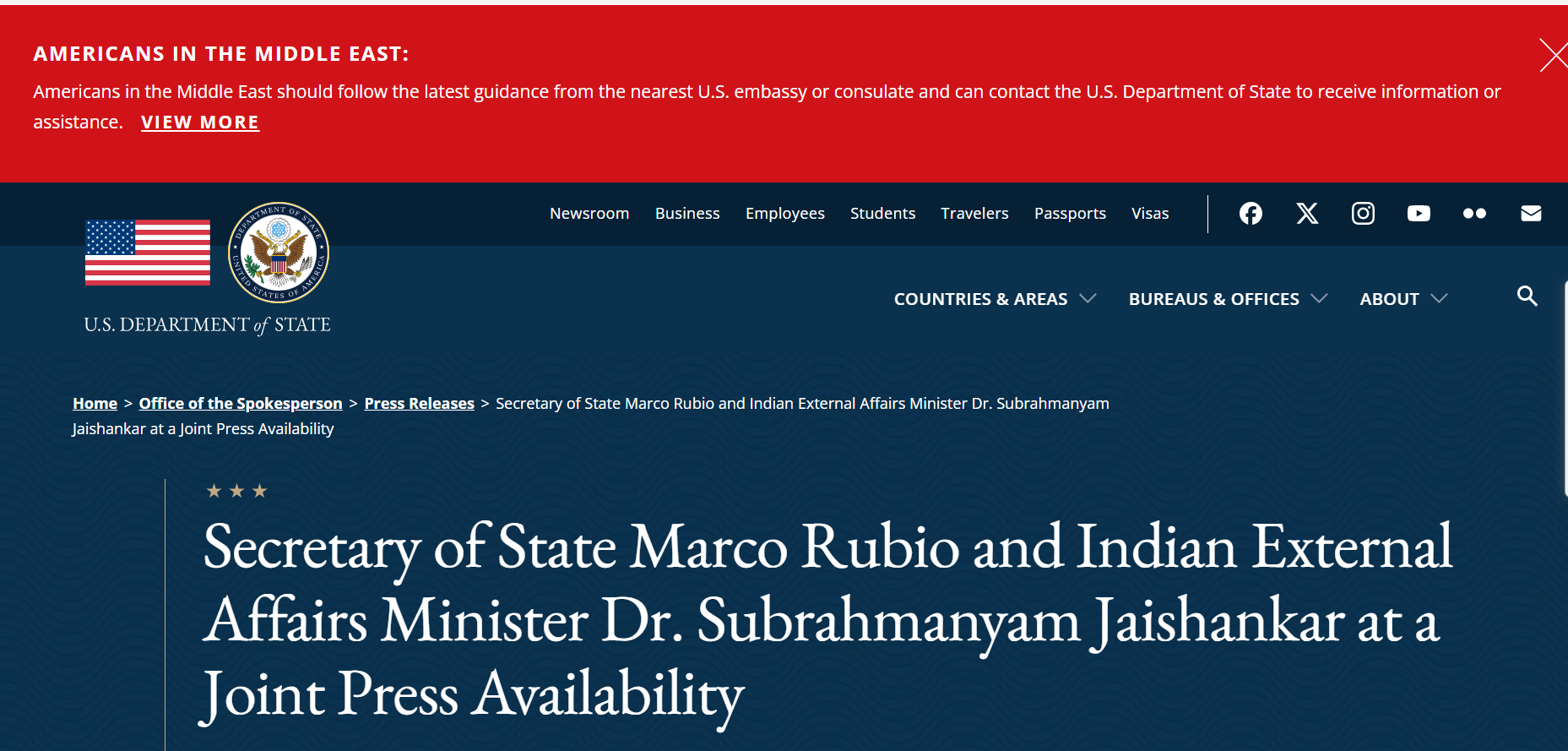
A review of the full press conference confirmed that Jaishankar made no mention of any “Cockroach Party,” its alleged handlers, or any Pakistani or Iranian proxy network. Further verification of the official transcripts published by both the Indian Ministry of External Affairs and the United States Department of State also found no references to the terms “Cockroach Party,” “handlers,” “Pakistani proxy,” or any statements matching the viral claim.
https://www.state.gov/releases/office-of-the-spokesperson/2026/05/secretary-of-state-marco-rubio-and-indian-external-affairs-minister-dr-subrahmanyam-jaishankar-at-a-joint-press-availability
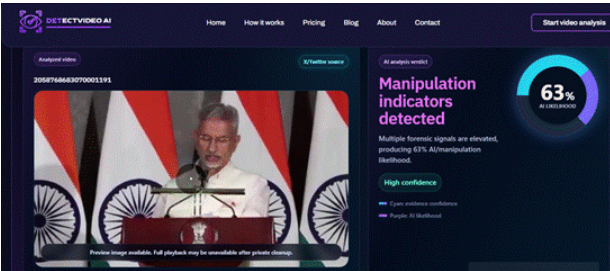
In the final stage of verification, the viral clip was analysed using an AI detection tool. The analysis suggested that the audio had been manipulated and that the video appeared to be edited. The tool indicated a 63 percent probability that the clip had been altered using AI-based editing techniques.
Conclusion
The research confirms that the viral claim is fake. S. Jaishankar did not make any statement regarding the “Cockroach Party” or its alleged handlers during the press conference. The viral clip has been edited and is being shared with misleading claims.

Introduction
Search Engine Optimisation (SEO) is a process through which one can improve website visibility on search engine platforms like Google, Microsoft Bing, etc. There is an implicit understanding that SEO suggestions or the links that are generated on top are the more popular information sources and, hence, are deemed to be more trustworthy. This trust, however, is being misused by threat actors through a process called SEO poisoning.
SEO poisoning is a method used by threat actors to attack and obtain information about the user by using manipulative methods that position their desired link, web page, etc to appear at the top of the search engine algorithm. The end goal is to lure the user into clicking and downloading their malware, presented in the garb of legitimate marketing or even as a valid result for Google search.
An active example of attempts at SEO poisoning has been discussed in a report by the Hindustan Times on 11th November, 2024. It highlights that using certain keywords could make a user more susceptible to hacking. Hackers are now targeting people who enter specific words or specific combinations in search engines. According to the report, users who looked up and clicked on links at the top related to the search query “Are Bengal cats legal in Australia?” had details regarding their personal information posted online soon after.
SEO Poisoning - Modus Operandi Of Attack
There are certain tactics that are used by the attackers on SEO poisoning, these are:
- Keyword stuffing- This method involves overloading a webpage with irrelevant words, which helps the false website appear higher in ranking.
- Typosquatting- This method involves creating domain names or links similar to the more popular and trusted websites. A lack of scrutiny before clicking would lead the user to download malware, from what they thought was a legitimate site.
- Cloaking- This method operates by showing different content to both the search engines and the user. While the search engine sees what it assumes to be a legitimate website, the user is exposed to harmful content.
- Private Link Networks- Threat actors create a group of unrelated websites in order to increase the number of referral links, which enables them to rank higher on search engine platforms.
- Article Spinning- This method involves imitating content from other pre-existing, legitimate websites, while making a few minor changes, giving the impression to search engine crawlers of it being original content.
- Sneaky Redirect- This method redirects the users to malicious websites (without their knowledge) instead of the ones the user had intended to click.
CyberPeace Recommendations
- Employee Security Awareness Training: Security awareness training can help employees familiarise themselves with tactics of SEO poisoning, encouraging them to either spot such inconsistencies early on or even alert the security team at the earliest.
- Tool usage: Companies can use Digital Risk Monitoring tools to catch instances of typosquatting. Endpoint Detection and Response (EDR) tools also help keep an eye on client history and assess user activities during security breaches to figure out the source of the affected file.
- Internal Security Measures: To refer to lists of Indicators of Compromise (IOC). IOC has URL lists that show evidence of the strange behaviour of websites, and this can be used to practice caution. Deploying Web Application Firewalls (WAFs) to mitigate and detect malicious traffic is helpful.
Conclusion
The nature of SEO poisoning is such that it inherently promotes the spread of misinformation, and facilitates cyberattacks. Misinformation regarding the legitimacy of the links and the content they display, in order to lure users into clicking on them, puts personal information under threat. As people trust their favoured search engines, and there is a lack of awareness of such tactics in use, one must exercise caution while clicking on links that seem to be popular, despite them being hosted by trusted search engines.
References
- https://www.checkpoint.com/cyber-hub/cyber-security/what-is-cyber-attack/what-is-seo-poisoning/
- https://www.vectra.ai/topics/seo-poisoning
- https://www.techtarget.com/whatis/definition/search-poisoning
- https://www.blackberry.com/us/en/solutions/endpoint-security/ransomware-protection/seo-poisoning
- https://www.coalitioninc.com/blog/seo-poisoning-attacks
- https://www.sciencedirect.com/science/article/abs/pii/S0160791X24000186
- https://www.repindia.com/blog/secure-your-organisation-from-seo-poisoning-and-malvertising-threats/
- https://www.hindustantimes.com/technology/typing-these-6-words-on-google-could-make-you-a-target-for-hackers-101731286153415.html
