
#FactCheck - AI-Generated Video of Monkey Falsely Linked to Hanuman Devotion
A video is being widely shared on social media showing a monkey, with users claiming that the animal is immersed in devotion to Lord Hanuman. The clip is being circulated with assertions that the monkey was seen participating in Hanuman Aarti. Cyber Peace Foundation’s research found that the viral claim is fake. Our investigation revealed that the video is not real and has been generated using artificial intelligence tools.
Claim
On January 6, 2026, Facebook users shared the viral video claiming, “A monkey was seen immersed in devotion during Hanuman Aarti.”
- Post link: https://www.facebook.com/reel/1261813845766976
- Archived link: https://archive.ph/anid5
Screenshots of the post can be seen below.

FactCheck:
When we closely examined the viral video, we noticed several visual inconsistencies. These anomalies raised suspicion that the video might be AI-generated. To verify this, we scanned the video using the AI detection tool Hive Moderation. According to the results, the video was found to be 97 percent AI-generated.

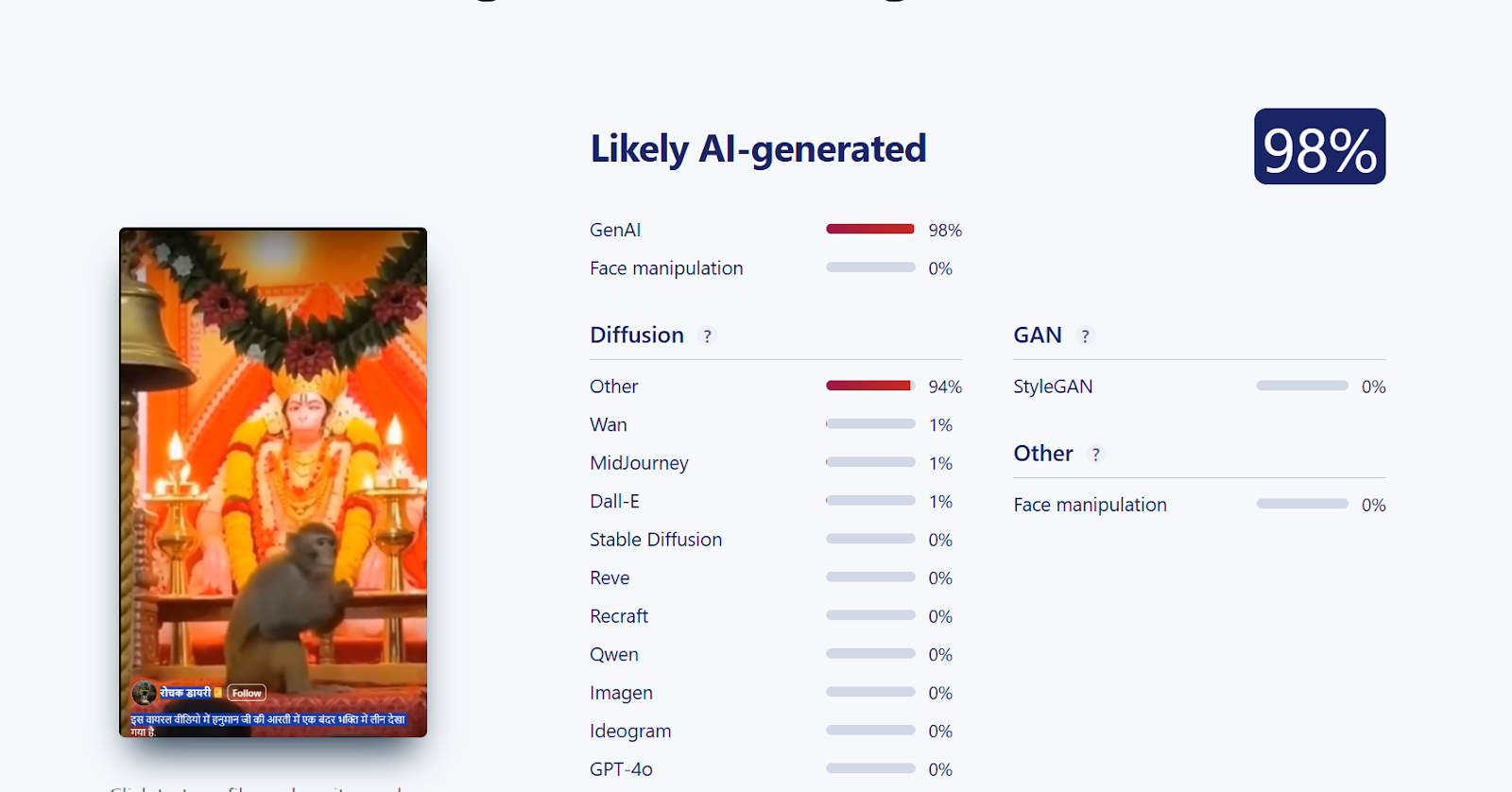
Further, we analysed the video using another AI detection tool, Sightengine. The tool’s assessment indicated that the viral video is 98 percent AI-generated.
Conclusion
Our investigation confirms that the viral video claiming to show a monkey immersed in devotion to Lord Hanuman is AI-generated and not real. The claim circulating on social media is false and misleading.

Related Blogs

Introduction
Public infrastructure has traditionally served as the framework for civilisation, transporting people, money, and ideas across time and space, from the iron veins of transcontinental railroads to the unseen arteries of the internet. In democracies where free markets and public infrastructure co-exist, this framework has not only facilitated but also accelerated progress. Digital Public Infrastructure (DPI), which powers inclusiveness, fosters innovation, and changes citizens from passive recipients to active participants in the digital age, is emerging as the new civic backbone as we move away from highways and towards high-speed data.
DPI makes it possible for innovation at the margins and for inclusion at scale by providing open-source, interoperable platforms for identities, payments, and data exchange. Examples of how the Global South is evolving from a passive consumer of technology to a creator of globally replicable governance models are India’s Aadhaar (digital identification), UPI (real-time payments), and DigiLocker (data empowerment). As the ‘digital commons’ emerges, DPI does more than simply link users; it also empowers citizens, eliminates inefficiencies from the past, and reimagines the creation and distribution of public value in the digital era.
Securing the Digital Infrastructure: A Contemporary Imperative
As humans, we are already the inhabitants of the future, we stand at the temporal threshold for reform. Digital Infrastructure is no longer just a public good. It’s now a strategic asset, akin to oil pipelines in the 20th century. India is recognised globally for the introduction of “India Stack”, through which the face of digital payments has also been changed. The economic value contributed by DPIs to India’s GDP is predicted to reach 2.9-4.2 percent by 2030, having already reached 0.9% in 2022. Its role in India’s economic development is partly responsible for its success; among emerging market economies, it helped propel India to the top of the revenue administrations’ digitalisation index. The other portion has to do with how India’s social service delivery has changed across the board. By enabling digital and financial inclusion, it has increased access to education (DIKSHA) and is presently being developed to offer agricultural (VISTAAR) and digital health (ABDM) services.
Securing the Foundations: Emerging Threats to Digital Public Infrastructure
The rising prominence of DPI is not without its risks, as adversarial forces are developing with comparable sophistication. The core underpinnings of public digital systems are the target of a new generation of cyber threats, ranging from hostile state actors to cybercriminal syndicates. The threats pose a great risk to the consistent development endeavours of the government. To elucidate, targeted attacks on Biometric databases, AI-based Misinformation and Psychological Warfare, Payment System Hacks, State-sponsored malware, cross-border phishing campaigns, surveillance spyware and Sovereign Malware are modern-day examples of cyber threats.
To secure DPI, a radical rethink beyond encryption methods and perimeter firewalls is needed. It requires an understanding of cybersecurity that is systemic, ethical, and geopolitical. Democracy, inclusivity, and national integrity are all at risk from DPI. To preserve the confidence and promise of digital public infrastructure, policy frameworks must change from fragmented responses to coordinated, proactive and people-centred cyber defence policies.
CyberPeace Recommendations
Powering Progress, Ignoring Protection: A Precarious Path
The Indian government is aware that cyberattacks are becoming more frequent and sophisticated in the nation. To address the nation’s cybersecurity issues, the government has implemented a number of legislative, technical, and administrative policy initiatives. While the initiatives are commendable, there are a few Non-Negotiables that need to be in place for effective protection:
- DPIs must be declared Critical Information Infrastructure. In accordance with the IT Act, 2000, the DPI (Aadhaar, UPI, DigiLocker, Account Aggregator, CoWIN, and ONDC) must be designated as Critical Information Infrastructure (CII) and be supervised by the NCIIPC, just like the banking, energy, and telecom industries. Give NCIIPC the authority to publish required security guidelines, carry out audits, and enforce adherence to the DPI stack, including incident response protocols tailored to each DPI.
- To solidify security, data sovereignty, and cyber responsibility, India should spearhead global efforts to create a Global DPI Cyber Compact through the “One Future Alliance” and the G20. To ensure interoperable cybersecurity frameworks for international DPI projects, promote open standards, cross-border collaboration on threat intelligence, and uniform incident reporting guidelines.
- Establish a DPI Threat Index to monitor vulnerabilities, including phishing attacks, efforts at biometric breaches, sovereign malware footprints, spikes in AI misinformation, and patterns in payment fraud. Create daily or weekly risk dashboards by integrating data from state CERTs, RBI, UIDAI, CERT-In, and NPCI. Use machine learning (ML) driven detection systems.
- Make explainability audits necessary for AI/ML systems used throughout DPI to make sure that the decision-making process is open, impartial, and subject to scrutiny (e.g., welfare algorithms, credit scoring). Use the recently established IndiaAI Safety Institute in line with India’s AI mission to conduct AI audits, establish explanatory standards, and create sector-specific compliance guidelines.
References
- https://orfamerica.org/newresearch/dpi-catalyst-private-sector-innovation?utm_source=chatgpt.com
- https://www.institutmontaigne.org/en/expressions/indias-digital-public-infrastructure-success-story-world
- https://www.pib.gov.in/PressReleasePage.aspx?PRID=2116341
- https://www.pib.gov.in/PressReleaseIframePage.aspx?PRID=2033389
- https://www.governancenow.com/news/regular-story/dpi-must-ensure-data-privacy-cyber-security-citizenfirst-approach

Introduction
Recently the Indian Government banned the import of Laptops and tablets in India under the computers of HSN 8471. According to the notification of the government, Directorate General of foreign trade, there will be restrictions on the import of Laptops, tablets, and other electronic items from 1st November 2023. The government advised the Domestic companies to apply for the license within three months. As the process is simple, and many local companies have already applied for the license. The government will require a valid license for the import of laptops and other electronic items.
The Government imposed restrictions on the Import of Laptops & other electronic products
The DGFT (The directorate General of foreign trade) imposed restrictions on the import of electronic items in India. And, there has been the final date has also been given that the companies only have 3 months to apply for a valid license, from November 1st 2023there will be a requirement for a valid license for the import, and there will be a proper ban on the import of laptops & tablets, and other electronic items. The ban is on the HSN-8471. These are the products that indicate that they are taxable. It is a classification code to identify the taxable items. India has sufficient capacity and capability to manufacture their own IT hardware devices and boost production.
The government has notified production linked incentive, PLI Scheme 2.0, for the IT devices, which will soon be disclosed, and the scheme is expected to lead to a total of 29 thousand crore rupees worth of IT hardware nearly. And this will create future job opportunities in the five to six years.
The pros & cons of the import
Banning import has two sides. The positive one is that, it will promote the domestic manufacturers, local companies will able to grow, and there will be job opportunities, but if we talk about the negative side of the import, then the prices will be high for the consumers. One aspect is making India’s digital infrastructure stable, and the other side is affecting consumers.
Reasons Behind the ban on the Import of electronic items
There are the following reasons behind the ban on the Import of laptops and tablets,
- The primary reason why the government banned the import of laptops and other electronic items is because of security concerns about the data. And to prevent data theft a step has been taken by the Government.
- The banning will help the domestic manufacturer to grow and will provide opportunities to the local companies in India.
- It will help in the creation of Job vacancies in the country.
- There will be a curb down of selling of Chinese products.
The government will promote the digital infrastructure of India by putting a ban on imports. Such as there are domestic companies like Reliance recently launched a laptop by the name of Jio Book, and there is a company that sells the cheapest tablet called Aakash, so the import ban will promote these types of electronic items of the local companies. This step will soon result in digital advancement in India.
Conclusion
The laptop, tablets, and other electronic products that have been banned in India will make a substantial move with the implications. The objective of the ban is to encourage domestic manufacturing and to secure the data, however, it will also affect the consumers which can not be ignored. The other future effects are yet to be seen. But the one scenario is clear, that the policy will significantly make a change in India’s Technology industry.

Executive Summary:
Viral pictures featuring US Secret Service agents smiling while protecting former President Donald Trump during a planned attempt to kill him in Pittsburgh have been clarified as photoshopped pictures. The pictures making the rounds on social media were produced by AI-manipulated tools. The original image shows no smiling agents found on several websites. The event happened with Thomas Mathew Crooks firing bullets at Trump at an event in Butler, PA on July 13, 2024. During the incident one was deceased and two were critically injured. The Secret Service stopped the shooter, and circulating photos in which smiles were faked have stirred up suspicion. The verification of the face-manipulated image was debunked by the CyberPeace Research Team.

Claims:
Viral photos allegedly show United States Secret Service agents smiling while rushing to protect former President Donald Trump during an attempted assassination in Pittsburgh, Pennsylvania.


Fact Check:
Upon receiving the posts, we searched for any credible source that supports the claim made, we found several articles and images of the incident but in those the images were different.

This image was published by CNN news media, in this image we can see the US Secret Service protecting Donald Trump but not smiling. We then checked for AI Manipulation in the image using the AI Image Detection tool, True Media.


We then checked with another AI Image detection tool named, contentatscale AI image detection, which also found it to be AI Manipulated.

Comparison of both photos:

Hence, upon lack of credible sources and detection of AI Manipulation concluded that the image is fake and misleading.
Conclusion:
The viral photos claiming to show Secret Service agents smiling when protecting former President Donald Trump during an assassination attempt have been proven to be digitally manipulated. The original image found on CNN Media shows no agents smiling. The spread of these altered photos resulted in misinformation. The CyberPeace Research Team's investigation and comparison of the original and manipulated images confirm that the viral claims are false.
- Claim: Viral photos allegedly show United States Secret Service agents smiling while rushing to protect former President Donald Trump during an attempted assassination in Pittsburgh, Pennsylvania.
- Claimed on: X, Thread
- Fact Check: Fake & Misleading

