
#FactCheck: Old Video of Subodh Uniyal’s Clash With Locals During Uttarakhand Municipal Elections Falsely Linked to Daler Mehndi Row
Executive Summary
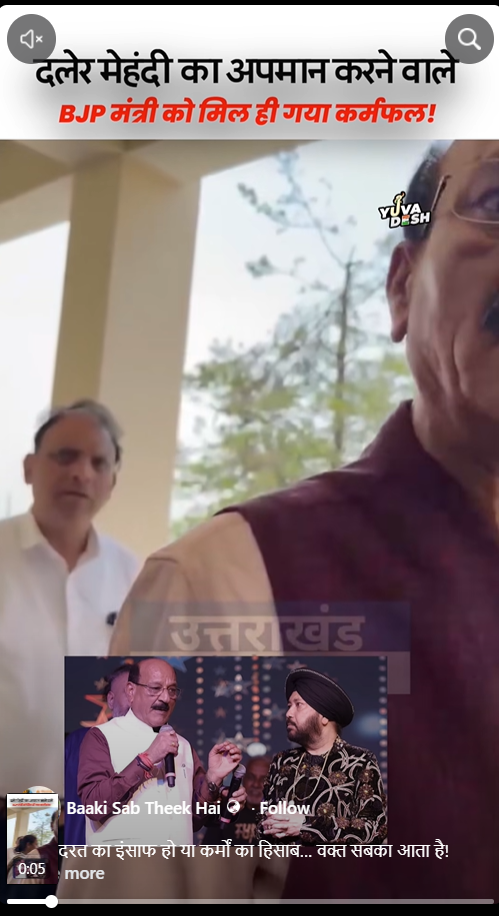
Following a public altercation on stage between Uttarakhand Cabinet Minister Subodh Uniyal and singer Daler Mehndi on October 18, a video has gone viral on social media showing a woman arguing loudly with Uniyal. Sharing the video, several users claim that Uniyal has faced the consequences of his actions.
CyberPeace Research found that the video dates back to June 2026, when some people accused Uniyal of illegally entering a polling booth during municipal elections.
Claim
Text overlaid on the video reads, “The BJP minister who insulted Daler Mehndi has finally faced the consequences of his actions!” The caption states, “Whether it is nature's justice or the reckoning for one's deeds, everyone's time comes! BJP minister Subodh Uniyal, who reprimanded Daler Mehndi on stage in front of everyone, clashed with women at a polling booth. The minister who insulted an artist has now had to face opposition from women!”
https://www.facebook.com/reel/1095658483207750
Fact Check
To verify the viral claim, we searched Google using relevant keywords. However, we did not find any credible media reports confirming the claim.
As the next step in our research, we conducted a reverse image search of the video's keyframes. During this search, we found a news report on the India TV website that featured the viral video. The report was published on January 10, 2026.
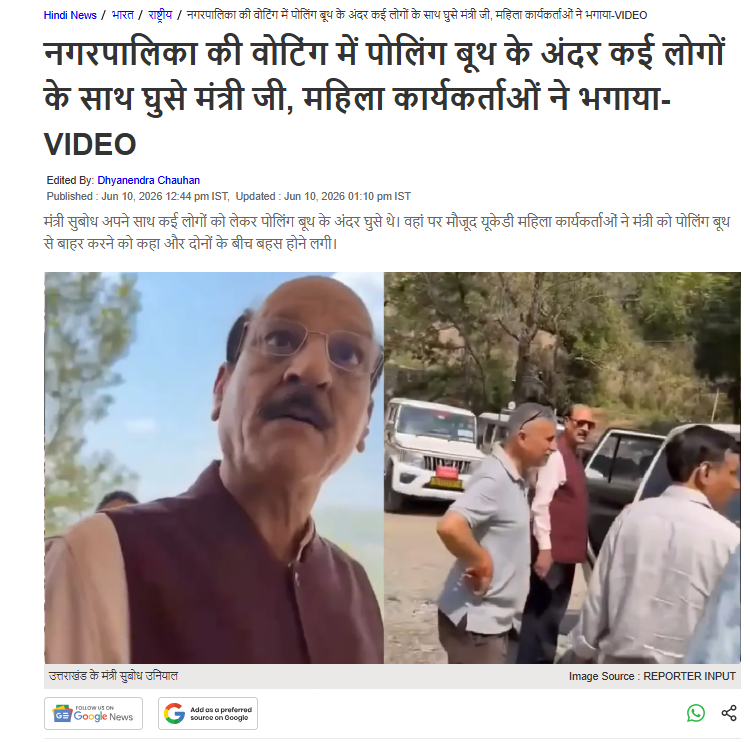
According to the India TV report, a controversy erupted over Cabinet Minister and local MLA Subodh Uniyal's entry into a polling booth during the Narendra Nagar municipal elections in Uttarakhand. It was alleged that Uniyal entered the polling booth in violation of the Model Code of Conduct. UKD leader Pramila Rawat and senior leader Dinesh Master opposed his entry. A heated argument also broke out between the minister and local residents during the protest, and a video of the incident went viral on social media.This establishes that the viral video is not recent but dates back to an earlier incident.
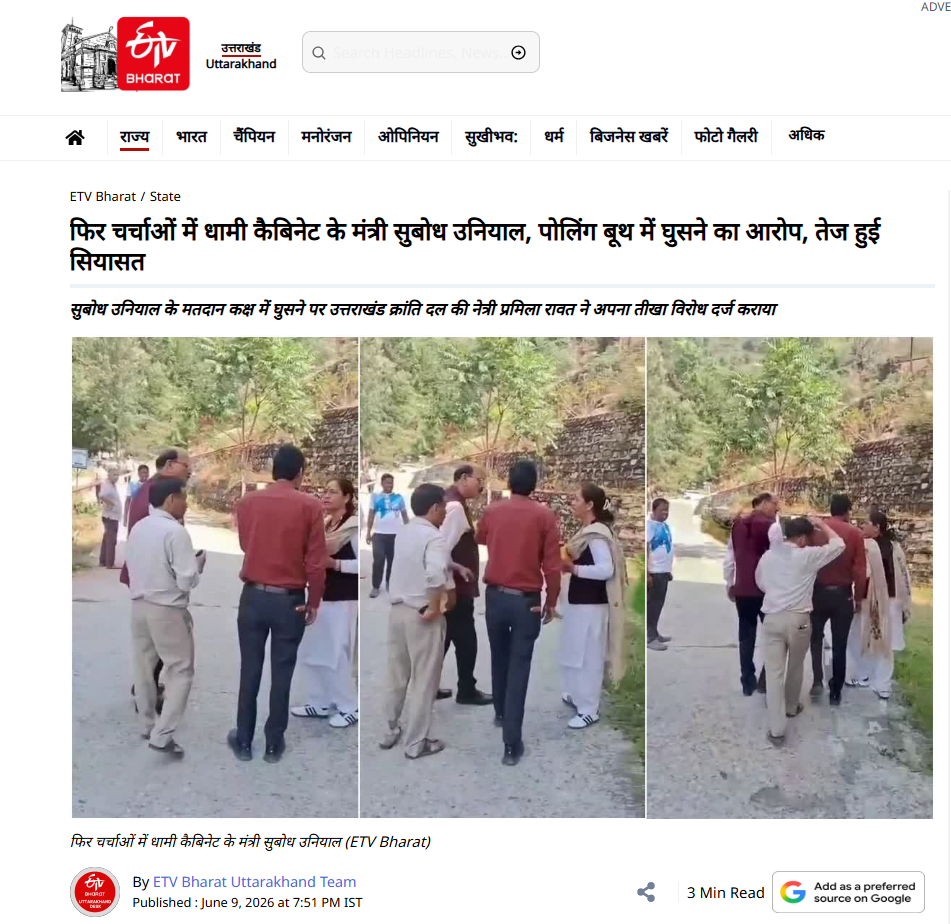
As the next step in our research, we also found a report published by ETV Bharat on June 9, 2026, which covered the incident in its original context.
https://www.etvbharat.com/hi/state/narendra-nagar-municipal-council-election-cabinet-minister-subodh-uniyal-polling-booth-uts26060906445
Conclusion
Our research found that the video dates back to June 2026, when some people accused Uniyal of illegally entering a polling booth during the municipal elections.

Related Blogs
Introduction
The Telecom Regulatory Authority of India (TRAI) issued a consultation paper titled “Encouraging Innovative Technologies, Services, Use Cases, and Business Models through Regulatory Sandbox in Digital Communication Sector. The paper presents a draft sandbox structure for live testing of new digital communication products or services in a regulated environment. TRAI seeks comments from stakeholders on several parts of the framework.
What is digital communication?
Digital communication is the use of internet tools such as email, social media messaging, and texting to communicate with other people or a specific audience. Even something as easy as viewing the content on this webpage qualifies as digital communication.
Aim of Paper
- Frameworks are intended to support regulators’ desire for innovation while also ensuring economic resilience and consumer protection. Considering this, the Department of Telecom (DoT) asked TRAI to offer recommendations on a regulatory sandbox framework. TRAI approaches the issue with the goal of encouraging creativity and hastening the adoption of cutting-edge digital communications technologies.
- Artificial intelligence, the Internet of Things, edge computing, and other emerging technologies are revolutionizing how we connect, communicate, and access information, driving the digital communication sector to rapidly expand. To keep up with this dynamic environment, an enabling environment for the development and deployment of novel technologies, services, use cases, and business models is required.
- The regulatory sandbox concept is becoming increasingly popular around the world as a means of encouraging innovation in a range of industries. A regulatory sandbox is a regulated environment in which businesses and innovators can test their concepts, commodities, and services while operating under changing restrictions.
- Regulatory Sandbox will benefit the telecom startup ecosystem by providing access to a real-time network environment and other data, allowing them to evaluate the reliability of new applications before releasing them to the market. Regulatory Sandbox also attempts to stimulate cross-sectoral collaboration for carrying out such testing by engaging the assistance of other ministries and departments in order to give the starting company with a single window for acquiring all clearances.
What is regulatory sandbox?
- A regulatory sandbox is a controlled regulatory environment in which new products or services are tested in real-time.
- It serves as a “safe space” for businesses because authorities may or may not allow certain relaxations for the sole purpose of testing.
- The sandbox enables the regulator, innovators, financial service providers, and clients to perform field testing in order to gather evidence on the benefits and hazards of new financial innovations, while closely monitoring and mitigating their risks.
What are the advantages of having a regulatory sandbox?
- Firstly, regulators obtain first-hand empirical evidence on the benefits and risks of emerging technologies and their implications, allowing them to form an informed opinion on the regulatory changes or new regulations that may be required to support useful innovation while mitigating the associated risks.
- Second, sandbox customers can evaluate the viability of a product without the need for a wider and more expensive roll-out. If the product appears to have a high chance of success, it may be authorized and delivered to a wider market more quickly.
Digital communication sector and Regulatory Sandbox
- Many countries’ regulatory organizations have built sandbox settings for telecom tech innovation.
- These frameworks are intended to encourage regulators’ desire for innovation while also promoting economic resilience and consumer protection.
- In this context, the Department of Telecom (DoT) had asked TRAI to give recommendations on a regulatory sandbox framework.
- Written comments on the drafting framework will be received until July 17, 2023, and counter-comments will be taken until August 1, 2023. The Authority’s goal in the digital communication industry is to foster creativity and expedite the use of emerging technologies such as artificial intelligence (AI), the Internet of Things (IoT), and edge computing. These technologies are changing the way individuals connect, engage, and access information, causing rapid changes in the industry.
Conclusion
According to TRAI, these technologies are changing how individuals connect, engage, and obtain information, resulting in significant changes in the sector.
The regulatory sandbox also wants to stimulate cross-sectoral collaboration for carrying out such testing by engaging the assistance of other ministries and departments in order to give the starting company with a single window for acquiring all clearances. The consultation paper covers some of the worldwide regulatory sandbox frameworks in use in the digital communication industry, as well as some of the frameworks in use inside the country in other sectors.
Overview of the Advisory
On 18 November 2025, the Ministry of Information and Broadcasting (I&B) published an Advisory that addresses all of the private satellite television channels in India. The advisory is one of the critical institutional interventions to the broadcast of sensitive content regarding recent security incidents concerning the blast at the Red Fort on November 10th, 2025. This advisory came after the Ministry noticed that some news channels have been broadcasting content related to alleged persons involved in Red Fort blasts, justifying their acts of violence, as well as information/video on explosive material. Broadcasting like this at this critical situation may inadvertently encourage or incite violence, disrupt public order, and pose risks to national security.
Key Instructions under the Advisory
The advisory provides certain guidelines to the TV channels to ensure strict compliance with the Programming and Advertising Code under the Cable Television Networks (Regulation) Act, 1995. The television channels are advised to exercise the highest level of discretion and sensitivity possible in reporting on issues involving alleged perpetrators of violence, and especially when reporting on matters involving the justification of acts of violence or providing instructional media on making explosive materials. The fundamental focus is to be very strict in following the Programme and Advertising Code as stipulated in the Cable Television Network Rules. In particular, broadcasters should not make programming that:
- Contain anything obscene, defamatory, deliberately false, or suggestive innuendos and half-truths.
- Likely to encourage or incite violence, contain anything against the maintenance of law and order, or promote an anti-national attitude.
- Contain anything that affects the integrity of the Nation.
- Could aid, abet or promote unlawful activities.
Responsible Reporting Framework
The advisory does not constitute outright censorship but instead a self-regulatory system that depends on the discretion and sensitivity of the TV channels focused on differentiating between broadcasting legitimate news and the content that crosses the threshold from information dissemination to incitement.
Why This Advisory is Important in a Digital Age
With the modern media systems, there has been an erosion of the line between the journalism of the traditional broadcasting medium and digital virality. The contents of television are no longer limited to the scheduled programs or cable channels of distribution. The contents of a single news piece, especially that of dramatic or contentious nature, can be ripped off, revised and repackaged on social media networks within minutes of airing- often without the context, editorial discretion or timing indicators.
This effect makes sensitive content have a multiplier effect. The short news item about a suspect justifying violence or containing bombs can be viewed by millions on YouTube, WhatsApp, Twitter/X, Facebook, by spreading organically and being amplified by an algorithm. Studies have shown that misinformation and sensational reporting are much faster to circulate compared to factual corrections- a fact that has been noticed in the recent past during conflicts and crisis cases in India and other parts of the world.
Vulnerabilities of Information Ecosystems
- The advisory is created in a definite information setting that is characterised by:
- Rapid Viral Mechanism: Content spreads faster than the process of verification.
- Algorithmic-driven amplification: Platform mechanism boosts emotionally charged content.
- Coordinated amplification networks: Organised groups are there to make these posts, videos viral, to set a narrative for the general public.
- Deepfake and synthetic media risks: Original broadcasts can be manipulated and reposted with false attribution.
Interconnection with Cybersecurity and National Security
Verified or sensationalised reporting of security incidents poses certain weaknesses:
- Trust Erosion: Trust is broken when the masses observe broadcasters in the air giving unverified claims or emotional accounts as facts. This is even to security agencies, law enforcement and government institutions themselves. The lack of trust towards the official information gives rise to information gaps, which are occupied by rumours, conspiracy theories, and enemy tales.
- Cognitive Fragmentation: Misinformation develops multiple versions of the truth among the people. The narratives given to citizens vary according to the sources of the media that they listen to or read. This disintegration complicates organising the collective response of the society an actual security threat because the populations can be organised around misguided stories and not the correct data.
- Radicalisation Pipeline: People who are interested in finding ideological backgrounds to violent action might get exposed to media-created materials that have been carefully distorted to evidence justifications of terrorism as a valid political or religious stand.
How Social Instability Is Exploited in Cyber Operations and Influence Campaigns
Misinformation causes exploitable vulnerability in three phases.
- First, conflicting unverified accounts disintegrate the information environment-populations are presented with conflicting versions of events by various media sources.
- Second, institutional trust in media and security agencies is shaken by exposure to subsequently rectified false information, resulting in an information vacuum.
- Third, in such a distrusted and puzzled setting, the population would be susceptible to organised manipulation by malicious agents.
- Sensationalised broadcasting gives opponents assets of content, narrative frameworks, and information gaps that they can use to promote destabilisation movements. These mechanisms of exploitation are directly opposed by responsible broadcasting.
Media Literacy and Audience Responsibility
Structural Information Vulnerabilities-
A major part of the Indian population is structurally disadvantaged in information access:
- Language barriers: Infrastructure in the field of fact-checking is still highly centralised in English and Hindi, as vernacular-language misinformation goes viral in Tamil, Telugu, Marathi, Punjabi, and others.
- Digital literacy gaps: It is estimated that there are about 40 million people in India who have been trained on digital literacy, but more than 900 million Indians access digital content with different degrees of ability to critically evaluate the content.
- Divides between rural and urban people: Rural citizens and less affluent people experience more difficulty with access to verification tools and media literacy resources.
- Algorithmic capture: social media works to maximise engagement over accuracy, and actively encourages content that is emotionally inflammatory or divisive to its users, according to their history of engagement.
Conclusion
The advisory of the Ministry of Information and Broadcasting is an acknowledgment of the fact that media accountability is a part of state security in the information era. It states the principles of responsible reporting without interference in editorial autonomy, a balance that various stakeholders should uphold. Implementation of the advisory needs to be done in concert with broadcasters, platforms, civil society, government and educational institutions. Information integrity cannot be handled by just a single player. Without media literacy resources, citizens are unable to be responsible in their evaluation of information. Without open and fast communication with the media stakeholders, government agencies are unable to combat misinformation.
The recommendations include collaborative governance, i.e., institutional forms in which media self-regulation, technological protection, user empowerment, and policy frameworks collaborate and do not compete. The successful deployment of measures will decide whether India can continue to have open and free media without compromising on information integrity that is sufficient to provide national security, democratic governance and social stability during the period of high-speed information flow, algorithmic amplification, and information warfare actions.
References
https://mib.gov.in/sites/default/files/2025-11/advisory-18.11.2025.pdf
Executive Summary
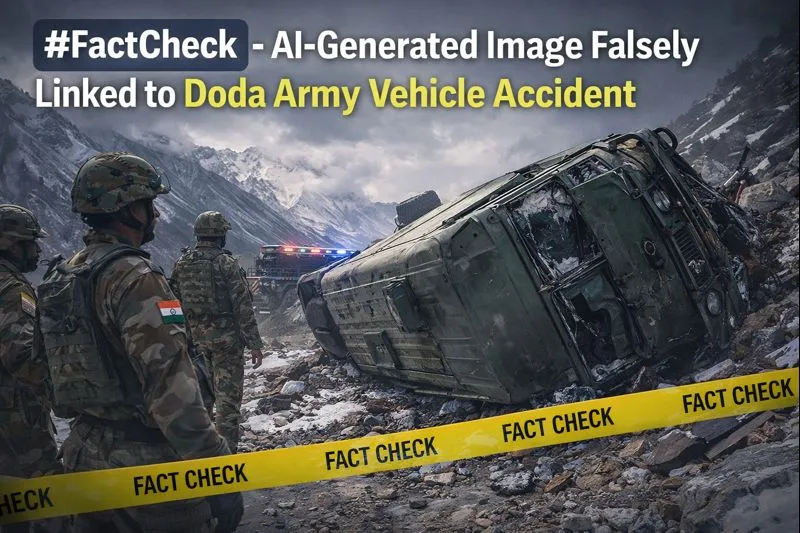
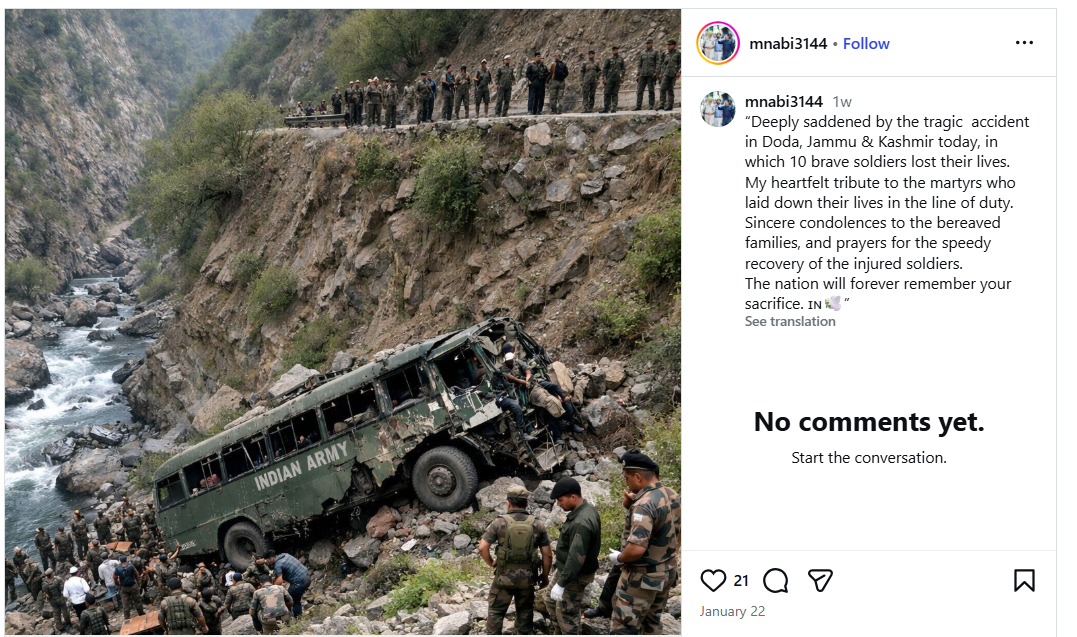
On January 22, an Indian Army vehicle met with an accident in Jammu and Kashmir’s Doda district, resulting in the death of 10 soldiers, while several others were injured. In connection with this tragic incident, a photograph is now going viral on social media. The viral image shows an Army vehicle that appears to have fallen into a deep gorge, with several soldiers visible around the site. Users sharing the image are claiming that it depicts the actual scene of the Doda accident.
However, an research by the CyberPeacehas found that the viral image is not genuine. The photograph has been generated using Artificial Intelligence (AI) and does not represent the real accident. Hence, the viral post is misleading.
Claim
An Instagram user shared the viral image on January 22, 2026, writing:“Deeply saddened by the tragic accident in Doda, Jammu & Kashmir today, in which 10 brave soldiers lost their lives. My heartfelt tribute to the martyrs who laid down their lives in the line of duty.Sincere condolences to the bereaved families, and prayers for the speedy recovery of the injured soldiers.The nation will forever remember your sacrifice.”
The link and screenshot of the post can be seen below.
- https://www.instagram.com/p/DT0UBIRk_3k/
- https://archive.ph/submit/?url=https%3A%2F%2Fwww.instagram.com%2Fp%2FDT0UBIRk_3k%2F+
Fact Check:
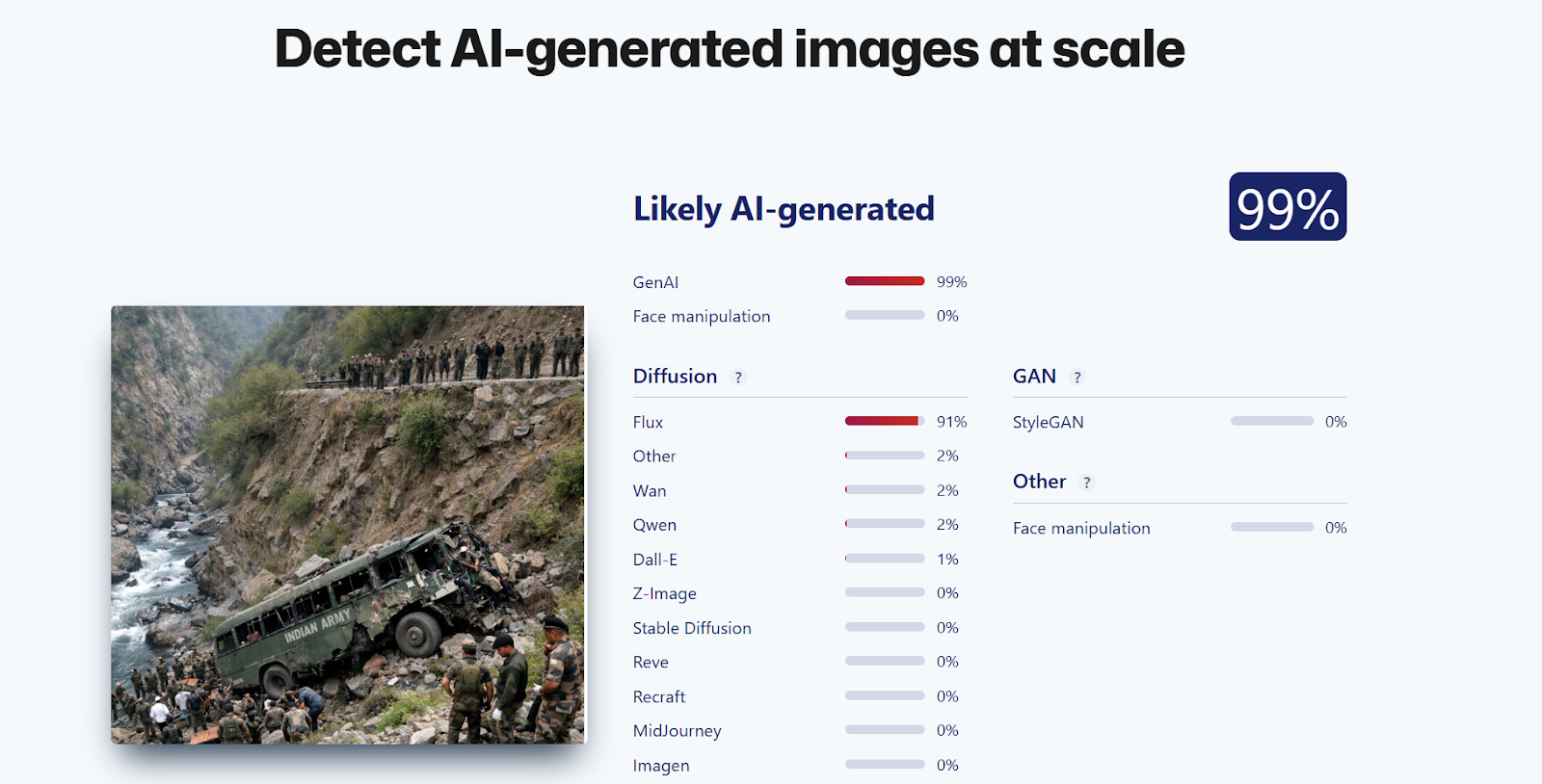
To verify the claim, we first closely examined the viral image. Several visual inconsistencies were observed. The structure of the soldier visible inside the damaged vehicle appears distorted, and the hands and limbs of people involved in the rescue operation look unnatural. These anomalies raised suspicion that the image might be AI-generated. Based on this, we ran the image through the AI detection tool Hive Moderation, which indicated that the image is over 99.9% likely to be AI-generated.
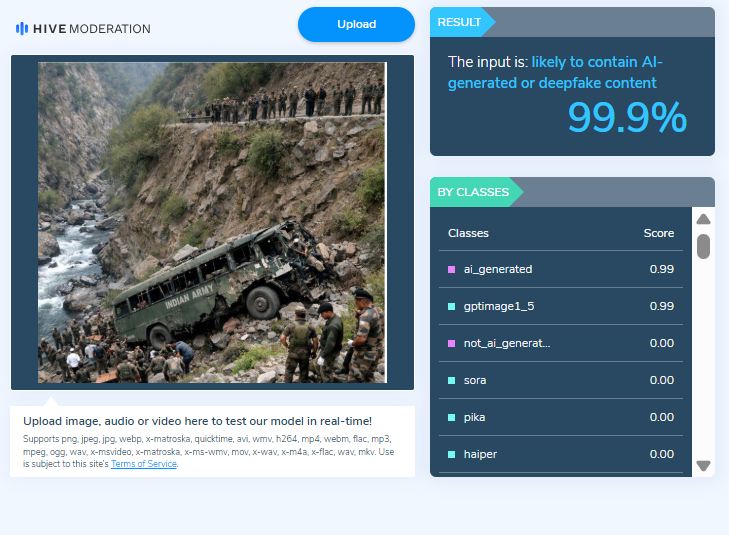
Another AI image detection tool, Sightengine, also flagged the image as 99% AI-generated.
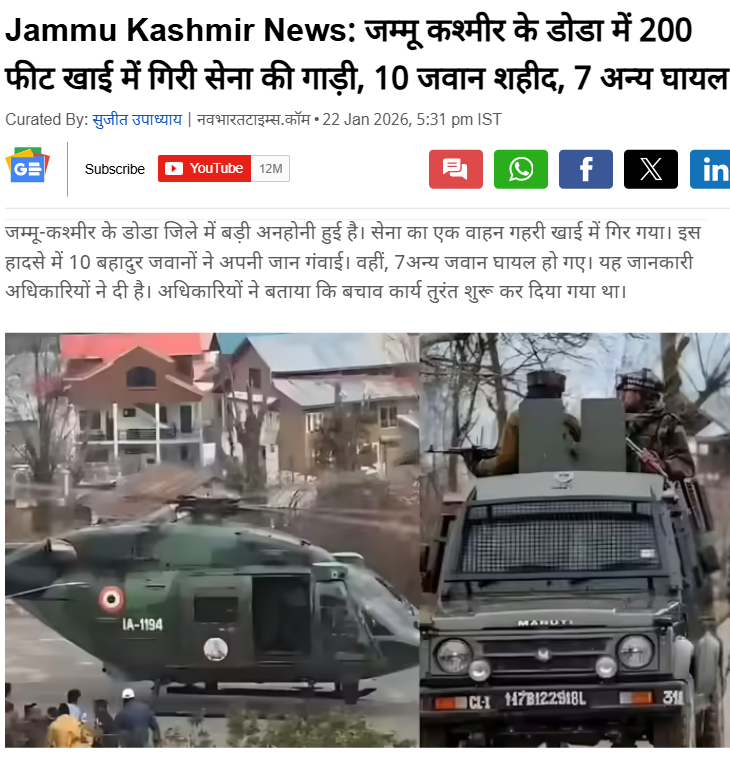
During further research , we found a report published by Navbharat Times on January 22, 2026, which confirmed that an Indian Army vehicle had indeed fallen into a deep gorge in Doda district. According to officials, 10 soldiers were killed and 7 others were injured, and rescue operations were immediately launched.
However, it is important to note that the image circulating on social media is not an actual photograph from the incident.
Conclusion
CyberPeace research confirms that the viral image linked to the Doda Army vehicle accident has been created using Artificial Intelligence. It is not a real photograph from the incident, and therefore, the viral post is misleading.
