
#FactCheck-AI-Generated Image Collage Falsely Linked to Recent Nepal Floods
Executive Summary
A collage made by combining two images is going viral on social media. It is being shared as being related to the recent devastating floods in Nepal. One image in the collage shows a beautiful town before the floods, while the other depicts the destruction caused by the flooding. A research done by the Research Wing of the CyberPeace found the viral claim to be false. The research revealed that the viral image collage circulating on social media is AI-generated and is being falsely shared as visuals of the recent floods in Nepal.
Claim:
A user on social media platform Facebook shared the viral collage with the caption: “Nepal in the morning, Nepal in the evening. The tragedy has shaken all of humanity. The flood originating from China-occupied Tibet devastated Nepal in an instant.”
The link to the post, its archived version, and a screenshot are provided below.
https://www.facebook.com/photo/?fbid=1630488505774559&set=a.467756888714399

Fact Check
To verify the authenticity of the viral images, the desk first conducted a reverse image search. However, the search did not lead us to any credible media reports or original sources featuring these images. We then closely examined the images. The analysis revealed several anomalies in the structure of the buildings, the vehicles visible on the road, and other elements in the images, further strengthening the suspicion that they were AI-generated. We then scanned the viral image using the AI detection tool Hive Moderation. The tool’s analysis indicated a 99 percent likelihood that the image was AI-generated.
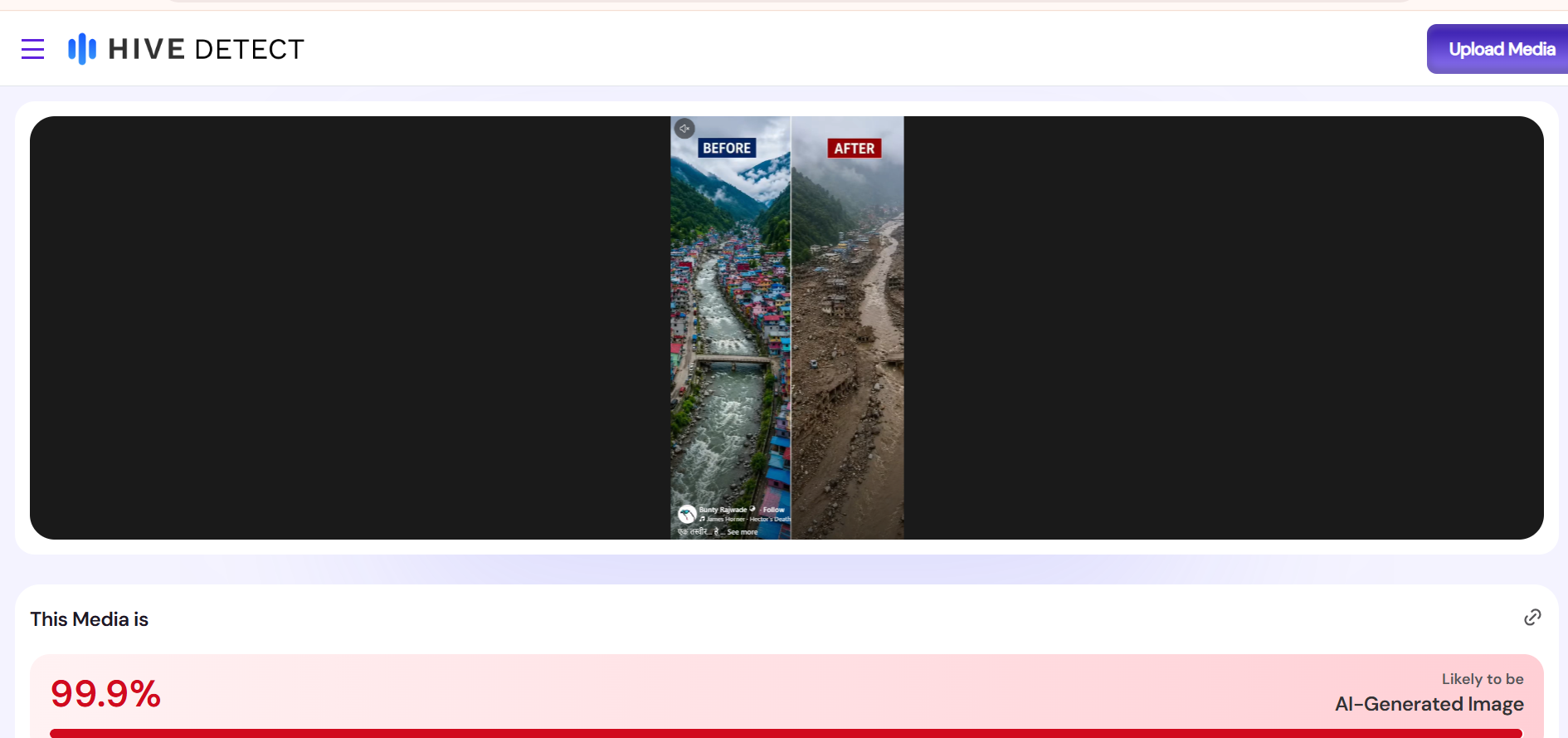
We then scanned the viral image using the AI detection tool Sightengine as well. The tool’s analysis indicated a 99 percent likelihood that the image was AI-generated.

Conclusion
Our research found that the viral collage of images being shared on social media is AI-generated and is being falsely linked to the recent floods in Nepal.

Related Blogs

Introduction
The Indian Computer Emergency Response Team, CERT-In, is the national statutory agency that responds to Cybersecurity Incidents under the Ministry of Electronics and Information Technology (MeitY) of the Government of India. CERT-In and Information Sharing and Analysis Center (ISAC) have joined hands to develop a focused pool of Cybersecurity Leaders through the National Cyber Security Scholar Program (NCSSP). This National Cyber Security Scholar Program is to create a pool of credible and ethical cybersecurity leaders in the country who prioritise national cyber security in their professional endeavours. This program allows both organisations to jointly issue joint certifications for Cohort 6 of the National Cyber Security Scholar Program (NCSSP). This certification is provided to cybersecurity professionals who complete one of the world’s leading cybersecurity management programs.
About the Program
The National Cybersecurity Scholar (NCSS) is a comprehensive 18-week, 160-hour Instructor-led program for emerging cybersecurity leaders. The ISAC will conduct the program with CERT-IN and KDEM as knowledge partners. This Cyber Security Scholar program aims to provide an extraordinary opportunity, for scholars, to gain hands-on experience in real-world scenarios through activities such as war games. It will allow scholars to acquaint themselves with roles such as that of stakeholders, including attackers, Security Operations Centre (SOC) teams, Forensicators, Chief Information Security Officers (CISOs), and CEOs, and engage in tabletop exercises that simulate a cyber crisis. This program would allow scholars to understand how responses to cyber crises impact the financial performance of an organisation, including, stock prices and sales. It offers a treasure trove of insights into the economic impact of cybersecurity decisions and the importance of proactive risk management.
The program invites applications from various scholars including Mid to senior-level leaders, diplomats and diplomatic corps officers, mid to senior-level government officials involved in homeland and cybersecurity operations, experienced executives from Managed Security Services Providers (MSSPs), faculty members who specialise in new and emerging technologies, cybersecurity professionals in CII sectors and post-doctoral or research scholars in cybersecurity.
CyberPeace Outlook
The National Cyber Security Scholar Program subsumes several key dimensions working towards building a resilient cybersecurity ecosystem for India.
- The program focuses on skill development and enhancing scholars’ knowledge in domains of network security, ethical hacking, cyber forensics, incident response, malware analysis, and threat intelligence.
- The partnership between CERT-In and ISAC, government and Industry entities, ensures that scholars are exposed to different policy-level frameworks and technical expertise, offering a unique blend of perspectives that cater to the country's national security goals and industry best practices.
- The scholar program encourages the development of new methodologies, tools, and frameworks that could be instrumental in tackling future cyber challenges and advancing India's position as a global leader in cybersecurity research and development. Research and innovation in cybersecurity are critical to the program.
- It plays a significant role in providing opportunities for career development by further providing networking platforms with professionals, researchers, and thought leaders in the cybersecurity field, giving them exposure to internships, job placements, and further academic pursuits.
This program aims to support upskilling India’s broader cyber defence strategy through the creation of highly skilled professionals. The scholars are expected to contribute actively to national cybersecurity efforts, whether through roles in government, private sector, or academia, helping to create a more secure and resilient cyberspace. The National Cyber Security Scholar Program is a major advancement in strengthening cybersecurity resilience in India. In a digital world where cyber threats crossing boundaries, such programs are essential for maintaining our national security and economic stability.
References
- https://theprint.in/ani-press-releases/cert-in-and-isac-collaborate-to-develop-focussed-pool-of-cybersecurity-leaders-through-the-national-cyber-security-scholar-program-ncssp/2318021/
- https://isacfoundation.org/national-cyber-security-scholar/
- https://cyberversefoundation.org/national-cyber-security-scholar/
.webp)
Introduction
In the labyrinthine world of digital currencies, a new chapter unfolds as India intensifies its scrutiny over the ethereal realm of offshore cryptocurrency exchanges. With nuance and determination that virtually mirrors the Byzantine complexities of the very currencies they seek to regulate, Indian authorities embark on a course of stringent oversight, bringing to the fore an ever-evolving narrative of control and compliance in the fintech sector. The government's latest manoeuvre—a directive to Apple Inc. to excise the apps of certain platforms, including the colossus Binance, from its App Store in India—signals a crescendo in the nation's efforts to rein in the unbridled digital bazaar that had hitherto thrived in a semi-autonomous expanse of cyberspace.
The directive, with ramifications as significant and intricate as the cryptographic algorithms that underpin the blockchain, stems from the Ministry of Electronics and Information Technology, which has cast eight exchanges, including Bitfinex, HTX, and Kucoin, into the shadows, rendering their apps as elusive as the Higgs boson in the vast App Store universe. The movement of these exchanges from visibility to obscurity in the digital storefront is cloaked in secrecy, with sources privy to this development remaining cloaked in anonymity, their identities as guarded as the cryptographic keys that secure blockchain transactions.
The Contention
This escalation, however, did not manifest from the vacuum of the ether; it is the culmination of a series of precipitating actions that began unfolding on December 28th, when the Indian authorities unfurled a net over nine exchanges, ensnaring them with suspicions of malfeasance. The spectre of inaccessible funds, a byproduct of this entanglement, has since haunted Indian crypto traders, prompting a migration of deposits to local exchanges that operate within the nation's regulatory framework—a fortress against the uncertainties of the offshore crypto tempest.
The extent of the authorities' reach manifests further, beckoning Alphabet Inc.'s Google to follow in Apple's footsteps. Yet, in a display of the unpredictable nature of enforcement, the Google Play Store in India still played host to the very apps that Apple's digital Eden had forsaken as of a nondescript Wednesday afternoon, marked by the relentless march of time. The triad of power-brokers—Apple, Google, and India's technology ministry—has maintained a stance as enigmatic as the Sphinx, their communications as impenetrable as the vaults that secure the nation's precious monetary reserves.
Compounding the tightening of this digital noose, the Financial Intelligence Unit of India, a sentinel ever vigilant at the gates of financial propriety, unfurled a compliance show-cause notice to the nine offshore platforms, an ultimatum demanding they justify their elusive presence in Indian cyberspace. The FIU's decree echoed with clarity amidst the cacophony of regulatory overtures: these digital entities were tethered to operations sequestered in the shadows, skirting the reach of India's anti-money laundering edicts, their websites lingering in cyberspace like forbidden fruit, tantalisingly within reach yet potentially laced with the cyanide of non-compliance.
In this chaotic tableau of constraint and control, a glimmer of presence remains—only Bitstamp has managed to brave the regulatory storm, maintaining its presence on the Indian App Store, a lone beacon amid the turbulent sea of regimentation. Kraken, another leviathan of crypto depths, presented only its Pro version to the Indian connoisseurs of the digital marketplace. An aura of silence envelops industry giants such as Binance, Bitfinex, and KuCoin, their absence forming a void as profound as the dark side of the moon in the consciousness of Indian users. HTX, formerly known as Huobi, has announced a departure from Indian operations with the detached finality of a distant celestial body, cold and indifferent to the gravitational pull of India's regulatory orbit.
Compliances
In compliance with the provisions of the Money Laundering Act (PMLA) 2002 and the recent uproar on crypto assessment apps, Apple store finally removed these apps namely Binance and Kucoin from the store after receiving show cause notice. The alleged illegal operation and failure to comply with existing money laundering laws are major reasons for their removal.
The Indian Narrative
The overarching narrative of India's embrace of rigid oversight aligns with a broader global paradigm shift, where digital financial assets are increasingly subjected to the same degree of scrutiny as their physical analogues. The persistence in imposing anti-money laundering provisions upon the crypto sector reflects this shift, with India positioning its regulatory lens in alignment with the stars of international accountability. The preceding year bore witness to seismic shifts as Indian authorities imposed a tax upon crypto transactions, a move that precipitated a downfall in trading volumes, reminiscent of Icarus's fateful flight—hubris personified as his waxen appendages succumbed to the unrelenting kiss of the sun.
On a local scale, trading powerhouses lament the imposition of a 1% levy, colloquially known as Tax Deducted at Source. This fiscal shackle drove an exodus of Indian crypto traders into the waiting, seemingly benevolent arms of offshore financial Edens, absolved of such taxational rites. As Sumit Gupta, CEO of CoinDCX, recounted, this fiscal migration witnessed the haemorrhaging of revenue. His estimation that a staggering 95% of trading volume abandoned local shores for the tranquil harbours of offshore havens punctuates the magnitude of this phenomenon.
Conclusion
Ultimately, the story of India's proactive clampdown on offshore crypto exchanges resembles a meticulously woven tapestry of regulatory ardour, financial prudence, and the inexorable progression towards a future where digital incarnations mirror the scrutinised tangibility of physical assets. It is a saga delineating a nation's valiant navigation through the tempestuous, cryptic waters of cryptocurrency, helming its ship with unwavering determination, with eyes keenly trained on the farthest reaches of the horizon. Here, amidst the fusion of digital and corporeal realms, India charts its destiny, setting its sails towards an inextricably linked future that promises to shape the contour of the global financial landscape.
References
- https://www.business-standard.com/markets/cryptocurrency/govt-escalates-clampdown-on-offshore-crypto-venues-like-binance-report-124011000586_1.html
- https://www.cnbctv18.com/technology/india-escalates-clampdown-on-offshore-crypto-exchanges-like-binance-18763111.htm
- https://economictimes.indiatimes.com/tech/technology/centre-blocks-web-platforms-of-offshore-crypto-apps-binance-kucoin-and-others/articleshow/106783697.cms?from=mdr

Executive Summary
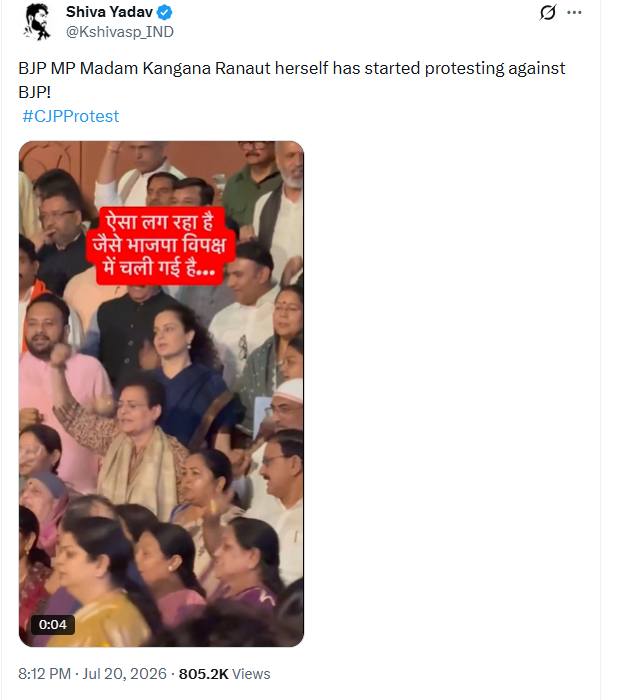
A video from the Parliament complex is being widely shared on social media with the claim that Bharatiya Janata Party (BJP) MP Kangana Ranaut has come out in support of the ongoing Cockroach Janata Party (CJP)-led protest at Delhi’s Jantar Mantar. The viral post claims that Ranaut can be seen raising slogans in support of the protesters. CyberPeace Research Wing’s research found the claim to be misleading. The viral footage is not related to the ongoing CJP protest. It dates back to April 2026, when BJP women MPs staged a demonstration outside Parliament after the 131st Constitutional Amendment Bill failed to pass. The old video is now being falsely linked to the current protest.
Claim:
On July 20, 2026, an X (formerly Twitter) user shared the viral video claiming that “BJP MP Kangana Ranaut has now started protesting against her own party.”
The post link, archive link and screenshot are provided below.
https://x.com/Kshivasp_IND/status/2079215438664233391
Fact Check:
To verify the claim, the Desk extracted keyframes from the viral video and conducted a reverse image search using Google Lens. This led to the same video uploaded on the Instagram account ashutoshjourno on April 17, 2026. The caption accompanying the post read, “Aaj Makar Dwar ka nazara alag tha” (The scene at Makar Dwar was different today).
https://www.instagram.com/reels/DXPQoIAiQ3L/

In the next stage of the research, the Desk carried out a keyword search based on the clues obtained from the Instagram post. This led to a Zee News report published on April 17, 2026, which reported that NDA MPs staged a protest outside Parliament after the 131st Constitutional Amendment Bill failed to pass. The visuals in the report matched those seen in the viral video.
https://www.instagram.com/reels/DXPL4tOky5P/

Conclusion:
CyberPeace Research Wing’s research found the viral claim to be misleading. The video is unrelated to the ongoing CJP protest at Jantar Mantar. It was recorded in April 2026, when BJP women MPs protested outside Parliament following the failure of the 131st Constitutional Amendment Bill to pass. The old footage is now being falsely shared as a recent video of Kangana Ranaut supporting the CJP protest.
