
#FactCheck: Old Video of Ranbir Kapoor Refusing Prasad Falsely Linked to Recent Ganesh Chaturthi
Executive Summary
A video of actor Ranbir Kapoor is being shared on social media amid the ongoing Ganesh festivities across the country. The video is being shared with the claim that Ranbir Kapoor refused to accept prasad on the occasion of Ganesh Chaturthi. CyberPeace Research found the claim to be misleading. Our research revealed that the viral video is from 2023. At the time, Ranbir Kapoor had attended a Ganpati puja at the T-Series office. After the puja, when he was handed a box of prasad, he gave the box to another person and said that he was on a diet.
Claim:
A user on the social media platform Facebook shared the video with the caption, “Ranbir Kapoor refused to eat prasad, saying, ‘I am on a diet.’” The post link, archive link and screenshot are provided below.
https://www.facebook.com/reel/1563843065515757

Fact Check:
To verify the viral claim, we conducted a Google search using relevant keywords. During the search, we found a report published on the Dainik Hindustan website. According to the report, the Ambani family once again hosted a Ganpati celebration.Several Bollywood celebrities, including Salman Khan, Ranbir Kapoor, Katrina Kaif and Alia Bhatt, attended the event. Photographs from the celebration were also shared on social media. However, the clothes worn by Ranbir Kapoor in the photographs featured in the report are different from those seen in the viral video. The report link and screenshot are provided below.

To verify the viral claim, we conducted a reverse image search of keyframes from the video. During the search, we found the same video on the YouTube channel of Gujarati Midday, where it was published on September 25, 2023. The report link and screenshot are provided below.
https://www.youtube.com/watch?v=JoBwpC-jr5A

According to the video description, actor Ranbir Kapoor, known for his role in the film ‘Animal’, visited the T-Series office for Ganpati darshan. Our research established that the video is from 2023 and is being shared on social media with a misleading claim by presenting it as a recent incident. At the end of our research, we found the same video on the YouTube channel of Ei Samay. It was published on September 25, 2023. The video also contains the same scene seen in the viral clip.
https://www.youtube.com/watch?v=vmDsoRu8Aco

Conclusion
Our research found that the viral video is from 2023. At the time, Ranbir Kapoor attended a Ganpati puja at the T-Series office. After the puja, when he was handed a box of prasad, he gave the box to another person and said that he was on a diet.

Related Blogs

Executive Summary
A video is being widely shared on social media with the claim that it shows the recent Assam floods, where nurses are rescuing newborn babies after water entered a hospital. The caption accompanying the viral video claims that the babies are not drowning; instead, healthcare workers and rescue teams are carrying them to safety amid floodwaters inside a hospital. It further states that the video shows humanity and courage during a time of crisis. CyberPeace Research Wing’s research found the claim to be false. The research revealed that the viral video showing healthcare workers rescuing newborn babies is not real but was created using Artificial Intelligence (AI).
Claim:
An Instagram user named kamlakritika shared the video and claimed that it showed the Assam floods. The post stated that the babies were not drowning but were being rescued by healthcare workers and rescue teams from a flooded hospital. In the viral video, several nurses can be seen running through waterlogged areas while trying to protect incubators — containers used to keep newborn babies — from being submerged or swept away. According to the caption, a devastating flood had turned the entire area into a disaster zone. It claimed that incubators containing premature newborn babies were floating in floodwaters, while nurses were running behind them amid strong water currents to save the infants. The caption further claimed that several incubators were overturning and sinking with babies inside, putting hundreds of fragile lives at risk.
https://www.instagram.com/reel/DbXvJwgz72X/?utm_source=ig_web_copy_link&igsh=NTc4MTIwNjQ2YQ==

Factcheck
To verify the claim, CyberPeace Research Wing conducted a Google search using relevant keywords. During the search, the video was found shared by several other Instagram accounts. During the research, we found a report published by News18 on August 1, 2026. Although the report was related to the Assam floods, it mentioned a different incident. According to the report, a viral video showed floodwaters surrounding houses, with water spread across the area. In the video, a rescue team member can be seen carefully carrying a newborn baby in his arms through the flooded area and handing the child over to another rescue worker near a boat so that the baby could be taken to safety.

However, during our research, we could not find any information from credible news organisations or official sources confirming the viral video showing newborn babies being rescued in incubators. As part of further research, we closely examined the viral video and noticed several indications suggesting that it could be AI-generated. The video was then analysed using the AI detection tool FauxLens, which indicated that the video was approximately 75% AI-generated.

To further verify the authenticity of the video, we also analysed it using another AI detection tool, Human Meter. The tool showed an 85% probability of the video being generated with the help of AI.

Conclusion:
CyberPeace Research Wing’s research found that the viral video claiming to show nurses rescuing newborn babies during Assam floods is false. The video is not an actual incident but an AI-generated creation.

Executive Summary
The IT giant Apple has alerted customers to the impending threat of "mercenary spyware" assaults in 92 countries, including India. These highly skilled attacks, which are frequently linked to both private and state actors (such as the NSO Group’s Pegasus spyware), target specific individuals, including politicians, journalists, activists and diplomats. In sharp contrast to consumer-grade malware, these attacks are in a league unto themselves: highly-customized to fit the individual target and involving significant resources to create and use.
As the incidence of such attacks rises, it is important that all persons, businesses, and officials equip themselves with information about how such mercenary spyware programs work, what are the most-used methods, how these attacks can be prevented and what one must do if targeted. Individuals and organizations can begin protecting themselves against these attacks by enabling "Lockdown Mode" to provide an extra layer of security to their devices and by frequently changing passwords and by not visiting the suspicious URLs or attachments.
Introduction: Understanding Mercenary Spyware
Mercenary spyware is a special kind of spyware that is developed exclusively for law enforcement and government organizations. These kinds of spywares are not available in app stores, and are developed for attacking a particular individual and require a significant investment of resources and advanced technologies. Mercenary spyware hackers infiltrate systems by means of techniques such as phishing (by sending malicious links or attachments), pretexting (by manipulating the individuals to share personal information) or baiting (using tempting offers). They often intend to use Advanced Persistent Threats (APT) where the hackers remain undetected for a prolonged period of time to steal data by continuous stealthy infiltration of the target’s network. The other method to gain access is through zero-day vulnerabilities, which is the process of gaining access to mobile devices using vulnerabilities existing in software. A well-known example of mercenary spyware includes the infamous Pegasus by the NSO Group.
Actions: By Apple against Mercenary Spyware
Apple has introduced an advanced, optional protection feature in its newer product versions (including iOS 16, iPadOS 16, and macOS Ventura) to combat mercenary spyware attacks. These features have been provided to the users who are at risk of targeted cyber attacks.
Apple released a statement on the matter, sharing, “mercenary spyware attackers apply exceptional resources to target a very small number of specific individuals and their devices. Mercenary spyware attacks cost millions of dollars and often have a short shelf life, making them much harder to detect and prevent.”
When Apple's internal threat intelligence and investigations detect these highly-targeted attacks, they take immediate action to notify the affected users. The notification process involves:
- Displaying a "Threat Notification" at the top of the user's Apple ID page after they sign in.

- Sending an email and iMessage alert to the addresses and phone numbers associated with the user's Apple ID.
- Providing clear instructions on steps the user should take to protect their devices, including enabling "Lockdown Mode" for the strongest available security.
- Apple stresses that these threat notifications are "high-confidence alerts" - meaning they have strong evidence that the user has been deliberately targeted by mercenary spyware. As such, these alerts should be taken extremely seriously by recipients.
Modus Operandi of Mercenary Spyware
- Installing advanced surveillance equipment remotely and covertly.
- Using zero-click or one-click attacks to take advantage of device vulnerabilities.
- Gain access to a variety of data on the device, including location tracking, call logs, text messages, passwords, microphone, camera, and app information.
- Installation by utilizing many system vulnerabilities on devices running particular iOS and Android versions.
- Defense by patching vulnerabilities with security updates (e.g., CVE-2023-41991, CVE-2023-41992, CVE-2023-41993).
- Utilizing defensive DNS services, non-signature-based endpoint technologies, and frequent device reboots as mitigation techniques.
Prevention Measures: Safeguarding Your Devices
- Turn on security measures: Make use of the security features that the device maker has supplied, such as Apple's Lockdown Mode, which is intended to prevent viruses of all types from infecting Apple products, such as iPhones.
- Frequent software upgrades: Make sure the newest security and software updates are installed on your devices. This aids in patching holes that mercenary malware could exploit.
- Steer clear of misleading connections: Exercise caution while opening attachments or accessing links from unidentified sources. Installing mercenary spyware is possible via phishing links or attachments.
- Limit app permissions: Reassess and restrict app permissions to avoid unwanted access to private information.
- Use secure networks: To reduce the chance of data interception, connect to secure Wi-Fi networks and stay away from public or unprotected connections.
- Install security applications: To identify and stop any spyware attacks, think about installing reliable security programs from reliable sources.
- Be alert: If Apple or other device makers send you a threat notice, consider it carefully and take the advised security precautions.
- Two-factor authentication: To provide an extra degree of protection against unwanted access, enable two-factor authentication (2FA) on your Apple ID and other significant accounts.
- Consider additional security measures: For high-risk individuals, consider using additional security measures, such as encrypted communication apps and secure file storage services
Way Forward: Strengthening Digital Defenses, Strengthening Democracy
People, businesses and administrations must prioritize cyber security measures and keep up with emerging dangers as mercenary spyware attacks continue to develop and spread. To effectively address the growing threat of digital espionage, cooperation between government agencies, cybersecurity specialists, and technology businesses is essential.
In the Indian context, the update carries significant policy implications and must inspire a discussion on legal frameworks for government surveillance practices and cyber security protocols in the nation. As the public becomes more informed about such sophisticated cyber threats, we can expect a greater push for oversight mechanisms and regulatory protocols. The misuse of surveillance technology poses a significant threat to individuals and institutions alike. Policy reforms concerning surveillance tech must be tailored to address the specific concerns of the use of such methods by state actors vs. private players.
There is a pressing need for electoral reforms that help safeguard democratic processes in the current digital age. There has been a paradigm shift in how political activities are conducted in current times: the advent of the digital domain has seen parties and leaders pivot their campaigning efforts to favor the online audience as enthusiastically as they campaign offline. Given that this is an election year, quite possibly the most significant one in modern Indian history, digital outreach and online public engagement are expected to be at an all-time high. And so, it is imperative to protect the electoral process against cyber threats so that public trust in the legitimacy of India’s democratic is rewarded and the digital domain is an asset, and not a threat, to good governance.
Executive Summary
The Central Bureau of research (CBI) is currently probing the alleged leak of the NEET-UG 2026 examination paper, and several accused persons have already been arrested in connection with the case. Amid this, a video of senior BJP leader and Defence Minister Rajnath Singh is being widely shared on social media. In the clip, he is heard saying, “There will be no resignations. This is not a UPA government, this is an NDA government.” Several users linked the video to the NEET controversy and claimed that Rajnath Singh made the remark while responding to demands for Education Minister Dharmendra Pradhan’s resignation over the alleged paper leak. However, research by the CyberPeace Research Wing found the viral claim to be false. An old video of Rajnath Singh is being misleadingly shared with a false context.
Claim
A Facebook user named “Ravi Kumar Huddi Baba” shared the viral clip on May 13, 2026, claiming that Rajnath Singh was defending the Modi government over demands for the resignation of the education minister in the NEET-UG paper leak case.

Fact Check
To verify the claim, relevant keyword searches were carried out using Google Open Search tools. No credible news reports were found confirming that Rajnath Singh had made any such statement regarding the NEET controversy or demands for Dharmendra Pradhan’s resignation. Had such a statement been made recently, it would likely have been widely reported by mainstream media outlets. A review of Rajnath Singh’s official social media accounts also yielded no such statement or video related to the NEET issue.
During the research, the full version of the viral clip was traced to an old press conference held on June 24, 2015, where Rajnath Singh and then Union Minister Ravi Shankar Prasad were briefing the media about Cabinet decisions. During the interaction, a journalist questioned them regarding resignations linked to controversies at the time. Responding to the question, Rajnath Singh made the now-viral remark. The complete press conference video is available on the BJP’s official YouTube channel and was streamed on June 24, 2015 itself. The viral portion can be heard after the 23-minute mark in the video.

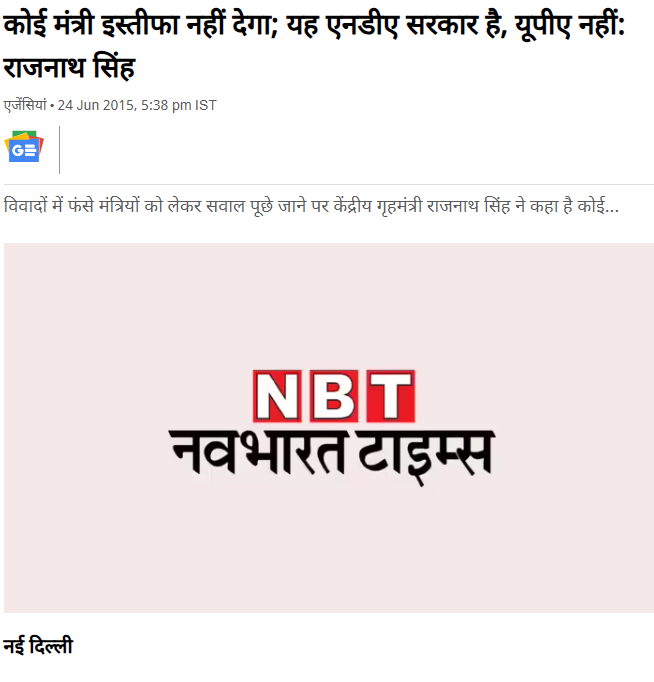
Further searches led to an old report published by Navbharat Times on June 24, 2015. The report stated that Rajnath Singh had made the “NDA, not UPA” remark while responding to questions regarding ministers embroiled in controversies at that time.
Conclusion
The viral claim is false. Rajnath Singh has not made any recent statement linking the NEET-UG 2026 paper leak case with demands for the education minister’s resignation. The viral clip is actually from a 2015 press conference and is being shared with misleading and false context.
