
#FactCheck: Old Video of Priest Being Assaulted Misleadingly Shared With False Harassment Claim
Executive Summary
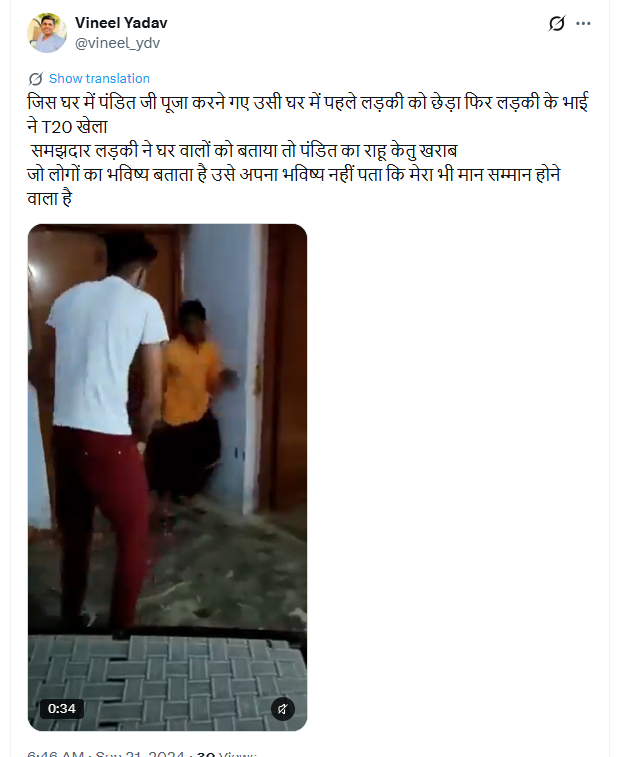
A video showing a man being beaten with a cricket bat is being widely shared on social media. It is being claimed that a priest had allegedly misbehaved with a girl at the same house where he had gone to perform a puja, following which the girl’s brother beat him up. However, our Research found the claim to be misleading. CyberPeace Research found that the video is around four years old. According to reports, the man was beaten after he allegedly objected to a cricket bat being kept inside a temple. Four youths were arrested by the police in connection with the incident.
Claim:
An X user shared the viral video with the caption: “The priest went to a house to perform a puja, where he first harassed a girl, and then the girl’s brother played T20. The sensible girl informed her family. The priest who predicts other people’s future could not predict his own—that his honour was also going to be at stake.”
https://x.com/vineel_ydv/status/1837299886921753054?s=20
https://ghostarchive.org/archive/b91vB
Fact Check
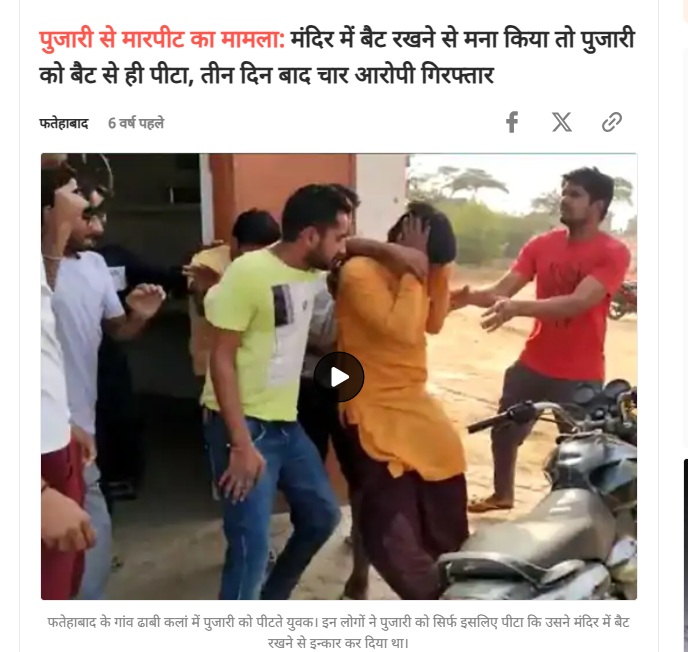
To verify the viral claim, we searched Google using relevant keywords. During the search, we did not find any credible media reports supporting the claim. To further verify the claim, we conducted a reverse image search of keyframes from the video. During the search, we found a report published by Dainik Bhaskar on November 5, 2020. According to the report, police arrested four youths in connection with the assault of a priest in Fatehabad, Haryana. The report stated that three days earlier, the youths had beaten the priest with a cricket bat after he objected to them keeping the bat inside the temple.
https://www.bhaskar.com/local/haryana/news/fatehabad-haryana-priest-beaten-with-cricket-bat-very-hardly-in-fatehabad-police-arrested-four-accused-127888122.html
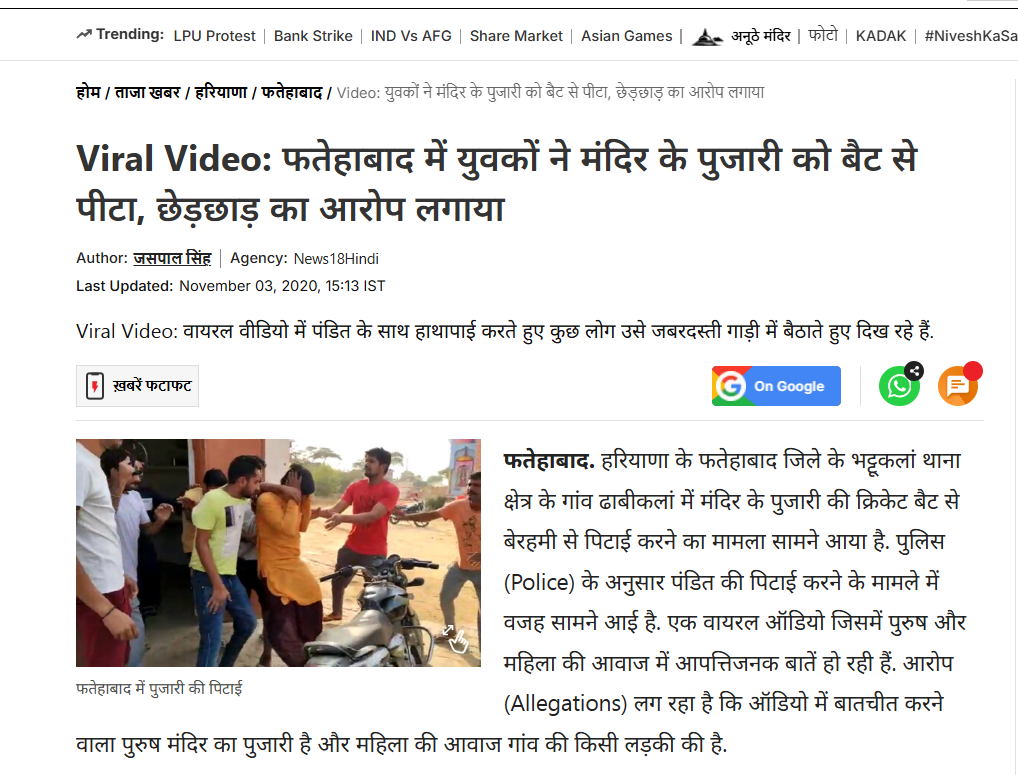
As part of the next step in our Research, we found a report published on the News18 website with a generic caption. The viral image was also included in the report.
Conclusion
Our Research found that the video is around four years old and is unrelated to the claim being circulated on social media. The incident took place after the priest objected to the youths keeping a cricket bat inside the temple, following which he was assaulted with the bat. Police subsequently arrested four youths in connection with the incident. Therefore, the claim that the priest was beaten after allegedly harassing a girl at the house where he had gone to perform a puja is misleading.

Related Blogs
.webp)
Introduction
Lawyers love saying that the devil lies in the detail, and privacy professionals in India have had a neat reminder of this. The Digital Personal Data Protection (Removal of Difficulties) Order, 2026, was issued by MeitY on 5 October and published in the Official Gazette on 7 October. It is brief: it makes two editorial corrections to the Digital Personal Data Protection Act, 2023, and these are described by MeitY as textual and editorial corrections that serve to give effect to the intention of the Parliament. This is fair language, but a careful reader will note the importance of the nuances.
What the Order is and what it is not
The Order is based on section 43(1) of the Act that allows the Central Government to make provision not inconsistent with the Act if difficulty arises in giving effect to the Act. This power is subject to some conditions. Section 43(2) states that no such order can be made after the expiry of three years from the commencement, and section 43(3) says that such order shall be laid before each House of the Parliament. So, it is just a tool for tidying up and not for rewriting the Act. According to India Briefing, the Order came into operation on the date of its publication in the Gazette.
Fix one: guardian consent for children and persons with disabilities
Section 9(1) of the Act says a Data Fiduciary must obtain verifiable consent from the parent or lawful guardian before processing the personal data of “a child or a person with disability who has a lawful guardian”. The Order inserts one small preposition so that the provision reads as the personal data of a child or of a person with a disability. As reported, the missing “of” created a grammatical disjunction between the two categories and could cloud the intended meaning, and the fix puts them side by side.
Why would that matter? Here is one way to see the risk, and to be clear, this is my own illustration and not something the Order says. Read the old phrase quickly, and you could ask whether “who has a lawful guardian” qualifies only the person with a disability or whether it also hangs on the child. The Act’s own definitions point to the answer. Section 2(j) treats the parents or lawful guardian of a child and the lawful guardian of a person with a disability as part of the Data Principal in parallel terms. Parallel treatment in the definitions and slightly tangled treatment in the operative clause is exactly the kind of mismatch that invites an argument later. The extra word shuts that door.
The stakes are not small. The Schedule to the Act sets a penalty of up to Rs 200 crore for breach of the additional obligations relating to children under section 9. Nobody wants to be in a hearing where the question is what a missing preposition was supposed to mean.
Fix two: “audit” becomes “data audit"
Section 10 adds duties for Significant Data Fiduciaries. Clause (b) of sub-section (2) requires them to appoint an independent data auditor to carry out a data audit. Clause (c)(ii), a few lines later, requires a “periodic audit” and nothing more. Same section, two audit duties, two slightly different vocabularies. The Order replaces “audit” with “data audit” in section 10(2)(c)(ii).
The reasoning behind the argument given by India Briefing is that the bare word could leave the scope of the audit ambiguous and subject of different interpretations by regulatory or supervisory authorities. One can only speculate what questions an SDF may have had to answer in the meanwhile. Does a periodic audit entail a financial audit, an information security audit, a generic internal audit or something completely different? With the amendment, the periodic audit has been tied to the compliance with data protection and data processing; fitting into the overall audit framework which the Act provides for SDFs. The Order does not combine the two obligations. The independent auditor and the periodic audit remain separate obligations. What changes is that the two now share a common language. The stakes, again, are real here as the Schedule permits a penalty of up to Rs 150 crore for violation of the additional obligations of an SDF under section 10.
Is “editorial” the right label?
Mostly, yes. India Briefing concludes that the Order does not substantially expand the Act’s obligations, and Zee Business reaches a similar view, noting that it clears up wording rather than creating a new compliance system.
Nevertheless, a label is no protection. Labelling it an editorial correction will not stop a regulator or a litigant from asserting that the text previously meant something else or that the amended text now conveys something different. Section 43 only permits the inclusion of provisions that are not inconsistent with the Act, which is exactly the point that the Government takes care to make through this text. My recommendation is that you read the Gazette text (not summaries of it) and retain a copy in your compliance file.
What privacy teams can do now
Nothing here is urgent, and that is the good news. The DPDP Rules, 2025, were notified in November 2025 with a phased timeline, and as Bar and Bench reports, most operational duties are due after an 18-month transition ending on 13 May 2027. The Rules also operationalise age verification and guardian validation, including through Digital Locker based methods, and expect enhanced governance from SDFs, including audits and risk assessments, as Khurana and Khurana notes. That leaves room to make small corrections calmly. A sensible short list looks like this:
- Check the wording of your consent flows. Make sure notices and policies that deal with children and persons with disabilities use language consistent with the amended section 9(1), and that the guardian route is clearly described.
- Align your audit vocabulary. If you are or may be notified as an SDF, use “data audit” consistently in policies, audit charters, checklists and engagement letters with your independent data auditor.
- Update your statutory reference library. Many teams quote the Act in templates and training decks. Those quotes should now match the amended text.
- Set up a Gazette watch. Notifications, rules and orders under this Act will keep arriving.
Conclusion
Privacy work is often couched in terms of grand themes such as consent, accountability and cross-border transfers. In practice, a substantial part of the work takes the form of close reading. Data Fiduciaries, auditors and the Data Protection Board will all be working from the same words, so that the distinction between 'audit' and 'data audit', or between a phrase including or omitting 'of', is the sort of gap that can decide an argument.
We therefore invite you to treat this order as a prompt to read your own documents as a regulator would. Spot points at which two terms are being used for one purpose or one term is being used to cover two purposes. Rectifying such issues now costs an afternoon's work; waiting until an inquiry is underway will require significantly more resources.
Sources
- Digital Personal Data Protection Act, 2023 (official text), Ministry of Electronics and Information Technology
- DPDP (Removal of Difficulties) Order 2026 Clarifies Consent and Data Audit Requirements in India, India Briefing
- DPDP Order 2026 clarifies data protection, consent and data audit requirements for businesses in India, Zee Business
- MeitY notifies final Digital Personal Data Protection Rules 2025, Bar and Bench
- Update: MeitY Notifies Rules Operationalising the DPDP Framework in India, Khurana and Khurana

Introduction
National AVGC-XR stands for National Animation, Visual Effects, Gaming, Comics, and Extended Reality. On 21 Aug 2024 Shri Sanjay Jaju, Secretary, Ministry of Information and Broadcasting, Speaking at the 5th Global AVGC and Immersive Media Summit 2024, announced that the National AVGC-XR Policy will be implemented soon. National AVGC-XR policy aims to facilitate investment, foster innovation, ensure skill development, protect intellectual property and help build world-class infrastructure. Additionally, Atul Kumar Tiwari, Secretary of Ministry of Skills and Entrepreneurship, said that the Centre's decision to revamp 1,000 ITIs is pivotal in aligning workforce skills with AVGC industry needs. He called for enhanced intellectual property rights to retain talent and content in India.
Key Highlights of National AVGC-XR Policy
- The policy will be implemented in conjunction with the National AVGC-XR Mission to improve India's AVGC sectors through infrastructure development, skill enhancement, innovation, and regulatory support.
- The policy aims to improve India's international competitiveness in the AVGC industry, specifically by supporting the creation of unique intellectual properties (IPs) that can gain worldwide acclaim.
- The policy acknowledges the significance of adapting and converting content for various international viewers, which has become easier considering technological advancements.
- The government is dedicated to providing strong policies and financial backing to the AVGC industry, ensuring that India continues to be a worldwide leader in the sector.
Tech-driven trends in the AVGC-XR Sector promoting exponential growth
- Advancements in technology specifically when we talk about the Animation and VFX industry, emerging trends such as AR, VR, and real-time 3D technology, are driving the expansion of the metaverse, resulting in a rising need for fresh jobs and broadening uses beyond gaming into education, e-commerce, and entertainment. Moreover, the transition to cloud-oriented production processes and the increase in unique or original content on OTT platforms are improving cooperation and propelling industry growth. To drive expansion, global OTT leaders are commissioning more original content. This has increased the need for VFX, post-production, and animation services.
- Technological advancements in India's gaming industry, like cloud gaming, increased popularity of mobile gaming, the introduction of 5G and 6G, and recognition of e-gaming at national and international forums, are breaking down obstacles and fueling swift growth, positioning India as a key player in growing e-gaming sector worldwide. Furthermore, the integration of gamification and XR in education and training is generating immersive experiences that improve learning and skill building, contributing to the expansion of the AVGC-XR industry.
- The comics industry is being transformed by technological advancements like digital technology and self-publishing, which are increasing access and distribution through online platforms and social media. The rising popularity of graphic novels and the greater use of digital comics, particularly among young audiences with smartphones, are fueling substantial growth in the AVGC-XR industry.
- The use of AR, VR, and MR (Mixed Reality) technologies is rapidly growing due to tech-driven trends in Extended Reality (XR), transforming industries such as healthcare, education, and retail. The rising number of startups in this sector, boosted by higher venture capital funding, is speeding up the uptake of XR services, establishing it as a primary catalyst of innovation and expansion in various industries.
Final Words:
Just like the IT revolution, the Indian AVGC-XR industry along with technological trends and advancements has great potential. With the growth in various sectors within the AVGC industry, the right policy framework in place and government support, it will be forefront of India’s global standing in the AVGC sectoral growth including various Intellectual Property (IP), creations, and outsourcing services. The proposed AVGC-XR policy with a forward-thinking approach will drive the industry growth. Thus, a comprehensive integrated and collaborative approach is essential. Furthermore with rising trends in technological space including the use of AR, VR, cloud spaces, 6G and expansion of the OTT sector, the safe and secure use in terms of cybersecurity is encouraged to ultimately protect the interest of users and establish a safe secure cyber world driven by exponential growth in various sectors including AVGC. We’re at the cusp of a new era, where we’re looking at technological advancements not as a tool but as a way of life, hence safe and secure usage remains a top priority.
References:
- https://www.cii.in/PressreleasesDetail.aspx?enc=IkIXRoaDhS+jXtgjqb7UcbWSnaI7mgIS485nHsQEMbw
- https://www.thehindu.com/sci-tech/technology/avgc-xr-policy-to-be-implemented-in-tandem-with-national-avgc-xr-mission-ib-secretary/article68550433.ece#:~:text=Speaking%20at%20the%20Fifth%20Global,competitiveness%20by%20fostering%20infrastructure%20development%2C
- https://mib.gov.in/sites/default/files/Annexure%20C-AVGC-XR%20-%20Draft%20for%20National%20Policy_16th%20December%202022-AG%20EDIT.pdf
- https://www.drishtiias.com/daily-updates/daily-news-analysis/potential-of-india-s-avgc-xr-sector

The Rise of Tech Use Amongst Children
Technology today has become an invaluable resource for children, as a means to research issues, be informed about events, gather data, and share views and experiences with others. Technology is no longer limited to certain age groups or professions: children today are using it for learning & entertainment, engaging with their friends, online games and much more. With increased digital access, children are also exposed to online mis/disinformation and other forms of cyber crimes, far more than their parents, caregivers, and educators were in their childhood or are, even in the present. Children are particularly vulnerable to mis/disinformation due to their still-evolving maturity and cognitive capacities. The innocence of the youth is a major cause for concern when it comes to digital access because children simply do not possess the discernment and caution required to be able to navigate the Internet safely. They are active users of online resources and their presence on social media is an important factor of social, political and civic engagement but young people and children often lack the cognitive and emotional capacity needed to distinguish between reliable and unreliable information. As a result, they can be targets of mis/disinformation. ‘A UNICEF survey in 10 countries’[1] reveals that up to three-quarters of children reported feeling unable to judge the veracity of the information they encounter online.
Social media has become a crucial part of children's lives, with them spending a significant time on digital platforms such as Youtube, Facebook, Instagram and more. All these platforms act as source of news, educational content, entertainment, peer communication and more. These platforms host a variety of different kinds of content across a diverse range of subject matters, and each platform’s content and privacy policies are different. Despite age restrictions under the Children's Online Privacy Protection Act (COPPA), and other applicable laws, it is easy for children to falsify their birth date or use their parent's accounts to access content which might not be age-appropriate.
The Impact of Misinformation on Children
In virtual settings, inaccurate information can come in the form of text, images, or videos shared through traditional and social media channels. In this age, online misinformation is a significant cause for concern, especially with children, because it can cause anxiety, damage self-esteem, shape beliefs, and skewing their worldview/viewpoints. It can distort children's understanding of reality, hinder their critical thinking skills, and cause confusion and cognitive dissonance. The growing infodemic can even cause an overdose of information. Misinformation can also influence children's social interactions, leading to misunderstandings, conflicts, and mistrust among peers. Children from low literacy backgrounds are more susceptible to fabricated content. Mis/disinformation can exacerbate social divisions amongst peers and lead to unwanted behavioural patterns. Sometimes even children themselves can unwittingly spread/share misinformation. Therefore, it is important to educate & empower children to build cognitive defenses against online misinformation risks, promote media literacy skills, and equip them with the necessary tools to critically evaluate online information.
CyberPeace Policy Wing Recommendations
- Role of Parents & Educators to Build Cognitive Defenses
One way parents shape their children's values, beliefs and actions is through modelling. Children observe how their parents use technology, handle challenging situations, and make decisions. For example, parents who demonstrate honesty, encourage healthy use of social media and show kindness and empathy are more likely to raise children who hold these qualities in high regard. Hence parents/educators play an important role in shaping the minds of their young charges and their behaviours, whether in offline or online settings. It is important for parents/educators to realise that they must pay close attention to how online content consumption is impacting the cognitive skills of their child. Parents/educators should educate children about authentic sources of information. This involves instructing children on the importance of using reliable, credible sources to utilise while researching on any topic of study or otherwise, and using verification mechanisms to test suspected information., This may sound like a challenging ideal to meet, but the earlier we teach children about Prebunking and Debunking strategies and the ability to differentiate between fact and misleading information, the sooner we can help them build cognitive defenses so that they may use the Internet safely. Hence it becomes paramount important for parents/educators to require children to question the validity of information, verify sources, and critically analyze content. Developing these skills is essential for navigating the digital world effectively and making informed decisions.
- The Role of Tech & Social Media Companies to Fortify their Steps in Countering Misinformation
Is worth noting that all major tech/social media companies have privacy policies in place to discourage any spread of harmful content or misinformation. Social media platforms have already initiated efforts to counter misinformation by introducing new features such as adding context to content, labelling content, AI watermarks and collaboration with civil society organisations to counter the widespread online misinformation. In light of this, social media platforms must prioritise both the designing and the practical implementation aspects of policy development and deployment to counter misinformation strictly. These strategies can be further improved upon through government support and regulatory controls. It is recommended that social media platforms must further increase their efforts to counter increasing spread of online mis/disinformation and apply advanced techniques to counter misinformation including filtering, automated removal, detection and prevention, watermarking, increasing reporting mechanisms, providing context to suspected content, and promoting authenticated/reliable sources of information.
Social media platforms should consider developing children-specific help centres that host educational content in attractive, easy-to-understand formats so that children can learn about misinformation risks and tactics, how to spot red flags and how to increase their information literacy and protect themselves and their peers. Age-appropriate, attractive and simple content can go a long way towards fortifying young minds and making them aware and alert without creating fear.
- Laws and Regulations
It is important that the government and the social media platforms work in sync to counteract misinformation. The government must consult with the concerned platforms and enact rules and regulations which strengthen the platform’s age verification mechanisms at the sign up/ account creation stage whilst also respecting user privacy. Content moderation, removal of harmful content, and strengthening reporting mechanisms all are important factors which must be prioritised at both the regulatory level and the platform operational level. Additionally, in order to promote healthy and responsible use of technology by children, the government should collaborate with other institutions to design information literacy programs at the school level. The government must make it a key priority to work with civil society organisations and expert groups that run programs to fight misinformation and co-create a safe cyberspace for everyone, including children.
- Expert Organisations and Civil Societies
Cybersecurity experts and civil society organisations possess the unique blend of large scale impact potential and technical expertise. We have the ability to educate and empower huge numbers, along with the skills and policy acumen needed to be able to not just make people aware of the problem but also teach them how to solve it for themselves. True, sustainable solutions to any social concern only come about when capacity-building and empowerment are at the heart of the initiative. Programs that prioritise resilience, teach Prebunking and Debunking and are able to understand the unique concerns, needs and abilities of children and design solutions accordingly are the best suited to implement the administration’s mission to create a safe digital society.
Final Words
Online misinformation significantly impacts child development and can hinder their cognitive abilities, color their viewpoints, and cause confusion and mistrust. It is important that children are taught not just how to use technology but how to use it responsibly and positively. This education can begin at a very young age and parents, guardians and educators can connect with CyberPeace and other similar initiatives on how to define age-appropriate learning milestones. Together, we can not only empower children to be safe today, but also help them develop into netizens who make the world even safer for others tomorrow.
References:
- [1] Digital misinformation / disinformation and children
- [2] Children's Privacy | Federal Trade Commission
