
#FactCheck: Old Video of Girl Mourning Her Father’s Death in Bangladesh Falsely Linked to Recent Death Sentences in Saudi Arabia
Executive Summary
A disturbing video showing a girl placing soil on a grave is going viral on social media. In the video, a young girl can be seen crying as she places soil on a grave in the presence of several people. The video is being shared in connection with Bangladeshi nationals allegedly killed in Saudi Arabia. It is claimed that her parents were killed while making a reel inside a mosque in Saudi Arabia and that she is placing soil on their grave.
CyberPeace Research found that the video of the girl placing soil on a grave dates back to May 2026. In reality, a Bangladeshi national named Sajal died in Saudi Arabia after a tree fell on him while he was eating. The girl seen in the video is Sajal’s daughter. The video is now being shared with a false claim linking it to a man and a woman who were recently sentenced to death in Saudi Arabia.
Claim:
A user on X shared the video with the caption: “At the age of 6 or 7, this little girl is placing soil on the graves of both her mother and father. Their crime was that they kissed each other while making reels inside a mosque in Saudi Arabia.”
https://x.com/jpsin1/status/2112109435393024287

Fact Check
During our research, we found a photograph of the girl seen in the viral video in a report published on May 6, 2026, by another Bangladeshi news website, Bhorer Kagoj (bhorerkagoj.net). The report stated that Sajal Howlader, 31, son of Imadul Howlader, a resident of Ward No. 4 of Khanda village under Rayenda Union No. 3 in Sharankhola Upazila, died after being crushed by a tree in Saudi Arabia.
According to the report, Sajal’s father, Imadul, said that on May 2, at around 4:30 p.m. Saudi Arabia time, Sajal and five other people were sitting under a tree and eating rice when a large she-oak tree fell on them. The five other people sitting under the tree survived, but Sajal died after being crushed by it.
The report also stated that Sajal’s daughter had appealed to Bangladesh Prime Minister Tarique Rahman to bring her father’s body back from Saudi Arabia.
https://www.bhorerkagoj.net/country/786354

Upon further research, we found a detailed report about the incident published by the Bangladeshi news website Daily Ajker Songram (dailyajkersongram.com). The report stated that 31-year-old Mohammad Sajal died in Saudi Arabia after a tree fell on him.
His body arrived at Hazrat Shahjalal International Airport at around 11 a.m. on May 25, 2026. After the completion of the legal formalities, Sajal’s body reached his hometown of Sharankhola on May 26, 2026.
https://www.dailyajkersongram.com/2026/05/27/

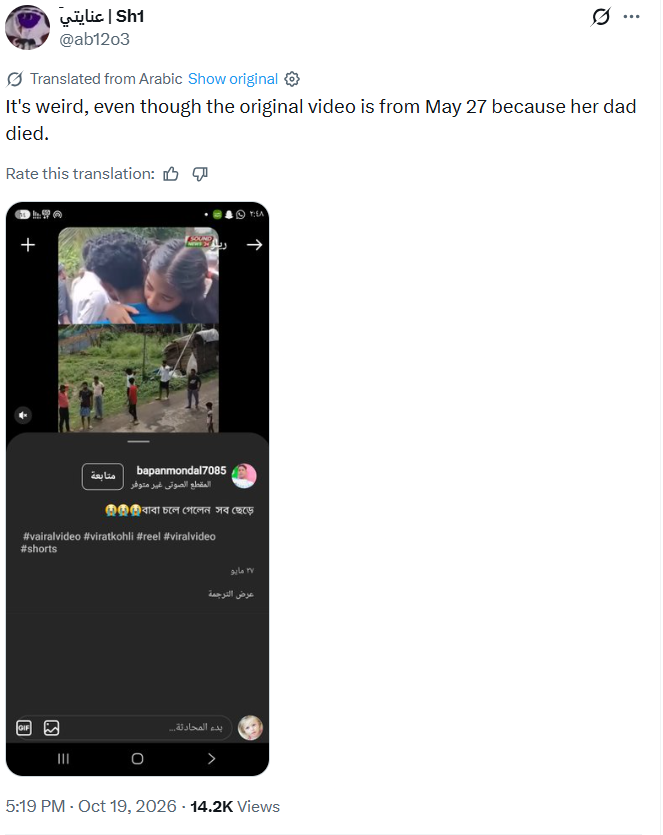
An X account also shared the video, claiming that the original video dates back to May 27, when the girl’s father had died.
https://x.com/ab12o3/status/2112149070764482702
Conclusion
Our research found that the video showing a girl placing soil on a grave dates back to May 2026. In reality, a Bangladeshi national named Sajal died in Saudi Arabia after a tree fell on him while he was eating. The girl seen in the video is Sajal’s daughter. The video is now being shared with a false claim linking it to a man and a woman who were recently sentenced to death in Saudi Arabia.

Related Blogs
Introduction
For years, Indian companies could get away with vague privacy promises. That window closed on 13 November 2025, when the government notified the Digital Personal Data Protection Rules, giving teeth to the broad principles Parliament had passed back in 2023 under the DPDP Act. The Rules turned soft commitments into specific, auditable duties, and a lot of organisations are only now realising how much that actually changes.
Start with Section 8(4). It requires every Data Fiduciary to put "appropriate technical and organisational measures" in place. Most readers skim past "organisational" and focus on the technical half, but that's a mistake, because the word is doing real work. It's asking for defined roles, written policies, staff training, and someone actually watching whether any of it holds up over time, not just firewalls and encryption keys. Section 8(5) goes further, demanding reasonable security safeguards against breaches, and Rule 6 spells out exactly what that phrase means in practice: encrypt data at rest and in transit, restrict access on a need to know basis, require multi factor authentication, log and monitor activity, run regular vulnerability checks, bind your data processors contractually to the same standard, and keep relevant logs for at least a year.
Then there's Rule 7, and this is where the clock starts running. Once a Data Fiduciary becomes aware of a breach, the Data Protection Board must be told without delay, and a full report has to follow within 72 hours covering what happened, when, why, what's being done about it, and confirmation that affected individuals were notified. Unlike GDPR, there's no minimum severity threshold here. A breach affecting ten people triggers the same obligation as one affecting ten million. And CERT-In's existing six hour reporting window under its 2022 Directions still applies separately, which means a serious incident can trigger two overlapping regulatory clocks running side by side.
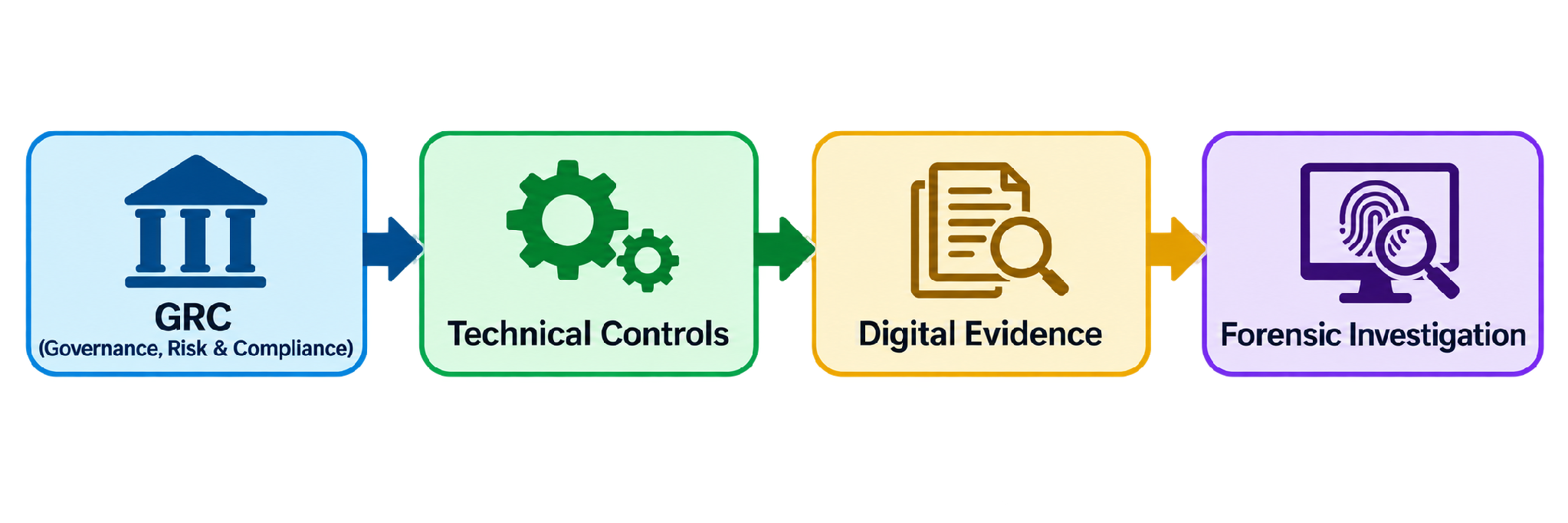
Put all of this together and a pattern emerges. The law assumes an organisation already knows what it's protecting, has actually protected it, kept usable records the whole way through, and can explain clearly what happened the moment something breaks. That coordination job belongs to Governance, Risk and Compliance, or GRC for short. GRC decides who's accountable, which risks actually matter, which controls address them, and how anyone checks whether compliance is real rather than assumed. Skip that structure and security work tends to splinter into a pile of disconnected tasks nobody truly owns.
GRC gives a legal duty somewhere to live. Forensic readiness is what lets an organisation prove, months or years later, that the duty was actually being met.
The Role of Governance, Risk and Compliance
On paper, most cybersecurity programmes look fine. There's an incident response plan somewhere, access control rules exist, logging is "in place," and someone has a title that says they're responsible for security. None of that gets tested until something actually breaks. A phishing compromise, a ransomware infection, a leaked database, a hijacked admin account, whatever the trigger, the questions that follow are always the same, and they're not comfortable ones. What happened, exactly, and when did it start? Which systems, which data, were actually touched? Were the controls the organisation claims to run genuinely functioning at that moment, or just described in a slide deck somewhere? And can anyone produce records solid enough to answer those questions with confidence rather than a shrug?
This is the exact seam where GRC and digital forensics meet. GRC lays out what's expected, who's responsible, and what evidence a control should be generating in the background. Digital forensics is the craft of taking whatever technical traces actually exist and turning them into an account of events that will hold up to scrutiny. Passing an audit was never really the point. Being able to stand in front of a regulator, mid incident, and show that the processes described on paper were real, active, and generating trustworthy evidence, that's the actual bar.
Why Compliance Alone Falls Short
Compliance, in the narrow sense, just means meeting whatever legal, contractual, or internal requirement applies. But a policy sitting in a document repository proves nothing about what actually happens on a Tuesday afternoon when someone requests admin access. A written incident response plan says nothing about whether the team can actually execute it under real pressure, at 2am, with a ransomware note on every screen. A logging policy is close to worthless if the logs it promises were switched off somewhere along the way, or overwritten, or scattered across systems that were never synchronised to the same clock.
NIST's Cybersecurity Framework 2.0 essentially built this concern into its core structure, placing "Govern" alongside Identify, Protect, Detect, Respond, and Recover as one of five equal functions rather than background paperwork sitting off to the side. India's own regulatory posture pushes in the same direction. CERT-In's 2022 Directions require certain incidents to be reported within six hours of discovery, and its guidance for government entities leans heavily on documented incident handling and disciplined evidence practices. The underlying message from both is identical: figure out, before anything goes wrong, whether the evidence you'll eventually need is actually going to exist when someone asks for it.
Where GRC and Forensics Actually Connect
A good GRC programme spells out what's supposed to happen. Forensic readiness is what lets you later prove what actually did.
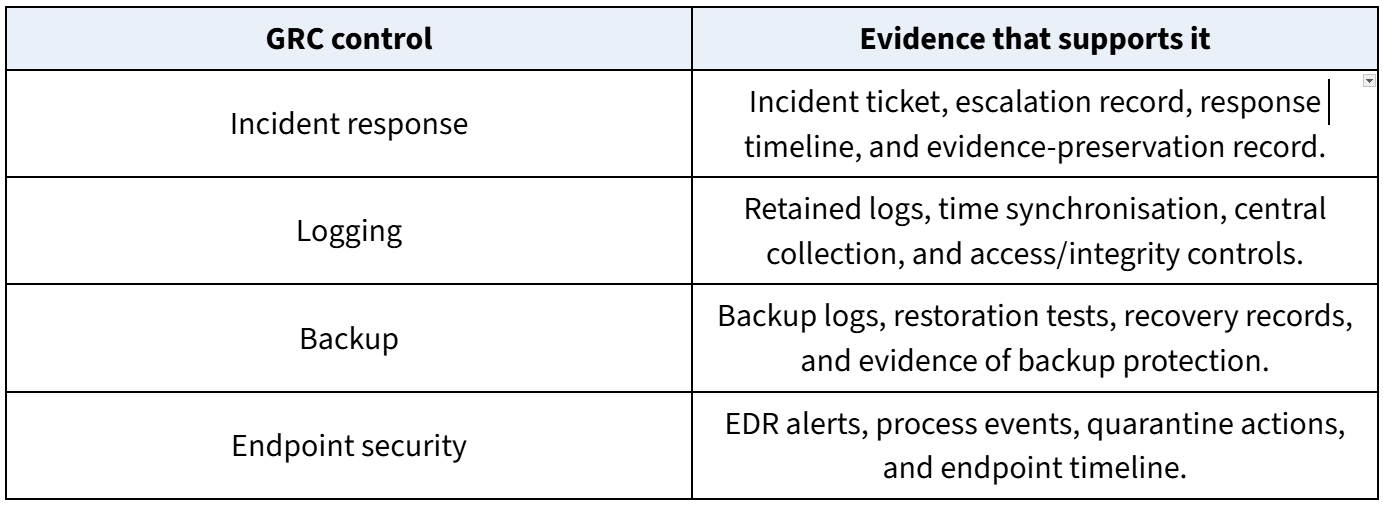
Access control is a useful example here. On the GRC side, an organisation might require least privilege access, multi factor authentication, periodic reviews of who holds privileged accounts, and prompt removal of access once someone leaves or changes roles. On the forensic side, none of that means anything without the underlying records that let investigators actually test it, authentication logs, MFA usage history, privilege change records, and account activity trails. The table below lines up a few common GRC controls against the specific evidence needed to show they were genuinely operating.
A Practical Scenario: After a Ransomware Incident
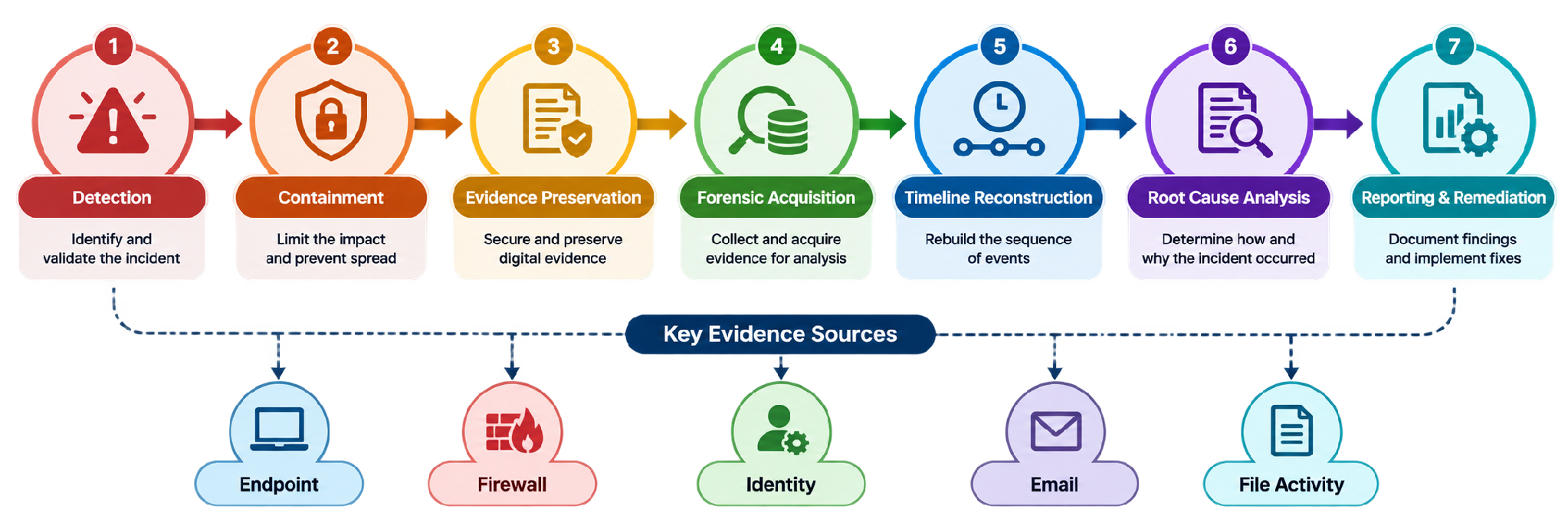
Picture a mid-sized company waking up to find half its file servers encrypted. There's an incident response plan somewhere in the shared drive, technically, but nobody's actually run through it in over a year. The security team isolates the obviously compromised endpoint and starts escalating. Now the forensic side of the house has to reconstruct what happened, working backward through endpoint telemetry, authentication logs, firewall events, email traffic, and file activity, hunting for the original point of entry, how the attacker escalated privileges, how they moved sideways through the network, what data they actually touched, and finally how the ransomware got deployed.
This is where the quality of everything collected beforehand suddenly matters a great deal. If server clocks were never properly synchronised, the timeline investigators build might not line up cleanly enough to trust. If logs only ever lived locally on individual machines rather than being pulled centrally, some of them are probably gone by now. If nobody ever bothered logging administrator actions, there are going to be real, unexplained gaps in the story. And if whatever evidence does exist wasn't collected the right way, its integrity can be challenged later, sometimes fatally, in a legal or regulatory proceeding. CERT-In actually ran a programme on exactly this in July 2026, "Inside the Breach," covering system artefacts, investigative technique, and chain of custody requirements, precisely because this is where real investigations tend to succeed or quietly fall apart.
Building a Forensic Ready GRC Programme
For an organisation starting more or less from scratch, forensic readiness doesn't need to be bolted on as some separate initiative. It can be built straight into the GRC programme that already exists. Start by identifying the systems, applications, cloud services, and privileged accounts that actually matter. Map the real risks and regulatory requirements onto the controls meant to address them. Then get specific about what evidence each control should be generating, and how that evidence gets protected and kept over time. Time synchronisation, centralised logging, tightly controlled access to security records, and clear ownership of preservation, escalation, and investigation all need to exist well before an incident, not be improvised during one. And none of it means much until it's actually been tested, through tabletop exercises and simulated incidents rather than assumed to work because it's written down somewhere. NIST SP 800-61 Revision 3 frames incident response as one continuous loop of preparation, detection, response, recovery, and improvement, rather than a series of separate boxes to check.
There's one question worth asking of every important control an organisation runs: could you actually prove this was working at the moment an incident happened? If the honest answer is no, what you have is a compliance process on paper, and a forensic readiness gap sitting quietly underneath it.
Conclusion
Cyber readiness was never really about how many policies sit in a binder or how many boxes get ticked in an audit. It shows up, or doesn't, in the hours right after something breaks, when an organisation has to move fast, preserve evidence that can actually stand up to scrutiny, explain clearly what happened, and prove that governance and technical controls were genuinely working together rather than just coexisting on paper. GRC sets the direction, the accountability, the risk priorities, and the compliance expectations. Digital forensics does the work of preserving and interpreting the technical evidence once something actually happens. Forensic readiness sits in between the two, making sure they're actually talking to each other long before an incident forces the conversation. The practical task for most organisations comes down to something simple to say, if not always simple to build: design controls that hold up under real incident response, not just an auditor's checklist. The strongest compliance posture was never the one with the thickest binder. It's the one that can back every document up with evidence, on the day it actually matters.
References
- Digital Personal Data Protection Act, 2023, Sections 8(4), 8(5), 8(6). https://www.meity.gov.in/writereaddata/files/Digital%20Personal%20Data%20Protection%20Act%202023.pdf
- Digital Personal Data Protection Rules, 2025, Rules 6 and 7, notified 13 November 2025. https://www.meity.gov.in
- National Institute of Standards and Technology, The NIST Cybersecurity Framework (CSF) 2.0, CSWP 29, 2024. https://csrc.nist.gov/pubs/cswp/29/the-nist-cybersecurity-framework-csf-20/final
- Indian Computer Emergency Response Team (CERT-In), Directions under Section 70B of the Information Technology Act, 2000, dated 28 April 2022. https://www.cert-in.org.in/Directions70B.jsp
- Indian Computer Emergency Response Team (CERT-In), Guidelines on Information Security Practices for Government Entities. https://www.cert-in.org.in/Downloader?fileName=CIPS-2026-0014.pdf&pageid=5&type=2
- National Institute of Standards and Technology, SP 800-86: Guide to Integrating Forensic Techniques into Incident Response, 2006. https://csrc.nist.gov/pubs/sp/800/86/final
- International Organization for Standardization, ISO/IEC 27037:2012, Guidelines for identification, collection, acquisition and preservation of digital evidence. CERT-In, "Inside the Breach: Advanced Cyber Forensics & Incident Investigation," 31 July 2026. https://www.cert-in.org.in/s2cMainServlet?pageid=PRSTNVIEW03&reCode=CIWS-2026-3569
- National Institute of Standards and Technology, SP 800-61 Rev. 3: Incident Response Recommendations and Considerations for Cybersecurity Risk Management, 2025. https://csrc.nist.gov/pubs/sp/800/61/r3/final
- Matters.ai, "DPDP Breach Notification: 72-Hour Rule & ₹200 Cr Penalty." https://www.matters.ai/article/dpdp-breach-notification MediaNama, "Data Breach Reporting Timeline of DPDP Rules 2025 Explained." https://www.medianama.com/2025/11/223-data-breach-reporting-timeline-of-dpdp-rules-2025-explained/

Introduction
The Chairman of Vardhman Group, Mr SP Oswal, an India-based textile manufacturer, fell victim to a cyber fraud scheme that cost him ₹7 crore. The scam unfolded on August 28 and 29, conning Mr Oswal into transferring Rs 7 crore into multiple bank accounts. As per the recent reports, the Police have managed to freeze these accounts and recover over Rs 5 crore as of now. The fraudsters convinced Mr SP Oswal that he was a suspect in a money laundering investigation and held on a “Digital Arrest”. These are sophisticated cyber frauds where cyber-criminals impersonate law enforcement officials or other authorities and target innocent individuals with manipulative tactics. The scam targets are often contacted out of the blue, on Instant messaging apps like WhatsApp and informed that their bank accounts, digital identities, or other online assets have been compromised. Criminals play into the victims' fear by threatening them with imminent arrest, legal consequences, or public humiliation if they don't cooperate with a series of urgent demands.
Posing as Officials, Fraudsters Orchestrate ₹7 Crore Scam
The investigation revealed that the fraudsters posed as members of the Central Bureau of Investigation (CBI). They had contacted Mr Oswal and claimed that his Aadhaar had been misused in a case involving fake passports and financial fraud. The imposter conducted a video call in a police uniform using a background with the CBI logo. The fraud escalated further, Mr Oswal got a fake "arrest warrant" on WhatsApp allegedly authorised by the Supreme Court. Fraudsters convinced Mr Oswal to transfer ₹7 crores to facilitate bail proceedings, claiming he was under "digital arrest". The meticulously planned scam involved fake documents, a virtual courtroom, and relentless intimidation tactics leaving Mr Oswal effectively under "digital arrest" for two days. While the police have successfully recovered over Rs 5 crore so far, this case highlights the alarming threat of digital impersonation of law enforcement authorities.
Legal Outlook on the Validity of Digital Arrests
In India, the main laws governing cyber crimes are the Information Technology Act, of 2000 and the rules made under therein, and the newly enacted Bhartiya Nyaya Sanhita, 2023. Recently enacted new criminal laws do not provide for any provision for law enforcement agencies conducting a digital arrest. The law only provides for service of the summons and the proceedings in an electronic mode. Hence, there are no provisions for conducting 'digital arrests' as per the laws of the country.
Further, It should be noted that the Indian Cyber Crime Coordination Centre (I4C), under the Ministry of Home Affairs, coordinates the activities related to combating cybercrime in the country. MHA works closely with other ministries to counter these frauds. The I4C also provides technical support to the police authorities of states/UTs for the identification and investigation of these cases.
Best Practices to Avoid Digital Arrest Scams
- To protect yourself from scams, it is crucial to verify the identity of individuals claiming to be law enforcement or government officials and use official contact channels to confirm their credentials.
- Be cautious of pressure tactics used by fraudsters, especially demands for quick payment over unverified communication platforms like WhatsApp.
- Cross-check official documents with legal advisors or relevant authorities.
- Never share sensitive personal information, such as your Aadhaar number, over phone calls, emails, or messages without verifying the request's authenticity.
- Avoid untraceable payments, such as cryptocurrency or prepaid cards, without validating the transaction's legitimacy, especially under duress.
- Stay informed on scam techniques, particularly those involving impersonation and digital threats.
- Enable Two-Factor Authentication (2FA) for sensitive online accounts to prevent misuse.
- Consult advice from legal professionals if you receive threatening communication involving digital arrest or legal actions and do not take any action on the asks of persons posing as legitimate authorities.
- In case of any cybercrime, you can file a complaint at cybercrime.gov.in or helpline number 1930. You can also seek assistance from the CyberPeace helpline at +91 9570000066.
Conclusion
The digital arrest of Vardhman Group's CEO underscores the increasing sophistication of cyber fraud schemes, which exploit fear and urgency, leading to severe financial and reputational harm. No one is immune from cybercrime, vigilance is essential at all leadership levels. While laws like the IT Act and initiatives taken by the I4C help combat cybercrime, rapidly evolving threats demand proactive safety measures. Beyond the possibility of financial loss, incidents like this jeopardise brand reputation, investor confidence, and operational stability. Be cautious of such threats and exercise due care and caution while navigating the digital landscape. Be aware of such kinds of scams and the manipulative tactics used by fraudsters to avoid them. By staying vigilant and aware we can avoid the growing scam of digital arrests.
References
- https://www.business-standard.com/companies/news/digital-arrest-and-rs-7-crore-heist-how-vardhman-group-head-was-tricked-124100100832_1.html
- https://www.hindustantimes.com/business/vardhman-group-chairman-sp-oswal-duped-of-rs-7-crore-fraudsters-posed-as-cbi-101727666912738.html
- https://www.msspalert.com/native/digital-arrests-the-new-frontier-of-cybercrime

Overview:
In today’s digital landscape, safeguarding personal data and communications is more crucial than ever. WhatsApp, as one of the world’s leading messaging platforms, consistently enhances its security features to protect user interactions, offering a seamless and private messaging experience
App Lock: Secure Access with Biometric Authentication
To fortify security at the device level, WhatsApp offers an app lock feature, enabling users to protect their app with biometric authentication such as fingerprint or Face ID. This feature ensures that only authorized users can access the app, adding an additional layer of protection to private conversations.
How to Enable App Lock:
- Open WhatsApp and navigate to Settings.
- Select Privacy.
- Scroll down and tap App Lock.
- Activate Fingerprint Lock or Face ID and follow the on-screen instructions.

Chat Lock: Restrict Access to Private Conversations
WhatsApp allows users to lock specific chats, moving them to a secured folder that requires biometric authentication or a passcode for access. This feature is ideal for safeguarding sensitive conversations from unauthorized viewing.
How to Lock a Chat:
- Open WhatsApp and select the chat to be locked.
- Tap on the three dots (Android) or More Options (iPhone).
- Select Lock Chat
- Enable the lock using Fingerprint or Face ID.

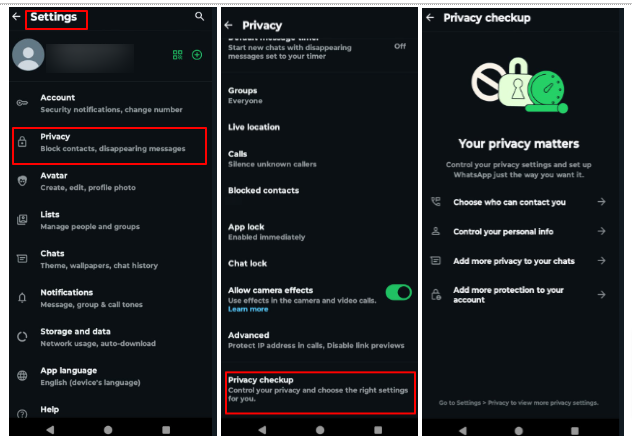
Privacy Checkup: Strengthening Security Preferences
The privacy checkup tool assists users in reviewing and customizing essential security settings. It provides guidance on adjusting visibility preferences, call security, and blocked contacts, ensuring a personalized and secure communication experience.
How to Run Privacy Checkup:
- Open WhatsApp and navigate to Settings.
- Tap Privacy.
- Select Privacy Checkup and follow the prompts to adjust settings.
Automatic Blocking of Unknown Accounts and Messages
To combat spam and potential security threats, WhatsApp automatically restricts unknown accounts that send excessive messages. Users can also manually block or report suspicious contacts to further enhance security.
How to Manage Blocking of Unknown Accounts:
- Open WhatsApp and go to Settings.
- Select Privacy.
- Tap to Advanced
- Enable Block unknown account messages

IP Address Protection in Calls
To prevent tracking and enhance privacy, WhatsApp provides an option to hide IP addresses during calls. When enabled, calls are routed through WhatsApp’s servers, preventing location exposure via direct connections.
How to Enable IP Address Protection in Calls:
- Open WhatsApp and go to Settings.
- Select Privacy, then tap Advanced.
- Enable Protect IP Address in Calls.

Disappearing Messages: Auto-Deleting Conversations
Disappearing messages help maintain confidentiality by automatically deleting sent messages after a predefined period—24 hours, 7 days, or 90 days. This feature is particularly beneficial for reducing digital footprints.
How to Enable Disappearing Messages:
- Open the chat and tap the Chat Name.
- Select Disappearing Messages.
- Choose the preferred duration before messages disappear.

View Once: One-Time Access to Media Files
The ‘View Once’ feature ensures that shared photos and videos can only be viewed a single time before being automatically deleted, reducing the risk of unauthorized storage or redistribution.
How to Send View Once Media:
- Open a chat and tap the attachment icon.
- Choose Camera or Gallery to select media.
- Tap the ‘1’ icon before sending the media file.

Group Privacy Controls: Manage Who Can Add You
WhatsApp provides users with the ability to control group invitations, preventing unwanted additions by unknown individuals. Users can restrict group invitations to ‘Everyone,’ ‘My Contacts,’ or ‘My Contacts Except…’ for enhanced privacy.
How to Adjust Group Privacy Settings:
- Open WhatsApp and go to Settings.
- Select Privacy and tap Groups.
- Choose from the available options: Everyone, My Contacts, or My Contacts Except

Conclusion
WhatsApp continuously enhances its security features to protect user privacy and ensure safe communication. With tools like App Lock, Chat Lock, Privacy Checkup, IP Address Protection, and Disappearing Messages, users can safeguard their data and interactions. Features like View Once and Group Privacy Controls further enhance confidentiality. By enabling these settings, users can maintain a secure and private messaging experience, effectively reducing risks associated with unauthorized access, tracking, and digital footprints. Stay updated and leverage these features for enhanced security.
