
#FactCheck-AI-Generated Audio Falsely Attributed to Former Western Army Commander Lt Gen Manoj Kumar Katiyar in Viral Video
Executive Summary
A video is going viral on social media purportedly showing former Western Army Commander Lieutenant General Manoj Kumar Katihar expressing concerns over India's military preparedness. In the video, he claims that several Indian aircraft were shot down during the conflict with Pakistan on May 10. He further claims that China has advanced 25 kilometres into Arunachal Pradesh and that the Indian Army has failed to stop its incursion. CyberPeace Research found the claim to be false. Our research revealed that the audio in the viral video is AI-generated.
Claim
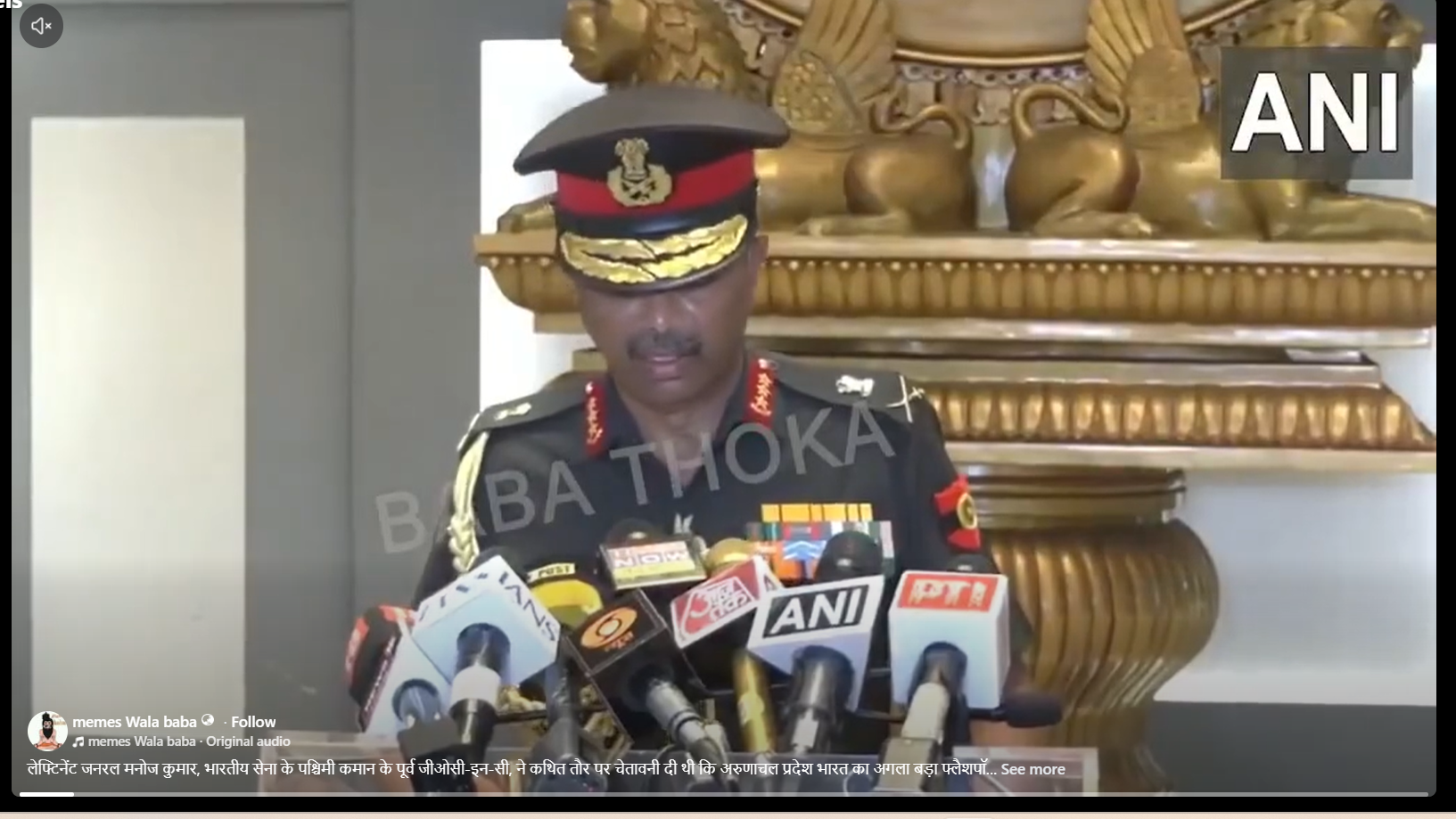
Social media users are claiming that former General Officer Commanding-in-Chief (GOC-in-C) of the Indian Army's Western Command, Lieutenant General Manoj Kumar, had warned that Arunachal Pradesh could become India's next major flashpoint.
https://www.facebook.com/reel/1785558896015331
Fact Check
We searched Google using the keywords “Lt Gen Manoj Kumar Katiyar”, “Arunachal Pradesh” and “China”. However, we did not find any credible media report attributing such a statement to Manoj Kumar Katiyar. We also examined the official social media accounts of the Western Command but found no such statement there either.
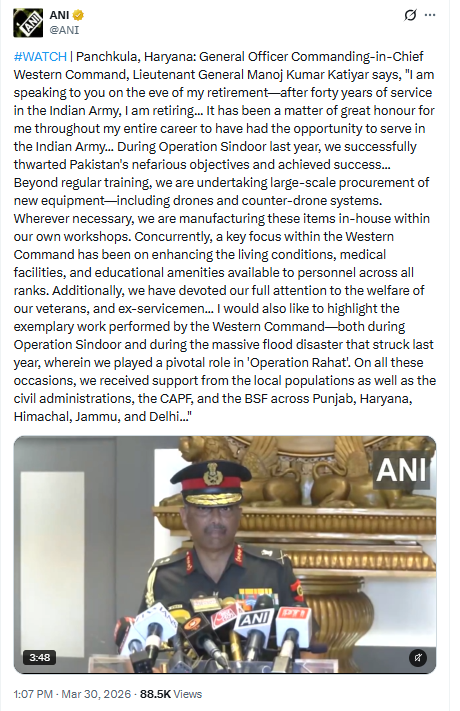
We then conducted a reverse image search of the keyframes from the viral video using Google Lens. During the search, we found a post published by news agency ANI on March 30, 2026, featuring visuals similar to those seen in the viral video. The ANI logo is also visible in the viral video.
https://x.com/ANI/status/2038520988682625491
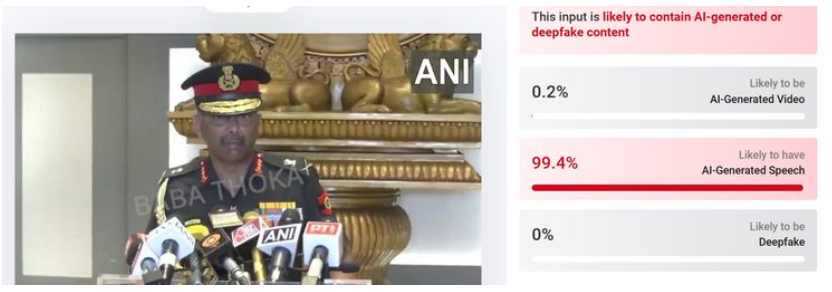
To determine the truth about the video, we used several AI detection tools. Among these, Hive Moderation indicated that the video might have been created using AI or deepfake technology.
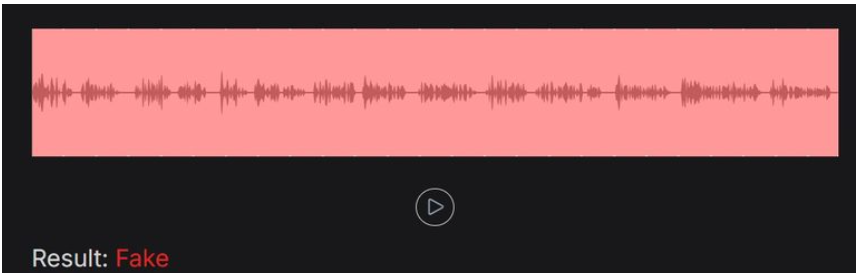
Resemble AI also identified the audio in the video as AI-generated.
Conclusion:
The evidence gathered during our research confirms that the viral video has been manipulated by adding AI-generated audio to it and is being shared with a false claim.

Related Blogs

Introduction
The Data Security Council of India’s India Cyber Threat Report 2025 calculates that a staggering 702 potential attacks happened per minute on average in the country in 2024. Recent alleged data breaches on organisations such as Star Health, WazirX, Indian Council of Medical Research (ICMR), BSNL, etc. highlight the vulnerabilities of government organisations, critical industries, businesses, and individuals in managing their digital assets. India is the second most targeted country for cyber attacks globally, which warrants the development and adoption of cybersecurity governance frameworks essential for the structured management of cyber environments. The following global models offer valuable insights and lessons that can help strengthen cybersecurity governance.
Overview of Global Cybersecurity Governance Models
Cybersecurity governance frameworks provide a structured strategy to mitigate and address cyber threats. Different regions have developed their own governance models for cybersecurity, but they all emphasize risk management, compliance, and cross-sector collaboration for the protection of digital assets. Four such major models are:
- NIST CSF 2.0 (U.S.A): The National Institute of Standards and Technology Cyber Security Framework provides a flexible, voluntary, risk-based approach rather than a one-size-fits-all solution to manage cybersecurity risks. It endorses six core functions, which are: Govern, Identify, Protect, Detect, Respond, and Recover. This is a widely adopted framework used by both public and private sector organizations even outside the U.S.A.
- ISO/IEC 27001: This is a globally recognized standard developed jointly by the International Organization for Standardization (ISO) and the International Electrotechnical Commission (IEC). It provides a risk-based approach to help organizations of all sizes and types to identify, assess, and mitigate potential cybersecurity threats to Information Security Management Systems (ISMS) and preserve the confidentiality, integrity, and availability of information. Organizations can seek ISO 27001 certification to demonstrate compliance with laws and regulations.
- EU NIS2 Directive: The Network and Information Security Directive 2 (NIS2) is an updated EU cybersecurity law that imposes strict obligations on critical services providers in four overarching areas: risk management, corporate accountability, reporting obligations, and business continuity. It is the most comprehensive cybersecurity directive in the EU to date, and non-compliance may attract non-monetary remedies, administrative fines up to at least €10 million or 2% of the global annual revenue (whichever is higher), or even criminal sanctions for top managers.
- GDPR: The General Data Protection Regulation (GDPR)of the EU is a comprehensive data privacy law that also has major cybersecurity implications. It mandates that organizations must integrate cybersecurity into their data protection policies and report breaches within 72 hours, and it prescribes a fine of up to €20 million or 4% of global turnover for non-compliance.
India’s Cybersecurity Governance Landscape
In light of the growing nature of cyber threats, it is notable that the Indian government has taken comprehensive measures along with efforts by relevant agencies such as the Ministry of Electronics and Information Technology, Reserve Bank of India (RBI), National Payments Corporation (NPCI) and Indian Cyber Crime Coordination Centre (I4C), CERT-In. However, there is still a lack of an overarching cybersecurity governance framework or comprehensive law in this area. Multiple regulatory bodies in India oversee cybersecurity for various sectors. Key mechanisms are:
- CERT-In Guidelines: The Indian Computer Emergency Response Team, under the Ministry of Electronics and Information Technology (MeitY), is the nodal agency responsible for cybersecurity incident response, threat intelligence sharing, and capacity building. Organizations are mandated to maintain logs for 180 days and report cyber incidents to CERT-In within six hours of noticing them according to directions under the Information Technology Act, 2000 (IT Act).
- IT Act & DPDP Act: These Acts, along with their associated rules, lay down the legal framework for the protection of ICT systems in India. While some sections mandate that “reasonable” cybersecurity standards be followed, specifics are left to the discretion of the organisations. Enforcement frameworks are vague, which leaves sectoral regulators to fill the gaps.
- Sectoral regulations: The Reserve Bank of India (RBI), the Insurance Regulatory and Development Authority of India (IRDAI), the Department of Telecommunications, the Securities Exchange Board of India (SEBI), National Critical Information Infrastructure Protection Centre (NCIIPC) and other regulatory bodies require that cybersecurity standards be maintained by their regulated entities.
Lessons for India & Way Forward
As the world faces unprecedented security and privacy threats to its digital ecosystem, the need for more comprehensive cybersecurity policies, awareness, and capacity building has perhaps never been greater. While cybersecurity practices may vary with the size, nature, and complexity of an organization (hence “reasonableness” informing measures taken), there is a need for a centralized governance framework in India similar to NIST2 to unify sectoral requirements for simplified compliance and improve enforcement. India ranks 10th on the World Cybercrime Index and was found to be "specialising" in scams and mid-tech crimes- those which affect mid-range businesses and individuals the most. To protect them, India needs to strengthen its enforcement mechanisms across more than just the critical sectors. This can be explored by penalizing bigger organizations handling user data susceptible to breaches more stringently, creating an enabling environment for strong cybersecurity practices through incentives for MSMEs, and investing in cybersecurity workforce training and capacity building. Finally, there is a scope for increased public-private collaboration for real-time cyber intelligence sharing. Thus, a unified, risk-based national cybersecurity governance framework encompassing the current multi-pronged cybersecurity landscape would give direction to siloed efforts. It would help standardize best practices, streamline compliance, and strengthen overall cybersecurity resilience across all sectors in India.
References
- https://cdn.prod.website-files.com/635e632477408d12d1811a64/676e56ee4cc30a320aecf231_Cloudsek%20Annual%20Threat%20Landscape%20Report%202024%20(1).pdf
- https://strobes.co/blog/top-data-breaches-in-2024-month-wise/#:~:text=In%20a%20large%2Dscale%20data,emails%2C%20and%20even%20identity%20theft.
- https://www.google.com/search?q=nist+2.0&oq=nist+&gs_lcrp=EgZjaHJvbWUqBggBEEUYOzIHCAAQABiPAjIGCAEQRRg7MgYIAhBFGDsyCggDEAAYsQMYgAQyBwgEEAAYgAQyBwgFEAAYgAQyBwgGEAAYgAQyBggHEEUYPNIBCDE2MTJqMGo3qAIAsAIA&sourceid=chrome&ie=UTF-8
- https://www.iso.org/standard/27001
- https://nis2directive.eu/nis2-requirements/
- https://economictimes.indiatimes.com/tech/technology/india-ranks-number-10-in-cybercrime-study-finds/articleshow/109223208.cms?from=mdr

Executive Summary:
Social media is buzzing with a link that claims to offer an iPhone 15 as a gift from LuLu Hypermarket, presented as part of Holi celebrations. This article examines the deceptive tactics behind this fraudulent offer and provides guidance on recognizing and avoiding such scams.
False Claim:
The link being shared is misleading and falsely claims that LuLu Hypermarket is giving away free iPhone 15 phones. This is taking advantage of the Holi festival to trick unsuspecting people. When users click on the link, they are redirected multiple times and end up on a page with LuLu Hypermarket's photo and some simple questions. Fake comments are also used to make the offer seem genuine, but it is all a deception.
The Deceptive Scheme:
The plan uses psychological tricks by linking the offer to a famous brand and a popular celebration. The landing page's simplicity and phoney comments try to make users trust it and feel like they need to act fast, so they'll join the scam.
The Fraudulent Campaign Analysed:
The scammers are using psychological tactics to manipulate people. They're exploiting the trust people have in LuLu Hypermarket and the excitement around the new iPhone 15 during the Holi festival. The fake questionnaire serves no real purpose, but it's a way to engage users and make the scam seem legitimate. Testimonials claiming people have successfully received the iPhone 15 are also fake, designed to create a false sense of credibility. Users are prompted to select a "gift box," which adds an interactive element to draw them in further. When a user selects a box, they're falsely congratulated on winning the iPhone 15, giving them a sense of accomplishment. Finally, users are urged to share the link via WhatsApp to "claim" the gift, spreading the scam to more potential victims.
What do we Analyse? :
- We analyse the deceptive tactics employed by the scam, including psychological manipulation, false engagement techniques, and fake testimonials, all aimed at convincing users of the offer's legitimacy.
Link : (https://sophisticateddistort[.]top/nTiwpTTTT526?llue1696559991144)
- It is important to note that at this particular point, there has not been any official declaration or a proper confirmation of an offer made by Lulu Hypermarket So, people must be very careful when encountering such messages because they are often employed as lures in phishing attacks or misinformation campaigns. Before engaging or transmitting such claims, it is always advisable to authenticate the information from trustworthy sources in order to protect oneself online and prevent the spread of wrongful information
- The campaign is hosted on a third party domain instead of any official Website of LuLu Hypermarket, this raised suspicion. Also the domain was registered last year.
- The intercepted request revealed a connection to a China-linked analytical service, Baidu in the backend.

- Domain Name: sophisticateddistort.top
- Registry Domain ID: D20230629G10001G_04181852-top
- Registrar WHOIS Server: whois.west263.com
- Registrar URL: www.west263.com
- Updated Date: 2023-07-01T02:55:34Z
- Creation Date: 2023-06-29T06:05:00Z
- Registry Expiry Date: 2024-06-29T06:05:00Z
- Registrar: Chengdu west dimension digital
- Registrant State/Province: Shan Xi
- Registrant Country: CN (China)
- Name Server: curt.ns.cloudflare.com
- Name Server: harlee.ns.cloudflare.com
Note: Cybercriminal used Cloudflare technology to mask the actual IP address of the fraudulent website.
CyberPeace Advisory:
- Do not open those messages received from social platforms in which you think that such messages are suspicious or unsolicited. In the beginning, your own discretion can become your best weapon.
- Falling prey to such scams could compromise your entire system, potentially granting unauthorised access to your microphone, camera, text messages, contacts, pictures, videos, banking applications, and more. Keep your cyber world safe against any attacks.
- Never, in any case, reveal such sensitive data as your login credentials and banking details to entities you haven't validated as reliable ones.
- Before sharing any content or clicking on links within messages, always verify the legitimacy of the source. Protect not only yourself but also those in your digital circle.
- For the sake of the truthfulness of offers and messages, find the official sources and companies directly. Verify the authenticity of alluring offers before taking any action.
Conclusion:
During the festive season, as we engage in merrymaking and online activities, we should be mindful of fraudster's exploitation strategies. Another instance is the illegitimate Lulu Hypermarket offer of the upcoming iPhone 15. With the knowledge and carefulness, we can report any suspicious actions to avoid being victims of fraud in this way. Keep in mind the fact that legitimate offers are usually issued by trustworthy sources while if, the offer looks too good to be true, then it is rather a scam.
Executive
An Indian official is seen allegedly speaking at a United Nations Security Council (UNSC) meeting, where he is purportedly defending India’s supply of weapons to Israel. The video claims that India is fulfilling its defence export commitments despite allegations concerning the supply of small arms, ammunition and military vehicles to Israel since October 2023, including shipments by government-owned companies. CyberPeace Research Wing found that Permanent Representative of India to the UN Parvathaneni Harish did not make any such statement at the UNSC. His AI-manipulated video is being circulated on social media with a misleading claim.
Claim
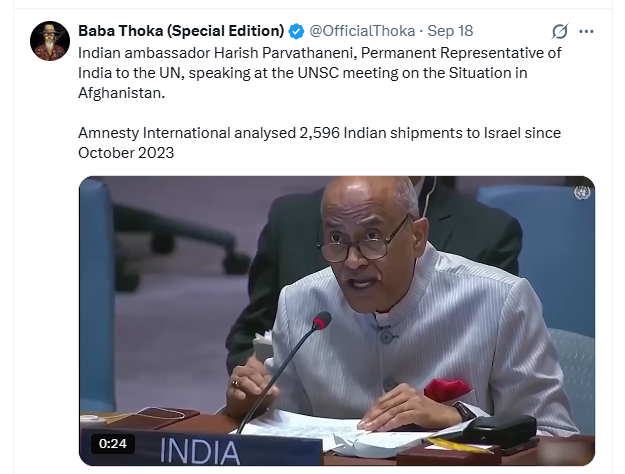
Indian ambassador Harish Parvathaneni, Permanent Representative of India to the UN, speaking at the UNSC meeting on the Situation in Afghanistan. Amnesty International analysed 2,596 Indian shipments to Israel since October 2023
https://x.com/OfficialThoka/status/2100656814660743174?s=20
Fact Check
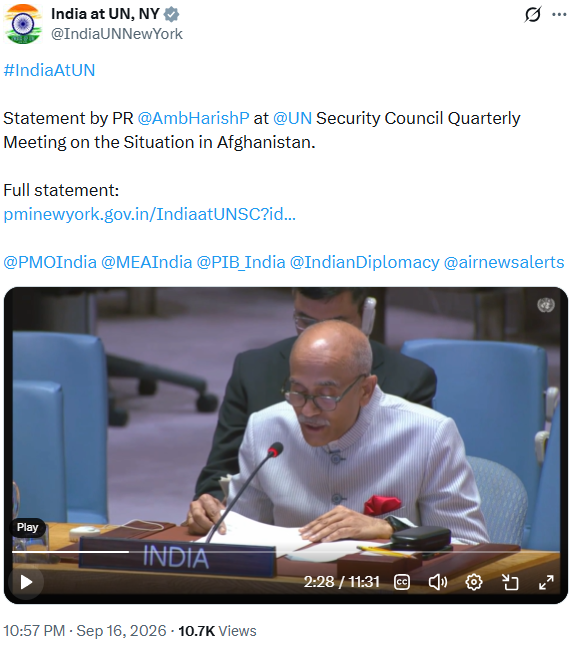
To investigate the video, we first converted it into keyframes and then conducted a reverse image search of those frames using Google Lens. We found the original video posted on the official X handle of the Permanent Mission of India to the United Nations. The post was accompanied by the caption: “#IndiaAtUN Statement by Permanent Representative Parvathaneni Harish at the quarterly UN Security Council meeting on the situation in Afghanistan.” We reviewed Parvathaneni Harish’s complete statement but found no such remarks as those shown in the video being circulated on social media. In his address, Harish did not make any reference to supplying weapons to Israel.
https://x.com/IndiaUNNewYork/status/2100275501851877641?s=20
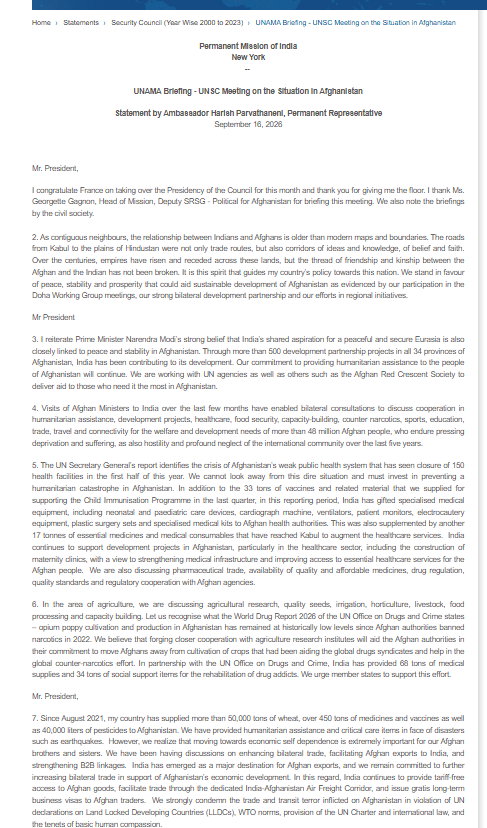
Our investigation found that Parvathaneni Harish, Permanent Representative of India to the United Nations, had issued a statement on the situation in Afghanistan and India-Afghanistan relations. We also found the text version of his statement on the official website of the Permanent Mission of India to the United Nations. In his statement, Harish referred to the historical ties between India and Afghanistan, noting that the relationship between the two countries predates modern maps and borders. He also spoke about India’s policy towards Afghanistan and its commitment to peace, stability and prosperity. In addition, he highlighted India’s participation in the meetings of the Doha Contact Group, its strong bilateral development partnership with Afghanistan, and its efforts through regional initiatives. However, a review of Harish’s complete statement shows that it contains no remarks resembling those attributed to him in the video being shared on social media. His official statement also makes no mention of India’s alleged supply of weapons to Israel or the 2,596 shipments cited by Amnesty International. This establishes that the video being circulated on social media is presenting Harish’s actual statement in a misleading context.
https://pminewyork.gov.in/IndiaatUNSC?id=NTYzNA
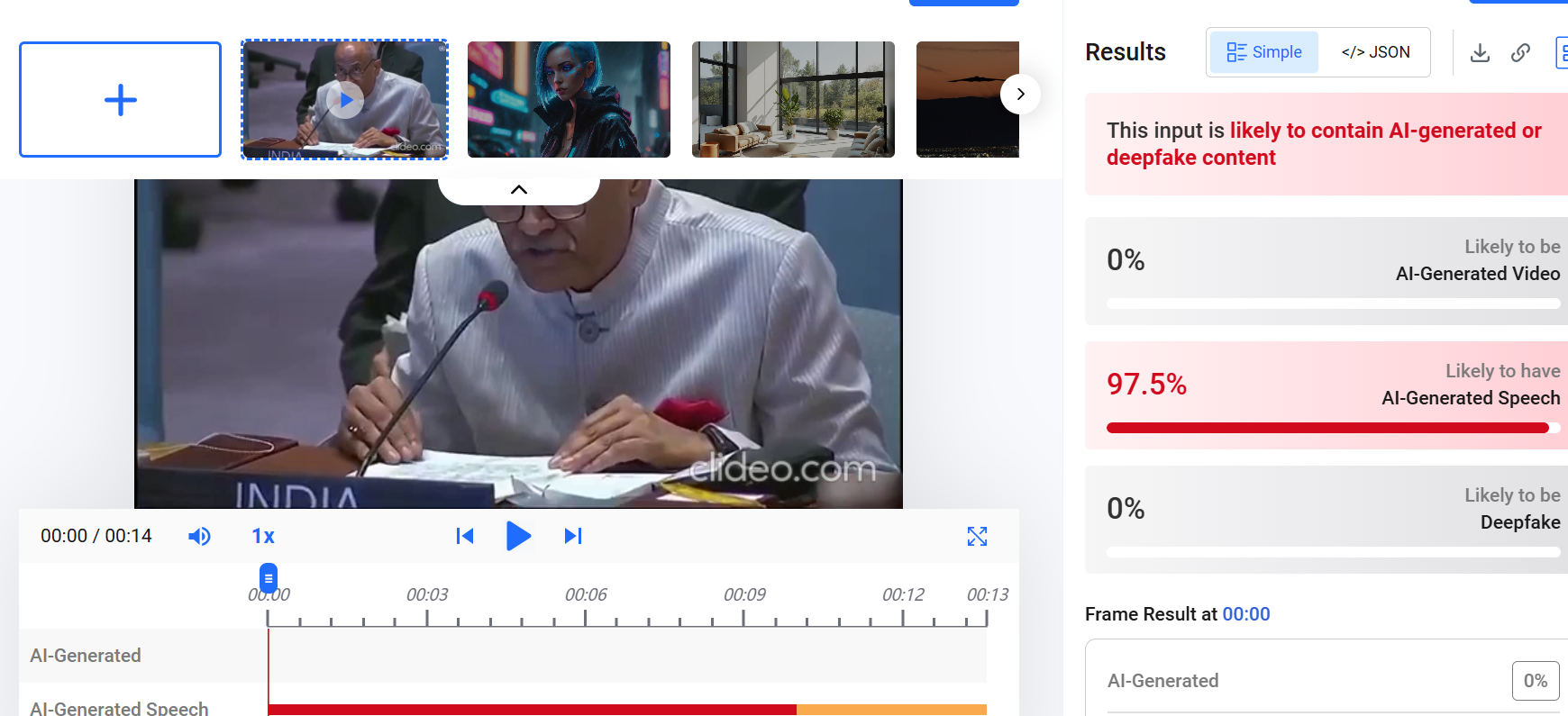
Hive Moderation’s analysis found no signs of manipulation in the video’s visuals. However, the analysis indicated a 97% probability that the speech used in the video was AI-generated.
Conclusion
Our research found that Parvathaneni Harish, Permanent Representative of India to the United Nations, did not make the statement attributed to him in the video being circulated on social media. His official statement at the UN Security Council meeting on the situation in Afghanistan focused on India-Afghanistan relations, peace, stability, development cooperation and regional initiatives, and contained no reference to India supplying weapons to Israel or to the 2,596 shipments mentioned in the viral video.
Further analysis by Hive Moderation found a 97% probability that the speech used in the video was AI-generated, while the visuals showed no signs of manipulation. These findings indicate that the video has been digitally manipulated by replacing or altering the original speech and is being presented with a misleading claim.Therefore, the claim that Parvathaneni Harish defended India’s alleged supply of weapons to Israel during a UNSC meeting is false and misleading.
