
#FactCheck: AI Generated audio of CDS admitting that Pakistan Army is superior than Indian Army.
Executive Summary:
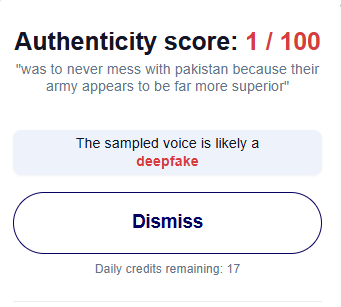
A viral social media claim alleges that India’s Chief of Defence Staff (CDS), General Anil Chauhan, praised Pakistan’s Army as superior during “Operation Sindoor.” Fact-checking confirms the claim is false. The original video, available on The Hindu’s official channel, shows General Chauhan inaugurating Ran-Samwad 2025 in Mhow, Madhya Pradesh. At the 1:22:12 mark, the genuine segment appears, proving the viral clip was altered. Additionally, analysis using Hiya AI Audio identified voice manipulation, flagging the segment as a deepfake with an authenticity score of 1/100. The fabricated statement was: “never mess with Pakistan because their army appears to be far more superior.” Thus, the viral video is doctored and misleading.
Claim:
A viral claim is being shared on social media (archived link) falsely claiming that India’s Chief of Defence Staff (CDS), General Anil Chauhan described Pakistan’s Army as superior and more advanced during Operation Sindoor.

Fact Check:
After performing a reverse image search we found a full clip on the official channel of The Hindu in which Chief of Defence Staff Anil Chauhan inaugurated ‘Ran-Samwad’ 2025 in Mhow, Madhya Pradesh.

In the clip on the time stamp of 1:22:12 we can see the actual part of the video segment which was manipulated in the viral video.
Also, by using Hiya AI Audio tool we got to know that the voice was manipulated in the specific segment of the video. The result shows Deepfake with an authenticity score 1/100, the result also shows the statement which is deepfake which was “ was to never mess with Pakistan because their army appears to be far more superior”.
Conclusion:
The viral video attributing remarks to CDS General Anil Chauhan about Pakistan’s Army being “superior” is fabricated. The original footage from The Hindu confirms no such statement was made, while forensic analysis using Hiya AI Audio detected clear voice manipulation, identifying the clip as a deepfake with minimal authenticity. Hence, the claim is baseless, misleading, and an attempt to spread disinformation.
- Claim: AI Generated audio of CDS admitting that the Pakistan Army is superior to the Indian Army.
- Claimed On: Social Media
- Fact Check: False and Misleading

Related Blogs

Executive Summary
A video circulating on social media falsely claims to show West Bengal leader Suvendu Adhikari making inflammatory and communal remarks. In the viral clip, he is allegedly heard saying that if elected, his party would “work only for Hindus” and “eliminate the 27% Muslim population in West Bengal,” while also claiming that the BJP would remain in power for over 100 years. CyberPeace Research Wing research found that the viral video, which allegedly shows West Bengal leader Suvendu Adhikari making a statement about eliminating the Muslim population in West Bengal to ensure long-term BJP rule, is AI-generated and not real.
Claim
An X user (@Naira_Seth1) shared the clip alleging it reflects “majoritarian extremism disguised as politics,” suggesting that Suvendu Adhikari made communally charged and unconstitutional statements.

Fact Check
A detailed analysis of the video shows clear signs of manipulation. The person appearing in the latter part of the clip does not match Suvendu Adhikari.

Additionally, the video was tested using an AI detection tool (Hive Moderation), which indicated a 98.8% probability of AI-generated content, particularly around the 0:25 timestamp.
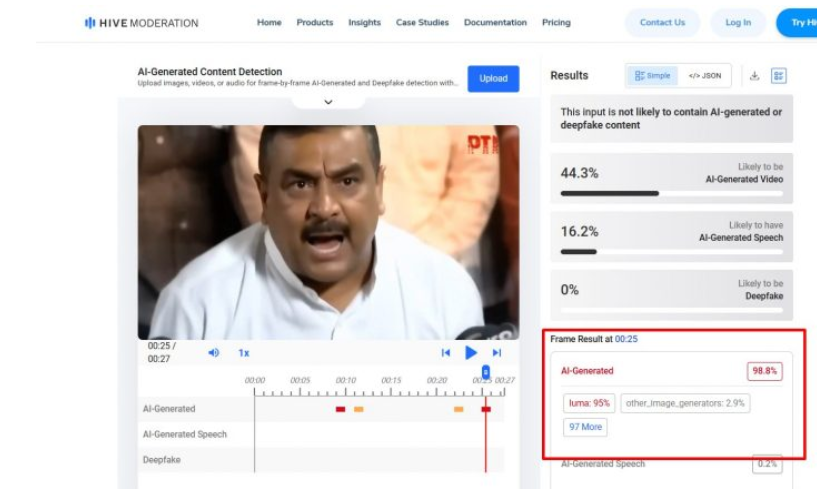
Further verification through reverse image search of key frames led to an original press byte of Suvendu Adhikari posted by PTI News on May 6. In that authentic video, he is seen speaking about taking strict legal action against criminals, with no mention of any religious community or communal statements.
https://x.com/PTI_News/status/2052020784152068114?s=20

Conclusion
The viral video allegedly showing Suvendu Adhikari making communal remarks is AI-generated and misleading. The original footage confirms that no such statements were made, and the clip has been digitally manipulated to spread misinformation.

CAPTCHA, or the Completely Automated Public Turing Test to Tell Computers and Humans Apart function, is an image or distorted text that users have to identify or interpret to prove they are human. 2007 marked the inception of CAPTCHA, and Google developed its free service called reCAPTCHA, one of the most commonly used technologies to tell computers apart from humans. CAPTCHA protects websites from spam and abuse by using tests considered easy for humans but were supposed to be difficult for bots to solve.
But, now this has changed. With AI becoming more and more sophisticated, it is now capable of solving CAPTCHA tests at a rate that is more accurate than humans, rendering them increasingly ineffective. This raises the question of whether CAPTCHA is still effective as a detection tool with the advancements of AI.
CAPTCHA Evolution: From 2007 Till Now
CAPTCHA has evolved through various versions to keep bots at bay. reCAPTCHA v1 relied on distorted text recognition, v2 introduced image-based tasks and behavioural analysis, and v3 operated invisibly, assigning risk scores based on user interactions. While these advancements improved user experience and security, AI now solves CAPTCHA with 96% accuracy, surpassing humans (50-86%). Bots can mimic human behaviour, undermining CAPTCHA’s effectiveness and raising the question: is it still a reliable tool for distinguishing real people from bots?
Smarter Bots and Their Rise
AI advancements like machine learning, deep learning and neural networks have developed at a very fast pace in the past decade, making it easier for bots to bypass CAPTCHA. They allow the bots to process and interpret the CAPTCHA types like text and images with almost human-like behaviour. Some examples of AI developments against bots are OCR or Optical Character Recognition. The earlier versions of CAPTCHA relied on distorted text: AI because of this tech is able to recognise and decipher the distorted text, making CAPTCHA useless. AI is trained on huge datasets which allows Image Recognition by identifying the objects that are specific to the question asked. These bots can mimic human habits and patterns by Behavioural Analysis and therefore fool the CAPTCHA.
To defeat CAPTCHA, attackers have been known to use Adversarial Machine Learning, which refers to AI models trained specifically to defeat CAPTCHA. They collect CAPTCHA datasets and answers and create an AI that can predict correct answers. The implications that CAPTCHA failures have on platforms can range from fraud to spam to even cybersecurity breaches or cyberattacks.
CAPTCHA vs Privacy: GDPR and DPDP
GDPR and the DPDP Act emphasise protecting personal data, including online identifiers like IP addresses and cookies. Both frameworks mandate transparency when data is transferred internationally, raising compliance concerns for reCAPTCHA, which processes data on Google’s US servers. Additionally, reCAPTCHA's use of cookies and tracking technologies for risk scoring may conflict with the DPDP Act's broad definition of data. The lack of standardisation in CAPTCHA systems highlights the urgent need for policymakers to reevaluate regulatory approaches.
CyberPeace Analysis: The Future of Human Verification
CAPTCHA, once a cornerstone of online security, is losing ground as AI outperforms humans in solving these challenges with near-perfect accuracy. Innovations like invisible CAPTCHA and behavioural analysis provided temporary relief, but bots have adapted, exploiting vulnerabilities and undermining their effectiveness. This decline demands a shift in focus.
Emerging alternatives like AI-based anomaly detection, biometric authentication, and blockchain verification hold promise but raise ethical concerns like privacy, inclusivity, and surveillance. The battle against bots isn’t just about tools but it’s about reimagining trust and security in a rapidly evolving digital world.
AI is clearly winning the CAPTCHA war, but the real victory will be designing solutions that balance security, user experience and ethical responsibility. It’s time to embrace smarter, collaborative innovations to secure a human-centric internet.
References
- https://www.business-standard.com/technology/tech-news/bot-detection-no-longer-working-just-wait-until-ai-agents-come-along-124122300456_1.html
- https://www.milesrote.com/blog/ai-defeating-recaptcha-the-evolving-battle-between-bots-and-web-security
- https://www.technologyreview.com/2023/10/24/1081139/captchas-ai-websites-computing/
- https://datadome.co/guides/captcha/recaptcha-gdpr/
Executive Summary:
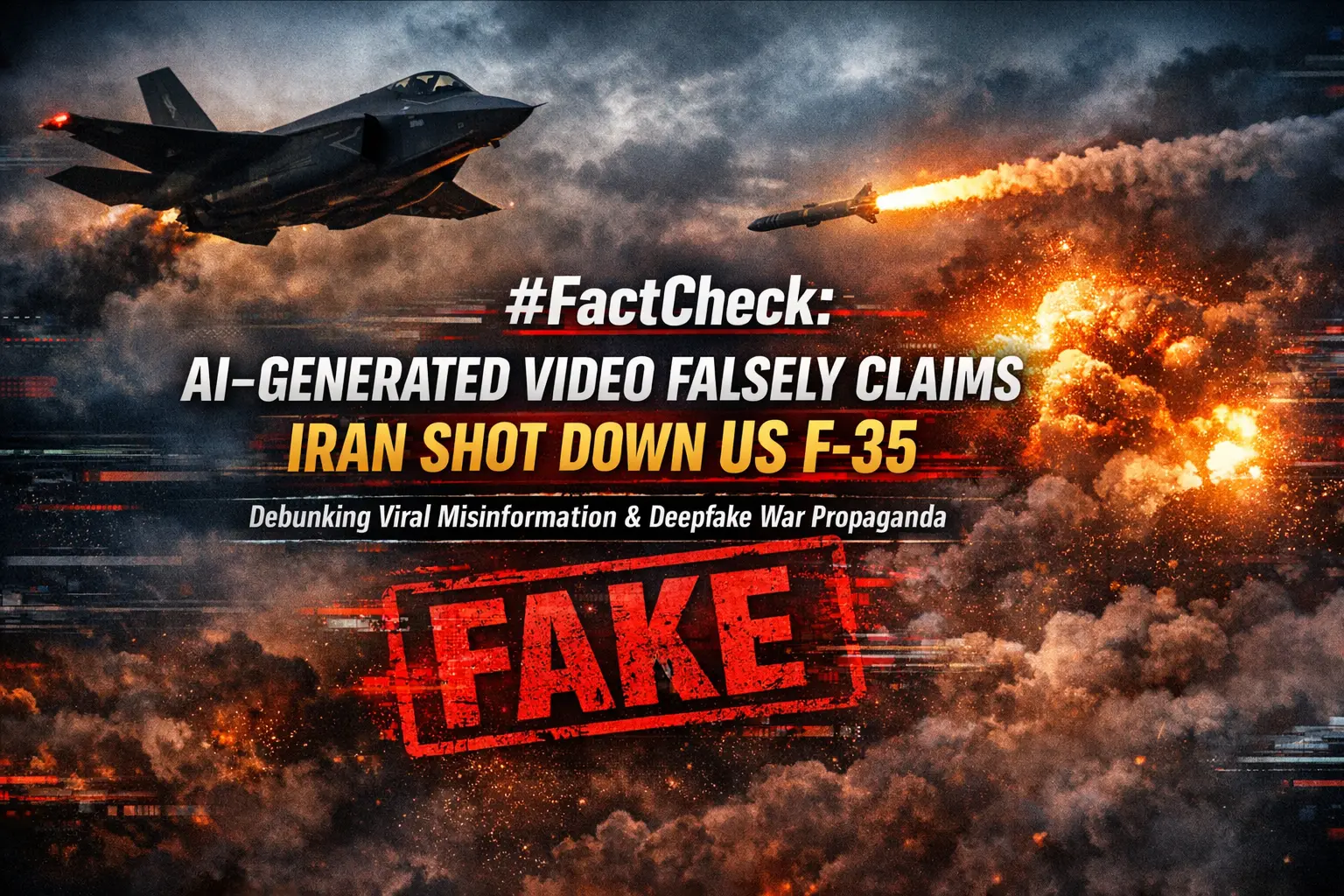
Amid the ongoing conflict involving the US-Israel and Iran, Tehran has claimed that it shot down a US F-35 fighter jet. In this context, a video is going viral on social media showing a crashed American fighter aircraft on the ground. It is being claimed that the footage shows Iran downing a US F-35 jet. However, an research by the CyberPeace found that the viral video is a deepfake and not real. The clip appears to have been created using Google AI tools.
Claim:
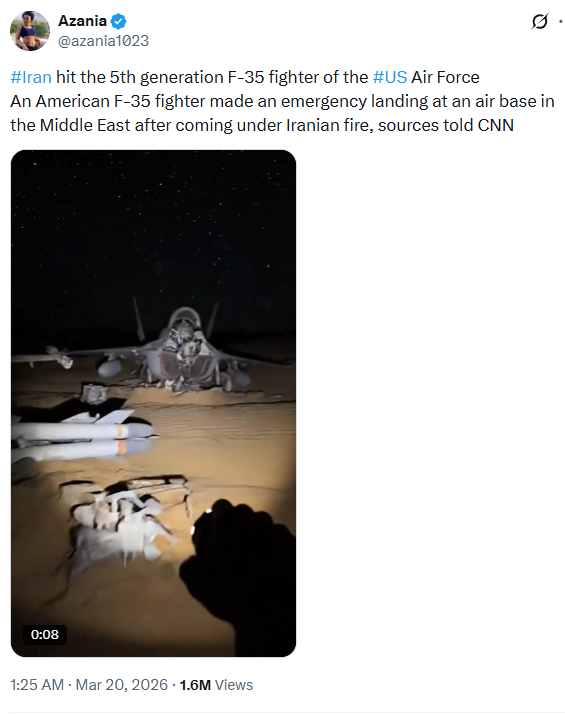
A social media user “Azania” shared the viral video on March 20, 2026, with the caption,“#Iran hit the 5th generation F-35 fighter of the #US Air Force… An American F-35 fighter made an emergency landing at an air base in the Middle East after coming under Iranian fire, sources told CNN.”
Fact Check:
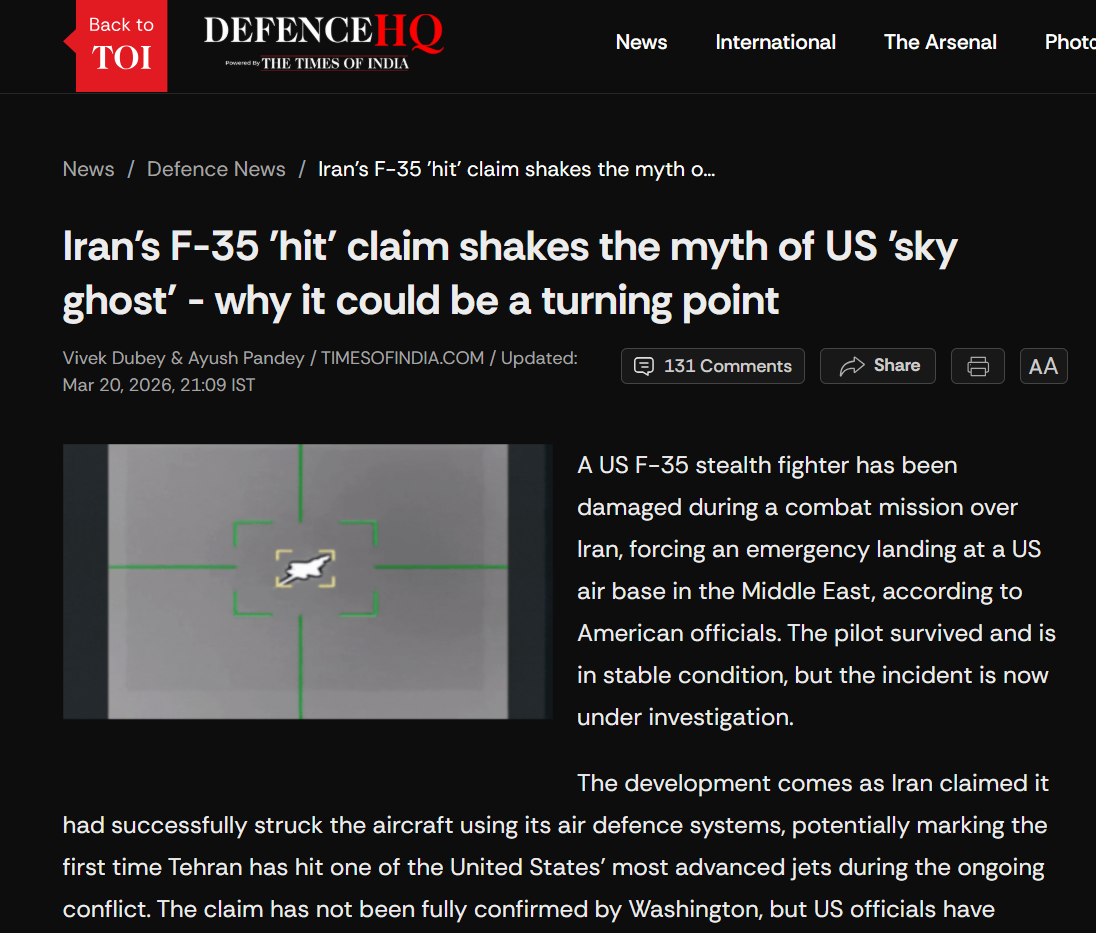
We began our research with a news search and found multiple reports stating that a US F-35 fighter jet was damaged during a combat mission over Iran. According to reports, Iran’s Islamic Revolutionary Guard Corps (IRGC) claimed to have damaged a US F-35 jet and also released a video. As per a CNN report, US officials confirmed that an American F-35 was damaged during a mission over Iran, forcing it to make an emergency landing at a US airbase in the Middle East. The pilot was safe and in stable condition, and the incident is currently under research .
A spokesperson for the US Central Command, Captain Tim Hawkins, also acknowledged that an F-35 made an emergency landing during the mission. However, the US has not officially confirmed that the damage was caused by an Iranian attack.Reports by Fox News and The Times of India also mention the emergency landing of the aircraft.
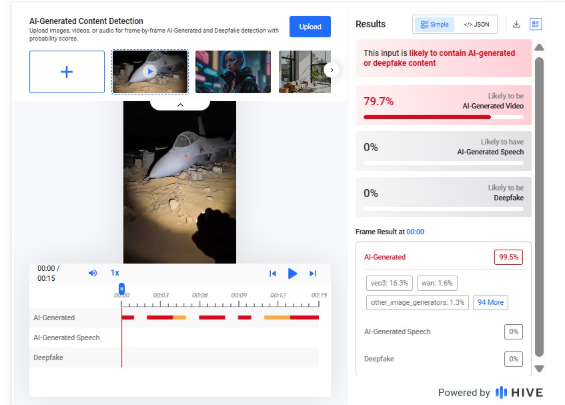
Upon closely examining the viral video, we noticed several inconsistencies indicating possible AI manipulation. We then analyzed the clip using Hive Moderation, which indicated nearly a 79 percent probability that the video is AI-generated. The analysis also suggests that it was likely created using Google’s AI video generation tools (Veo).
Conclusion:
The viral video claiming to show Iran shooting down a US F-35 fighter jet is AI-generated and not real. While Iran has claimed to have targeted a US F-35, and the US has confirmed an emergency landing during a mission, there is no official confirmation that the aircraft was shot down by Iran.
