
#FactCheck - Old Ajman Fire Video Falsely Linked to Iran Drone Attack on Dubai Airport
Executive Summary:
The ongoing conflict between Iran and the US-Israel has entered its 19th day. Meanwhile, a video is being widely shared on social media claiming that Iran is carrying out continuous drone attacks at Dubai International Airport. The clip shows visuals of massive fire and explosion However, research by the CyberPeace has found the claim to be misleading. Our research revealed that the video has been available on the internet since 2020. In reality, the footage shows a fire at a market in Ajman, UAE, and not explosions at Dubai Airport in 2026. Although there were recent reports of a fire near DXB (Dubai Airport) following a drone attack, this video is not related to that incident.
Claim:
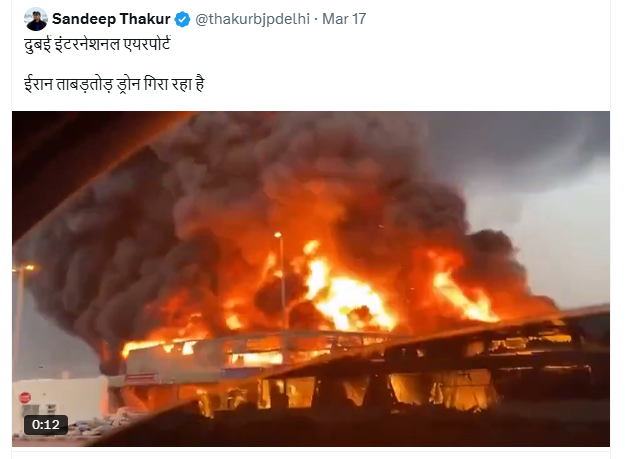
On social media platform X (formerly Twitter), a user shared the viral video on March 17, 2026, writing:
“Dubai International Airport – Iran is dropping drones continuously.”
Post link, archive link, and screenshot are given below:
Fact Check:
To verify the viral claim, we extracted keyframes from the video and conducted a reverse image search using Google Lens. During the research, we found the same video on a YouTube channel, where it was uploaded on August 6, 2020. The caption read: “Ajman fruits and vegetables market caught in fire.”
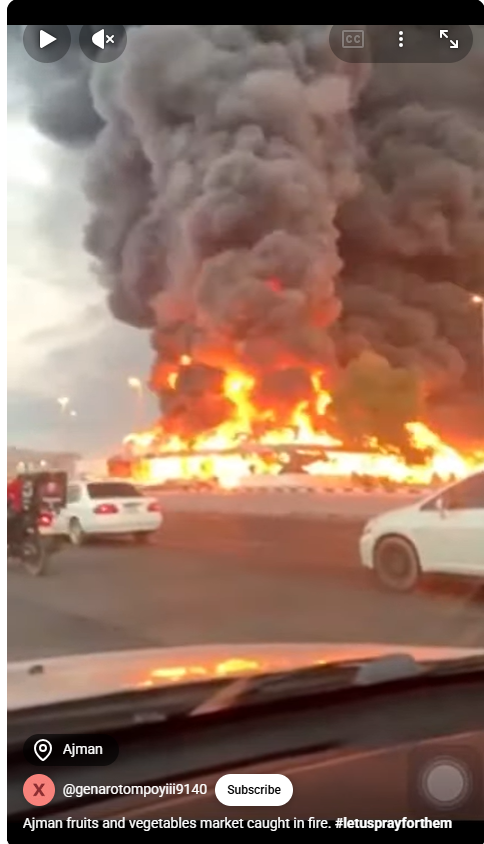
Based on this clue, it became clear that the viral video has no connection with the ongoing Iran-US-Israel conflict. In the next step, we searched using relevant keywords and found a report published on August 5, 2020, on the website of Gulf News, which contained visuals similar to the viral video.
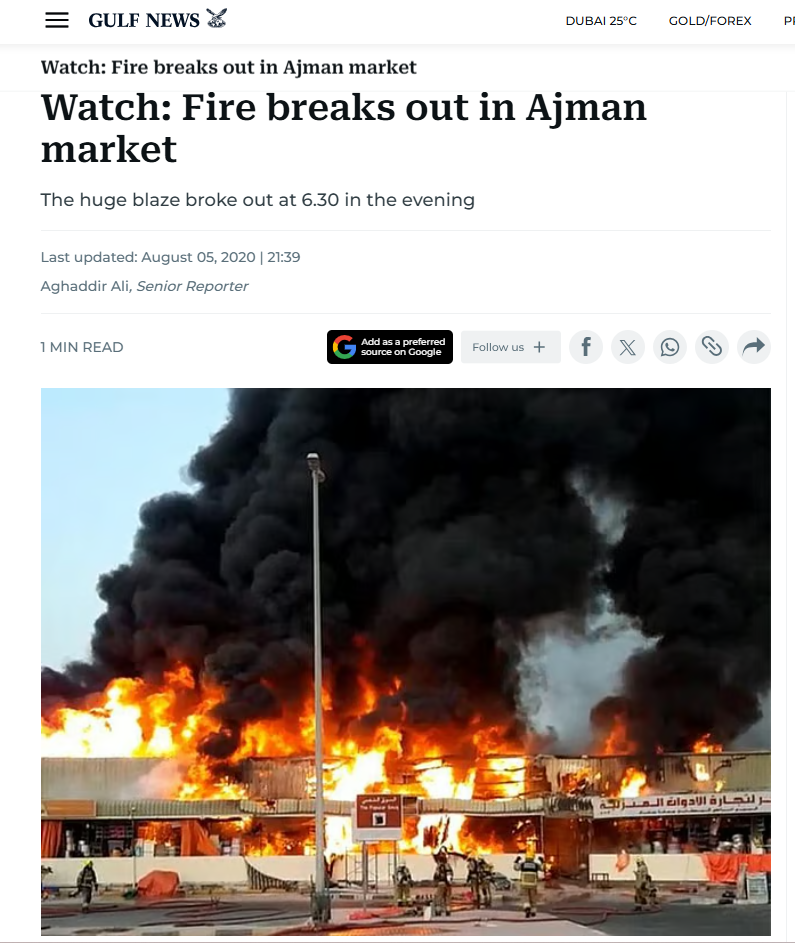
According to the Gulf News report, a major fire broke out at a public market in the new industrial area of Ajman at around 6:30 pm. The blaze was later brought under control by Ajman Civil Defence with assistance from teams in Dubai, Sharjah, and Umm Al Quwain.
Conclusion:
Our research found that the viral video has been online since 2020 and shows a fire at a market in Ajman, UAE. It is not related to any recent incident at Dubai Airport.

Related Blogs
Executive Summary
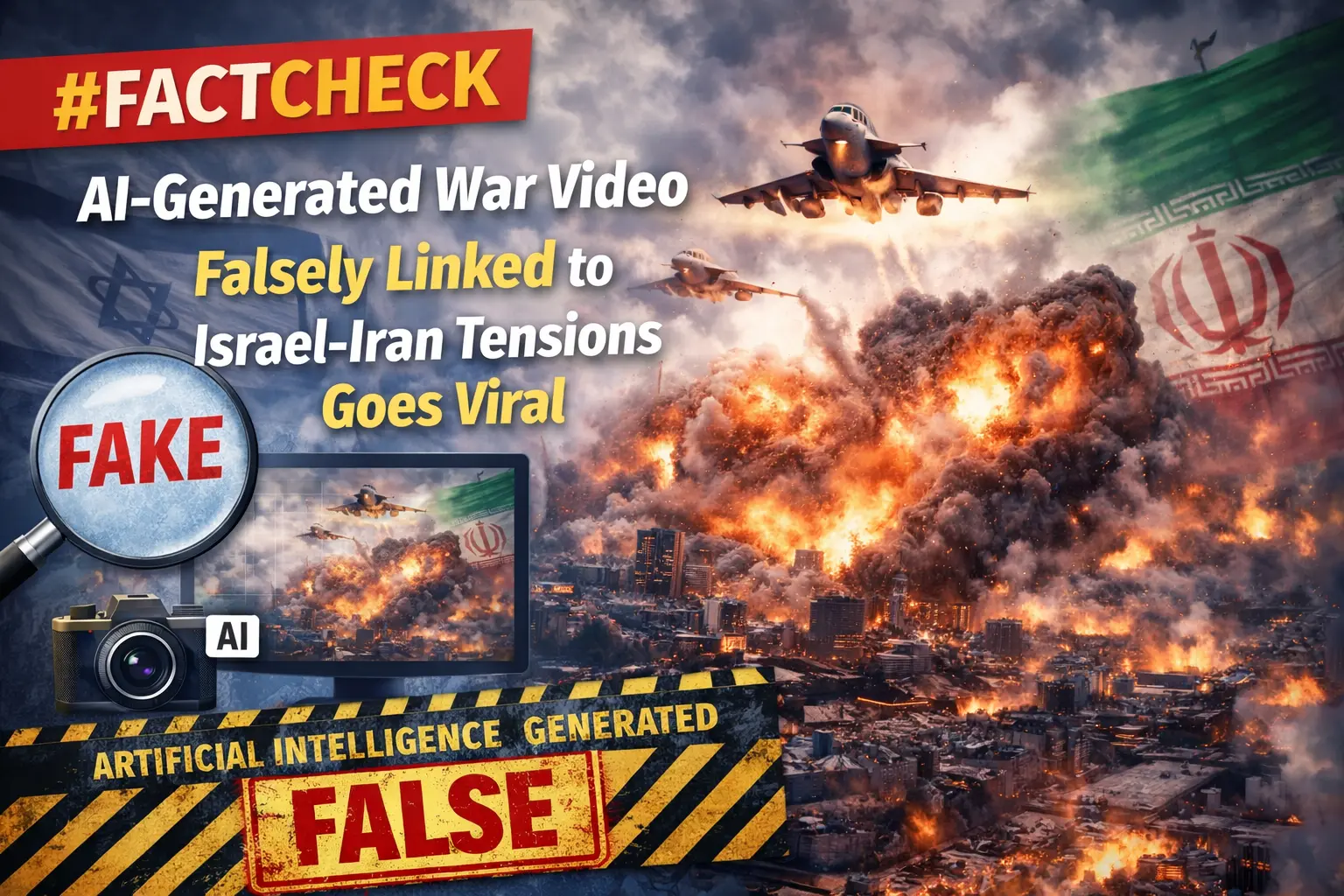
A video is being widely shared on social media linking it to the ongoing tensions between Israel and Iran. The clip shows multiple fighter jets flying across the sky, while massive flames appear to be rising from tall buildings below. The visuals are dramatic and alarming, creating the impression of a large-scale military strike. Users sharing the video claim that after Israel carried out an attack, Iran launched a retaliatory strike on Israel, and that the viral footage captures the aftermath of this counterattack. However, research conducted by the CyberPeace found the claim to be misleading. Our research revealed that the viral video is not authentic but AI-generated.
Claim
On the social media platform Facebook, a user shared the viral video with the caption: “Iran has also carried out a retaliatory attack on Israel.”
(Post link and archive link provided above.)
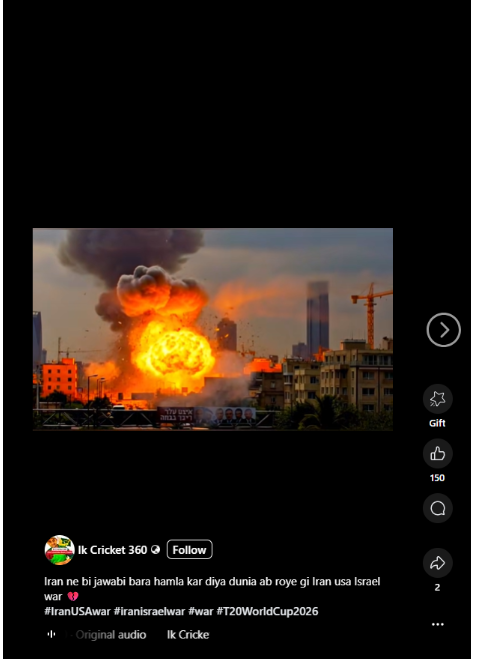
Factcheck
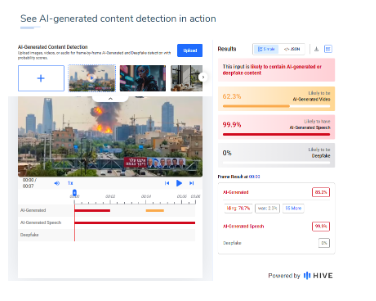
Upon closely examining the video, we noticed several irregularities in the visuals and motion patterns, which raised suspicion that the footage may have been generated using artificial intelligence. To verify this, we analyzed the video using the AI detection tool developed by Hive Moderation. According to the analysis report, there is a 62 percent likelihood that the viral video is AI-generated.
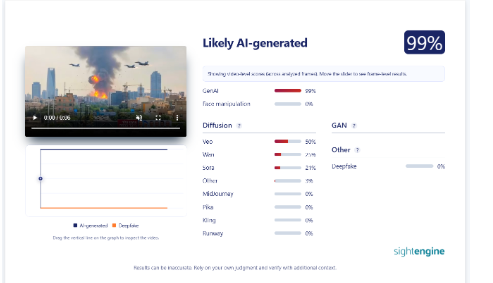
As part of further verification, we also scanned the video using Sightengine. The results indicated an even stronger probability, suggesting that the video is 99 percent AI-generated.
Conclusion
Our research confirms that the viral video does not depict a real military attack. It is AI-generated content being falsely shared in the context of Israel-Iran tensions.

Executive Summary
An image showing Prime Minister Narendra Modi and Leader of Opposition in the Lok Sabha and Congress MP Rahul Gandhi standing face to face inside Parliament is going viral on social media. Several users are sharing the image claiming that the photograph was taken during the ongoing Budget Session, suggesting a direct face-off between the two leaders inside Parliament. However, research conducted by the CyberPeacehas found that the viral claim is false. The image in question is not real but has been generated using Artificial Intelligence (AI). The AI-generated image is now being shared on social media with a misleading claim.
Claim
A Facebook user named Madhu Davi shared the viral image on January 30, 2026, with the caption: “If this photo is from today and the Budget Session, it is commendable. RAGA Zindabad.”
(Archived version of the post available here.)
- https://www.facebook.com/photo/?fbid=759145877237871&set=a.110639115421887
- https://perma.cc/N2XD-TZ32?type=image

Fact Check:
To verify the viral claim, we first conducted a keyword search on Google to check whether any credible media outlet had reported such an incident during the Budget Session. However, no news reports supporting the claim were found. We then performed a reverse image search using Google Lens, but this too did not yield any reliable media reports or evidence confirming the authenticity of the image. This raised suspicion that the image might be AI-generated. To further verify, the image was analysed using the AI detection tool Hive Moderation. The tool indicated a probability of over 99 per cent that the image was generated using Artificial Intelligence.

Conclusion
CyberPeace research confirms that the image being circulated with the claim that Prime Minister Narendra Modi and Rahul Gandhi came face to face during the Budget Session is fake. The viral image has been created using AI and is being shared with a false and misleading narrative.
A war in the twenty-first century does not start when the first bullet or missile is fired. It begins much earlier, covertly, and without any official announcement. Cyberspace is this new battlefield. States now use a variety of ransomware, malicious codes, and disinformation campaigns to undermine their enemies' capabilities before launching an offensive. These pre-conflict cyber operations are now the primary frontline of contemporary hybrid warfare, which is changing how conflicts are fought and conducted.
The Birth of a Digital Battlefield
Hybrid Warfare is a blend of conventional military force with nonmilitary tactics like economic coercion, disinformation, and cyberattacks that have evolved rapidly in recent decades. Hybrid methods of warfare are nothing new, as the scale and sophistication of cyber operations in modern conflicts are unprecedented. Russia’s actions in Ukraine demonstrated the capability of digital tools to paralyse the critical systems before its heavy munitions could be deployed for combat operations. Within days of the 2022 invasions, Ukraine faced massive Distributed Denial of Service (DDoS) attacks targeting banks, government websites, and energy infrastructures. The digital frontlines have softened the physical defences long before the conventional warfare began.
According to the FP Analytics’ “Digital Front Lines” Project, cyber operations are no longer an auxiliary tactic but a core component of hybrid warfare, blurring the boundary between peace and war. They enable states to exert pressure, gather intelligence, and disrupt adversaries, often without being attributed or held accountable.
Cyber Operations: The modern Prelude to War
The use of digital technologies for surveillance, information network disruption, or critical infrastructure destruction is known as cyber operations. They are especially useful instruments for pre-conflict manipulation because of their ambiguity and stealth. Cyberattacks, in contrast to conventional military strikes, can accomplish strategic goals while providing plausible deniability.
Coordinated cyberattacks that spread misinformation and damaged public confidence disrupted government communication systems prior to Russia's invasion of Ukraine. These sorts of incidents highlight the integrated nature of cyber and kinetic operations, where digital assaults often serve as the initial phases of modern wars.
The Expanding Spectrum of Actors or Threat
Cyberspace has democratized warfare, which once required an army, can now be initiated by a handful of skilled programmers with access to the right tools. The cyber landscape of the present times features a wide spectrum of threat actors, which can be understood as;
- State actors like intelligence or military agencies conduct cyber operations as part of official foreign policy.
- Cybercriminals pursue financial gains, often overlapping with political motives.
- Terrorist groups use cyberspace to spread propaganda for coordinated attacks.
- Cyber mercenaries being hired by both the state and nonstate clients can blur the ethical and legal boundaries.
This diversity can complicate the attribution by determining that anyone who is actively working behind conducting cyberattacks can be notoriously difficult, allowing the states to hide behind “plausible deniability.” This ‘Gray Zone’ of conflict below the threshold of a declared war, above mere diplomacy, has become the preferred arena for modern power struggles.
Civilian Involvement and Ethical Dilemmas
Unlike traditional warfare, where the cyber domain entangles civilians as both participants and targets. Much of the nation’s critical infrastructure, which includes energy grids, hospitals, transportation, and communication systems, is owned and operated by private entities. As a result, the civilian industries and experts are becoming central to both cyber defence and offence.
During the Russia–Ukraine War, the volunteer hackers from around the world were many of whom are being coordinated through the app Telegram, which is termed as ‘IT Army of Ukraine’, are known for conducting digital strikes on Russian networks. Conversely, the Russia-affiliated hacker groups like Conti had vowed to retaliate against any nations that supported Ukraine.
This civilian participation raises profound legal and moral questions, over a private company’s role in defending their networks of becoming a combatant, or the impact of retaliatory cyberattacks on civilian infrastructure war crimes. International law has yet to provide a clear answer, which can leave dangerous gaps in the governance to counter cybercrimes.
Susceptibility of Contemporary Society to Cyber Warfare
Cyberwarfare can impact an entire global digital ecosystem due to its interconnectedness. Power grids, hospitals, air traffic systems, and even automation devices can be compromised. While the NotPetya ransomware, which was cloaked as ransomware, caused billions of losses and caused worldwide economic damage from shipping companies to pharmaceutical companies, the WannaCry ransomware attacks in 2017 paralysed hospitals throughout the UK's National Health Service.
When taken as a whole, these incidents have also shown that cyberattacks are no longer limited to espionage situations and can have real-world consequences comparable to those of conventional warfare. The consequences of cyberattacks could increase dramatically as our dependence on technology increases. Because these effects are profoundly psychological in nature and seek to sow fear, mistrust, and social disintegration, they are not merely technical or economic in nature.
The Future: Permanent Cyber Frontlines
Technological developments have made cyberspace a permanent theatre of conflict, joining the land, sea, air, and space. Countries are currently making significant investments in cyber capabilities for deterrence as well as defence. According to security experts like Eriksson and Giacomello, societies are now inherently fragile due to our increasing reliance on information technologies.
Cyber operations in this context are about strategic dominance in a globalised world, not just digital espionage. Who controls the networks and algorithms that run contemporary civilisation will determine the future of war, not just who controls the skies or the seas. As per the new reality, before the drop of the first bomb, a silent war in cyberspace will already be underway.
References
- https://digitalfrontlines.io/2023/05/25/the-evolution-of-cyber-operations-in-armed-conflict/
- https://theses.ubn.ru.nl/server/api/core/bitstreams/9d74149e-fb9a-402f-aa65-a90445ad7603/content
- https://cybersecurityguide.org/resources/cyberwarfare/
- https://re.public.polimi.it/retrieve/e0c31c0b-ce6c-4599-e053-1705fe0aef77/21%20Century%20Cyber%20Warfare.pdf
