
#FactCheck-Deepfake Video Falsely Claims Indian Army JCO Criticised Govt, Resigned
Executive Summary
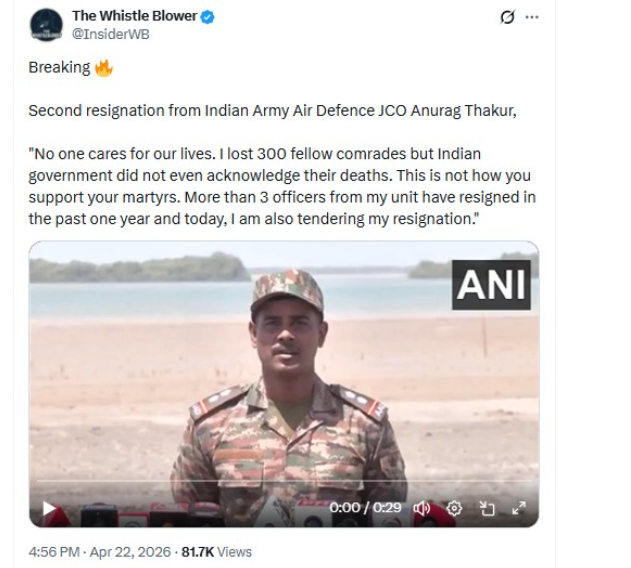
A video circulating on social media allegedly shows an Indian Army Air Defence JCO, identified as “Anurag Thakur,” criticising the Central government and announcing his resignation. In the clip, the individual is purportedly heard expressing disappointment with the government’s support for soldiers and claiming heavy casualties within his unit. However, an investigation by the CyberPeace Research Wing has found the claim to be false and the video manipulated.
Claim:
The viral post alleges that an Indian Army Air Defence JCO criticised the Centre and resigned, citing lack of support for soldiers and unacknowledged casualties.
Fact Check:
A keyword search using terms such as “Indian Army Air Defence JCO,” “Anurag Thakur,” and “resignation” did not yield any credible news reports supporting the claim. A reverse image search of the viral clip led to an original video posted by ANI on April 22, 2026. The ANI watermark is also visible in the viral footage, confirming that the clip has been sourced from this original video.
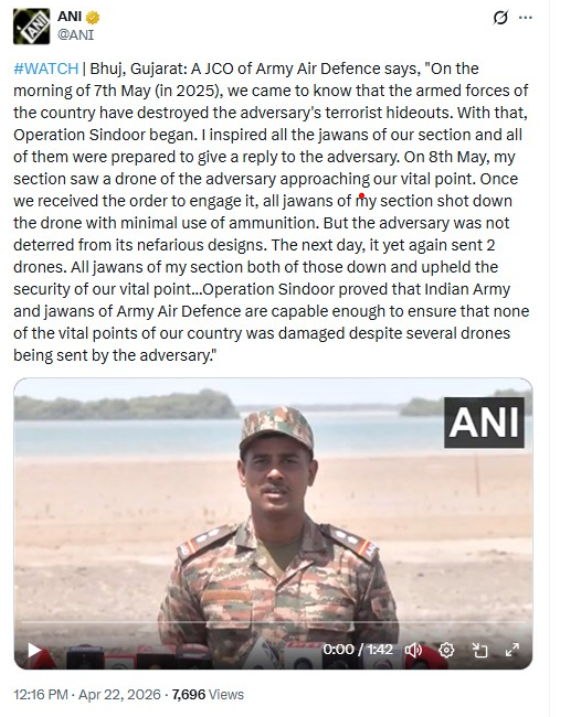
In the authentic version, the same personnel appears in the same setting, but he is speaking in Hindi about operations against adversary drones during “Operation Sindoor” in May 2025. He explains how his unit detected and neutralised multiple drones, successfully safeguarding a critical installation. Importantly, the original video does not identify the individual as Anurag Thakur, nor does it contain any reference to resignation, casualties, or criticism of the government.
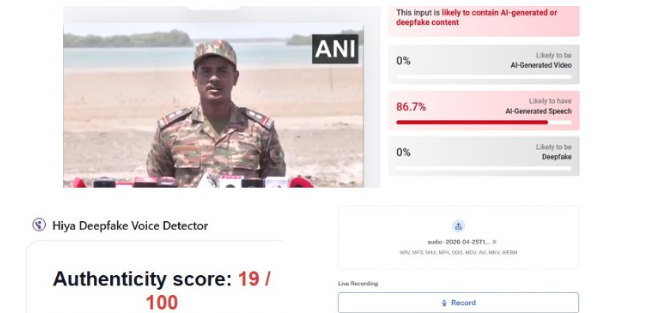
Further technical analysis using the AI detection tool Hive Moderation indicated that the audio in the viral clip has an 86 percent likelihood of being artificially generated.
Conclusion:
The viral video has been altered with fabricated audio to falsely claim that an Indian Army officer criticised the government and resigned. The claim is baseless and the clip is a clear case of a deepfake created to mislead viewers.

Related Blogs

Introduction
A bill requiring social media companies, providers of encrypted communications, and other online services to report drug activity on their platforms to the U.S. The Drug Enforcement Administration (DEA) advanced to the Senate floor, alarming privacy advocates who claim the legislation transforms businesses into de facto drug enforcement agents and exposes many of them to liability for providing end-to-end encryption.
Why is there a requirement for online companies to report drug activity?
The reason behind the bill is that there was a Kansas teenager died after unknowingly taking a fentanyl-laced pill he purchased on Snapchat. The bill requires social media companies and other web communication providers to provide the DEA with users’ names and other information when the companies have “actual knowledge” that illicit drugs are being distributed on their platforms.
There is an urgent need to look into this matter as platforms like Snapchat and Instagram are the constant applications that netizens use. If these kinds of apps promote the selling of drugs, then it will result in major drug-selling vehicles and become drug-selling platforms.
Threat to end to end encryption
End-to-end encryption has long been criticised by law enforcement for creating a “lawless space” that criminals, terrorists, and other bad actors can exploit for their illicit purposes. End- to end encryption is important for privacy, but it has been criticised as criminals also use it for bad purposes that result in cyber fraud and cybercrimes.
Cases of drug peddling on social media platforms
It is very easy to get drugs on social media, just like calling an Uber. It is that simple to get the drugs. The survey discovered that access to illegal drugs is “staggering” on social media applications, which has contributed to the rising number of fentanyl overdoses, which has resulted in suicide, gun violence, and accidents.
According to another survey, drug dealers use slang, emoticons, QR codes, and disappearing messages to reach customers while avoiding content monitoring measures on social networking platforms. Drug dealers are frequently active on numerous social media platforms, advertising their products on Instagram while providing their WhatApps or Snapchat names for queries, making it difficult for law officials to crack down on the transactions.
There is a need for social media platforms to report these kinds of drug-selling activity on specific platforms to the Drug enforcement administration. The bill requires online companies to report drug cases going on websites, such as the above-mentioned Snapchat case. There are so many other cases where drug dealers sell the drug through Instagram, Snapchat etc. Usually, if Instagram blocks one account, they create another account for the drug selling. Just by only blocking the account does not help to stop drug trafficking on social media platforms.
Will this put the privacy of users at risk?
It is important to report the cybercrime activities of selling drugs on social media platforms. The companies will only detect the activity regarding the drugs which are being sold through social media platforms which are able to detect bad actors and cyber criminals. The detection will be on the particular activities on the applications where it is happening because the social media platforms lack regulations to govern them, and their convenience becomes the major vehicle for the drugs sale.
Conclusion
Social media companies are required to report these kinds of activities happening on their platforms immediately to the Drugs enforcement Administration so that the DEA will take the required steps instead of just blocking the account. Because just blocking does not stop these drug markets from happening online. There must be proper reporting for that. And there is a need for social media regulations. Social media platforms mostly influence people.
Executive Summary
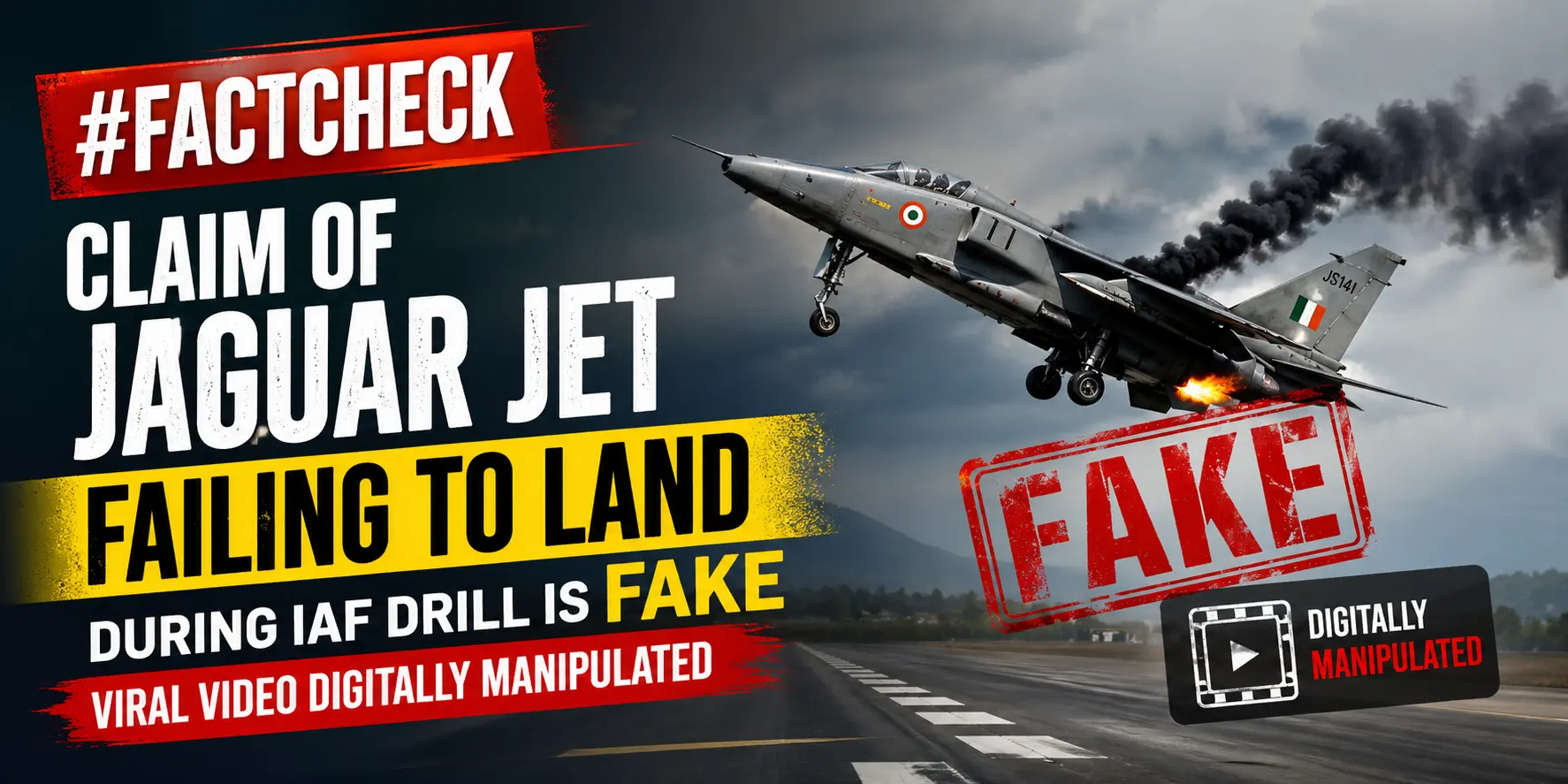
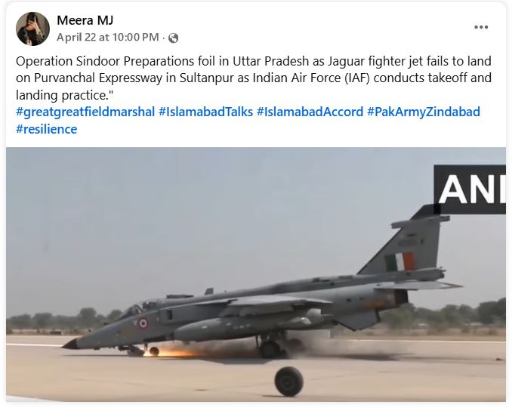
A video circulating on social media claims that a Jaguar fighter jet of the Indian Air Force (IAF) failed to land during a takeoff and landing exercise held on April 22, 2026, at the Purvanchal Expressway in Uttar Pradesh. The claim suggests that the incident disrupted preparations for “Operation Sindoor.” However, an research by the CyberPeace Research Wing has found the claim to be false.
Claim
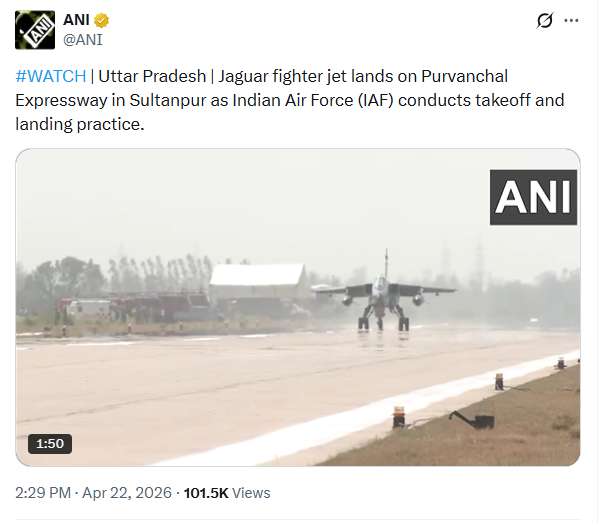
The video was shared by a Facebook user, ‘Meera MJ,’ alleging that the Jaguar aircraft could not land during the exercise conducted near Sultanpur. To verify the authenticity of the video, multiple keyframes were extracted and analyzed using reverse image search tools. This led to the original footage shared by ANI on its official X (formerly Twitter) handle on April 22, 2026. The authentic video of the air show does not show any such incident of a failed landing.
Fact Check
A detailed review of ANI’s social media posts also revealed no evidence supporting the viral claim. This strongly indicates that the circulating clip has been digitally manipulated by altering the original footage.
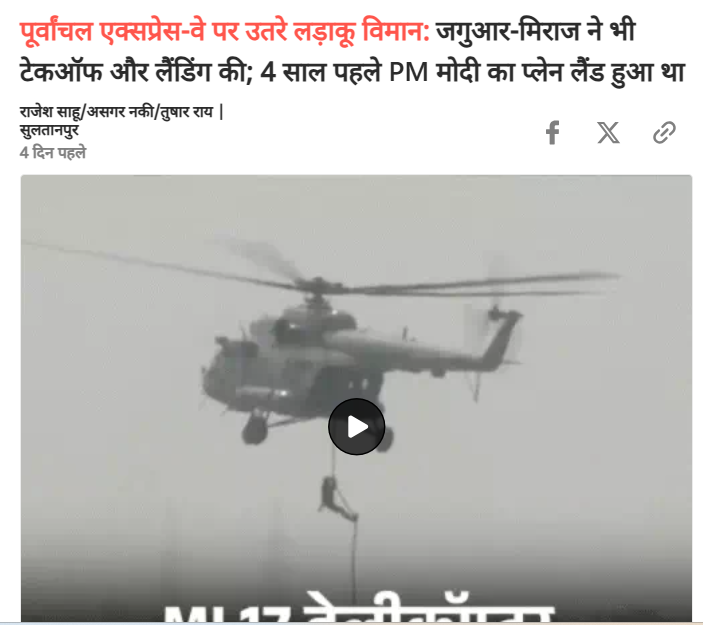
Further corroboration came from a report published by Bhaskar.com, which extensively covered the air show. According to the report, the event featured successful operations by multiple aircraft, including the C-295 transport aircraft landing on the expressway airstrip, followed by Jaguar jets taking off. Sukhoi and Mirage fighter jets also performed takeoff and landing drills, while M17 helicopters carried out commando mock operations. Additionally, the M32 Bhishma aircraft conducted ‘touch and go’
Conclusion:
The viral claim that a Jaguar fighter jet failed to land during the Indian Air Force drill is baseless. The video being circulated is digitally manipulated and does not reflect any real incident.

Executive Summary:
A photographer breaking down in tears in a viral photo is not connected to the Ram Mandir opening. Social media users are sharing a collage of images of the recently dedicated Lord Ram idol at the Ayodhya Ram Mandir, along with a claimed shot of the photographer crying at the sight of the deity. A Facebook post that posts this video says, "Even the cameraman couldn't stop his emotions." The CyberPeace Research team found that the event happened during the AFC Asian Cup football match in 2019. During a match between Iraq and Qatar, an Iraqi photographer started crying since Iraq had lost and was out of the competition.
Claims:
The photographer in the widely shared images broke down in tears at seeing the icon of Lord Ram during the Ayodhya Ram Mandir's consecration. The Collage was also shared by many users in other Social Media like X, Reddit, Facebook. An Facebook user shared and the Caption of the Post reads,


Fact Check:
CyberPeace Research team reverse image searched the Photographer, and it landed to several memes from where the picture was taken, from there we landed to a Pinterest Post where it reads, “An Iraqi photographer as his team is knocked out of the Asian Cup of Nations”

Taking an indication from this we did some keyword search and tried to find the actual news behind this Image. We landed at the official Asian Cup X (formerly Twitter) handle where the image was shared 5 years ago on 24 Jan, 2019. The Post reads, “Passionate. Emotional moment for an Iraqi photographer during the Round of 16 clash against ! #AsianCup2019”

We are now confirmed about the News and the origin of this image. To be noted that while we were investigating the Fact Check we also found several other Misinformation news with the Same photographer image and different Post Captions which was all a Misinformation like this one.
Conclusion:
The recent Viral Image of the Photographer claiming to be associated with Ram Mandir Opening is Misleading, the Image of the Photographer was a 5 years old image where the Iraqi Photographer was seen Crying during the Asian Cup Football Competition but not of recent Ram Mandir Opening. Netizens are advised not to believe and share such misinformation posts around Social Media.
- Claim: A person in the widely shared images broke down in tears at seeing the icon of Lord Ram during the Ayodhya Ram Mandir's consecration.
- Claimed on: Facebook, X, Reddit
- Fact Check: Fake
