
#FactCheck-Four-Year-Old Video of BJP MP Janardan Mishra Cleaning a Toilet Falsely Shared as Recent
Executive Summary
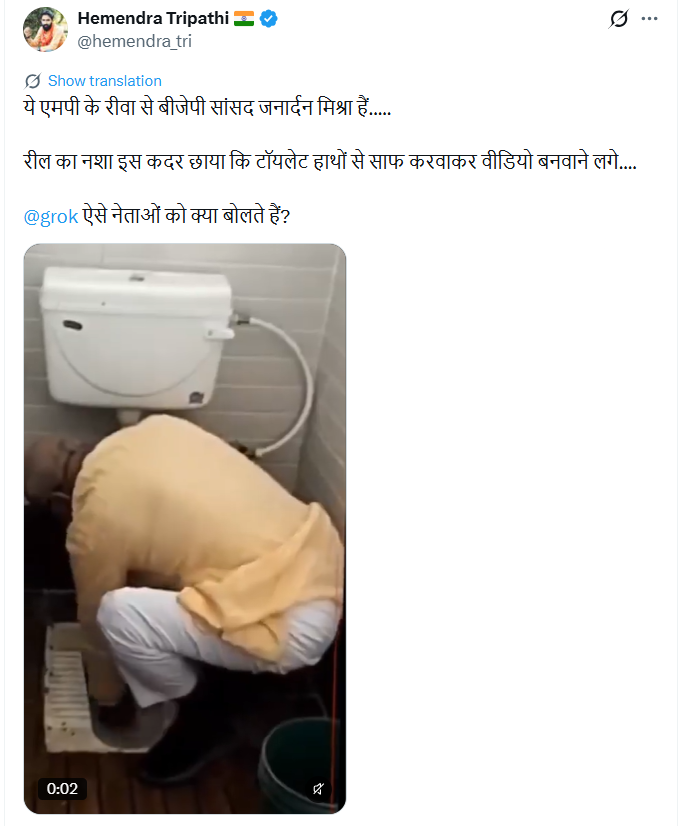
A video is being shared on social media with the claim that BJP MP from Rewa, Janardan Mishra, can be seen cleaning a toilet with his bare hands. The video is being shared as a recent incident. CyberPeace Research found that the viral video is not recent but four years old. It is now being shared with a misleading claim suggesting that it is a recent video.
Claim:
A user on social media platform X shared the viral video on November 2, 2026, with the caption: “This is BJP MP Janardan Mishra from Rewa, Madhya Pradesh... He has become so addicted to making reels that he got a toilet cleaned with his hands and had a video made.” The post link, archive link and screenshot are provided below.
https://x.com/hemendra_tri/status/2116775334838149622
Fact Check
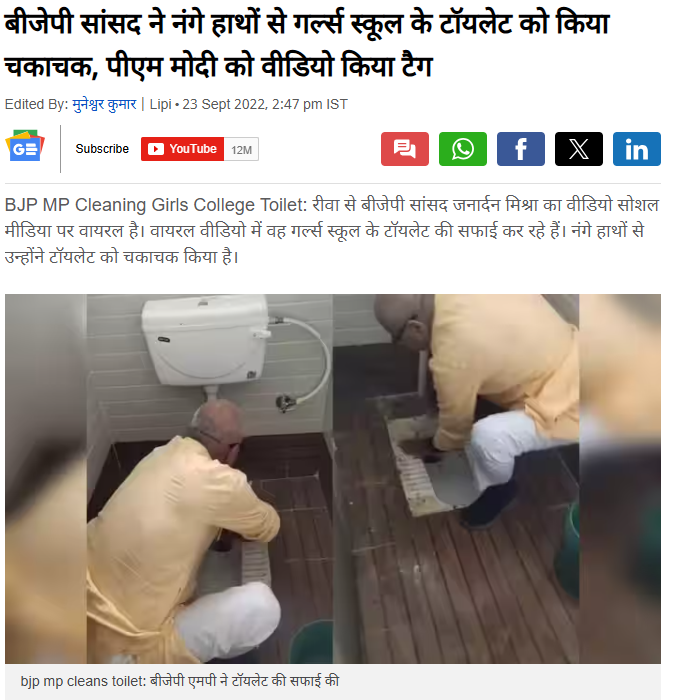
To verify the viral claim, we conducted a reverse image search of the viral video. During this process, we found a report published on the Navbharat Times website in 2022 that featured visuals from the viral video. The report link and screenshot are provided below.
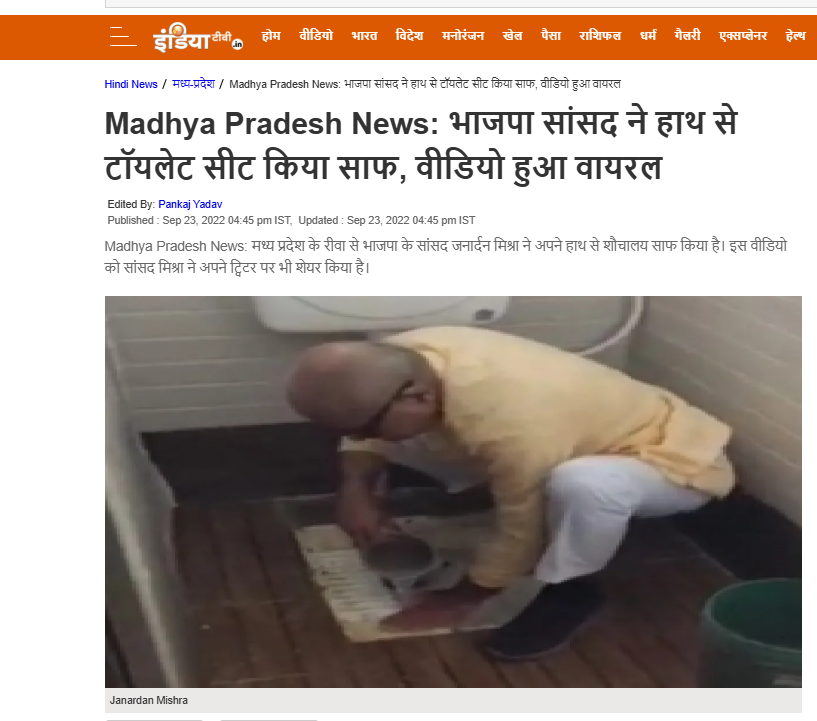
As the research progressed, we also found another report published on the India TV website on September 23, 2022, with a neutral caption. It also featured visuals from the viral video. The report link and screenshot are provided below. https://www.indiatv.in/madhya-pradesh/madhya-pradesh-news-bjp-mp-cleans-toilet-seat-by-hand-video-goes-viral-2022-09-23-886428
Conclusion
Our research found that the viral video is not recent but dates back four years to 2022. It is now being shared with a misleading claim suggesting that it shows a recent incident.

Related Blogs

Executive Summary
Following the resignation of Union Education Minister Dharmendra Pradhan on July 25, 2026, after protests by the Cockroach Janata Party (CJP) at Delhi's Jantar Mantar, a video of Bollywood actor Salman Khan has been widely shared on social media. In the clip, Salman is heard saying, “Kyunki is desh aur desh ki janta mein hai bada dum” (“Because this country and its people are truly strong”). Social media users have falsely claimed that the actor made the statement in response to Pradhan’s resignation. CyberPeace Research Wing’s research found that the viral video is not recent. It dates back to October 2022, when Salman Khan congratulated actor Chiranjeevi on the release of his film GodFather. Salman Khan did not make any such statement following Dharmendra Pradhan’s resignation. The viral claim is false.
Claim
An Instagram user, 'snatani_9', shared a video on July 27, 2026, claiming it showed Salman Khan reacting to Dharmendra Pradhan’s resignation.
“Where were these people during the Pahalgam attack? Where were they during Pulwama? Can any chamcha answer? Salman Khan’s big statement on Dharmendra Pradhan’s resignation.”
In the viral clip, Salman Khan is heard saying:“Kyunki is desh aur desh ki janta mein hai bada dum. Vande Mataram.”
https://www.instagram.com/reels/DbTfYjjz3_f/
https://perma.cc/F2XF-G268?type=standard

Fact Check
To verify the claim, we extracted keyframes from the viral video and performed a reverse image search using Google Lens. The search led us to a longer version of the same video uploaded on October 5, 2022, on Salman Khan’s official Instagram account, @beingsalmankhan.
In the original video, Salman Khan is congratulating veteran actor Chiranjeevi on the success of his film GodFather. He says, “My dear Chiru Garu, I love you very much. I have heard that GodFather is doing extremely well. Congratulations and may God bless you. Do you know why, Chiru Garu? Because this country and its people are truly strong.”
https://www.instagram.com/p/CjVhqZbgFJh

As part of our research , we also reviewed Salman Khan’s recent Instagram posts. We found a post published on July 23, 2026, in which he appealed to students and their parents amid the paper leak controversy. In the post, he urged students not to worry, expressed confidence that Prime Minister Narendra Modi would ensure strict action against those responsible, and appealed to protesters to return home peacefully.
https://www.instagram.com/p/DbI2C8CoUSa

However, none of Salman Khan’s recent posts contain any statement linking him to Dharmendra Pradhan’s resignation.
Conclusion
Our research found that the viral video is from October 2022, when Salman Khan congratulated Chiranjeevi on the success of GodFather. The clip has been taken out of context and falsely linked to Dharmendra Pradhan’s resignation in July 2026. Salman Khan did not make any such statement after the minister stepped down. Therefore, the viral claim is false.

Executive Summary
A misleading advertisement circulating in social media providing attractive offers like iPhone15, AirPods and Smartwatches from the Indian e-commerce platform ‘Myntra’. This “Myntra - Festival Gifts” scam aims to attract the unsuspecting users into a series of redirects and fake interactions to compromise their personal information and devices. It is important to stay vigilant to protect ourselves from misleading attractive offers. Through this report, the Research Wing of CyberPeace explains about a series of processes that happens when the link gets clicked. Through this knowledge, we aim to provide awareness and empower the users to guard themselves and not fall into deceptive offers that aim to scam them.
False Claim
The widely shared WhatsApp message claims that Myntra is offering a wide range of high-valued prizes including the latest iPhone 15, AirPods, various smartwatches among all as a Festival Gift promotion. The campaign invites the users to click on the link provided and take a short quiz to be eligible for the prize.

The Deceptive Scheme
- The link in the social media post is tailored to work only on mobile devices, users are taken through a chain of redirects.
- Users are greeted with the Myntra's "Big Fashion Festival" branding accompanied by Myntra’s logo once they reach the landing page, which gives an impression of authenticity.
- Next, a simple quiz asks basic questions about the user's shopping experience with Myntra, their age, and gender.
- On the bottom of the quiz, there is a comment section that shows the comments from users who are supposedly provided with the prizes to look real,
- After the completion of the quiz, users are presented with a Spin-to-Win mechanism, to win the prize.
- After winning, a congratulatory message is displayed which says that the user has won an iPhone 15.
- The final step requires the user to share the campaign over WhatsApp in order to claim the prize.
Analyzing the Fraudulent Campaign
- The use of Myntra's branding and the promise of exclusive, high-value prizes are designed to attract users' interest.
- The fake comments and social proof elements aim to create a false sense of legitimacy and widespread participation, making the offer seem more credible.
- The series of redirects, quizzes, and Spin-to-Win mechanics are tactics to keep users engaged and increase the likelihood of them falling for the scam.
- The final step of sharing the post on WhatsApp is a way for the scammers to further spread the campaign and compromise more victims. Through sharing the link over WhatsApp, users become unaware accomplices that are simply assisting the scammers to reach an even bigger audience and hence their popularity.
- The primary objectives of such scams are to gather users' personal information and potentially gain access to their devices. By luring users with the promise of exclusive gifts and creating a false sense of legitimacy, the scammers aim to exploit user trust and compromise their data, leading to potential identity theft, financial fraud, or the installation of potentially unwanted softwares.
- We have also cross-checked and as of now there is no well established and credible source or any official notification that has confirmed such an offer advertised by Myntra.
- Domain Analysis: If we closely look at the viral message, it is clearly visible that the scammers mentioned myntra.com in the url. However, the actual url takes the user to a different domain as the campaign is hosted on a third party domain instead of the official Website of Myntra, this raised suspicion. This is the common way to deceive users into falling for a Phishing scam. Whois information reveals that the domain has been registered not long ago i.e on 8th April 2024, just a few days back. Cybercriminals used Cloudflare technology to mask the actual IP address of the fraudulent website.

- Domain Name: MYTNRA.CYOU
- Registry Domain ID: D445770144-CNIC
- Registrar WHOIS Server: whois.hkdns.hk
- Registrar URL: http://www.hkdns.hk
- Updated Date: 2024-04-08T03:27:58.0Z
- Creation Date: 2024-04-08T02:58:14.0Z
- Registry Expiry Date: 2025-04-08T23:59:59.0Z
- Registrar: West263 International Limited
- Registrant State/Province: Delhi
- Registrant Country: IN
- Name Server: NORMAN.NS.CLOUDFLARE.COM
- Name Server: PAM.NS.CLOUDFLARE.COM
CyberPeace Advisory and Best Practices
- Do not open those messages received from social platforms in which you think that such messages are suspicious or unsolicited. In the beginning, your own discretion can become your best weapon.
- Falling prey to such scams could compromise your entire system, potentially granting unauthorized access to your microphone, camera, text messages, contacts, pictures, videos, banking applications, and more. Keep your cyber world safe against any attacks.
- Never, in any case, reveal such sensitive data as your login credentials and banking details to entities you haven't validated as reliable ones.
- Before sharing any content or clicking on links within messages, always verify the legitimacy of the source. Protect not only yourself but also those in your digital circle.
- For the sake of the truthfulness of offers and messages, find the official sources and companies directly. Verify the authenticity of alluring offers before taking any action.
Conclusion:
The “Myntra - Festival Gift” scam is a kind of manipulation in which the fraudsters exploit the trust of the users and take advantage of a popular e-commerce website. It is equally crucial to equip the users by imparting them knowledge on fraudulent behavior tactics like impersonating brands, creating fake social proof and application of different engagement strategies. We are required to remain alert and stand firm against cyber attacks. Be careful, make sure that information is verified and share awareness to help make a safe online environment for all users.

Introduction
The increasing online interaction and popularity of social media platforms for netizens have made a breeding ground for misinformation generation and spread. Misinformation propagation has become easier and faster on online social media platforms, unlike traditional news media sources like newspapers or TV. The big data analytics and Artificial Intelligence (AI) systems have made it possible to gather, combine, analyse and indefinitely store massive volumes of data. The constant surveillance of digital platforms can help detect and promptly respond to false and misinformation content.
During the recent Israel-Hamas conflict, there was a lot of misinformation spread on big platforms like X (formerly Twitter) and Telegram. Images and videos were falsely shared attributing to the ongoing conflict, and had spread widespread confusion and tension. While advanced technologies such as AI and big data analytics can help flag harmful content quickly, they must be carefully balanced against privacy concerns to ensure that surveillance practices do not infringe upon individual privacy rights. Ultimately, the challenge lies in creating a system that upholds both public security and personal privacy, fostering trust without compromising on either front.
The Need for Real-Time Misinformation Surveillance
According to a recent survey from the Pew Research Center, 54% of U.S. adults at least sometimes get news on social media. The top spots are taken by Facebook and YouTube respectively with Instagram trailing in as third and TikTok and X as fourth and fifth. Social media platforms provide users with instant connectivity allowing them to share information quickly with other users without requiring the permission of a gatekeeper such as an editor as in the case of traditional media channels.
Keeping in mind the data dumps that generated misinformation due to the elections that took place in 2024 (more than 100 countries), the public health crisis of COVID-19, the conflicts in the West Bank and Gaza Strip and the sheer volume of information, both true and false, has been immense. Identifying accurate information amid real-time misinformation is challenging. The dilemma emerges as the traditional content moderation techniques may not be sufficient in curbing it. Traditional content moderation alone may be insufficient, hence the call for a dedicated, real-time misinformation surveillance system backed by AI and with certain human sight and also balancing the privacy of user's data, can be proven to be a good mechanism to counter misinformation on much larger platforms. The concerns regarding data privacy need to be prioritized before deploying such technologies on platforms with larger user bases.
Ethical Concerns Surrounding Surveillance in Misinformation Control
Real-time misinformation surveillance could pose significant ethical risks and privacy risks. Monitoring communication patterns and metadata, or even inspecting private messages, can infringe upon user privacy and restrict their freedom of expression. Furthermore, defining misinformation remains a challenge; overly restrictive surveillance can unintentionally stifle legitimate dissent and alternate perspectives. Beyond these concerns, real-time surveillance mechanisms could be exploited for political, economic, or social objectives unrelated to misinformation control. Establishing clear ethical standards and limitations is essential to ensure that surveillance supports public safety without compromising individual rights.
In light of these ethical challenges, developing a responsible framework for real-time surveillance is essential.
Balancing Ethics and Efficacy in Real-Time Surveillance: Key Policy Implications
Despite these ethical challenges, a reliable misinformation surveillance system is essential. Key considerations for creating ethical, real-time surveillance may include:
- Misinformation-detection algorithms should be designed with transparency and accountability in mind. Third-party audits and explainable AI can help ensure fairness, avoid biases, and foster trust in monitoring systems.
- Establishing clear, consistent definitions of misinformation is crucial for fair enforcement. These guidelines should carefully differentiate harmful misinformation from protected free speech to respect users’ rights.
- Only collecting necessary data and adopting a consent-based approach which protects user privacy and enhances transparency and trust. It further protects them from stifling dissent and profiling for targeted ads.
- An independent oversight body that can monitor surveillance activities while ensuring accountability and preventing misuse or overreach can be created. These measures, such as the ability to appeal to wrongful content flagging, can increase user confidence in the system.
Conclusion: Striking a Balance
Real-time misinformation surveillance has shown its usefulness in counteracting the rapid spread of false information online. But, it brings complex ethical challenges that cannot be overlooked such as balancing the need for public safety with the preservation of privacy and free expression is essential to maintaining a democratic digital landscape. The references from the EU’s Digital Services Act and Singapore’s POFMA underscore that, while regulation can enhance accountability and transparency, it also risks overreach if not carefully structured. Moving forward, a framework for misinformation monitoring must prioritise transparency, accountability, and user rights, ensuring that algorithms are fair, oversight is independent, and user data is protected. By embedding these safeguards, we can create a system that addresses the threat of misinformation and upholds the foundational values of an open, responsible, and ethical online ecosystem. Balancing ethics and privacy and policy-driven AI Solutions for Real-Time Misinformation Monitoring are the need of the hour.
References
- https://www.pewresearch.org/journalism/fact-sheet/social-media-and-news-fact-sheet/
- https://eur-lex.europa.eu/legal-content/EN/TXT/HTML/?uri=OJ:C:2018:233:FULL
