
#FactCheck - Viral Clip Not Harish Rana’s Farewell, Linked to Surat Woman’s Organ Donation
Executive Summary
Amid reports that AIIMS Delhi has initiated the process to implement the Supreme Court’s decision allowing passive euthanasia for Harish Rana, a video is being shared on social media claiming to show his emotional farewell. However, research by the CyberPeace found the viral claim to be misleading. Our research revealed that the video has no connection to the Harish Rana case. In reality, the footage is from Surat, Gujarat, where the family of a 45-year-old brain-dead woman donated her organs.
Claim:
On social media platform X (formerly Twitter), a user shared the viral video on March 16, 2026, with the caption:
“Harish Rana… struggled for life for 13 years… in the end said goodbye to the world through euthanasia… but even while leaving, gave new life to many through organ donation… eyes, liver, kidneys and several other organs will give a new life to many…”
Post link and archive link are given below:
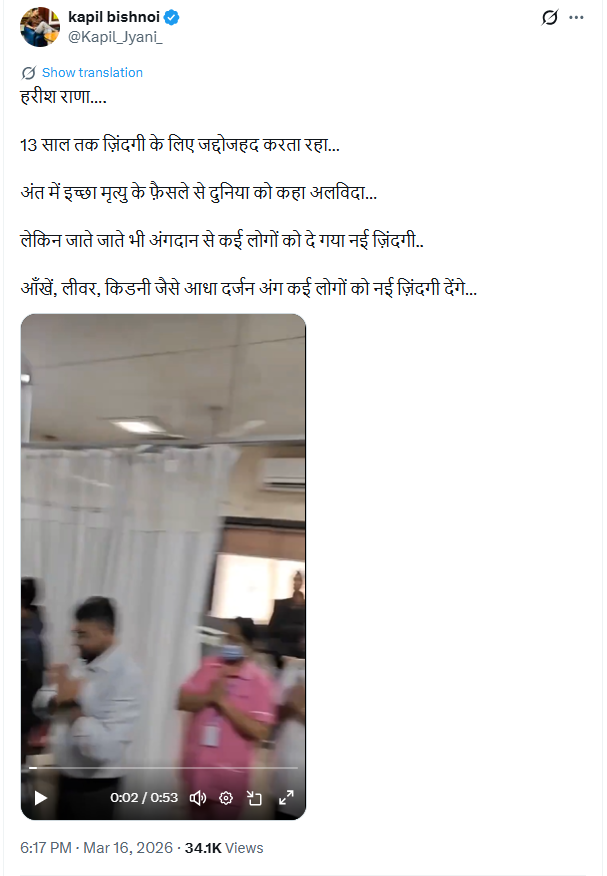
Fact Check
We took screenshots from the viral video and conducted a reverse image search. This led us to an Instagram handle where the same video was uploaded on January 27, 2026.
- https://www.instagram.com/reels/DUAt_42k2ME/

According to the caption on the Instagram post, the video shows a brain-dead woman in Surat whose liver, both kidneys, and eyes were donated. The post also included an image of the woman. Based on clues from the viral video, we conducted a keyword search on Google and found a report on the website of News18 Gujarati.

According to the report, organ donation by Ritaben Hareshbhai Korat in Surat gave a new life to five patients. The report also carried her photograph, matching the visuals seen in the viral video.
Conclusion:
Our research found that the viral video has no connection to Harish Rana. It actually shows an incident from Surat, Gujarat, where the family of a 45-year-old brain-dead woman, Ritaben Korat, donated her organs.

Related Blogs
.webp)
The Equitable Growth Approach of AI and Digital Twins
Digital Twins can be simply described as virtual replicas of physical assets or systems, powered by real-time data and advanced simulations. When this technology is combined with AI, the impact it has on enabling real-time monitoring, predictive maintenance, optimised operations, and improved design processes through the creation of virtual replicas of physical assets becomes even greater. The greatest value of AI is its ability to make data actionable. And when combined with digital twins, these data can be collated, analysed, inefficiencies removed, and better decisions can be taken to improve efficiency and quality.
This intersection between AI and Digital Twins holds immense potential for addressing key challenges, particularly in countries like India, which is rapidly embracing digital adoption to achieve its economic ambitions and sustainability goals. According to Salesforce’s most recent survey on generative AI use among the general population within the U.S., UK, Australia and India, 75% of generative AI users are looking to automate repetitive tasks and use generative AI for work communications. India is particularly looking towards a rapid digital adoption, economic ambitions, and sustainable developments to be achieved through AI adoption. This blog discuss the intersection of equitable growth, sustainability, and AI-driven policies in India.
Sustainability and the Path Ahead: Digital Twin and AI-Driven Solutions
India faces sustainability challenges which are mainly associated with issues such as urban congestion, the rising demand for energy along with climate change and environmental degradation. AI and Digital Twins provide solutions for real-time simulations and predictive analysis. Some of the examples are its applications in sustainable urban planning such as smart cities like the Indore Smart City Initiative and traffic optimisation, energy efficiency/optimisation through AI-driven renewable energy projects and power grid optimisation and even water resource management through leak detection, equitable distribution and conservation.
The need is to balance innovation with regulation, particularly, underscoring the importance of ethical and sustainable deployment of AI and digital twins and addressing data privacy with AI ethics with recent developments such as the India’s evolving AI policy landscape, including the National Strategy for Artificial Intelligence and its focus on AI for All, regulatory frameworks such as DPDP Act and the manner in which they address AI ethics, data privacy, and digital governance.
The need is to initiate targeted policies that promote research and development in AI and digital twin technologies, skill development and partnerships with the private sector, think tanks, nonprofits and others. Also, collaborations at the global level would include aligning our domestic policies with global AI and sustainability initiatives and leveraging the international frameworks for climate tech and smart infrastructure.
Cyberpeace Outlook
As part of specific actions, policymakers need to engage in proactive governance to ensure the responsible use and development of AI. This includes enacting incentive schemes for sustainable AI projects and strengthening the enforcement of data privacy laws. Industry leaders must support equitable access to AI and digital twin technologies and develop tailored AI tools for resource-constrained settings, particularly in India. Finally, researchers need to drive innovation in alignment with sustainability goals, such as those related to agriculture and groundwater management.
References
- https://economictimes.indiatimes.com/tech/artificial-intelligence/technologies-like-ai-and-digital-twins-can-tackle-challenges-like-equitable-growth-to-sustainability-wef/articleshow/117121897.cms
- https://www.salesforce.com/news/stories/generative-ai-statistics/
- https://www.mdpi.com/2673-2688/4/3/38
- https://www.ibm.com/think/topics/generative-ai-for-digital-twin-energy-utilities

Executive Summary:
A viral claim circulating on social media suggests that the Indian government is offering a 50% subsidy on tractor purchases under the so-called "Kisan Tractor Yojana." However, our research reveals that the website promoting this scheme, allegedly under the Ministry of Agriculture and Farmers Welfare, is misleading. This report aims to inform readers about the deceptive nature of this claim and emphasize the importance of safeguarding personal information against fraudulent schemes.


Claim:
A website has been circulating misleading information, claiming that the Indian government is offering a 50% subsidy on tractor purchases under the so-called "Kisan Tractor Yojana." Additionally, a YouTube video promoting this scheme suggests that individuals can apply by submitting certain documents and paying a small, supposedly refundable application fee.


Fact Check:
Our research has confirmed that there is no scheme by the Government of India named 'PM Kisan Tractor Yojana.' The circulating announcement is false and appears to be an attempt to defraud farmers through fraudulent means.
While the government does provide various agricultural subsidies under recognized schemes such as the PM Kisan Samman Nidhi and the Sub-Mission on Agricultural Mechanization (SMAM), no such initiative under the name 'PM Kisan Tractor Yojana' exists. This misleading claim is, therefore, a phishing attempt aimed at deceiving farmers and unlawfully collecting their personal or financial information.
Farmers and stakeholders are advised to rely only on official government sources for scheme-related information and to exercise caution against such deceptive practices.
To assess the authenticity of the “PM Kisan Tractor Yojana” claim, we reviewed the websites farmertractoryojana.in and tractoryojana.in. Our analysis revealed several inconsistencies, indicating that these websites are fraudulent.
As part of our verification process, we evaluated tractoryojana.in using Scam Detector to determine its trustworthiness. The results showed a low trust score, raising concerns about its legitimacy. Similarly, we conducted the same check for farmertractoryojana.in, which also appeared untrustworthy and risky. The detailed results of these assessments are attached below.
Given that these websites falsely present themselves as government-backed initiatives, our findings strongly suggest that they are part of a fraudulent scheme designed to mislead and exploit individuals seeking genuine agricultural subsidies.


During our research, we examined the "How it Works" section of the website, which outlines the application process for the alleged “PM Kisan Tractor Yojana.” Notably, applicants are required to pay a refundable application fee to proceed with their registration. It is important to emphasize that no legitimate government subsidy program requires applicants to pay a refundable application fee.


Our research found that the address listed on the website, “69A, Hanuman Road, Vile Parle East, Mumbai 400057,” is not associated with any government office or agricultural subsidy program. This further confirms the website’s fraudulent nature. Farmers should verify subsidy programs through official government sources to avoid scams.

A key inconsistency is the absence of a verified social media presence. Most legitimate government programs maintain official social media accounts for updates and communication. However, these websites fail to provide any such official handles, further casting doubt on their authenticity.

Upon attempting to log in, both websites redirect to the same page, suggesting they may be operated by the same entity or individual. This further raises concerns about their legitimacy and reinforces the likelihood of fraudulent activity.

Conclusion:
Our research confirms that the "PM Kisan Tractor Yojana" claim is fraudulent. No such government scheme exists, and the websites promoting it exhibit multiple red flags, including low trust scores, a misleading application process requiring a refundable fee, a false address, and the absence of an official social media presence. Additionally, both websites redirect to the same page, suggesting they are operated by the same entity. Farmers are advised to rely on official government sources to avoid falling victim to such scams.
- Claim: PM-Kisan Tractor Yojana Government Offering Subsidy on tractors.
- Claimed On: Social Media
- Fact Check: False and Misleading

Introduction
Prebunking is a technique that shifts the focus from directly challenging falsehoods or telling people what they need to believe to understanding how people are manipulated and misled online to begin with. It is a growing field of research that aims to help people resist persuasion by misinformation. Prebunking, or "attitudinal inoculation," is a way to teach people to spot and resist manipulative messages before they happen. The crux of the approach is rooted in taking a step backwards and nipping the problem in the bud by deepening our understanding of it, instead of designing redressal mechanisms to tackle it after the fact. It has been proven effective in helping a wide range of people build resilience to misleading information.
Prebunking is a psychological strategy for countering the effect of misinformation with the goal of assisting individuals in identifying and resisting deceptive content, hence increasing resilience against future misinformation. Online manipulation is a complex issue, and multiple approaches are needed to curb its worst effects. Prebunking provides an opportunity to get ahead of online manipulation, providing a layer of protection before individuals encounter malicious content. Prebunking aids individuals in discerning and refuting misleading arguments, thus enabling them to resist a variety of online manipulations.
Prebunking builds mental defenses for misinformation by providing warnings and counterarguments before people encounter malicious content. Inoculating people against false or misleading information is a powerful and effective method for building trust and understanding along with a personal capacity for discernment and fact-checking. Prebunking teaches people how to separate facts from myths by teaching them the importance of thinking in terms of ‘how you know what you know’ and consensus-building. Prebunking uses examples and case studies to explain the types and risks of misinformation so that individuals can apply these learnings to reject false claims and manipulation in the future as well.
How Prebunking Helps Individuals Spot Manipulative Messages
Prebunking helps individuals identify manipulative messages by providing them with the necessary tools and knowledge to recognize common techniques used to spread misinformation. Successful prebunking strategies include;
- Warnings;
- Preemptive Refutation: It explains the narrative/technique and how particular information is manipulative in structure. The Inoculation treatment messages typically include 2-3 counterarguments and their refutations. An effective rebuttal provides the viewer with skills to fight any erroneous or misleading information they may encounter in the future.
- Micro-dosing: A weakened or practical example of misinformation that is innocuous.
All these alert individuals to potential manipulation attempts. Prebunking also offers weakened examples of misinformation, allowing individuals to practice identifying deceptive content. It activates mental defenses, preparing individuals to resist persuasion attempts. Misinformation can exploit cognitive biases: people tend to put a lot of faith in things they’ve heard repeatedly - a fact that malicious actors manipulate by flooding the Internet with their claims to help legitimise them by creating familiarity. The ‘prebunking’ technique helps to create resilience against misinformation and protects our minds from the harmful effects of misinformation.
Prebunking essentially helps people control the information they consume by teaching them how to discern between accurate and deceptive content. It enables one to develop critical thinking skills, evaluate sources adequately and identify red flags. By incorporating these components and strategies, prebunking enhances the ability to spot manipulative messages, resist deceptive narratives, and make informed decisions when navigating the very dynamic and complex information landscape online.
CyberPeace Policy Recommendations
- Preventing and fighting misinformation necessitates joint efforts between different stakeholders. The government and policymakers should sponsor prebunking initiatives and information literacy programmes to counter misinformation and adopt systematic approaches. Regulatory frameworks should encourage accountability in the dissemination of online information on various platforms. Collaboration with educational institutions, technological companies and civil society organisations can assist in the implementation of prebunking techniques in a variety of areas.
- Higher educational institutions should support prebunking and media literacy and offer professional development opportunities for educators, and scholars by working with academics and professionals on the subject of misinformation by producing research studies on the grey areas and challenges associated with misinformation.
- Technological companies and social media platforms should improve algorithm transparency, create user-friendly tools and resources, and work with fact-checking organisations to incorporate fact-check labels and tools.
- Civil society organisations and NGOs should promote digital literacy campaigns to spread awareness on misinformation and teach prebunking strategies and critical information evaluation. Training programmes should be available to help people recognise and resist deceptive information using prebunking tactics. Advocacy efforts should support legislation or guidelines that support and encourage prebunking efforts and promote media literacy as a basic skill in the digital landscape.
- Media outlets and journalists including print & social media should follow high journalistic standards and engage in fact-checking activities to ensure information accuracy before release. Collaboration with prebunking professionals, cyber security experts, researchers and advocacy analysts can result in instructional content and initiatives that promote media literacy, prebunking strategies and misinformation awareness.
Final Words
The World Economic Forum's Global Risks Report 2024 identifies misinformation and disinformation as the top most significant risks for the next two years. Misinformation and disinformation are rampant in today’s digital-first reality, and the ever-growing popularity of social media is only going to see the challenges compound further. It is absolutely imperative for all netizens and stakeholders to adopt proactive approaches to counter the growing problem of misinformation. Prebunking is a powerful problem-solving tool in this regard because it aims at ‘protection through prevention’ instead of limiting the strategy to harm reduction and redressal. We can draw parallels with the concept of vaccination or inoculation, reducing the probability of a misinformation infection. Prebunking exposes us to a weakened form of misinformation and provides ways to identify it, reducing the chance false information takes root in our psyches.
The most compelling attribute of this approach is that the focus is not only on preventing damage but also creating widespread ownership and citizen participation in the problem-solving process. Every empowered individual creates an additional layer of protection against the scourge of misinformation, not only making safer choices for themselves but also lowering the risk of spreading false claims to others.
References
- [1] https://www3.weforum.org/docs/WEF_The_Global_Risks_Report_2024.pdf
- [2] https://prebunking.withgoogle.com/docs/A_Practical_Guide_to_Prebunking_Misinformation.pdf
- [3] https://ijoc.org/index.php/ijoc/article/viewFile/17634/3565
