#FactCheck- Viral video of UP Police patrolling on e-rickshaw is AI-generated
Executive Summary
A video is being widely shared on social media showing a police officer driving an e-rickshaw, while two other policemen are seen in the back seat. Users sharing the clip claim that, due to a shortage of petrol, this is a new initiative by the Uttar Pradesh Police. However, research by CyberPeace found the viral claim to be false. Our research also confirms that the video is not real but AI-generated.
Claim
An Instagram user shared the viral video claiming that due to fuel shortages, Uttar Pradesh Police has started patrolling using e-rickshaws.
- Post link: https://www.instagram.com/reel/DWepKWXAeiE/
- Archive: https://archive.ph/QBNXs

Fact Check
To verify the claim, we first conducted a keyword search on Google but found no credible media reports supporting this claim.
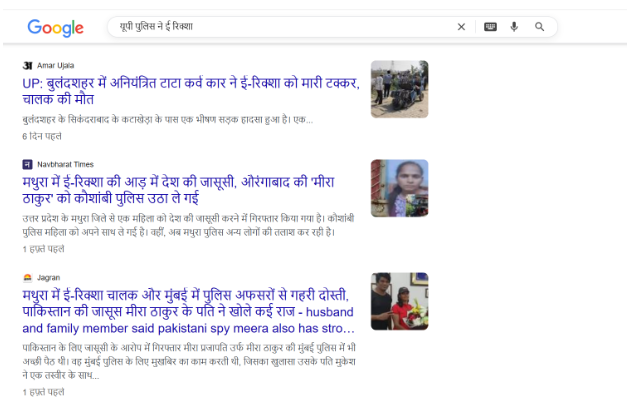
Next, we extracted keyframes from the viral video and performed a reverse image search using Google Lens. During this process, we found the same video uploaded on an Instagram channel on March 28, 2026. The uploader clearly mentioned that the video was created purely for entertainment purposes.

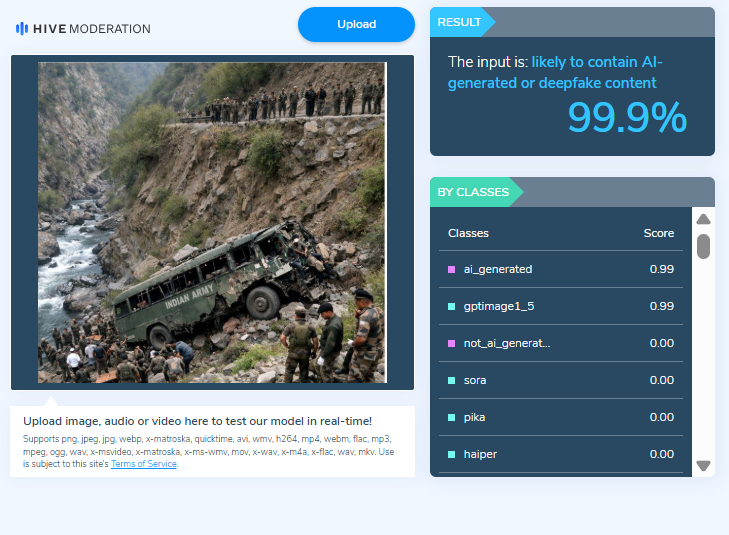
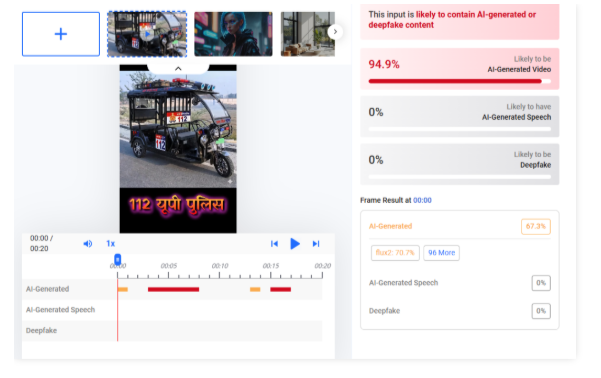
We further analyzed the video using AI detection tools. When scanned with Hive Moderation, the results indicated that the video is approximately 94% AI-generated.
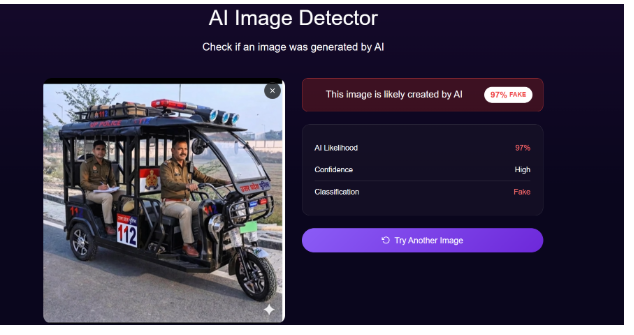
In the next step, we also tested the clip using DeepAI. According to its analysis, the video is about 97% AI-generated.
Conclusion
Our research clearly shows that the viral video is not authentic. It is an AI-generated clip created for entertainment purposes, and the claim that Uttar Pradesh Police has started e-rickshaw patrolling due to petrol shortage is false.
Related Blogs
.webp)
Misinformation spread has become a cause for concern for all stakeholders, be it the government, policymakers, business organisations or the citizens. The current push for combating misinformation is rooted in the growing awareness that misinformation leads to sentiment exploitation and can result in economic instability, personal risks, and a rise in political, regional, and religious tensions. The circulation of misinformation poses significant challenges for organisations, brands and administrators of all types. The spread of misinformation online poses a risk not only to the everyday content consumer, but also creates concerns for the sharer but the platforms themselves. Sharing misinformation in the digital realm, intentionally or not, can have real consequences.
Consequences for Platforms
Platforms have been scrutinised for the content they allow to be published and what they don't. It is important to understand not only how this misinformation affects platform users, but also its impact and consequences for the platforms themselves. These consequences highlight the complex environment that social media platforms operate in, where the stakes are high from the perspective of both business and societal impact. They are:
- Legal Consequences: Platforms can be fined by regulators if they fail to comply with content moderation or misinformation-related laws and a prime example of such a law is the Digital Services Act of the EU, which has been created for the regulation of digital services that act as intermediaries for consumers and goods, services, and content. They can face lawsuits by individuals, organisations or governments for any damages due to misinformation. Defamation suits are part of the standard practice when dealing with misinformation-causing vectors. In India, the Prohibition of Fake News on Social Media Bill of 2023 is in the pipeline and would establish a regulatory body for fake news on social media platforms.
- Reputational Consequences: Platforms employ a trust model where the user trusts it and its content. If a user loses trust in the platform because of misinformation, it can reduce engagement. This might even lead to negative coverage that affects the public opinion of the brand, its value and viability in the long run.
- Financial Consequences: Businesses that engage with the platform may end their engagement with platforms accused of misinformation, which can lead to a revenue drop. This can also have major consequences affecting the long-term financial health of the platform, such as a decline in stock prices.
- Operational Consequences: To counter the scrutiny from regulators, the platform might need to engage in stricter content moderation policies or other resource-intensive tasks, increasing operational costs for the platforms.
- Market Position Loss: If the reliability of a platform is under question, then, platform users can migrate to other platforms, leading to a loss in the market share in favour of those platforms that manage misinformation more effectively.
- Freedom of Expression vs. Censorship Debate: There needs to be a balance between freedom of expression and the prevention of misinformation. Censorship can become an accusation for the platform in case of stricter content moderation and if the users feel that their opinions are unfairly suppressed.
- Ethical and Moral Responsibilities: Accountability for platforms extends to moral accountability as they allow content that affects different spheres of the user's life such as public health, democracy etc. Misinformation can cause real-world harm like health misinformation or inciting violence, which leads to the fact that platforms have social responsibility too.
Misinformation has turned into a global issue and because of this, digital platforms need to be vigilant while they navigate the varying legal, cultural and social expectations across different jurisdictions. Efforts to create standardised practices and policies have been complicated by the diversity of approaches, leading platforms to adopt flexible strategies for managing misinformation that align with global and local standards.
Addressing the Consequences
These consequences can be addressed by undertaking the following measures:
- The implementation of a more robust content moderation system by the platforms using a combination of AI and human oversight for the identification and removal of misinformation in an effective manner.
- Enhancing the transparency in platform policies for content moderation and decision-making would build user trust and reduce the backlash associated with perceived censorship.
- Collaborations with fact checkers in the form of partnerships to help verify the accuracy of content and reduce the spread of misinformation.
- Engage with regulators proactively to stay ahead of legal and regulatory requirements and avoid punitive actions.
- Platforms should Invest in media literacy initiatives and help users critically evaluate the content available to them.
Final Takeaways
The accrual of misinformation on digital platforms has resulted in presenting significant challenges across legal, reputational, financial, and operational functions for all stakeholders. As a result, a critical need arises where the interlinked, but seemingly-exclusive priorities of preventing misinformation and upholding freedom of expression must be balanced. Platforms must invest in the creation and implementation of a robust content moderation system with in-built transparency, collaborating with fact-checkers, and media literacy efforts to mitigate the adverse effects of misinformation. In addition to this, adapting to diverse international standards is essential to maintaining their global presence and societal trust.
References
- https://pirg.org/edfund/articles/misinformation-on-social-media/
- https://www.mdpi.com/2076-0760/12/12/674
- https://scroll.in/article/1057626/israel-hamas-war-misinformation-is-being-spread-across-social-media-with-real-world-consequences
- https://www.who.int/europe/news/item/01-09-2022-infodemics-and-misinformation-negatively-affect-people-s-health-behaviours--new-who-review-finds
.webp)
Introduction
We were all stunned and taken aback when multiple photos of streets in the U.S. surfaced with heavily drugged individuals loosely sitting on the streets, victims of a systematically led drug operation that has recently become a target of the Trump-led “tariff” war, which he terms as a war on drug cartels. The drug is a synthetic opioid, fentanyl, which is highly powerful and addictive. The menace of this drug is found in a country that has Wall Street and the largest and most powerful economy globally. The serious implications of drug abuse are not about a certain economy; instead, it has huge costs to society in general. The estimated cost of substance misuse to society is more than $820 billion each year and is expected to continue rising.
On June 26, the International Day against Drug Abuse and Illicit Trafficking is observed globally. However, this war is waged daily for millions of people, not on streets or borders, but in bloodstreams, behind locked doors, and inside broken homes. Drug abuse is no longer a health crisis; it is a developmental crisis. The United Nations Office on Drugs and Crime has launched a campaign against this organised crime that says, “Break the Cycle’ attributing to the fact that de-addiction is hard for individuals.
The Evolving Drug Crisis: From Alleyways to Algorithms
The menace of Drug abuse and illicit trafficking has also taken strides in advancement, and what was once considered a street-side vice has made its way online in a faceless, encrypted, and algorithmically optimised sense. The online drug cartels operate in the shadows and often hide in plain sight, taking advantage of the privacy designed to benefit individuals. With the help of darknet markets, cryptocurrency, and anonymised logistics, the drug trade has transformed into a transnational, tech-enabled industry on a global scale. In an operation led by the U.S. Department of Justice’s Joint Criminal Opiod and Darknet Enforcement (JCODE) and related to Operation RapTor, an LA apartment was only to find an organised business centre that operated as a hub of one of the most prolific methamphetamine and cocaine distributors in the market. Aaron Pinder, Unit Chief of the FBI Hi-Tech Organised Crime Unit, said in his interview, “The darknet vendors that we investigate, they truly operate on a global scale.” On January 11, 2025, during the Regional Conference on “Drug Trafficking and National Security,” it was acknowledged how cryptocurrency, the dark web, online marketplaces, and drones have made drug trafficking a faceless crime. Reportedly, there has been a seven-fold increase in the drugs seized from 2004-14 to 2014-24.
India’s Response: Bridging Borders, Policing Bytes
India has been historically vulnerable due to its geostrategic placement between the Golden Crescent (Afghanistan-Iran-Pakistan) and Golden Triangle (Myanmar-Laos-Thailand), and confronts a fresh danger from “click-to-consume’ narcotics. Although India has always adopted a highly sensitised approach, it holds an optimistic future outlook for the youth. Last year, to commemorate the occasion of International Day against Drug Abuse and Illicit Trafficking, the Department of Social Justice & Empowerment organised a programme to engage individuals for the cause. The Indian authorities are often seen coming down heavily on the drug peddlers and cartels, and to aid the cause, the Home Minister Amit Shah inaugurated the new office complex of the NCB’s Bhopal zonal unit and extension of the MANAS-2 helpline to all 36 states and UTs. The primary objectives of this step are to evaluate the effectiveness of the Narcotics Coordination Mechanism (NCORD), assess the progress of states in fighting drug trafficking, and share real-time information from the National Narcotics Helpline ‘MANAS’ portal with the Anti-Narcotics Task Force (ANTF) of states and UTs.
The United Nation’s War on Narcotics: From Treaties to Technology
The United Nations Office on Drugs and Crime (UNODC) is leading the international response. It offers vital data, early warning systems, and technical support to the states fighting the drug problem. The UNODC incorporates cooperation in cross-border intelligence, overseeing the darknet activities, encouraging the treatment and harm reduction, and using anti-money laundering mechanisms to stop financial flows. India has always pledged its support to the UN led activities, and as per reports dated 26th March, 2025, India chaired the prestigious UN-backed Commission on Narcotic Drugs (CND) meeting held in vienna, wherein India highlighted the importance of opioids for medical purposes as well as the nation’s notable advancements in the field.
Resolution on June 26: From Commemoration to Commitment
Let June 26 be more than a date on the calendar- let it echo as a call to action, a day when awareness transforms into action, and resolve becomes resistance. On this day, CyberPeace resolves the following:
- To treat addicts as victims rather than criminals and to pitch for reforms to provide access to reasonably priced, stigma-free rehabilitation.
- To integrate anti-drug awareness into digital literacy initiatives and school curricula in order to teach frequently and early.
- To demand responsibility and accountability from online marketplaces and delivery services that unwittingly aid traffickers
- To tackle the demand side through employment, mental health services, and social protection, particularly for at-risk youth.
References
- https://www.gatewayfoundation.org/blog/cost-of-drug-addiction/#:~:text=The%20estimated%20cost%20for%20substance,Alcohol%3A%20%24249%20billion
- https://www.unodc.org/unodc/en/drugs/index-new.html
- https://www.fbi.gov/news/stories/global-operation-targets-darknet-drug-trafficking
- https://www.thehindu.com/news/national/dark-web-crypto-drones-emerge-as-challenges-in-fight-against-drug-trafficking-amit-shah/article69088383.ece
- https://www.pib.gov.in/PressReleaseIframePage.aspx?PRID=2028704
- https://www.newindianexpress.com/nation/2025/Mar/26/in-a-first-india-chairs-un-forum-on-narcotics-pledges-to-improve-access-to-pain-relief-and-palliative-care

Introduction
The Central Board of Secondary Education (CBSE) has issued a warning to students about fake social media accounts that spread false information about the CBSE. The board has warned students not to trust the information coming from these accounts and has released a list of 30 fake accounts. The board has expressed concern that these handles are misleading students and parents by spreading fake information with the name and logo of the CBSE. The board has has also clarified that it is not responsible for the information being spread from these fake accounts.
The Central Board of Secondary Education (CBSE), a venerable institution in the realm of Indian education, has found itself ensnared in the web of cyber duplicity. Impersonation attacks, a sinister facet of cybercrime, have burgeoned, prompting the Board to adopt a vigilant stance against the proliferation of counterfeit social media handles that masquerade under its esteemed name and emblem.
The CBSE, has revealed a list of approximately 30 spurious handles that have been sowing seeds of disinformation across the social media landscape. These digital doppelgängers, cloaked in the Board's identity, have been identified and exposed. The Board's official beacon in this murky sea of falsehoods is the verified handle '@cbseindia29', a lighthouse guiding the public to the shores of authentic information.
This unfolding narrative signifies the Board's unwavering commitment to tackle the scourge of misinformation and to fortify the bulwarks safeguarding the sanctity of its official communications. By spotlighting the rampant growth of fake social media personas, the CBSE endeavors to shield the public from the detrimental effects of misleading information and to preserve the trust vested in its official channels.
CBSE Impersonator Accounts
The list of identified malefactors, parading under the CBSE banner, serves as a stark admonition to the public to exercise discernment while navigating the treacherous waters of social media platforms. The CBSE has initiated appropriate legal manoeuvres against these unauthorised entities to stymie their dissemination of fallacious narratives.
The Board has previously unfurled comprehensive details concerning the impending board examinations for both Class 10 and Class 12 in the year 2024. These academic assessments are slated to commence from February 15 to April 2, 2024, with a uniform start time of 10:30 AM (IST) across all designated dates.
The CBSE has made it unequivocally clear that there are nefarious entities lurking in the shadows of social media, masquerading in the guise of the CBSE. It has implored students and the general public not to be ensnared by the siren songs emanating from these fraudulent accounts and has also unfurled a list of these imposters. The Board's warning is a beacon of caution, illuminating the path for students as they navigate the digital expanse with the impending commencement of the CBSE Class X and XII exams.
Sounding The Alarm
The Central Board of Secondary Education (CBSE) has sounded the alarm, issuing an advisory to schools, students, and their guardians about the existence of fake social media platform handles that brandish the board’s logo and mislead the academic community. The board has identified about 30 such accounts on the microblogging site 'X' (formerly known as Twitter) that misuse the CBSE logo and acronym, sowing confusion and disarray.
The board is in the process of taking appropriate action against these deceptive entities. CBSE has also stated that it bears no responsibility for any information disseminated by any other source that unlawfully appropriates its name and logo on social media platforms.
Sources reveal that these impostors post false information on various updates, including admissions and exam schedules. After receiving complaints about such accounts on 'X', the CBSE issued the advisory and has initiated action against those operating these accounts, sources said.
The Brute Nature of Impersonation
In the contemporary digital epoch, cybersecurity has ascended to a position of critical importance. It is the bulwark that ensures the sanctity of computer networks is maintained and that computer systems are not marked as prey by cyber predators. Cyberattacks are insidious stratagems executed with the intent of expropriating, manipulating, or annihilating authenticated user or organizational data. It is imperative that cyberattacks be mitigated at their roots so that users and organizations utilizing internet services can navigate the digital domain with a sense of safety and security. Knowledge about cyberattacks thus plays a pivotal role in educating cyber users about the diverse types of cyber threats and the preventive measures to counteract them.
Impersonation Attacks are a vicious form of cyberattack, characterised by the malicious intent to extract confidential information. These attacks revolve around a process where cyber attackers eschew the use of malware or bots to perpetrate their crimes, instead wielding the potent tactic of social engineering. The attacker meticulously researches and harvests information about the legitimate user through platforms such as social media and then exploits this information to impersonate or masquerade as the original, legitimate user.
The threats posed by Impersonation Attacks are particularly insidious because they demand immediate action, pressuring the victim to act without discerning between the authenticated user and the impersonated one. The very nature of an Impersonation Attack is a perilous form of cyber assault, as the original user who is impersonated holds rights to private information. These attacks can be executed by exploiting a resemblance to the original user's identity, such as email IDs. Email IDs with minute differences from the legitimate user are employed in this form of attack, setting it apart from the phishing cyber mechanism. The email addresses are so similar and close to each other that, without paying heed or attention to them, the differences can be easily overlooked. Moreover, the email addresses appear to be correct, as they generally do not contain spelling errors.
Strategies to Prevent
To prevent Impersonation Attacks, the following strategies can be employed:
- Proper security mechanisms help identify malicious emails and thereby filter spamming email addresses on a regular basis.
- Double-checking sensitive information is crucial, especially when important data or funds need to be transferred. It is vital to ensure that the data is transferred to a legitimate user by cross-verifying the email address.
- Ensuring organizational-level security is paramount. Organizations should have specific domain names assigned to them, which can help employees and users distinguish their identity from that of cyber attackers.
- Protection of User Identity is essential. Employees must not publicly share their private identities, which can be exploited by attackers to impersonate their presence within the organization.
Conclusion
The CBSE's struggle against the masquerade of misinformation is a reminder of the vigilance required to safeguard the legitimacy of our digital interactions. As we navigate the complex and uncharted terrain of the internet, let us arm ourselves with the knowledge and discernment necessary to unmask these digital charlatans and uphold the sanctity of truth.
References
- https://timesofindia.indiatimes.com/city/ahmedabad/cbse-warns-against-misuse-of-its-name-by-fake-social-media-handles/articleshow/107644422.cms
- https://www.timesnownews.com/education/cbse-releases-list-of-fake-social-media-handles-asks-not-to-follow-article-107632266
- https://www.etvbharat.com/en/!bharat/cbse-public-advisory-enn24021205856