
#FactCheck-Fake Graphic Falsely Claims Rajinikanth Appointed Kerala Governor
Executive Summary
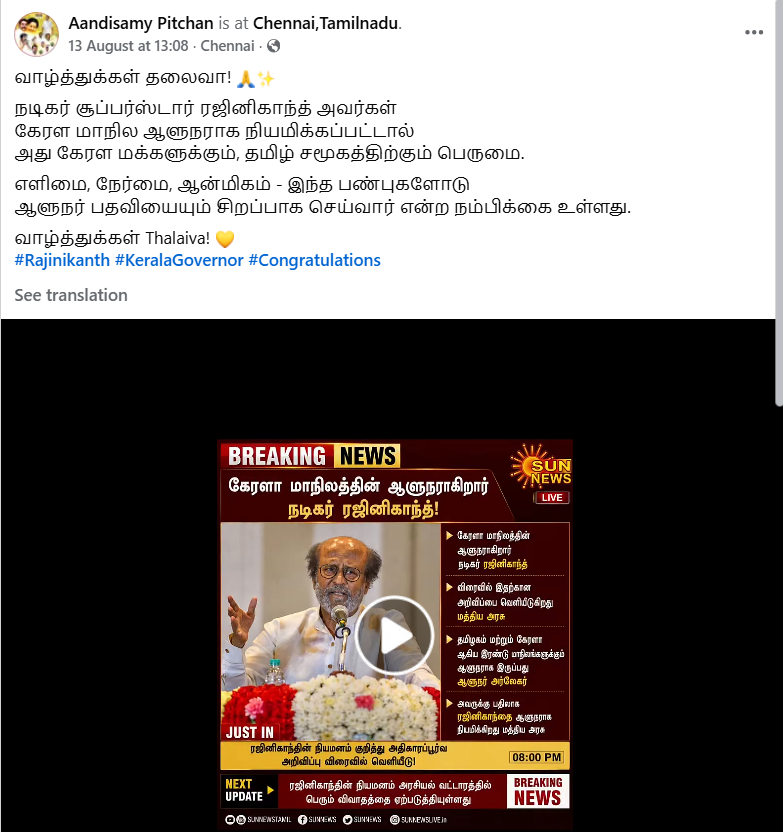
A graphic carrying the logo of Tamil news channel Sun News is circulating widely on social media, claiming that veteran South Indian actor Rajinikanth has been appointed as the new Governor of Kerala. The viral graphic features a photograph of Rajinikanth along with congratulatory messages, creating the impression that his appointment has been officially announced. However, the claim is false. An research by the CyberPeace ’s Research Wing found that the viral graphic is digitally manipulated and falsely attributed to Sun News.
Claim
A graphic bearing the Sun News logo is being widely shared on social media with congratulatory messages, claiming that actor Rajinikanth has been appointed as the new Governor of Kerala.
https://www.facebook.com/andisamy.puthur/posts/1456280999637808/
FactCheck
The CyberPeace ’s Research Wing investigated the viral claim and found no official notification or credible media report confirming Rajinikanth’s appointment as the Governor of Kerala or as the Governor of any other state. We searched relevant government sources and credible media reports but found no announcement regarding such an appointment. We also checked the official platforms of Sun News, but found no report confirming that Rajinikanth had been appointed as the Governor of Kerala. Further research revealed that the photograph of Rajinikanth used in the viral graphic is actually from a press conference held on March 12, 2020. A video of the original press conference shows Rajinikanth speaking about his political plans. During the press conference, he had clarified that he was not interested in becoming the Chief Minister of Tamil Nadu.
The original video of the press conference is available on YouTube.
https://www.youtube.com/watch?v=Vni3pxjWSR8
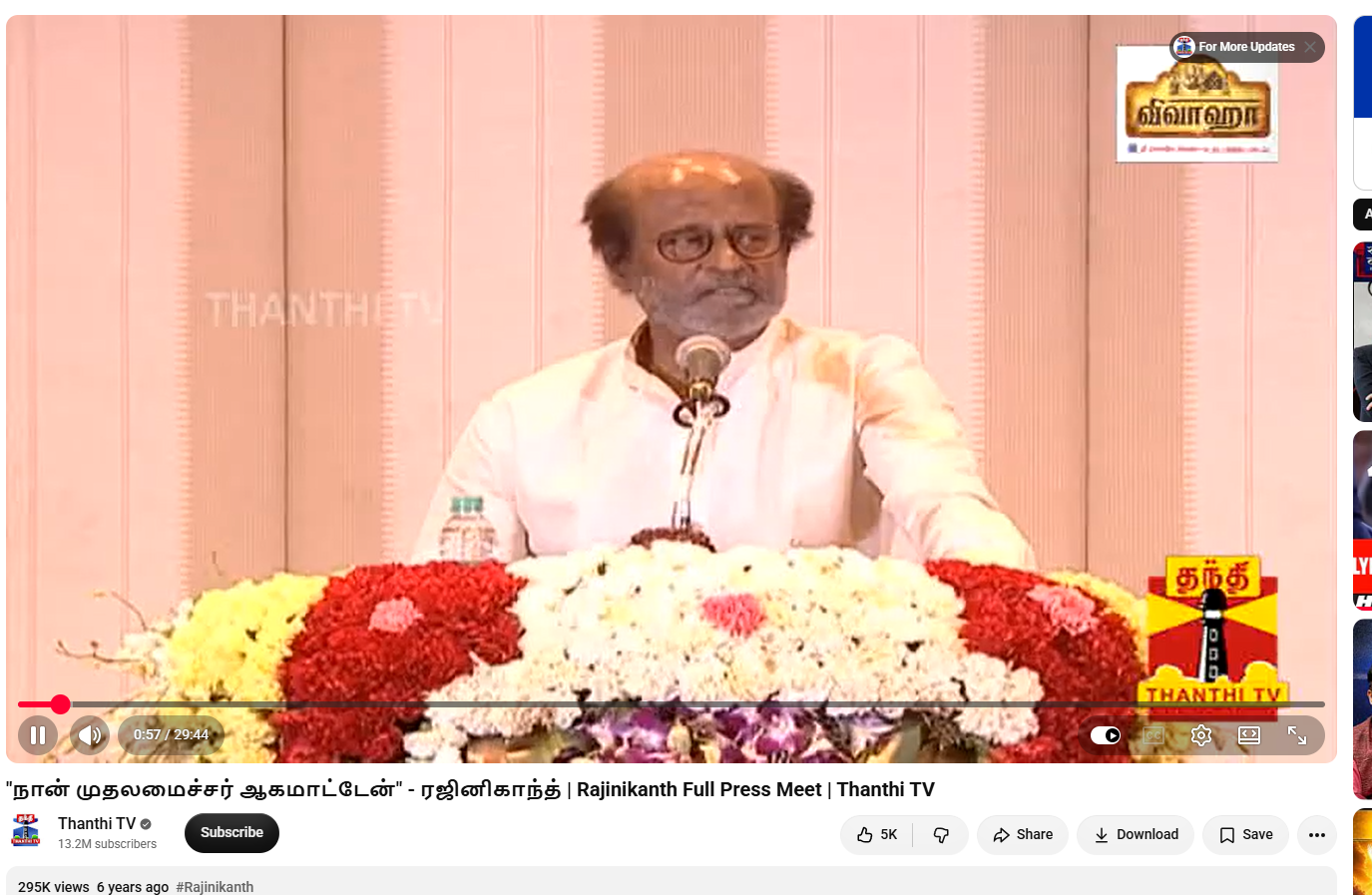
The research further found that the viral graphic has been digitally altered and falsely attributed to Sun News. The graphic was also found to have been created using an artificial intelligence (AI) tool.
Conclusion
The claim that Rajinikanth has been appointed as the new Governor of Kerala is false and misleading. There has been no official government announcement or credible media report confirming his appointment, and Sun News has not published any such report. The viral graphic is digitally manipulated and falsely attributed to the news channel.

Related Blogs
Executive Summary
A dramatic video showing several people jumping from the upper floors of a building into what appears to be thick snow has been circulating on social media, with users claiming that it captures a real incident in Russia during heavy snowfall. In the footage, individuals can be seen leaping one after another from a multi-storey structure onto a snow-covered surface below, eliciting reactions ranging from amusement to concern. The claim accompanying the video suggests that it depicts a reckless real-life episode in a snow-hit region of Russia.
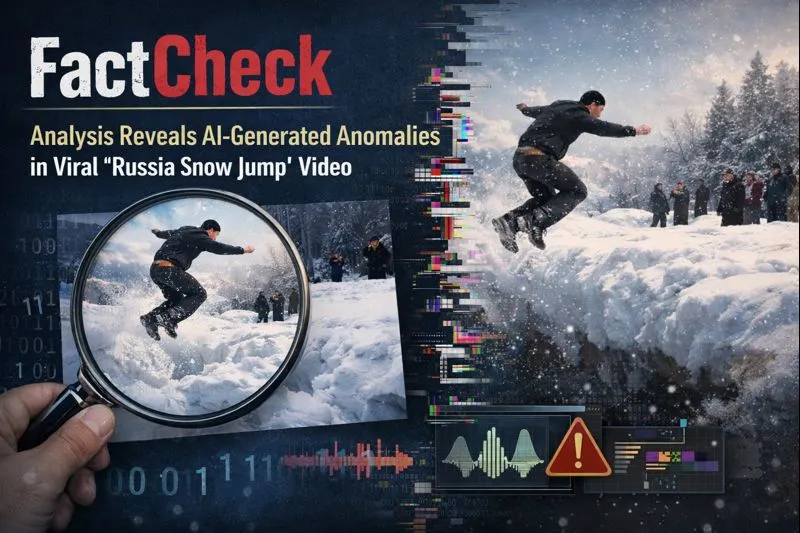
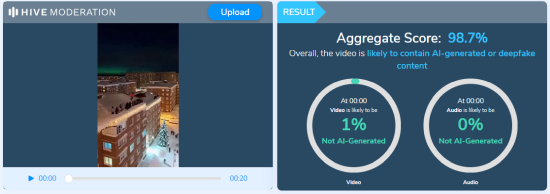
A thorough analysis by CyberPeace confirmed that the video is not a real-world recording but an AI-generated creation. The footage exhibits multiple signs of synthetic media, including unnatural human movements, inconsistent physics, blurred or distorted edges, and a glossy, computer-rendered appearance. In some frames, a partial watermark from an AI video generation tool is visible. Further verification using the Hive Moderation AI-detection platform indicated that 98.7% of the video is AI-generated, confirming that the clip is entirely digitally created and does not depict any actual incident in Russia.
Claim:
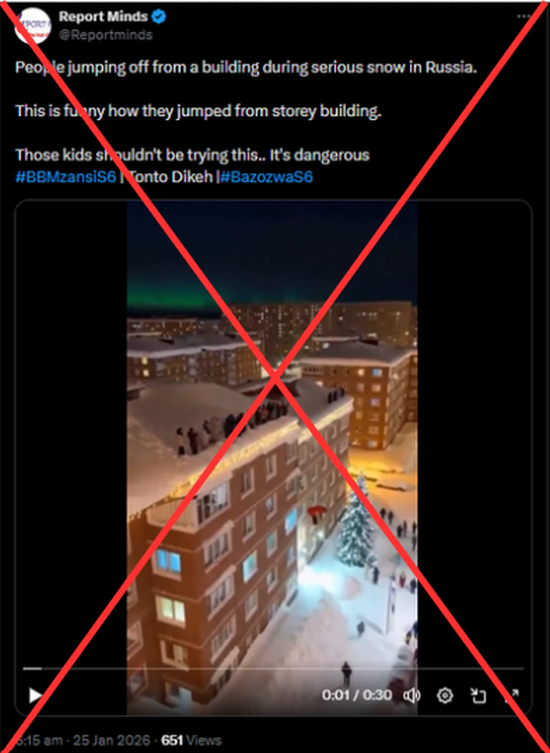
The video was shared on social media by an X (formerly Twitter) user ‘Report Minds’ on January 25, claiming it showed a real-life event in Russia. The post caption read: "People jumping off from a building during serious snow in Russia. This is funny, how they jumped from a storey building. Those kids shouldn't be trying this. It's dangerous." Here is the link to the post, and below is a screenshot.
Fact Check:
The Desk used the InVid tool to extract keyframes from the viral video and conducted a reverse image search, which revealed multiple instances of the same video shared by other users with similar claims. Upon close visual examination, several anomalies were observed, including unnatural human movements, blurred and distorted sections, a glossy, digitally-rendered appearance, and a partially concealed logo of the AI video generation tool ‘Sora AI’ visible in certain frames. Screenshots highlighting these inconsistencies were captured during the research .
- https://x.com/DailyLoud/status/2015107152772297086?s=20
- https://x.com/75secondes/status/2015134928745164848?s=20
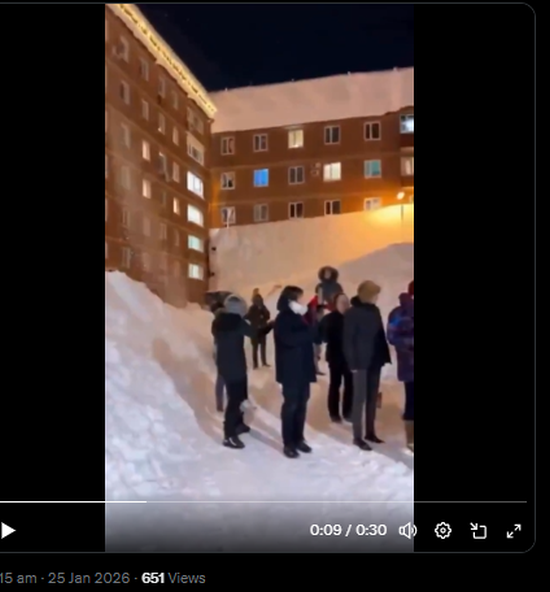
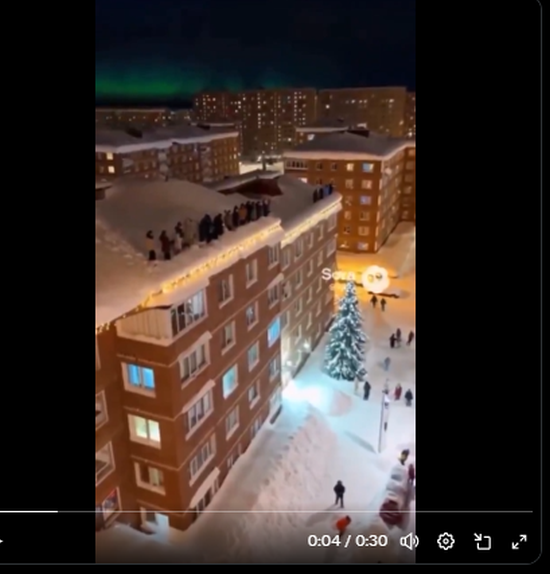
The video was analyzed on Hive Moderation, an AI-detection platform, which confirmed that 98.7% of the content is AI-generated.
The viral video showing people jumping off a building into snow, claimed to depict a real incident in Russia, is entirely AI-generated. Social media users who shared it presented the digitally created footage as if it were real, making the claim false and misleading.
Executive Summary:
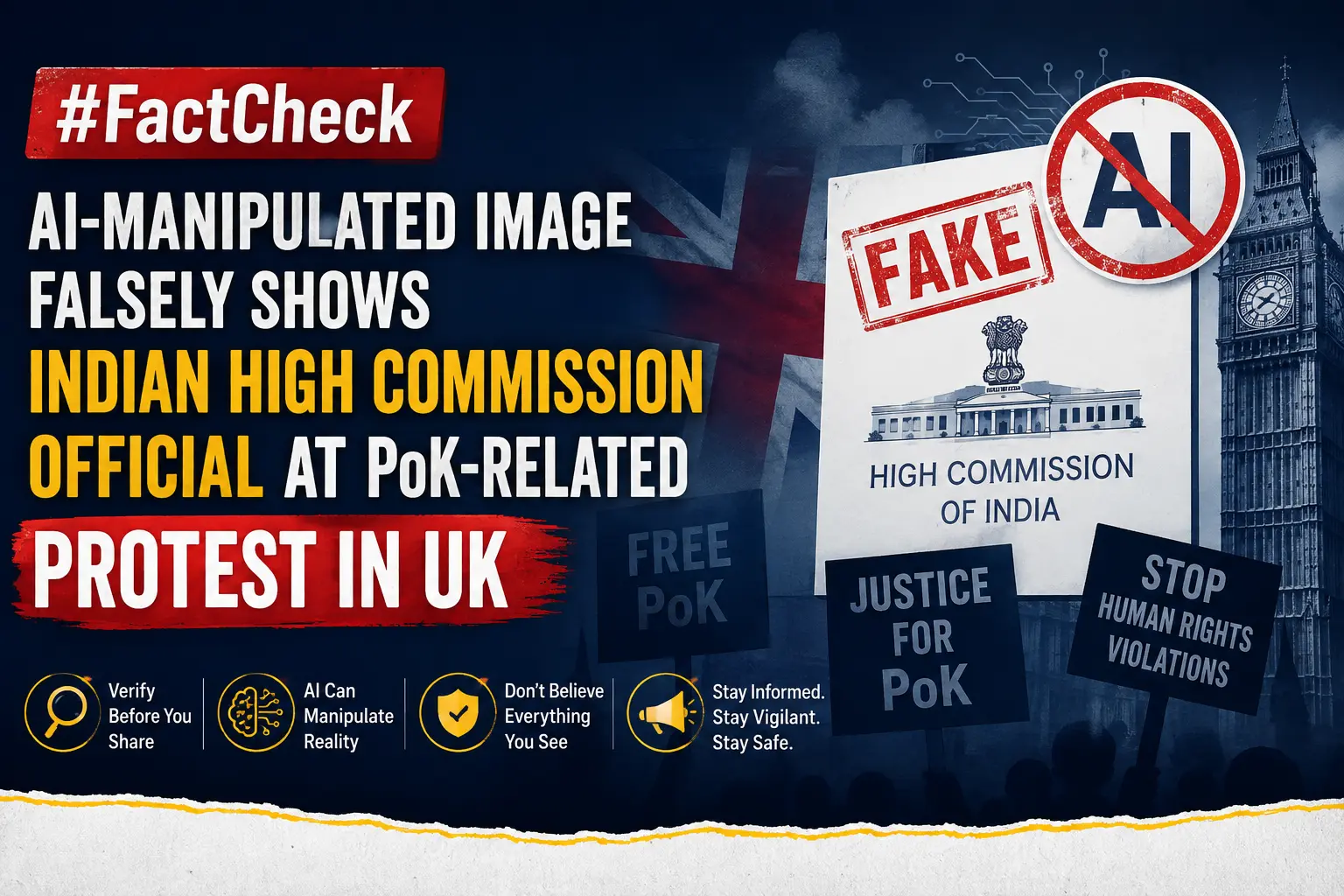
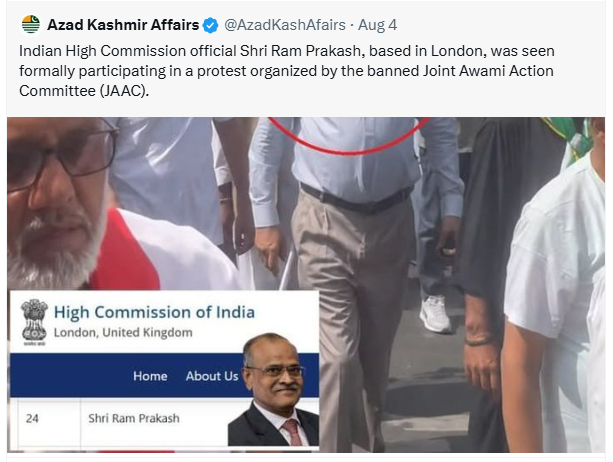
A photo is being circulated on social media with the claim that it shows Ram Prakash, an official from the Indian High Commission in the United Kingdom (UK), participating in a protest organised over issues related to PoK. CyberPeace Research Wing’s research found the claim associated with the image to be false. The research confirmed that the image was digitally modified using OpenAI’s AI tools.
Claim:
A user on social media platform X (formerly Twitter) shared the viral image on August 4, 2026, claiming that Shri Ram Prakash, an official from the Indian High Commission in London, was seen formally participating in a protest organised by the banned Joint Awami Action Committee (JAAC). The post link, archive link, and screenshot are provided below:
https://x.com/i/birdwatch/t/2084551118189904105?source=6
Fact Check:
During the research, we conducted a Google search using relevant keywords. We traced the original source of the viral visual to a social media post shared by Pakistani media outlet GEO News’ UK Bureau Chief Murtaza Ali Shah on August 2, 2024.
The post featured a video of a protest held in Luton, United Kingdom, where a large number of British Kashmiris were seen marching to express concerns over the situation in Pakistan-occupied Kashmir (PoK). At the time, the Joint Awami Action Committee (JAAC) was leading a prolonged protest in the region.
https://www.facebook.com/reel/1383400640416385
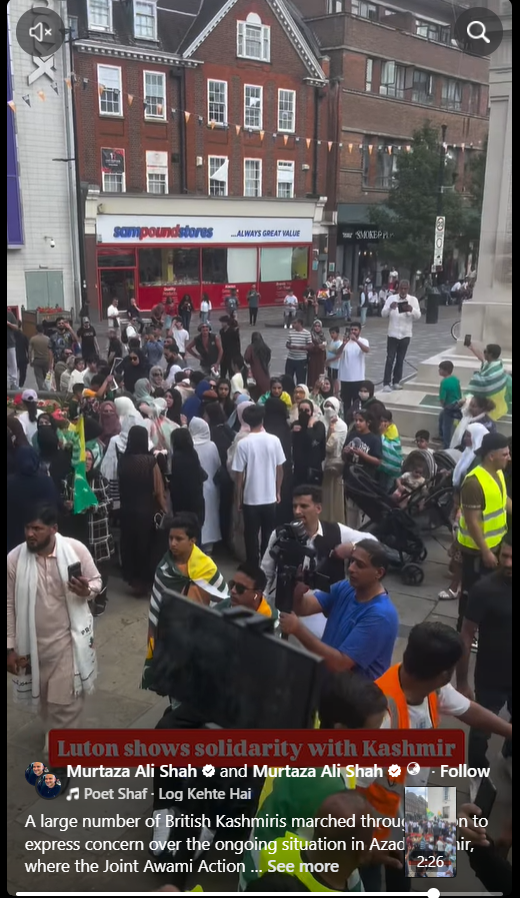
At the 1:23 mark of the video shared by the Pakistani journalist, we found the same scene that appears in the viral image. However, the individual seen in the viral image does not appear in the original footage. Instead, the video shows a different person participating in the protest.

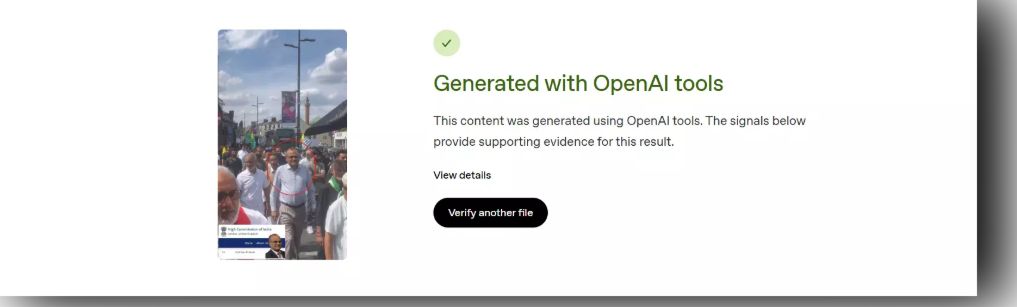
To further verify the authenticity of the image, we analysed it using multiple AI detection tools, including OpenAI’s image detection tool. The analysis detected provenance signals associated with OpenAI tools such as ChatGPT, OpenAI API, or Codex. These signals indicate that the image was created or modified using OpenAI’s AI tools.
Conclusion:
The research established that the viral image has been manipulated to falsely portray Indian High Commission official Ram Prakash as a participant in the protest. The original footage shows a different individual, while AI analysis confirmed that the image was modified using OpenAI tools. Therefore, the claim circulating with the image is misleading.

As AI language models become more powerful, they are also becoming more prone to errors. One increasingly prominent issue is AI hallucinations, instances where models generate outputs that are factually incorrect, nonsensical, or entirely fabricated, yet present them with complete confidence. Recently, ChatGPT released two new models—o3 and o4-mini, which differ from earlier versions as they focus more on step-by-step reasoning rather than simple text prediction. With the growing reliance on chatbots and generative models for everything from news summaries to legal advice, this phenomenon poses a serious threat to public trust, information accuracy, and decision-making.
What Are AI Hallucinations?
AI hallucinations occur when a model invents facts, misattributes quotes, or cites nonexistent sources. This is not a bug but a side effect of how Large Language Models (LLMs) work, and it is only the probability that can be reduced, not their occurrence altogether. Trained on vast internet data, these models predict what word is likely to come next in a sequence. They have no true understanding of the world or facts, they simulate reasoning based on statistical patterns in text. What is alarming is that the newer and more advanced models are producing more hallucinations, not fewer. seemingly counterintuitive. This has been prevalent reasoning-based models, which generate answers step-by-step in a chain-of-thought style. While this can improve performance on complex tasks, it also opens more room for errors at each step, especially when no factual retrieval or grounding is involved.
As per reports shared on TechCrunch, it mentioned that when users asked AI models for short answers, hallucinations increased by up to 30%. And a study published in eWeek found that ChatGPT hallucinated in 40% of tests involving domain-specific queries, such as medical and legal questions. This was not, however, limited to this particular Large Language Model, but also similar ones like DeepSeek. Even more concerning are hallucinations in multimodal models like those used for deepfakes. Forbes reports that some of these models produce synthetic media that not only look real but are also capable of contributing to fabricated narratives, raising the stakes for the spread of misinformation during elections, crises, and other instances.
It is also notable that AI models are continually improving with each version, focusing on reducing hallucinations and enhancing accuracy. New features, such as providing source links and citations, are being implemented to increase transparency and reliability in responses.
The Misinformation Dilemma
The rise of AI-generated hallucinations exacerbates the already severe problem of online misinformation. Hallucinated content can quickly spread across social platforms, get scraped into training datasets, and re-emerge in new generations of models, creating a dangerous feedback loop. However, it helps that the developers are already aware of such instances and are actively charting out ways in which we can reduce the probability of this error. Some of them are:
- Retrieval-Augmented Generation (RAG): Instead of relying purely on a model’s internal knowledge, RAG allows the model to “look up” information from external databases or trusted sources during the generation process. This can significantly reduce hallucination rates by anchoring responses in verifiable data.
- Use of smaller, more specialised language models: Lightweight models fine-tuned on specific domains, such as medical records or legal texts. They tend to hallucinate less because their scope is limited and better curated.
Furthermore, transparency mechanisms such as source citation, model disclaimers, and user feedback loops can help mitigate the impact of hallucinations. For instance, when a model generates a response, linking back to its source allows users to verify the claims made.
Conclusion
AI hallucinations are an intrinsic part of how generative models function today, and such a side-effect would continue to occur until foundational changes are made in how models are trained and deployed. For the time being, developers, companies, and users must approach AI-generated content with caution. LLMs are, fundamentally, word predictors, brilliant but fallible. Recognising their limitations is the first step in navigating the misinformation dilemma they pose.
References
- https://www.eweek.com/news/ai-hallucinations-increase/
- https://www.resilience.org/stories/2025-05-11/better-ai-has-more-hallucinations/
- https://www.ekathimerini.com/nytimes/1269076/ai-is-getting-more-powerful-but-its-hallucinations-are-getting-worse/
- https://techcrunch.com/2025/05/08/asking-chatbots-for-short-answers-can-increase-hallucinations-study-finds/
- https://en.as.com/latest_news/is-chatgpt-having-robot-dreams-ai-is-hallucinating-and-producing-incorrect-information-and-experts-dont-know-why-n/
- https://www.newscientist.com/article/2479545-ai-hallucinations-are-getting-worse-and-theyre-here-to-stay/
- https://www.forbes.com/sites/conormurray/2025/05/06/why-ai-hallucinations-are-worse-than-ever/
- https://towardsdatascience.com/how-i-deal-with-hallucinations-at-an-ai-startup-9fc4121295cc/
- https://www.informationweek.com/machine-learning-ai/getting-a-handle-on-ai-hallucinations
