#FactCheck - Viral Video of Army Chief Upendra Dwivedi ‘Admitting’ India Betrayed Iran Is a Deepfake
Executive Summary
A 57-second video featuring India’s Chief of Army Staff Upendra Dwivedi is widely circulating on social media. The clip is being shared with the claim that the Army chief admitted India had “betrayed” Iran by providing the location of an Iranian naval ship to Israel, allegedly leading to its destruction The video is spreading amid heightened tensions in West Asia involving United States, Israel, and Iran. According to posts sharing the claim, the Iranian naval vessel IRIS Dena, which had participated in a naval event in Visakhapatnam and was returning to Iran with around 130 personnel onboard, was torpedoed by a US submarine near the southern coast of Sri Lanka on March 4 while sailing in the Indian Ocean.
In the viral clip, the speaker—presented as the Indian Army chief—appears to say that India informed Israel about the exact location of the Iranian ship after it left Indian waters, describing Israel as a strategic ally and suggesting that the attack occurred in international waters. The clip also claims that India had no direct involvement in the alleged joint US-Israel torpedo strike.
However, research conducted by the CyberPeace found the claim to be false. Our research shows that the video does not contain a genuine statement from Army Chief Upendra Dwivedi and is in fact a manipulated clip.
Claim
On X (formerly Twitter), a page named GPX (@GPX_Press) shared the video on March 9 with the caption: “India confesses it BETRAYED Iran by leaking the location of an Iranian ship to Israel, leading to its total destruction!”

Fact Check
During the verification process, researchers noticed a ticker in the viral video reading “Raisina Dialogue 2026 × Firstpost.” Using this clue, we conducted a keyword search on YouTube and located a video uploaded by Firstpost on March 7 titled “India’s Army Chief Speaks on Op Sindoor, Pakistan and Future of Warfare | Raisina Dialogue 2026.”
In the 21-minute interview, Army Chief Upendra Dwivedi is seen speaking with strategic affairs expert Harsh V. Pant. According to the video description, the discussion focuses on lessons from Operation Sindoor and the evolving nature of modern warfare.

The viral clip appears to be taken from this interview. However, throughout the conversation, Dwivedi does not mention any conflict involving the United States, Israel, and Iran, nor does he refer to the sinking of an Iranian naval ship in the Indian Ocean. This indicates that the circulating clip has been edited and misrepresented to create a misleading narrative.
For additional verification, the viral video was analyzed using the AI detection tool Hive Moderation. The results suggested a 99.9% probability that the speech in the clip was generated using AI, indicating manipulation of the original footage.
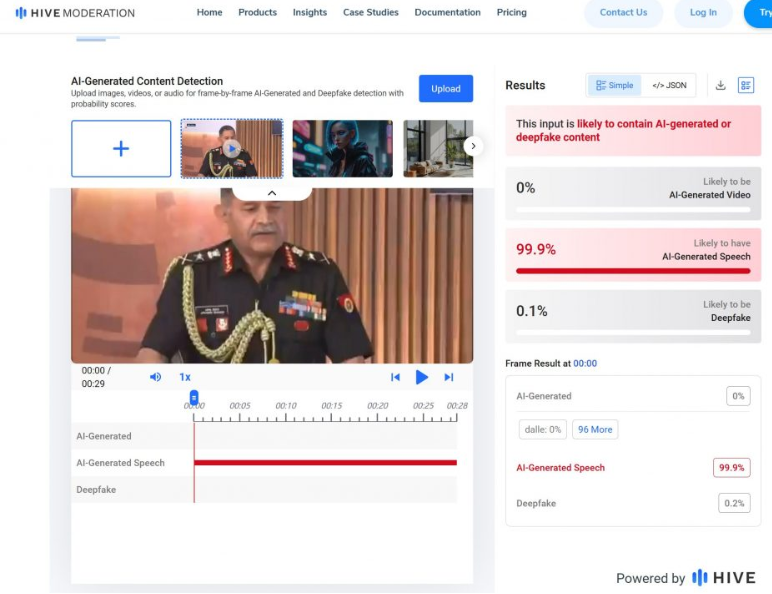
Conclusion
The research makes it clear that the viral video does not reflect an authentic statement by India’s Army Chief Upendra Dwivedi. The clip has been altered and the audio appears to be AI-generated. In other words, the circulating video is a deepfake being shared with a misleading claim.
Related Blogs

Introduction
In the era of the internet where everything is accessible at your fingertip, a disturbing trend is on the rise- over 90% of websites containing child abuse material now have self-generated images, obtained from victims as young as three years old. A shocking revelation, shared by the (IWF) internet watch foundation, The findings of the IWF have caused concern about the increasing exploitation of children below the age of 10. The alarming trend highlights the increasing exploitation of children under the age of 10, who are coerced, blackmailed, tricked, or groomed into participating in explicit acts online. The IWF's data for 2023 reveals a record-breaking 275,655 websites hosting child sexual abuse material, with 92% of them containing such "self-generated" content.
Disturbing Tactics Shift
Disturbing numbers came that, highlight a distressing truth. In 2023, 275,655 websites were discovered to hold child sexual abuse content, reaching a new record and reflecting an alarming 8% increase over the previous year. What's more concerning is that 92% of these websites had photos or videos generated by the website itself. Surprisingly, 107,615 of these websites had content involving children under the age of ten, with 2,500 explicitly featuring youngsters aged three to six.
Profound worries
Deep concern about the rising incidence of images taken by extortion or coercion from elementary school-aged youngsters. This footage is currently being distributed on very graphic and specialised websites devoted to child sexual assault. The process begins in a child's bedroom with the use of a camera and includes the exchange, dissemination, and gathering of explicit content by devoted and determined persons who engage in sexual exploitation. These criminals are ruthless. The materials are being circulated via mail, instant messaging, chat rooms, and social media platforms, (WhatsApp, Telegram, Skype, etc.)
Live Streaming of such material involves real-time broadcast which again is a major concern as the nature of the internet is borderless the access to such material is international, national, and regional, which even makes it difficult to get the predators and convict them. With the growth, it has become easy for predators to generate “self-generated “images or videos.
Financial Exploitation in the Shadows: The Alarming Rise of Sextortion
Looking at the statistics globally there have been studies that show an extremely shocking pattern known as “sextortion”, in which adolescents are targeted for extortion and forced to pay money under the threat of exposing images to their families or relatives and friends or on social media. The offender's goal is to obtain sexual gratification.
The financial variation of sextortion takes a darker turn, with criminals luring kids into making sexual content and then extorting them for money. They threaten to reveal the incriminating content unless their cash demands, which are frequently made in the form of gift cards, mobile payment services, wire transfers, or cryptocurrencies, are satisfied. In this situation, the predators are primarily driven by money gain, but the psychological impact on their victims is as terrible. A shocking case was highlighted where an 18-year-old was landed in jail for blackmailing a young girl, sending indecent images and videos to threaten her via Snapchat. The offender was pleaded guilty.
The Question on Security?
The introduction of end-to-end encryption in platforms like Facebook Messenger has triggered concerns within law enforcement agencies. While enhancing user privacy, critics argue that it may inadvertently facilitate criminal activities, particularly the exploitation of vulnerable individuals. The alignment with other encrypted services is seen as a potential challenge, making it harder to detect and investigate crimes, thus raising questions about finding a balance between privacy and public safety.
One of the major concerns in the online safety of children is the implementation of encryption by asserting that it enhances the security of individuals, particularly children, by safeguarding them from hackers, scammers, and criminals. They underscored their dedication to enforcing safety protocols, such as prohibiting adults from texting teenagers who do not follow them and employing technology to detect and counteract bad conduct.
These distressing revelations highlight the urgent need for comprehensive action to protect our society's most vulnerable citizens i.e., children, youngsters, and adolescents throughout the era of digital progress. As experts and politicians grapple with these troubling trends, the need for action to safeguard kids online becomes increasingly urgent.
Role of Technology in Combating Online Exploitation
With the rise of technology, there has been a rise in online child abuse, technology also serves as a powerful tool to combat it. The advanced algorithms and use of Artificial intelligence tools can be used to disseminate ‘self-generated’ images. Additional tech companies can collaborate and develop some effective solutions to safeguard every child and individual.
Role of law enforcement agencies
Child abuse knows no borders, and addressing the issues requires legal intervention at all levels. National, regional, and international law enforcement agencies investigate online child sexual exploitation and abuse and cooperate in the investigation of these cybercrimes, Various investigating agencies need to have mutual legal assistance and extradition, bilateral, and multilateral conventions to conduct to identify, investigate, and prosecute perpetrators of online child sexual exploitation and abuse. Apart from this cooperation between private and government agencies is important, sharing the database of perpetrators can help the agencies to get them caught.
How do you safeguard your children?
Looking at the present scenario it has become a crucial part of protecting and safeguarding our children online against online child abuse here are some practical steps that can help in safeguarding your loved one.
- Open communication: Establish open communication with your children, make them feel comfortable, and share your experiences with them, make them understand what good internet surfing is and educate them about the possible risks without generating fear.
- Teach Online Safety: educate your children about the importance of privacy and the risks associated with it. Teach them strong privacy habits like not sharing any personal information with a stranger on any social media platform. Teach them to create some unique passwords and to make them aware not to click on any suspicious links or download files from unknown sources.
- Set boundaries: As a parent set rules and guidelines for internet usage, set time limits, and monitor their online activities without infringing their privacy. Monitor their social media platforms and discuss inappropriate behaviour or online harassment. As a parent take an interest in your children's online activities, websites, and apps inform them, and teach them online safety measures.
Conclusion
The predominance of self-generated' photos in online child abuse content necessitates immediate attention and coordinated action from governments, technology corporations, and society as a whole. As we negotiate the complicated environment of the digital age, we must be watchful, modify our techniques, and collaborate to defend the innocence of the most vulnerable among us. To combat online child exploitation, we must all work together to build a safer, more secure online environment for children all around the world.
References
- https://www.the420.in/over-90-of-websites-containing-child-abuse-feature-self-generated-images-warns-iwf/
- https://news.sky.com/story/self-generated-images-found-on-92-of-websites-containing-child-sexual-abuse-with-victims-as-young-as-three-13049628
- https://www.firstpost.com/world/russia-rejects-us-proposal-to-resume-talks-on-nuclear-arms-control-13630672.html
- https://www.news4hackers.com/iwf-warns-that-more-than-90-of-websites-contain-self-generated-child-abuse-images/

Introduction
A photo circulating on social media depicting modified tractors is being misrepresented as part of the 'Delhi Chalo' farmers' protest narrative. In the recent swirl of misinformation surrounding the 'Delhi Chalo' farmers' protest. A photo, ostensibly showing a phalanx of modified tractors, has been making the rounds on social media platforms, falsely tethered to the ongoing protests. This image, accompanied by a headline suggesting a mechanical metamorphosis to resist police barricades, was allegedly published by a news agency. However, beneath the surface of this viral phenomenon lies a more complex and fabricated reality.
The Movement
The 'Delhi Chalo' movement, a clarion call that resonated with thousands of farmers from the fertile plains of Punjab, the verdant fields of Haryana, and the sprawling expanses of Uttar Pradesh, has been a testament to the agrarian community's demand for assured crop prices and legal guarantees for the Minimum Support Price (MSP). The protest, which has seen the fortification of borders and the chaos at the Punjab-Haryana border on February 13, 2024, has become a crucible for the farmers' unyielding spirit.
Yet, amidst this backdrop of civil demonstration and discourse, a nefarious narrative of misinformation has taken root. The viral image, which has been shared with the fervour of wildfire, was accompanied by a screenshot of an article allegedly published by the news agency. This article, dated February 11, 2024, quoted an anonymous official who claimed that intelligence agencies had alerted the police to the protesters' plans to outfit tractors with hydraulic tools. The implication was clear: these machines had been transformed into battering rams against the bulwark of law enforcement.
The Pursuit of Truth
However, the India TV Fact Check team, in their relentless pursuit of truth, unearthed that the viral photo of these so-called modified tractors is nothing but a chimerical creation, a figment of artificial intelligence. Visual discrepancies betrayed its AI-generated nature.
This is not the first time that the misinformation has loomed over the farmers' protest. Previous instances, including a viral video of a modified tractor, have been debunked by the same fact-checking team. These efforts are a bulwark against the tide of false narratives that seek to muddy the waters of public understanding.
The claim that the photo depicted modified tractors intended for use in the ‘Delhi Chalo’ farmers' protest rally in Delhi on February 13, 2024, was a mirage.
The Fact Check
OpIndia, in their article, clarified that the photo used was a representative image created by AI and not a real photograph. To further scrutinize this viral photo, the HIVE AI detector tool was employed, indicating a 99.4% likelihood of the image being AI-generated. Thus, the claim made in the post was misleading.
The viral photo claiming that farmers had modified their tractors to avoid tear gas shells and remove barricades put up by the police during the rally was a digital illusion. The internet has become a fertile ground for the rapid spread of misinformation, reaching millions in an instant. Social media, with its complex algorithms, amplifies this spread, as any interaction, even those intended to debunk false information, inadvertently increases its reach. This phenomenon is exacerbated by 'echo chambers,' where users are exposed to a homogenous stream of content that reinforces their pre-existing beliefs, making it difficult to encounter and consider alternative perspectives.
Conclusion
The viral image depicting modified tractors for the ‘Delhi Chalo’ farmers' protest rally was a digital fabrication, a testament to the power of AI in creating convincing yet false narratives. As we navigate the labyrinth of information in the digital era, it is imperative to remain vigilant, to question the veracity of what we see and hear, and to rely on the diligent work of fact-checkers in discerning the truth. The mirage of modified machines serves as a stark reminder of the potency of misinformation and the importance of critical thinking in the age of artificial intelligence.
References
- https://www.indiatvnews.com/fact-check/fact-check-ai-generated-tractor-photo-misrepresented-delhi-chalo-farmers-protest-narrative-msp-police-barricades-punjab-haryana-uttar-pradesh-2024-02-15-917010
- https://factly.in/this-viral-image-depicting-modified-tractors-for-the-delhi-chalo-farmers-protest-rally-is-created-using-ai/
.webp)
Introduction
Smartphones have revolutionised human connectivity. In 2023, it was estimated that almost 96% of the global digital population is accessing the internet via their mobile phones and India alone has 1.05 billion users. Information consumption has grown exponentially due to the enhanced accessibility that these mobiles provide. These devices allow accessibility to information no matter where one is, and have completely transformed how we engage with the world around us, be it to skim through work emails while commuting, video streaming during breaks, reading an ebook at our convenience or even catching up on news at any time or place. Mobile phones grant us instant access to the web and are always within reach.
But this instant connection has its downsides too, and one of the most worrying of these is the rampant rise of misinformation. These tiny screens and our constant, on-the-go dependence on them can be directly linked to the spread of “fake news,” as people consume more and more content in rapid bursts, without taking the time to really process the same or think deeply about its authenticity. There is an underlying cultural shift in how we approach information and learning currently: the onslaught of vast amounts of “bite-sized information” discourages people from researching what they’re being told or shown. The focus has shifted from learning deeply to consuming more and sharing faster. And this change in audience behaviour is making us vulnerable to misinformation, disinformation and unchecked foreign influence.
The Growth of Mobile Internet Access
More than 5 billion people are connected to the internet and web traffic is increasing rapidly. The developed countries in North America and Europe are experiencing mobile internet penetration at a universal rate. Contrastingly, the developing countries of Africa, Asia, and Latin America are experiencing rapid growth in this penetration. The introduction of affordable smartphones and low-cost mobile data plans has expanded access to internet connectivity. 4G and 5G infrastructure development have further bridged any connectivity gaps. This widespread access to the mobile internet has democratised information, allowing millions of users to participate in the digital economy. Access to educational resources while at the same time engaging in global conversations is one such example of the democratisation of information. This reduces the digital divide between diverse groups and empowers communities with unprecedented access to knowledge and opportunities.
The Nature of Misinformation in the Mobile Era
Misinformation spread has become more prominent in recent times and one of the contributing factors is the rise of mobile internet. This instantaneous connection has made social media platforms like Facebook, WhatsApp, and X (formerly Twitter) available on a single compact and portable device. These social media platforms enable users to share content instantly and to a wide user base, many times without verifying its accuracy. The virality of social media sharing, where posts can reach thousands of users in seconds, accelerates the spread of false information. This ease of sharing, combined with algorithms that prioritise engagement, creates a fertile ground for misinformation to flourish, misleading vast numbers of people before corrections or factual information can be disseminated.
Some of the factors that are amplifying misinformation sharing through mobile internet are algorithmic amplification which prioritises engagement, the ease of sharing content due to instant access and user-generated content, the limited media literacy of users and the echo chambers which reinforce existing biases and spread false information.
Gaps and Challenges due to the increased accessibility of Mobile Internet
Despite growing concerns about misinformation spread due to mobile internet, policy responses remain inadequate, particularly in developing countries. These gaps include: the lack of algorithm regulation, as social media platforms prioritise engaging content, often fueling misinformation. Inadequate international cooperation further complicates enforcement, as addressing the cross-border nature of misinformation has been a struggle for national regulations.
Additionally, balancing content moderation with free speech remains challenging, with efforts to curb misinformation sometimes leading to concerns over censorship.
Finally, a deficit in media literacy leaves many vulnerable to false information. Governments and international organisations must prioritise public education to equip users with the required skills to evaluate online content, especially in low-literacy regions.
CyberPeace Recommendations
Addressing misinformation via mobile internet requires a collaborative, multi-stakeholder approach.
- Governments should mandate algorithm transparency, ensuring social media platforms disclose how content is prioritised and give users more control.
- Collaborative fact-checking initiatives between governments, platforms, and civil society could help flag or correct false information before it spreads, especially during crises like elections or public health emergencies.
- International organisations should lead efforts to create standardised global regulations to hold platforms accountable across borders.
- Additionally, large-scale digital literacy campaigns are crucial, teaching the public how to assess online content and avoid misinformation traps.
Conclusion
Mobile internet access has transformed information consumption and bridged the digital divide. At the same time, it has also accelerated the spread of misinformation. The global reach and instant nature of mobile platforms, combined with algorithmic amplification, have created significant challenges in controlling the flow of false information. Addressing this issue requires a collective effort from governments, tech companies, and civil society to implement transparent algorithms, promote fact-checking, and establish international regulatory standards. Digital literacy should be enhanced to empower users to assess online content and counter any risks that it poses.
References
- https://www.statista.com/statistics/1289755/internet-access-by-device-worldwide/
- https://www.forbes.com/sites/kalevleetaru/2019/05/01/are-smartphones-making-fake-news-and-disinformation-worse/
- https://www.pewresearch.org/short-reads/2019/03/07/7-key-findings-about-mobile-phone-and-social-media-use-in-emerging-economies/ft_19-02-28_globalmobilekeytakeaways_misinformation/
- https://www.psu.edu/news/research/story/slow-scroll-users-less-vigilant-about-misinformation-mobile-phones