#FactCheck -Old Karnataka Video Falsely Linked to Holi Celebrations on Eid in Delhi
Executive Summary
A video is being shared on social media showing a group of people dancing on a road while carrying saffron flags. A mosque can also be seen nearby in the video Sharing this clip, some users are claiming that it is from Uttam Nagar in Delhi, where members of the Hindu community celebrated Holi on the occasion of Eid on March 21. Research by the CyberPeace found the viral claim to be misleading. Our probe revealed that the video is not related to Holi celebrations on Eid in Uttam Nagar, Delhi. In fact, the video has been available on the internet since 2024 and is said to be from Raichur district in Karnataka. Several users have shared it claiming that it was recorded during Ganesh Chaturthi celebrations.
Claim:
A social media user shared the viral video on March 21, 2026, with a misleading claim. The link and archive link of the post are given below.

Fact Check:
To verify the viral claim, we first conducted a keyword search on Google. However, we did not find any credible media report supporting the claim. In the next step, we extracted keyframes from the video and performed a reverse search using Google Lens. During this process, we found the same video on an Instagram account, which was posted on September 23, 2024.
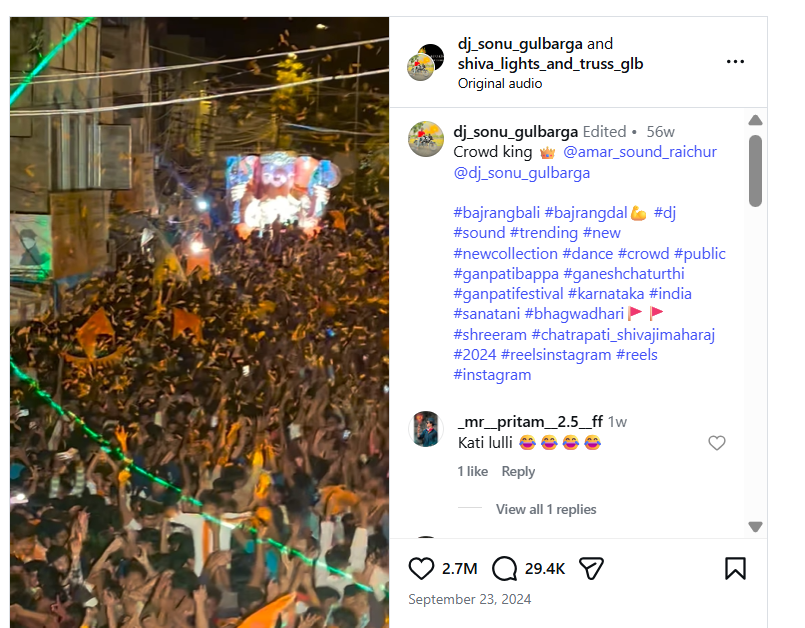
The user had captioned the video as “Ganesh Chaturthi 2024,” suggesting that the clip is related to the festival. Further, upon closely analyzing the video, we noticed that the mosque visible in the background had “Usmania Masjid” written on it. We then searched for this location on Google Maps and found that the mosque is located on Teen Khandil Road in Raichur, Karnataka, which matches the visuals seen in the viral clip.

Conclusion:
Our research found that the video is not from Uttam Nagar, Delhi, nor is it related to Holi celebrations on Eid. The clip has been available online since 2024 and is from Raichur, Karnataka. It has been shared with a misleading claim and is actually linked to Ganesh Chaturthi celebrations.
Related Blogs

Introduction:
A new Android malware called NGate is capable of stealing money from payment cards through relaying the data read by the Near Field Communication (“NFС”) chip to the attacker’s device. NFC is a device which allows devices such as smartphones to communicate over a short distance wirelessly. In particular, NGate allows forging the victims’ cards and, therefore, performing fraudulent purchases or withdrawing money from ATMs. .
About NGate Malware:
The whole purpose of NGate malware is to target victims’ payment cards by relaying the NFC data to the attacker’s device. The malware is designed to take advantage of phishing tactics and functionality of the NFC on android based devices.
Modus Operandi:
- Phishing Campaigns: The first step is spoofed emails or SMS used to lure the users into installing the Progressive Web Apps (“PWAs”) or the WebAPKs presented as genuine banking applications. These apps usually have a layout and logo that makes them look like an authentic app of a Targeted Bank which makes them believable.
- Installation of NGate: When the victim downloads the specific app, he or she is required to input personal details including account numbers and PIN numbers. Users are also advised to turn on or install NFC on their gadgets and place the payment cards to the back part of the phone to scan the cards.
- NFCGate Component: One of the main working features of the NGate is the NFCGate, an application created and designed by some students of Technical University of Darmstadt. This tool allows the malware to:
- Collect NFC traffic from payment cards in the vicinity.
- Transmit, or relay this data to the attacker’s device through a server.
- Repeat data that has been previously intercepted or otherwise copied.
It is important to note that some aspects of NFCGate mandate a rooted device; however, forwarding NFC traffic can occur with devices that are not rooted, and therefore can potentially ensnare more victims.
Technical Mechanism of Data Theft:
- Data Capture: The malware exploits the NFC communication feature on android devices and reads the information from the payment card, if the card is near the infected device. It is able to intercept and capture the sensive card details.
- Data Relay: The stolen information is transmitted through a server to the attacker’s device so that he/she is in a position to mimic the victim’s card.
- Unauthorized Transactions: Attackers get access to spend money on the merchants or withdraw money from the ATM that has NFC enabled. This capability marks a new level of Android malware in that the hackers are able to directly steal money without having to get hold of the card.
Social Engineering Tactics:
In most cases, attackers use social engineering techniques to obtain more information from the target before implementing the attack. In the second phase, attackers may pretend to be representatives of a bank that there is a problem with the account and offer to download a program called NGate, which in fact is a Trojan under the guise of an application for confirming the security of the account. This method makes it possible for the attackers to get ITPIN code from the sides of the victim, which enables them to withdraw money from the targeted person’s account without authorization.
Technical Analysis:
The analysis of malicious file hashes and phishing links are below:
Malicious File Hashes:
csob_smart_klic.apk:
- MD5: 7225ED2CBA9CB6C038D8
- Classification: Android/Spy.NGate.B
csob_smart_klic.apk:
- MD5: 66DE1E0A2E9A421DD16B
- Classification: Android/Spy.NGate.C
george_klic.apk:
- MD5: DA84BC78FF2117DDBFDC
- Classification: Android/Spy.NGate.C
george_klic-0304.apk:
- MD5: E7AE59CD44204461EDBD
- Classification: Android/Spy.NGate.C
rb_klic.apk:
- MD5: 103D78A180EB973B9FFC
- Classification: Android/Spy.NGate.A
rb_klic.apk:
- MD5: 11BE9715BE9B41B1C852
- Classification: Android/Spy.NGate.C.
Phishing URLs:
Phishing URL:
- https://client.nfcpay.workers[.]dev/?key=8e9a1c7b0d4e8f2c5d3f6b2
Additionally, several distinct phishing websites have been identified, including:
- rb.2f1c0b7d.tbc-app[.]life
- geo-4bfa49b2.tbc-app[.]life
- rb-62d3a.tbc-app[.]life
- csob-93ef49e7a.tbc-app[.]life
- george.tbc-app[.]life.
Analysis:

Broader Implications of NGate:
The ultramodern features of NGate mean that its manifestation is not limited to financial swindling. An attacker can also generate a copy of NFC access cards and get full access when hacking into restricted areas, for example, the corporate offices or restricted facility. Moreover, it is also safe to use the capacity to capture and analyze NFC traffic as threats to identity theft and other forms of cyber-criminality.
Precautionary measures to be taken:
To protect against NGate and similar threats, users should consider the following strategies:
- Disable NFC: As mentioned above, NFC should be not often used, it is safe to turn NFC on Android devices off. This perhaps can be done from the general control of the device in which the bursting modes are being set.
- Scrutinize App Permissions: Be careful concerning the permission that applies to the apps that are installed particularly the ones allowed to access the device. Hence, it is very important that applications should be downloaded only from genuine stores like Google Play Store only.
- Use Security Software: The malware threat can be prevented by installing relevant security applications that are available in the market.
- Stay Informed: As it has been highlighted, it is crucial for a person to know risks that are associated with the use of NFC while attempting to safeguard an individual’s identity.
Conclusion:
The presence of malware such as NGate is proof of the dynamism of threats in the context of mobile payments. Through the utilization of NFC function, NGate is a marked step up of Android malware implying that the attackers can directly manipulate the cash related data of the victims regardless of the physical aspect of the payment card. This underscores the need to be careful when downloading applications and to be keen on the permission one grants on the application. Turn NFC when not in use, use good security software and be aware of the latest scams are some of the measures that help to fight this high level of financial fraud. The attackers are now improving their methods. It is only right for the people and companies to take the right steps in avoiding the breach of privacy and identity theft.
Reference:
- https://www.welivesecurity.com/en/eset-research/ngate-android-malware-relays-nfc-traffic-to-steal-cash/
- https://therecord.media/android-malware-atm-stealing-czech-banks
- https://www.darkreading.com/mobile-security/nfc-traffic-stealer-targets-android-users-and-their-banking-info
- https://cybersecuritynews.com/new-ngate-android-malware/

Introduction
India’s telecommunications infrastructure is one of the world’s largest and most complex, serving over a billion users across urban and rural landscapes. With rampant digitisation and mobile penetration, the vulnerability of telecom networks to cyber threats has grown exponentially. On April 24, 2025, the Ministry of Communications (MOC) released a draft of the “Telecommunications (Telecom Cyber Security) Amendment Rules, 2025,” to update the prior Telecommunications (Telecom Cyber Security) Rules, 2024, to improve cybersecurity in India's telecom industry and fortify network security. Public comments and recommendations regarding these draft rules can be sent to the department by July 24, 2025, after they have been made available for public comment. These rules are enacted under the Telecommunications Act, 2023, to enhance national cybersecurity in the telecom domain. These rules aim to prevent misuse of telecom networks and reinforce data and infrastructure protection mechanisms across service providers.
Safeguarding the Spectrum: Unpacking the 2025 Cybersecurity Revisions
The menace of fraudulent SIM cards deals the issue of cyber threats a fresh hand. The rising number of digital scams can also be attributed to unverified or fake mobile numbers. Fraudulent SIM cards have often been linked to various cybercrimes such as phishing, vishing, SIM swapping and identity theft. The situation has worsened in the face of easy availability of pre-activated SIM cards and weak KYC enforcement. In a recent example, as per reports of June 28, 2025, the Special Task Force (STF) found that the accused was operating a criminal nexus where he utilised fake documents and the Aadhaar credentials of law-abiding locals to activate numerous SIM cards. Following activation, the SIMs were either transferred to other telecom carriers for additional exploitation or sold illegally. This poses a serious concern for the data protection of vulnerable individuals, especially those in rural areas, whose credentials have been compromised.
Given the adverse state of cybersecurity in the telecom industry, the Telecommunications (Telecom Cyber Security) Rules, 2024, were passed on 22nd November, 2024, which put various telecom entities under an obligation to actively prevent cybersecurity threats by adopting such policies that mitigate cybersecurity risks and notify the same to the Central Government. The 2024 Telecom Cybersecurity Rules were a significant step in fortifying India’s telecom infrastructure against cyber threats, but they primarily focused on licensed telecom service providers, leaving behind a large segment of digital platforms operating outside the traditional telecom framework largely unregulated.
Expanding the Net: Key Revisions Under the 2025 Cybersecurity Amendment Rules
The amended rules of 2025 adequately address the regulatory blind spot that is created by the rapid expansion of online services, fintech apps, OTT platforms and social media networks, as these platforms often rely on telecom identifiers such as mobile numbers for user onboarding and service delivery. This regulatory blind spot was exploited for fraud, impersonation and other cybercrimes, especially in the absence of standardised identity verification mechanisms. The proposed regulations would give the government the authority to require private companies’ clients to provide identification if they use a mobile number. For a fee, businesses can also undertake this kind of verification on their own. “ The draft rules introduce a new category called “Telecommunication Identifier User Entities’ (TIUEs), extending cybersecurity compliance obligations to a broad category that now captures any entity using telecom identifiers to deliver digital services. It also creates a unified, government-backed verification framework, enabling better interoperability and uniform user identification norms across sectors.
While strengthening national digital security is the goal of the Telecom Cybersecurity (Amendment) Rules, 2025, the proposed rules create a great deal of uncertainty and compliance difficulties, especially for private digital platforms. A broad definition of Telecommunication Identifier User businesses (TIUEs) may include a variety of businesses, including e-commerce services, fintech apps and OTT platforms, under the purview of required mobile number verification. Given that many platforms already have advanced internal processes in place to verify users, this scope uncertainty creates significant concerns regarding operational clarity.
Conclusion
The Telecommunications (Telecom Cyber Security) Amendment Rules, 2025, represent a necessary evolution in India’s quest to secure its telecom ecosystem amid growing cyber threats. The draft regulations recognise the evolving landscape of digital services by broadening the legal scope to encompass Telecommunication Identifier User Entities (TIUEs). Though the goal of creating a strong, transparent and accountable framework is admirable, more clarification and stakeholder involvement are required due to the scope’s vagueness and the possible compliance burden on digital platforms. A truly durable telecom cybersecurity regime will require striking the correct balance between security, viability and privacy.
References
- https://www.cyberpeace.org/resources/blogs/the-government-enforces-key-sections-of-the-telecommunication-act-2023
- https://www.cyberpeace.org/resources/blogs/govt-notifies-the-telecommunications-telecom-cyber-security-rules-2024
- https://the420.in/uttarakhand-stf-busts-fake-sim-racket-linked-to-cyber-crimes-and-nepal-network/
- https://www.thehindu.com/business/dot-puts-out-draft-rules-to-enable-mobile-user-validation/article69741367.ece
- https://www.scconline.com/blog/post/2025/06/28/dot-telecom-cyber-security-draft-policy-update/

Introduction
In the labyrinthine expanse of the digital age, where the ethereal threads of our connections weave a tapestry of virtual existence, there lies a sinister phenomenon that preys upon the vulnerabilities of human emotion and trust. This phenomenon, known as cyber kidnapping, recently ensnared a 17-year-old Chinese exchange student, Kai Zhuang, in its deceptive grip, leading to an $80,000 extortion from his distraught parents. The chilling narrative of Zhuang found cold and scared in a tent in the Utah wilderness, serves as a stark reminder of the pernicious reach of cybercrime.
The Cyber Kidnapping
The term 'cyber kidnapping' typically denotes a form of cybercrime where malefactors gain unauthorised access to computer systems or data, holding it hostage for ransom. Yet, in the context of Zhuang's ordeal, it took on a more harrowing dimension—a psychological manipulation through online communication that convinced his family of his peril, despite his physical safety before the scam.
The Incident
The incident unfolded like a modern-day thriller, with Zhuang's parents in China alerting officials at his host high school in Riverdale, Utah, of his disappearance on 28 December 2023. A meticulous investigation ensued, tracing bank records, purchases, and phone data, leading authorities to Zhuang's isolated encampment, 25 miles north of Brigham City. In the frigid embrace of Utah's winter, Zhuang awaited rescue, armed only with a heat blanket, a sleeping bag, limited provisions, and the very phones used to orchestrate his cyber kidnapping.
Upon his rescue, Zhuang's first requests were poignantly human—a warm cheeseburger and a conversation with his family, who had been manipulated into paying the hefty ransom during the cyber-kidnapping scam. This incident not only highlights the emotional toll of such crimes but also the urgent need for awareness and preventative measures.
The Aftermath
To navigate the treacherous waters of cyber threats, one must adopt the scepticism of a seasoned detective when confronted with unsolicited messages that reek of urgency or threat. The verification of identities becomes a crucial shield, a bulwark against deception. Sharing sensitive information online is akin to casting pearls before swine, where once relinquished, control is lost forever. Privacy settings on social media are the ramparts that must be fortified, and the education of family and friends becomes a communal armour against the onslaught of cyber threats.
The Chinese embassy in Washington has sounded the alarm, warning its citizens in the U.S. about the risks of 'virtual kidnapping' and other online frauds. This scam fragments a larger criminal mosaic that threatens to ensnare parents worldwide.
Kai Zhuang's story, while unique in its details, is not an isolated event. Experts warn that technological advancements have made it easier for criminals to pursue cyber kidnapping schemes. The impersonation of loved ones' voices using artificial intelligence, the mining of social media for personal data, and the spoofing of phone numbers are all tools in the cyber kidnapper's arsenal.
The Way Forward
The crimes have evolved, targeting not just the vulnerable but also those who might seem beyond reach, demanding larger ransoms and leaving a trail of psychological devastation in their wake. Cybercrime, as one expert chillingly notes, may well be the most lucrative of crimes, transcending borders, languages, and identities.
In the face of such threats, awareness is the first line of defense. Reporting suspicious activity to the FBI's Internet Crime Complaint Center, verifying the whereabouts of loved ones, and establishing emergency protocols are all steps that can fortify one's digital fortress. Telecommunications companies and law enforcement agencies also have a role to play in authenticating and tracing the source of calls, adding another layer of protection.
Conclusion
The surreal experience of reading about cyber kidnapping belies the very real danger it poses. It is a crime that thrives in the shadows of our interconnected world, a reminder that our digital lives are as vulnerable as our physical ones. As we navigate this complex web, let us arm ourselves with knowledge, vigilance, and the resolve to protect not just our data, but the very essence of our human connections.
References
- https://www.bbc.com/news/world-us-canada-67869517
- https://www.ndtv.com/feature/what-is-cyber-kidnapping-and-how-it-can-be-avoided-4792135