
#FactCheck-Elephant Video Predates Nepal Floods, Street Video Likely AI-Generated
Executive Summary
Amid the floods in Nepal, several videos are being shared on social media, claiming to show the current situation in the country. A research done by the Research Wing of the CyberPeace found that the video showing elephants is from an incident that occurred before the floods in Nepal, while the video showing the street is likely AI-generated.
Claim 1
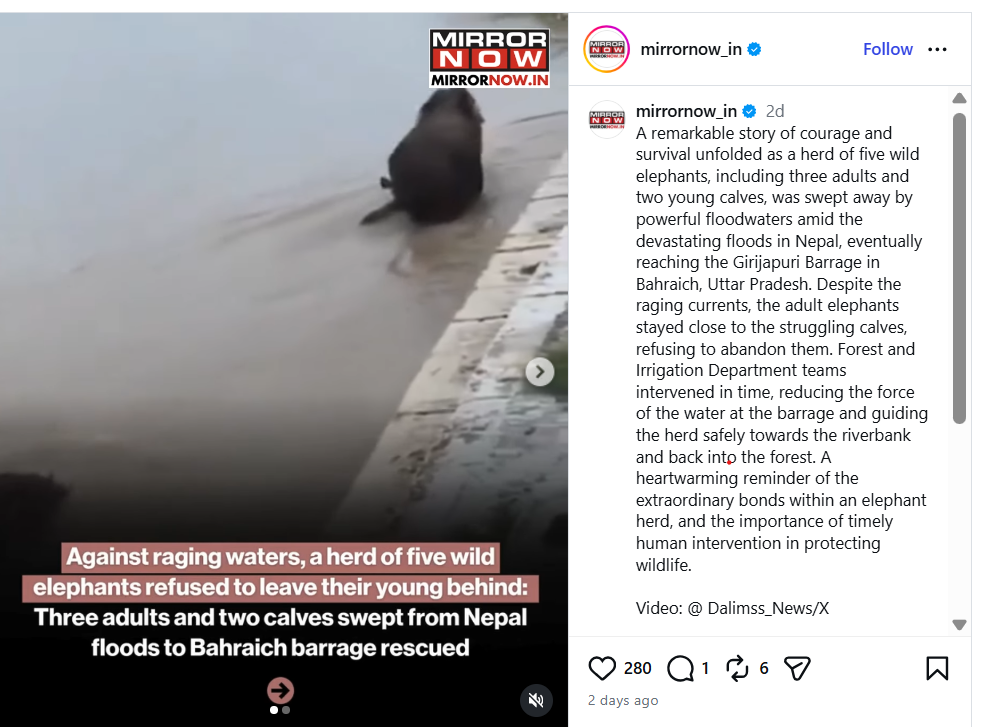
Videos claiming to show a street being swept away by flash floods in Nepal and a herd of elephants being carried away by the floods and reaching Uttar Pradesh are going viral on social media.
https://www.instagram.com/p/DcimGaiiCa7/
Claim 2
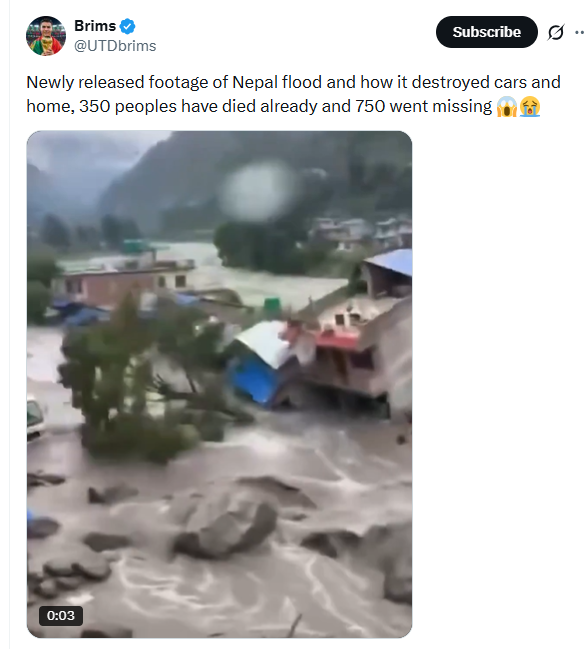
A newly surfaced video purportedly shows the devastation caused by floods in Nepal, with cars and homes being destroyed. It is being claimed that 350 people have died and 750 are missing so far
https://x.com/UTDbrims/status/2092829398462341484?s=48
Fact Check 1
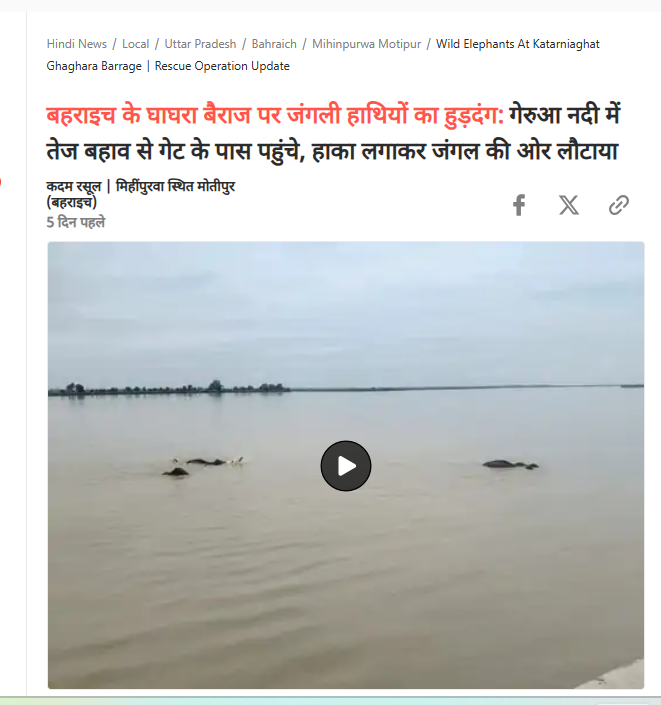
The first video claims to show a herd of wild elephants that was swept away by the floods in Nepal and reached Uttar Pradesh. We conducted a reverse image search of the first video using Google Lens and found a report by Hindi news publication Dainik Bhaskar, which shared a video featuring visuals similar to those in the viral clip. According to the report, a herd of wild elephants coming from the Gerua River reached the gates of the Chaudhary Charan Singh Ghaghra Barrage in Bahraich district, Uttar Pradesh, due to the strong current of the river. The report also quoted the Forest Range Officer as saying that the area is adjacent to an elephant corridor, which is why elephants frequently move through the region.
Fact Check 2
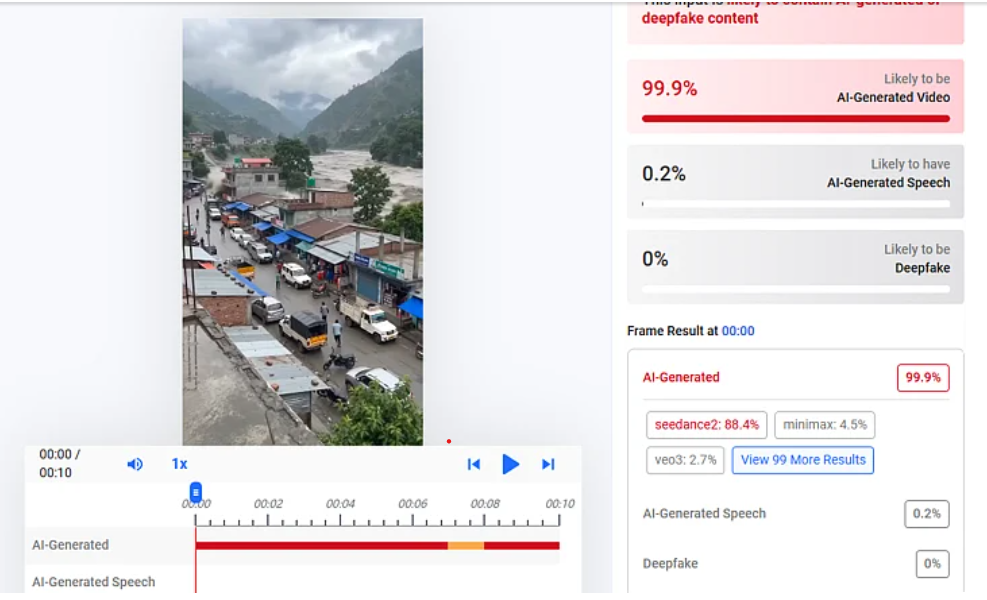
The second video shows a street being completely swept away by floodwaters. We conducted a reverse image search of the video using Google Lens but could not find any credible source that had shared the footage. Following this, we ran the video through the AI detection tool Hive Moderation, which flagged it as 99 percent likely to be AI-generated.
Conclusion
Our research found that the viral videos being shared as scenes of devastation caused by the recent floods in Nepal are misleading. The video showing a herd of elephants is from a separate incident in Bahraich, Uttar Pradesh, and predates the Nepal floods. Meanwhile, the video showing a street being swept away could not be traced to any credible source and was flagged as 99 percent likely to be AI-generated by Hive Moderation.

Related Blogs

AI-generated content has been taking up space in the ever-changing dynamics of today's tech landscape. Generative AI has emerged as a powerful tool that has enabled the creation of hyper-realistic audio, video, and images. While advantageous, this ability has some downsides, too, particularly in content authenticity and manipulation.
The impact of this content is varied in the areas of ethical, psychological and social harms seen in the past couple of years. A major concern is the creation of non-consensual explicit content, including nudes. This content includes content where an individual’s face gets superimposed onto explicit images or videos without their consent. This is not just a violation of privacy for individuals, and can have humongous consequences for their professional and personal lives. This blog examines the existing laws and whether they are equipped to deal with the challenges that this content poses.
Understanding the Deepfake Technology
Deepfake technology is a media file (image, video, or speech) that typically represents a human subject that is altered deceptively using deep neural networks (DNNs). It is used to alter a person’s identity, and it usually takes the form of a “face swap” where the identity of a source subject is transferred onto a destination subject. The destination’s facial expressions and head movements remain the same, but the appearance in the video is that of the source. In the case of videos, the identities can be substituted by way of replacement or reenactment.
This superimposed content creates realistic content, such as fake nudes. Presently, creating a deepfake is not a costly endeavour. It requires a Graphics Processing Unit (GPU), software that is free, open-source, and easy to download, and graphics editing and audio-dubbing skills. Some of the common apps to create deepfakes are DeepFaceLab and FaceSwap, which are both public and open source and are supported by thousands of users who actively participate in the evolution and development of these software and models.
Legal Gaps and Challenges
Multiple gaps and challenges exist in the legal space for deepfakes and their regulation. They are:
- The inadequate definitions governing AI-generated explicit content often lead to enforcement challenges.
- Jurisdictional challenges due to the cross-border nature of crimes and the difficulties caused by international cooperation measures are in the early stages for AI content.
- There is a gap between the current consent-based and harassment laws for AI-generated nudes.
- Providing evidence or providing proof for the intent and identification of perpetrators in digital crimes is a challenge that is yet to be overcome.
Policy Responses and Global Trends
Presently, the global response to deepfakes is developing. The UK has developed the Online Safety Bill, the EU has the AI Act, the US has some federal laws such as the National AI Initiative Act of 2020 and India is currently developing the India AI Act as the specific legislation dealing with AI and its correlating issues.
The IT Rules, 2021, and the DPDP Act, 2023, regulate digital platforms by mandating content governance, privacy policies, grievance redressal, and compliance with removal orders. Emphasising intermediary liability and safe harbour protections, these laws play a crucial role in tackling harmful content like AI-generated nudes, while the DPDP Act focuses on safeguarding privacy and personal data rights.
Bridging the Gap: CyberPeace Recommendations
- Initiate legislative reforms by advocating for clear and precise definitions for the consent frameworks and instituting high penalties for AI-based offences, particularly those which are aimed at sexually explicit material.
- Advocate for global cooperation and collaborations by setting up international standards and bilateral and multilateral treaties that address the cross-border nature of these offences.
- Platforms should push for accountability by pushing for stricter platform responsibility for the detection and removal of harmful AI-generated content. Platforms should introduce strong screening mechanisms to counter the huge influx of harmful content.
- Public campaigns which spread awareness and educate users about their rights and the resources available to them in case such an act takes place with them.
Conclusion
The rapid advancement of AI-generated explicit content demands immediate and decisive action. As this technology evolves, the gaps in existing legal frameworks become increasingly apparent, leaving individuals vulnerable to profound privacy violations and societal harm. Addressing this challenge requires adaptive, forward-thinking legislation that prioritises individual safety while fostering technological progress. Collaborative policymaking is essential and requires uniting governments, tech platforms, and civil society to develop globally harmonised standards. By striking a balance between innovation and societal well-being, we can ensure that the digital age is not only transformative but also secure and respectful of human dignity. Let’s act now to create a safer future!
References
- https://etedge-insights.com/technology/artificial-intelligence/deepfakes-and-the-future-of-digital-security-are-we-ready/
- https://odsc.medium.com/the-rise-of-deepfakes-understanding-the-challenges-and-opportunities-7724efb0d981
- https://insights.sei.cmu.edu/blog/how-easy-is-it-to-make-and-detect-a-deepfake/

Introduction
As the sun rises on the Indian subcontinent, a nation teeters on the precipice of a democratic exercise of colossal magnitude. The Lok Sabha elections, a quadrennial event that mobilises the will of over a billion souls, is not just a testament to the robustness of India's democratic fabric but also a crucible where the veracity of information is put to the sternest of tests. In this context, the World Economic Forum's 'Global Risks Report 2024' emerges as a harbinger of a disconcerting trend: the spectre of misinformation and disinformation that threatens to distort the electoral landscape.
The report, a carefully crafted document that shares the insights of 1,490 experts from the interests of academia, government, business and civil society, paints a tableau of the global risks that loom large over the next decade. These risks, spawned by the churning cauldron of rapid technological change, economic uncertainty, a warming planet, and simmering conflict, are not just abstract threats but tangible realities that could shape the future of nations.
India’s Electoral Malice
India, as it strides towards the general elections scheduled in the spring of 2024, finds itself in the vortex of this hailstorm. The WEF survey positions India at the zenith of vulnerability to disinformation and misinformation, a dubious distinction that underscores the challenges facing the world's largest democracy. The report depicts misinformation and disinformation as the chimaeras of false information—whether inadvertent or deliberate—that are dispersed through the arteries of media networks, skewing public opinion towards a pervasive distrust in facts and authority. This encompasses a panoply of deceptive content: fabricated, false, manipulated and imposter.
The United States, the European Union, and the United Kingdom too, are ensnared in this web of varying degrees of misinformation. South Africa, another nation on the cusp of its own electoral journey, is ranked 22nd, a reflection of the global reach of this phenomenon. The findings, derived from a survey conducted over the autumnal weeks of September to October 2023, reveal a world grappling with the shadowy forces of untruth.
Global Scenario
The report prognosticates that as close to three billion individuals across diverse economies—Bangladesh, India, Indonesia, Mexico, Pakistan, the United Kingdom, and the United States—prepare to exercise their electoral rights, the rampant use of misinformation and disinformation, and the tools that propagate them, could erode the legitimacy of the governments they elect. The repercussions could be dire, ranging from violent protests and hate crimes to civil confrontation and terrorism.
Beyond the electoral arena, the fabric of reality itself is at risk of becoming increasingly polarised, seeping into the public discourse on issues as varied as public health and social justice. As the bedrock of truth is undermined, the spectre of domestic propaganda and censorship looms large, potentially empowering governments to wield control over information based on their own interpretation of 'truth.'
The report further warns that disinformation will become increasingly personalised and targeted, honing in on specific groups such as minority communities and disseminating through more opaque messaging platforms like WhatsApp or WeChat. This tailored approach to deception signifies a new frontier in the battle against misinformation.
In a world where societal polarisation and economic downturn are seen as central risks in an interconnected 'risks network,' misinformation and disinformation have ascended rapidly to the top of the threat hierarchy. The report's respondents—two-thirds of them—cite extreme weather, AI-generated misinformation and disinformation, and societal and/or political polarisation as the most pressing global risks, followed closely by the 'cost-of-living crisis,' 'cyberattacks,' and 'economic downturn.'
Current Situation
In this unprecedented year for elections, the spectre of false information looms as one of the major threats to the global populace, according to the experts surveyed for the WEF's 2024 Global Risk Report. The report offers a nuanced analysis of the degrees to which misinformation and disinformation are perceived as problems for a selection of countries over the next two years, based on a ranking of 34 economic, environmental, geopolitical, societal, and technological risks.
India, the land of ancient wisdom and modern innovation, stands at the crossroads where the risk of disinformation and misinformation is ranked highest. Out of all the risks, these twin scourges were most frequently selected as the number one risk for the country by the experts, eclipsing infectious diseases, illicit economic activity, inequality, and labor shortages. The South Asian nation's next general election, set to unfurl between April and May 2024, will be a litmus test for its 1.4 billion people.
The spectre of fake news is not a novel adversary for India. The 2019 election was rife with misinformation, with reports of political parties weaponising platforms like WhatsApp and Facebook to spread incendiary messages, stoking fears that online vitriol could spill over into real-world violence. The COVID-19 pandemic further exacerbated the issue, with misinformation once again proliferating through WhatsApp.
Other countries facing a high risk of the impacts of misinformation and disinformation include El Salvador, Saudi Arabia, Pakistan, Romania, Ireland, Czechia, the United States, Sierra Leone, France, and Finland, all of which consider the threat to be one of the top six most dangerous risks out of 34 in the coming two years. In the United Kingdom, misinformation/disinformation is ranked 11th among perceived threats.
The WEF analysts conclude that the presence of misinformation and disinformation in these electoral processes could seriously destabilise the real and perceived legitimacy of newly elected governments, risking political unrest, violence, and terrorism, and a longer-term erosion of democratic processes.
The 'Global Risks Report 2024' of the World Economic Forum ranks India first in facing the highest risk of misinformation and disinformation in the world at a time when it faces general elections this year. The report, released in early January with the 19th edition of its Global Risks Report and Global Risk Perception Survey, claims to reveal the varying degrees to which misinformation and disinformation are rated as problems for a selection of analyzed countries in the next two years, based on a ranking of 34 economic, environmental, geopolitical, societal, and technological risks.
Some governments and platforms aiming to protect free speech and civil liberties may fail to act effectively to curb falsified information and harmful content, making the definition of 'truth' increasingly contentious across societies. State and non-state actors alike may leverage false information to widen fractures in societal views, erode public confidence in political institutions, and threaten national cohesion and coherence.
Trust in specific leaders will confer trust in information, and the authority of these actors—from conspiracy theorists, including politicians, and extremist groups to influencers and business leaders—could be amplified as they become arbiters of truth.
False information could not only be used as a source of societal disruption but also of control by domestic actors in pursuit of political agendas. The erosion of political checks and balances and the growth in tools that spread and control information could amplify the efficacy of domestic disinformation over the next two years.
Global internet freedom is already in decline, and access to more comprehensive sets of information has dropped in numerous countries. The implication: Falls in press freedoms in recent years and a related lack of strong investigative media are significant vulnerabilities set to grow.
Advisory
Here are specific best practices for citizens to help prevent the spread of misinformation during electoral processes:
- Verify Information:Double-check the accuracy of information before sharing it. Use reliable sources and fact-checking websites to verify claims.
- Cross-Check Multiple Sources:Consult multiple reputable news sources to ensure that the information is consistent across different platforms.
- Be Wary of Social Media:Social media platforms are susceptible to misinformation. Be cautious about sharing or believing information solely based on social media posts.
- Check Dates and Context:Ensure that information is current and consider the context in which it is presented. Misinformation often thrives when details are taken out of context.
- Promote Media Literacy:Educate yourself and others on media literacy to discern reliable sources from unreliable ones. Be skeptical of sensational headlines and clickbait.
- Report False Information:Report instances of misinformation to the platform hosting the content and encourage others to do the same. Utilise fact-checking organisations or tools to report and debunk false information.
- Critical Thinking:Foster critical thinking skills among your community members. Encourage them to question information and think critically before accepting or sharing it.
- Share Official Information:Share official statements and information from reputable sources, such as government election commissions, to ensure accuracy.
- Avoid Echo Chambers:Engage with diverse sources of information to avoid being in an 'echo chamber' where misinformation can thrive.
- Be Responsible in Sharing:Before sharing information, consider the potential impact it may have. Refrain from sharing unverified or sensational content that can contribute to misinformation.
- Promote Open Dialogue:Open discussions should be promoted amongst their community about the significance of factual information and the dangers of misinformation.
- Stay Calm and Informed:During critical periods, such as election days, stay calm and rely on official sources for updates. Avoid spreading unverified information that can contribute to panic or confusion.
- Support Media Literacy Programs:Media Literacy Programs in schools should be promoted to provide individuals with essential skills to sail through the information sea properly.
Conclusion
Preventing misinformation requires a collective effort from individuals, communities, and platforms. By adopting these best practices, citizens can play a vital role in reducing the impact of misinformation during electoral processes.
References:
- https://thewire.in/media/survey-finds-false-information-risk-highest-in-india
- https://thesouthfirst.com/pti/india-faces-highest-risk-of-disinformation-in-general-elections-world-economic-forum/

Introduction
Romance scams have been rised in India. A staggering 66 percent of individuals in India have been ensnared by the siren songs of deceitful online dating schemes. These are not the attempts of yesteryears but rather a new breed of scams, seamlessly weaving the threads of traditional deceit with the sinew of cutting-edge technologies such as generative AI and deep fakes. A report by Tenable highlights the rise of romance scams in India, which now combine traditional tactics with advanced technologies like generative AI and deepfakes. Over 69% of Indians struggle to distinguish between artificial and authentic human voices. Scammers are using celebrity impersonations and platforms like Facebook to lure victims into a false sense of security.
The Romance Scam
A report by Tenable, the exposure management company, illuminates the disturbing evolution of these romance scams. It reveals a reality: AI-generated deep lakes have attained a level of sophistication where an astonishing 69 percent of Indians confess to struggling to discern between artificial and authentic human voices. This technological prowess has armed scammers with the tools to craft increasingly convincing personas, enabling them to perpetrate their nefarious acts with alarming success.
In 2023 alone, 43 percent of Indians reported falling victim to AI voice scams, with a staggering 83 percent of those targeted suffering financial loss. The scammers, like puppeteers, manipulate their digital marionettes with a deftness that is both awe-inspiring and horrifying. They have mastered the art of impersonating celebrities and fabricating personas that resonate with their targets, particularly preying on older demographics who may be more susceptible to their charms.
Social media platforms, which were once heralded as the town squares of the 21st century, have unwittingly become fertile grounds for these fraudulent activities. They lure victims into a false sense of security before the scammers orchestrate their deceitful symphonies. Chris Boyd, a staff research engineer at Tenable, issues a stern warning against the lure of private conversations, where the protective layers of security are peeled away, leaving individuals exposed to the machinations of these digital charlatans.
The Vulnerability of Individuals
The report highlights the vulnerability of certain individuals, especially those who are older, widowed, or experiencing memory loss. These individuals are systematically targeted by heartless criminals who exploit their longing for connection and companionship. The importance of scrutinising requests for money from newfound connections is underscored, as is the need for meticulous examination of photographs and videos for any signs of manipulation or deceit.
'Increasing awareness and maintaining vigilance are our strongest weapons against these heartless manipulations, 'safeguarding love seekers from the treacherous web of AI-enhanced deception.'
The landscape of love has been irrevocably altered by the prevalence of smartphones and the deep proliferation of mobile internet. Finding love has morphed into a digital odyssey, with more and more Indians turning to dating apps like Tinder, Bumble, and Hinge. Yet, as with all technological advancements, there lurks a shadowy underbelly. The rapid adoption of dating sites has provided potential scammers with a veritable goldmine of opportunity.
It is not uncommon these days to hear tales of individuals who have lost their life savings to a person they met on a dating site or who have been honey-trapped and extorted by scammers on such platforms. A new study, titled 'Modern Love' and published by McAfee ahead of Valentine's Day 2024, reveals that such scams are rampant in India, with 39 percent of users reporting that their conversations with a potential love interest online turned out to be with a scammer.
The study also found that 77 percent of Indians have encountered fake profiles and photos that appear AI-generated on dating websites or apps or on social media, while 26 percent later discovered that they were engaging with AI-generated bots rather than real people. 'The possibilities of AI are endless, and unfortunately, so are the perils,' says Steve Grobman, McAfee’s Chief Technology Officer.
Steps to Safeguard
Scammers have not limited their hunting grounds to dating sites alone. A staggering 91 percent of Indians surveyed for the study reported that they, or someone they know, have been contacted by a stranger through social media or text message and began to 'chat' with them regularly. Cybercriminals exploit the vulnerability of those seeking love, engaging in long and sophisticated attempts to defraud their victims.
McAfee offers some steps to protect oneself from online romance and AI scams:
- Scrutinise any direct messages you receive from a love interest via a dating app or social media.
- Be on the lookout for consistent, AI-generated messages which often lack substance or feel generic.
- Avoid clicking on any links in messages from someone you have not met in person.
- Perform a reverse image search of any profile pictures used by the person.
- Refrain from sending money or gifts to someone you haven’t met in person, even if they send you money first.
- Discuss your new love interest with your trusted friend. It can be easy to overlook red flags when you are hopeful and excited.
Conclusion
The path is fraught with illusions, and only by arming oneself with knowledge and scepticism can one hope to find true connection without falling prey to the mirage of deceit. As we navigate this treacherous terrain, let us remember that the most profound connections are often those that withstand the test of time and the scrutiny of truth.
References
- https://www.businesstoday.in/technology/news/story/valentine-day-alert-deepfakes-genai-amplifying-romance-scams-in-india-warn-researchers-417245-2024-02-13
- https://www.indiatimes.com/amp/news/india/valentines-day-around-40-per-cent-indians-have-been-scammed-while-looking-for-love-online-627324.html
- https://zeenews.india.com/technology/valentine-day-deepfakes-in-romance-scams-generative-ai-in-scams-romance-scams-in-india-online-dating-scams-in-india-ai-voice-scams-in-india-cyber-security-in-india-2720589.html
- https://www.mcafee.com/en-us/consumer-corporate/newsroom/press-releases/2023/20230209.html
