
#FactCheck -Misleading Social Media Claim Targets University Over Viral Video
Executive Summary
A video circulating on social media shows a woman using abusive language in front of a camera. Users sharing the clip claim that the woman is a professor at Galgotias University and that the video exposes her alleged reality. However, an research by CyberPeace found the claim to be misleading. The probe revealed that the woman seen in the viral video has no connection with Galgotias University and is not a professor there.Fact-checking further showed that the video is not recent but around seven years old. The woman featured in the clip was identified as Shubhrastha, who is a political strategist by profession.
Claim:
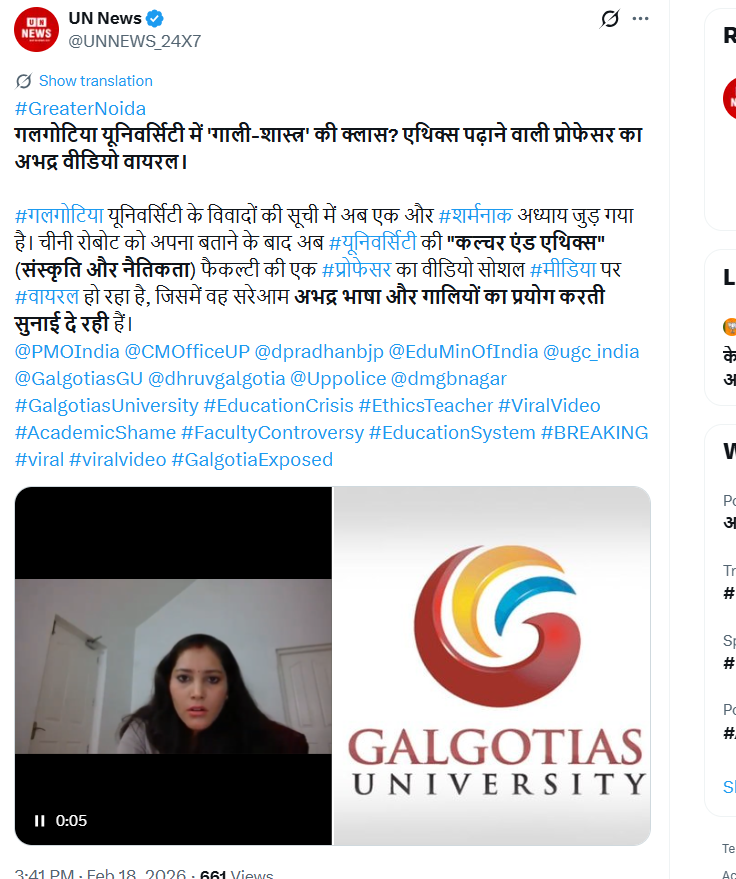
A user on X (formerly Twitter) shared the viral video on February 18, 2026, claiming: “A ‘class in abuse studies’ at Galgotias University? An obscene video of a professor teaching ethics has gone viral. Another shameful chapter has been added to the list of controversies surrounding Galgotias University.” The post further alleged that after falsely claiming a Chinese robot as its own, the university’s “Culture and Ethics” faculty member was seen publicly using abusive language in the viral clip. The post link and its archived version are provided below:
Fact Check:
To verify the authenticity of the viral claim, we extracted key frames from the video and conducted a reverse image search using Google Lens. During the research , we found the same video uploaded on the Indian Spectator’s YouTube channel on June 9, 2018

The video was also found on another YouTube channel, where it had been uploaded on June 12, 2018.

Conclusion
The research clearly establishes that the woman seen in the viral video has no association with Galgotias University and is not a professor there. The clip is also not recent but approximately seven years old. The woman in the video was identified as Shubhrastha, a political strategist.

Related Blogs

Executive Summary
Recent claims circulating on social media allege that an Indian Air Force MiG-29 fighter jet was shot down by Pakistani forces during "Operation Sindoor." These reports suggest the incident involved a jet crash attributed to hostile action. However, these assertions have been officially refuted. No credible evidence supports the existence of such an operation or the downing of an Indian aircraft as described. The Indian Air Force has not confirmed any such event, and the claim appears to be misinformation.

Claim
A social media rumor has been circulating, suggesting that an Indian Air Force MiG-29 fighter jet was shot down by Pakistani Air forces during "Operation Sindoor." The claim is accompanied by images purported to show the wreckage of the aircraft.

Fact Check
The social media posts have falsely claimed that a Pakistani Air Force shot down an Indian Air Force MiG-29 during "Operation Sindoor." This claim has been confirmed to be untrue. The image being circulated is not related to any recent IAF operations and has been previously used in unrelated contexts. The content being shared is misleading and does not reflect any verified incident involving the Indian Air Force.

After conducting research by extracting key frames from the video and performing reverse image searches, we successfully traced the original post, which was first published in 2024, and can be seen in a news article from The Hindu and Times of India.
A MiG-29 fighter jet of the Indian Air Force (IAF), engaged in a routine training mission, crashed near Barmer, Rajasthan, on Monday evening (September 2, 2024). Fortunately, the pilot safely ejected and escaped unscathed, hence the claim is false and an act to spread misinformation.

Conclusion
The claims regarding the downing of an Indian Air Force MiG-29 during "Operation Sindoor" are unfounded and lack any credible verification. The image being circulated is outdated and unrelated to current IAF operations. There has been no official confirmation of such an incident, and the narrative appears to be misleading. Peoples are advised to rely on verified sources for accurate information regarding defence matters.
- Claim: Pakistan Shot down an Indian Fighter Jet, MIG-29
- Claimed On: Social Media
- Fact Check: False and Misleading

Introduction
MGM Resorts, which is an international company, has suffered an ongoing cyberattack which led to the shutdown of a number of its computer systems, including its website, in response to a cybersecurity issue. MGM Resorts International is in touch with external cybersecurity experts to resolve the issue since it has affected its entire Computer systems. MGM is a larger entity and operates thousands of hotel rooms across Las Vegas and the United States. MGM Resorts shared about the incident and posted that MGM recently identified a cybersecurity issue affecting some of the Company's systems. Promptly after detecting the issue, they quickly began an investigation with assistance from leading external cybersecurity experts. MGM has notified law enforcement and took prompt action to protect systems and data, including putting down certain systems. MGM further stated that the investigation is ongoing.
The issue
Basic operations such as the online reservation and booking system MGM have been affected and shut down due to the cybersecurity issue faced by a lot of visitors. Since earlier times, casino security has been the state of the art as they were very vulnerable to attacks by robbers and con artists. This is what we have also seen in a lot of movies. In today's time, con artists and robbers are now strengthened by cyber tactics. This is exactly what was seen in the case of the MGM attack.
MGM Resorts is home to best-in-class amenities and facilities for guests, but with the increase in tourist traction, the vulnerabilities and the scope of cyber attacks have also increased. This is also because of open wifis in the establishments and the transition of casinos to e-casinos, thus causing a major shift towards digital and technology-based intervention for better customer experience and streamlining a lot of operations.
How real is the threat?
As reported by MGM Resorts, the following systems were impacted in the cyber security attack:
- Slots Machines: The slot machines placed in the casino suddenly went offline and displayed an error message for the players. Some players who were already using the slot machines lost their bets and were unable to withdraw their winnings.
- Room Keys: Some of the guests reported that the room keys became unresponsive, and in some cases, the replacement keys were also inactive for some time, causing massive chaos at the reception.
- Booking Status: All the bookings in today's time are made online; this was one of the worst-hit segments of the cyber attacks. Most of the bookings made automatically were put on hold, and the confirmations could be made only from the hotel reception, thus causing massive cancelling of the bookings and both the hotel and customers losing out on money.
- MGM App: The official app of MGM Resorts was completely down, thus causing a situation of confusion and panic among the guests. The users also received notifications to speak to different customer care executives, but some of the numbers were unattentive and seemed to be operated by bad actors.
- Data breach: The main focus of the cyber attack was dedicated to committing a data breach. The attack led to the breach of personal data of most of the users registered on the app or on the system of MGM Resorts.
Conclusion
The cyber attack on the tourism industry is a major and growing concern for the industry and its customers. Seeing the volatility of the data and the regular inflow of personal information this makes the hotel's cyber security system a vulnerable choice for bad actors. The cyber attack was no less than a fire sale, where in all the segments of the services offered were impacted. Similar attacks were reported by MGM in 2019 and 2020, and subsequently, the safety measures were also deployed, but the bad actors have hit the resorts chain owners again, in such cases the most paramount defence is having a safe and regularly updated firewall, upskilling of staff for IT issues and attacks, active reporting and investigation mechanisms for assisting the LEAs. In the times of rising cyberattacks, one needs to be critical of their data management and digital footprints. The sooner we adopt safe, secure and resilient cyber hygiene practices, the safer our future will be.
References:
https://www.bleepingcomputer.com/news/security/mgm-resorts-shuts-down-it-systems-after-cyberattack/
https://www.cnbc.com/2023/09/12/mgm-resorts-cybersecurity-incident-forces-system-outage.html

Introduction
In April 2026, a class action suit in a federal court in California rejuvenated one of the most basic assertions in digital communication: that private messages are private. The suit claims that Meta Platforms, its subsidiary WhatsApp, and third-party contractors such as Accenture could have accessed user messages even though it had long promised end-to-end encryption.
This case is not merely about a single company or a single platform. It poses more profound questions regarding the definition, communication and regulation of privacy in an age when digital infrastructure is becoming more and more incomprehensible or unprovable to regular users.
What the Lawsuit Actually Says
The suit was filed by plaintiffs Brian Y. Shirazi and Nida Samson, who alleged that WhatsApp, Meta and contractors had intercepted and shared private messages with third parties without their consent. The complaint states that the federal investigators were notified by the whistleblowers that employees of Meta and external contractors had access to the content of WhatsApp messages that were expected to be encrypted and inaccessible.
This directly puts into question the main privacy promise of WhatsApp. The platform has been promoting itself as an end-to-end encrypted service in which not even WhatsApp can read your messages. The case asserts that this assertion was deceptive in its application and that no one ever gave any consent prior to their messages being intercepted, stored, or read.
The plaintiffs are proposing to represent a nationwide class of users of WhatsApp who sent or received messages between April 5, 2016, and the current time and subclasses in California and Pennsylvania. The claims involve breach of contract, California laws on privacy and data violations, false advertising and the Pennsylvania Wiretapping and Electronic Surveillance Act.
It should be mentioned that they are allegations. Similar assertions have been refuted by Metacomet in the past, with the company asserting that its encryption frameworks ensure that the company cannot access the messages. The case is in progress, and no facts have been found.
The Grey Area No One Talks About
In order to see the significance of this lawsuit outside the court, it is useful to consider the way modern messaging platforms actually work. In principle, end-to-end encryption means that only the sender and receiver can decipher a message. Even the service provider should not be able to access the content.
However, there is a grey space that is seldom publicly discussed: content moderation. User reports, metadata analysis or restricted message review processes are common methods used by platforms to identify harmful content, like fraud, child exploitation, or spam. The complaint indicates that such moderation procedures might have opened avenues to the content of messages to human reviewers or automated systems more than users were made to think.
This is not the first time that privacy and safety are at odds. Many jurisdictions have also advocated access to encrypted communications through legal means in the name of national security or criminal investigations. What this suit does is put that tension into even more stark relief by asking whether platforms are really open with users about these trade-offs.
The Consent Problem
The emphasis on consent is one of the most significant implications of this case. The plaintiffs claim that the users were never warned that their messages would be accessed by the employees or third parties and were never provided with any meaningful option on the same.
This is where the case turns into a data governance issue, rather than a legal one. Most data protection models consider the legality of data processing to be based on whether the users know how their data is being processed or not. When the accusations are found to be true, then the matter is not technical. It would be a contractual and ethical failure, a disjuncture between what platforms promise and what they do.
The implications are huge to the billions of users who use WhatsApp to communicate, both personally and professionally, and even politically.
What This Means Going Forward
An effective attack on the encryption assertions of WhatsApp might have actual implications for the rest of the digital ecosystem. Users might start doubting that any platform can be really considered to guarantee privacy. The regulators can advocate more stringent disclosure policies and compulsory independent audits of encryption systems. Social networks might have to re-architect their moderation frameworks to make sure that safety features do not silently compromise privacy guarantees that they claim.
Meanwhile, there is a real policy dilemma in this case that cannot be disregarded. Complete privacy may preclude the capacity to identify abuse or hateful material. The manner in which that balance is achieved and, more to the point, the manner in which it is made transparent to users is an issue that has yet to be addressed by policymakers, civil society and the tech industry.
Other technical experts have also questioned the plausibility of the claims in the lawsuit at scale, noting that it would be an extraordinary undertaking to systematically bypass end-to-end encryption. This further supports the argument of independent verification mechanisms. The problem is that users should not be forced to decide what they should believe in more: corporate guarantees or legal charges. There must be rules that can be enforced which are above the two.
Conclusion: Beyond One Lawsuit
The WhatsApp class action is eventually concerning a structural issue within the digital economy. Users are expected to have faith in systems that they cannot observe, on the assertions that they cannot test themselves.
This case is a warning, regardless of whether the allegations are proved or not. Privacy cannot be based on marketing language. It needs legally binding norms, actual transparency in the treatment of data, and external control that will provide users with something more to hang on than a tagline.
References
- https://www.bitdefender.com/en-us/blog/hotforsecurity/lawsuit-claims-meta-can-access-whatsapp-messages-despite-end-to-end-encryption-2
- https://blog.cryptographyengineering.com/2026/02/02/whatsapp-encryption-a-lawsuit-and-a-lot-of-noise/
- https://www.bloomberg.com/news/articles/2026-01-25/lawsuit-claims-meta-can-see-whatsapp-chats-in-breach-of-privacy
- https://www.classaction.org/blog/despite-privacy-promises-meta-third-parties-read-and-store-whatsapp-messages-class-action-lawsuit-alleges
